
Urothemis aliena, commonly called the red baron,[3] is a species of dragonfly native to northern and eastern Australia and New Guinea. It belongs to the family Libellulidae.[4][5] This species is typically found in riverine lagoons and ponds.
| Red baron | |
|---|---|
 | |
| Male, Cairns, Australia | |
Scientific classification  | |
| Kingdom: | Animalia |
| Phylum: | Arthropoda |
| Clade: | Pancrustacea |
| Class: | Insecta |
| Order: | Odonata |
| Infraorder: | Anisoptera |
| Family: | Libellulidae |
| Genus: | Urothemis |
| Species: | U. aliena |
| Binomial name | |
| Urothemis aliena | |
 | |

Urothemis aliena is a medium-sized dragonfly (wingspan 85mm, length 45mm). It is characterized by its vibrant red body and features two dark spots on segments eight and nine of its abdomen. The hindwing displays a dark triangular-shaped reddish-brown mark at the base. This species is found across Australia, ranging from Broome, Western Australia along the northern region of the continent to the southern border of Queensland.
Etymology
editThe genus name Urothemis is derived from the Greek οὐρά (oura, "tail") and the common dragonfly suffix -themis. The name refers to the long vulvar scale below the female abdomen.[6]
The species name aliena is derived from the Latin alienus ("belonging to another" or "foreign"), referring to the large dark spot on each hindwing that distinguishes it from other members of the genus.[2][6]
Gallery
edit Male
Male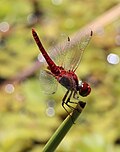 Male in obelisk position
 Male wings
_(16503063358).jpg)
_(16502975508)_(2).jpg)
.jpg)
See also
editReferences
edit- ↑ Dow, R.A. (2017). "Urothemis aliena". IUCN Red List of Threatened Species. 2017 e.T87535319A87540054. doi:10.2305/IUCN.UK.2017-1.RLTS.T87535319A87540054.en. Retrieved 20 November 2021.
- 1 2 Selys-Longchamps, E. (1878). "Odonates de la région de la Nouvelle Guinée". Mittheilungen aus dem K. Zoologischen Museum zu Dresden (in French). 3: 289–323 [305] – via Biodiversity Heritage Library.
- ↑ Theischinger, Gunther; Hawking, John (2006). The Complete Field Guide to Dragonflies of Australia. Collingwood Vic.: CSIRO. p. 254. ISBN 0-643-09073-8.
- ↑ "Species Urothemis aliena Selys, 1878". Australian Faunal Directory. Australian Biological Resources Study. 2012. Retrieved 2 March 2017.
- ↑ Paulson, D.; Schorr, M.; Abbott, J.; Bota-Sierra, C.; Deliry, C.; Dijkstra, K.-D.; Lozano, F. "World Odonata List". OdonataCentral. University of Alabama.
- 1 2 Endersby, Ian; Fliedner, Heinrich (2015). The Naming of Australia's Dragonflies. Eltham, Victoria, Australia: Busybird Publishing. ISBN 9781925260625.
