


Tuaran mee, or mee Tuaran (Malay: Mi Tuaran; Chinese: 斗亚兰面; pinyin: Dòu yà lán miàn), is a Sabahan dish consisting of springy handmade egg noodles combined with choy sum and slices of char siu, which are cooked through intense frying in a wok until they attain a crispy texture originating from the northwestern part of Tuaran town in Sabah, Malaysia.[3] The noodle is among Sabah's noodle heritage, which is considered the region's main noodle signature dish and usually served with a local Hakka spring roll known as "chun kien".[4][5][6]
 | |
| Alternative names |
|
|---|---|
| Type | Noodle dish |
| Course | Main course |
| Place of origin | Tuaran, Malaysia[1] |
| Region or state | Sabah |
| Associated cuisine | Sabahan cuisine |
| Created by | Madam Si[2] |
| Main ingredients | Egg noodles, choy sum, and char siu slices |
Origin and background
editIn Sabah, where the local Chinese populace is dominated by the Hakkas, each Chinese noodle is named after its districts, such as the Beaufort mee, Tamparuli mee, and Tenom mee, aside from the Tuaran mee.[7] The noodle was created in 1952 by Madam Si and subsequently proliferated among Sabah's Hakka communities in Tuaran town during the late 1970s,[1][2][8] when it began to replace the traditional knife-cut noodles.[1] Until the mid-1980s, fried noodles in Sabah were earlier referred to as "chao men" in the local Hakka dialect.[1] When the fried noodles became popularised, other local Hakka around Sabah began to refer to it as simply of "tao-ah-lan men" (Tuaran mee).[1]
Preparation
editThe preparation of Tuaran mee consists of three primary steps to attain its distinctive texture: first, the noodles are fried until crispy; second, they are briefly boiled; and finally, they are stir-fried with eggs, vegetables, and meats.[9] The egg's coating yields its characteristic appearance, which is subtly golden and lustrous.[10] The noodle is offered in numerous kopitiams and restaurants throughout Sabah, with some establishments also allowing the option to combine it with lihing, a local Kadazan-Dusun rice wine.[11]
Gallery
edit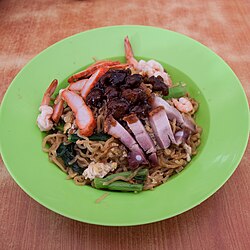 Tuaran mee served in a plate
 Tuaran mee with dipping sauce and soup
 Tuaran mee served with tea


See also
edit

References
edit- 1 2 3 4 5 Miao, Jackie (6 January 2015). "Real street food: Tuaran mee noodles". The Guardian. Archived from the original on 22 June 2026. Retrieved 23 June 2026.
- 1 2 "Tuaran Mee: The Iconic Eggy Noodle Dish from Tuaran Sabah". The Ambitious Salted Fish. 2 April 2022. Archived from the original on 23 June 2026. Retrieved 23 June 2026.
- ↑ "Tuaran mee". TasteAtlas. Archived from the original on 22 June 2026. Retrieved 23 June 2026.
- ↑ Lee, Joanne (3 August 2015). "Tuaran Mee – Sabahan Favourite noodle". Sabah Eats. Archived from the original on 22 June 2026. Retrieved 23 June 2026.
- ↑ Murphy (28 November 2022). "Tuaran Mee (Tuaran Noodle) the gold noodle of Sabah". MySabah.com. Archived from the original on 22 June 2026. Retrieved 23 June 2026.
- ↑ Tan et al. 2024, p. 510.
- ↑ Tan, Vincent (22 January 2022). "Different district, different noodles: Sabah Chinese cuisine a reflection of immigrant history and adaptation". CNA. Archived from the original on 22 June 2026. Retrieved 23 June 2026.
- ↑ Chan, Julia (25 January 2015). "Tuaran mee: Sabah's most famous noodle dish". The Malay Mail. Archived from the original on 22 June 2026. Retrieved 23 June 2026.
- ↑ Azreen (26 August 2019). "Mee Tuaran" [Tuaran Mee]. Daily Makan (in Malay). Archived from the original on 22 June 2026. Retrieved 23 June 2026.
- ↑ "Tuaran Mee — Hand-Rolled Egg Noodles from Sabah". SabahGuide. Archived from the original on 22 June 2026. Retrieved 20 May 2026.
- ↑ "Different noodles for different districts in Sabah: A food traveller's guide". Daily Express. 2 August 2024. Archived from the original on 10 June 2026. Retrieved 23 June 2026.
Bibliography
edit- Tan, Winnie; Brown, Lindsay; Ferrarese, Marco; Richmond, Simon; Seah, Jaclynn; Sim, Cheng; Louis, Regis St; Jong, Ria de (2024). Lonely Planet Malaysia, Singapore & Brunei. Lonely Planet. ISBN 978-1-83758-611-0.