
This article needs additional citations for verification. (June 2026) |
The 1965 Pacific typhoon season has no official bounds; it ran year-round in 1965, but most tropical cyclones tend to form in the northwestern Pacific Ocean between June and December. These dates conventionally delimit the period of each year when most tropical cyclones form in the northwestern Pacific Ocean.
| 1965 Pacific typhoon season | |
|---|---|
 Season summary map | |
| Seasonal boundaries | |
| First system formed | January 2, 1965 |
| Last system dissipated | December 28, 1965 |
| Strongest storm | |
| Name | Dinah |
| • Maximum winds | 295 km/h (185 mph) (1-minute sustained) |
| • Lowest pressure | 895 hPa (mbar) |
| Seasonal statistics | |
| Total depressions | 44 |
| Total storms | 35 |
| Typhoons | 21 |
| Super typhoons | 11 (unofficial) (record high; tied with 1997) |
| Total fatalities | Unknown |
| Total damage | Unknown |
| Related articles | |
The scope of this article is limited to the Pacific Ocean, north of the equator and west of the International Date Line. Storms that form east of the date line and north of the equator are called hurricanes; see 1965 Pacific hurricane season. Tropical Storms formed in the entire west pacific basin were assigned a name by the Joint Typhoon Warning Center. Tropical depressions in this basin have the "W" suffix added to their number. Tropical depressions that enter or form in the Philippine area of responsibility are assigned a name by the Philippine Weather Bureau. This can often result in the same storm having two names.
Systems
edit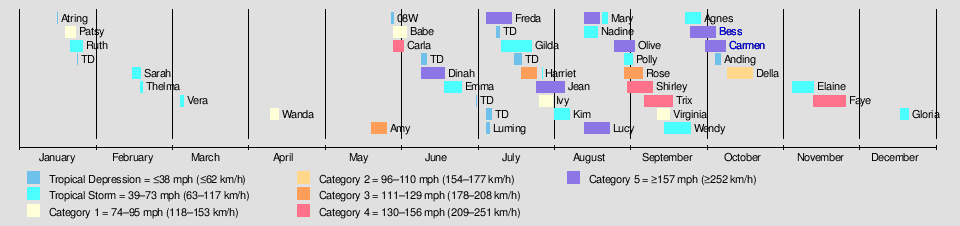
This section needs expansion. You can help by adding missing information. (June 2026) |
A total of 40 tropical depressions formed this year in the Western Pacific, of which 35 became tropical storms. A total of 21 storms reached typhoon intensity, of which a record-tying 11 reached super typhoon strength and 8 reached category 5.
Tropical Depression Atring
edit| Tropical depression (PAGASA) | |
  | |
| Duration | January 16 – January 17 |
|---|---|
| Peak intensity | 55 km/h (35 mph) (10-min); 1003 hPa (mbar) |
A low pressure system was spotted steadily approaching the Philippines on January 15. The next day, on January 16, the disturbance organized into a tropical depression receiving the name Atring via PAGASA. Shortly later, the depression peaked with winds of 55 km/h (34 mph) and pressure levels of 1003 hPa (mbar). The tropical depression collapsed back into an extratropical cyclone after a brief 12 hours and was last tracked by the agency on January 17.[1]
Typhoon Patsy (Bining)
edit| Agency | Wind (kt)[a] |
Pressure (hPa) |
|---|---|---|
| CMA | 68 | 989 |
| HKO | 60 | 990 |
| JMA | N/a | 990 |
| JTWC | 65 | N/a |
| Typhoon (JMA) | |
| Category 1 typhoon (SSHWS) | |
  | |
| Duration | January 19 – January 23 |
|---|---|
| Peak intensity | 120 km/h (75 mph) (1-min); 990 hPa (mbar) |
On January 17, a short wave trough fractured off from powerful high lying westerly winds, being accompanied by a subsequent surge in the northeast wind flow.[3]: 90 This led to a tropical disturbance being spotted by various agencies nearby Samar. The disturbance meandered in its position, before eventually tracking northward on January 19.[2] Later that day, the disturbance eventually became a tropical storm assigned the name Patsy by the Joint Typhoon Warning Center.[3]: 75 Continuing on its mostly northward trajectory, the tropical storm reached it's peak intensity as a Category 1 typhoon on January 20, with winds of 120 km/h (75 mph) and pressure levels as low as 990 hPa (mbar).[2] Upon reaching its peak intensity, Patsy took a sharp turn to the southwest weakening back into a tropical storm. The typhoon made landfall in Luzon as a tropical depression and collapsed into an extratropical cyclone upon crossing the island. The cyclone continued on a mostly southwest trajectory before it dissipated on January 26.[2]
Tropical Storm Ruth
edit| Severe tropical storm (JMA) | |
| Tropical storm (SSHWS) | |
 | |
| Duration | January 21 – January 26 |
|---|---|
| Peak intensity | 110 km/h (70 mph) (1-min); 994 hPa (mbar) |
This section needs expansion. You can help by adding missing information. (June 2026) |
CMA Tropical Depression 4
edit| Tropical depression (CMA) | |
 | |
| Duration | January 24 – January 24 |
|---|---|
| Peak intensity | 45 km/h (30 mph) (10-min); 1002 hPa (mbar) |
A tropical disturbance was spotted far east of the Philippines by the China Meteorological Administration on January 24. The disturbance, moving east, was quickly designated as a tropical depression by the agency, where they observed winds of 45 km/h (28 mph) and pressure levels of 1002 hPa (mbar). 12 hours after the depression reached its peak intensity, it collapsed back into an extratropical cyclone and steered to the right, eventually doing a 180° turn westward. It continued on its westward trajectory before it eventually fully dissipated on January 26.[4]
Tropical Storm Sarah
edit

Tropical Storm Thelma (Kuring)
edit| Tropical depression (JMA) | |
| Tropical storm (SSHWS) | |
 | |
| Duration | February 18 – February 19 |
|---|---|
| Peak intensity | 75 km/h (45 mph) (1-min); 1000 hPa (mbar) |
Thelma was short-lived and it dissipated east in the Mindanao, Philippines.
Tropical Storm Vera (Daling)
edit
Typhoon Wanda
edit| Severe tropical storm (JMA) | |
| Category 1 typhoon (SSHWS) | |
 | |
| Duration | April 11 – April 14 |
|---|---|
| Peak intensity | 120 km/h (75 mph) (1-min); 996 hPa (mbar) |
This section needs expansion. You can help by adding missing information. (June 2026) |
This Category 1 typhoon had only minor effects to the Philippines.
Typhoon Amy (Elang)
edit
Tropical Depression 08W
edit
Typhoon Babe
edit
Typhoon Carla (Goring)
edit| Severe tropical storm (JMA) | |
| Category 4 typhoon (SSHWS) | |
 | |
| Duration | May 30 – June 3 |
|---|---|
| Peak intensity | 220 km/h (140 mph) (1-min); 952 hPa (mbar) |
Carla formed with Babe. Carla rapidly intensified on June 1 but then rapidly weakened and then moved northeastward then dissipated on June 3.
CMA Tropical Depression 12
edit
Super Typhoon Dinah (Huling)
edit| Typhoon (JMA) | |
| Category 5 super typhoon (SSHWS) | |
  | |
| Duration | June 10 – June 19 |
|---|---|
| Peak intensity | 295 km/h (185 mph) (1-min); 895 hPa (mbar) |
A surge in the southern hemisphere indraft developed into Tropical Depression 11W on June 12 to the east of the Philippines. It tracked west-northwestward, quickly strengthening to a tropical storm that day and a typhoon on the 13th. Dinah continued to quickly intensify as it turned to the northwest, and attained a peak of 185 mph on the 17th to the northeast of Luzon. Its southerly inflow was cut off, and Dinah weakened as it turned to the north. It hit southern Taiwan on the 18th as a 140 mph typhoon, and weakened greatly over the island to a tropical storm. At this time, Dinah exhibited a rare false radar eye. Dinah turned to the northeast, where it became extratropical near Japan on June 20. The storm killed 45 people on its path, and destroyed 5000 homes on Taiwan.[5][citation needed]
Tropical Storm Emma (Ibiang)
edit
CMA Tropical Depression 15
edit
CMA Tropical Depression 16
edit| Tropical depression (CMA) | |
 | |
| Duration | July 6 – July 8 |
|---|---|
| Peak intensity | 55 km/h (35 mph) (10-min); 1002 hPa (mbar) |
This section needs expansion. You can help by adding missing information. (June 2026) |
Tropical Depression 13W (Luming)
edit
Super Typhoon Freda (Miling)
edit| Typhoon (JMA) | |
| Category 5 super typhoon (SSHWS) | |
 | |
| Duration | July 6 – July 16 |
|---|---|
| Peak intensity | 260 km/h (160 mph) (1-min); 925 hPa (mbar) |
160 mph Super Typhoon Freda, which began its life on July 6, hit northern Luzon on the 13th. It crossed the island and the South China Sea, where it hit Hainan Island as a 115 mph typhoon on the 15th. Freda dissipated the next day over China, after causing heavy flooding killing an unknown number of people. In Hong Kong, Freda killed 2 people.[6][7]
CMA Tropical Depression 18
edit
Tropical Storm Gilda (Narsing)
edit| Severe tropical storm (JMA) | |
| Tropical storm (SSHWS) | |
  | |
| Duration | July 12 – July 24 |
|---|---|
| Peak intensity | 110 km/h (70 mph) (1-min); 985 hPa (mbar) |
Gilda did not last long, although it caused some damage.[citation needed]
CMA Tropical Depression 20
edit| Tropical depression (CMA) | |
 | |
| Duration | July 17 – July 20 |
|---|---|
| Peak intensity | 55 km/h (35 mph) (10-min); |
This section needs expansion. You can help by adding missing information. (June 2026) |
The depression did not last long.
Typhoon Harriet (Openg)
edit

Super Typhoon Jean (Rubing)
edit| Typhoon (JMA) | |
| Category 5 super typhoon (SSHWS) | |
 | |
| Duration | July 26 – August 6 |
|---|---|
| Peak intensity | 260 km/h (160 mph) (1-min); 920 hPa (mbar) |
Super Typhoon Jean, after reaching a peak of 160 mph on August 3, weakened slightly to hit southwestern Japan as a 150 mph super typhoon on August 5. The typhoon brought heavy winds to Southern Japan before becoming extratropical on the 7th. Typhoon Jean killed 28 people throughout Southern Japan.[8][9]
Typhoon Ivy (Pining)
edit| Typhoon (JMA) | |
| Category 1 typhoon (SSHWS) | |
 | |
| Duration | July 27 – August 1 |
|---|---|
| Peak intensity | 150 km/h (90 mph) (1-min); 978 hPa (mbar) |
Ivy did a loop and only survived 5 days before dissipating. Although Ivy did not make landfall in the Philippines it caused some damages.
Tropical Storm Kim
edit| Severe tropical storm (JMA) | |
| Tropical storm (SSHWS) | |
 | |
| Duration | August 2 – August 8 |
|---|---|
| Peak intensity | 110 km/h (70 mph) (1-min); 990 hPa (mbar) |
This section needs expansion. You can help by adding missing information. (June 2026) |
Kim stayed at sea.
Super Typhoon Lucy
edit| Typhoon (JMA) | |
| Category 5 super typhoon (SSHWS) | |
  | |
| Duration | August 14 – August 24 |
|---|---|
| Peak intensity | 285 km/h (180 mph) (1-min); 910 hPa (mbar) |
On August 14 a tropical depression formed and was named Lucy after it became a tropical storm. Lucy became a typhoon and soon into a 175 mph super typhoon. Lucy weakened and struck Japan as a minimal typhoon. Lucy dissipated on August 24.[10]
Super Typhoon Mary (Saling)
edit| Typhoon (JMA) | |
| Category 5 super typhoon (SSHWS) | |
  | |
| Duration | August 14 – August 23 |
|---|---|
| Peak intensity | 285 km/h (180 mph) (1-min); 929 hPa (mbar) |
175 mph Super Typhoon Mary weakened from its peak to hit eastern Taiwan on August 18 as a 105 mph typhoon. The typhoon brought strong winds and heavy rain before dissipating over China on the 20th.[11]
Tropical Storm Nadine
edit| Tropical storm (JMA) | |
| Tropical storm (SSHWS) | |
 | |
| Duration | August 14 – August 19 |
|---|---|
| Peak intensity | 110 km/h (70 mph) (1-min); 990 hPa (mbar) |
This section needs expansion. You can help by adding missing information. (June 2026) |
Super Typhoon Olive
edit
Tropical Storm Polly (Tasing)
edit| Tropical storm (JMA) | |
| Tropical storm (SSHWS) | |
 | |
| Duration | August 30 – September 2 |
|---|---|
| Peak intensity | 85 km/h (50 mph) (1-min); 994 hPa (mbar) |
This section needs expansion. You can help by adding missing information. (June 2026) |
Typhoon Rose (Unding)
edit
Super Typhoon Shirley
edit| Typhoon (JMA) | |
| Category 4 super typhoon (SSHWS) | |
 | |
| Duration | August 31 – September 10 |
|---|---|
| Peak intensity | 240 km/h (150 mph) (1-min); 940 hPa (mbar) |
130 mph Typhoon Shirley, after weakening from a peak of 150 mph, hit southern Japan on September 10, causing moderate damage and heavy rain. Resulting floods and landslides killed 67 people and left 6 missing.[8][13]
Super Typhoon Trix (Walding)
edit| Typhoon (JMA) | |
| Category 4 super typhoon (SSHWS) | |
 | |
| Duration | September 7 – September 18 |
|---|---|
| Peak intensity | 240 km/h (150 mph) (1-min); 935 hPa (mbar) |
Typhoon Trix struck central Honshū Island in Japan just days after Typhoon Shirley. Trix caused heavy rains. 98 people were killed and 9 were missing due to the resulting flooding and landslides.[8][14]
Typhoon Virginia
edit| Severe tropical storm (JMA) | |
| Category 1 typhoon (SSHWS) | |
 | |
| Duration | September 12 – September 17 |
|---|---|
| Peak intensity | 120 km/h (75 mph) (1-min); 980 hPa (mbar) |
This section needs expansion. You can help by adding missing information. (June 2026) |
Virginia stayed in the sea.
Tropical Storm Wendy (Yeyeng)
edit| Severe tropical storm (JMA) | |
| Tropical storm (SSHWS) | |
 | |
| Duration | September 15 – September 25 |
|---|---|
| Peak intensity | 95 km/h (60 mph) (1-min); 986 hPa (mbar) |
This section needs expansion. You can help by adding missing information. (June 2026) |
Tropical Storm Agnes
edit
Super Typhoon Bess
edit| Typhoon (JMA) | |
| Category 5 super typhoon (SSHWS) | |
  | |
| Duration | September 25 – October 5 |
|---|---|
| Peak intensity | 280 km/h (175 mph) (1-min); 900 hPa (mbar) |
Bess formed on the 25 September northeast of Pohnpei, Micronesia where it would track east for 18 hours. The next day, the storm would officially be recognized as a tropical depression on the Saffir-Simpson scale whilst moving northwest. Twelve hours later at 6pm, the depression would be upgraded to a tropical storm with barometric pressure of 998 hPa and would be assigned the name Bess by the JTWC.
Once becoming a tropical storm, Bess would start drifting to the east. The storm would reach hurricane-force winds on the 27 September with winds of 120 km/h (75 mph) and would be recognized as a typhoon by the Japan Meteorological Agency (JMA). Bess reached Category 2 winds the next morning at 6am whilst gradually turning to the north. Bess would intensify and hit Category 4 winds exactly a day later on the 29th. Typhoon Bess would hit its peak intensity on the 30th September with 1-minute sustained winds of 280 km/h and barometric pressure of 900 hPa, sustaining it for 36 hours.
On the 1st October, the storm would weaken back into a Category 4 super typhoon and would begin weakening. Bess would become a Category 3 typhoon the next day on the 2nd; starting to move northeast. Another 18 hours later on the next day, the storm would begin rapidly weakening; becoming a Category 1 typhoon just 12 hours later. Unexpectedly on the 4th October, Bess would experience an extreme case of rapid intensification, jumping from winds of 150 to 205 km/h in just 6 hours. This intensity would be short lived as Bess weakened back to a Category 1 typhoon just 12 hours later.
Exactly 18 hours after Bess reached Category 4 intensity, the storm had dropped to winds of 110 km/h; a tropical storm on the Saffir-Simpson scale. Whilst moving to the northeast, the storm continued to weaken, briefly becoming a tropical depression on the 6th October and becoming an extratropical cyclone that same day. The now extratropical cyclone drifted east, passing Russia and then dissipated on the 8th October nearby Alaska.[15][16]
Late September depression
edit| Tropical depression (SSHWS) | |
 | |
| Duration | September 25 – September 26 |
|---|---|
This section needs expansion. You can help by adding missing information. (June 2026) |
Super Typhoon Carmen
edit| Typhoon (JMA) | |
| Category 5 super typhoon (SSHWS) | |
  | |
| Duration | October 1 – October 9 |
|---|---|
| Peak intensity | 280 km/h (175 mph) (1-min); 910 hPa (mbar) |
Typhoon Carmen formed from a vortex developing on September 30, 1965, becoming a tropical depression on October 1 near Eniwetok Atoll. It intensified into a tropical storm on October 3 and a typhoon by October 5. Carmen rapidly strengthened, peaking as a Category 5 equivalent super typhoon with winds of 280 km/h (170 mph) and a central pressure of 914 hPa on October 6. Its eye passed over Pagan in the Mariana Islands that day, causing catastrophic damage on Agrihan where all structures and crops were destroyed, forcing permanent evacuation. Carmen maintained peak intensity until October 9, when cold air intrusion began weakening it east of Tokyo. It accelerated northeastward, transitioning to an extratropical cyclone. Carmen weakened further, passing over the Aleutian Islands on October 11 and entering the Gulf of Alaska before dissipating near southeastern Alaska on October 15.[17] The typhoon caused severe impacts, particularly in the Northern Marianas. Before landfall, B-52s evacuated Guam. Agrihan was devastated. A major maritime disaster occurred when Carmen's center passed near Agrihan: seven fishing boats capsized attempting to flee, resulting in 1,290 tons lost, 208 people missing, and only 1 confirmed survivor (with 39 others rescued ashore). Relief efforts, including rebuilding Pagan's airstrip, were initiated.[citation needed]
Tropical Depression Anding
edit| Tropical depression (PAGASA) | |
| | |
| Duration | October 5 – October 7 |
|---|---|
| Peak intensity | 55 km/h (35 mph) (10-min); |
Anding did not last long. This is the only Tropical Depression tracked by PAGASA.
Typhoon Della
edit| Typhoon (JMA) | |
| Category 2 typhoon (SSHWS) | |
  | |
| Duration | October 10 – October 20 |
|---|---|
| Peak intensity | 155 km/h (100 mph) (1-min); 975 hPa (mbar) |
This section needs expansion. You can help by adding missing information. (June 2026) |
Della stayed at sea.
Tropical Storm Elaine
edit| Tropical storm (JMA) | |
| Tropical storm (SSHWS) | |
 | |
| Duration | November 5 – November 13 |
|---|---|
| Peak intensity | 95 km/h (60 mph) (1-min); 996 hPa (mbar) |
This section needs expansion. You can help by adding missing information. (June 2026) |
Super Typhoon Faye (Binang)
edit
Tropical Storm Gloria
edit
Storm names
edit
|
|
|
|
Philippines
editUsed Names
edit| Official List | ||||
|---|---|---|---|---|
| Atring | Bining | Kuring | Daling | Elang |
| Goring | Huling | Ibiang | Luming | Miling |
| Narsing | Openg | Pining | Rubing | Saling |
| Tasing | Unding | Walding | Yeyeng | |
| Auxiliary list used | ||||
| Anding | ||||
| Binang | ||||
Unused names
edit| Unused names | ||||
|---|---|---|---|---|
| Kadiang (unused) | Dinang (unused) | Epang (unused) | Gundang (unused) | |
The Philippine Weather Bureau uses its own naming scheme for tropical cyclones in their area of responsibility. It assigns names to tropical depressions that form within their area of responsibility and any tropical cyclone that might move into their area of responsibility. Should the list of names for a given year prove to be insufficient, names are taken from an auxiliary list, the first 6 of which are published each year before the season starts. Names not retired from this list will be used again in the 1969 season. PWB (and its eventual successor, PAGASA) uses its own naming scheme that starts in the Filipino alphabet, with names of Filipino female names ending with "ng" (A, B, K, D, etc.). Names that were not assigned/going to use are marked in gray.
See also
edit
References
edit- ↑ 1965 Tropical Depression UNNAMED (1965015N10131). International Best Track Archive for Climate Stewardship (Report). North Carolina Institute for Climate Studies. Retrieved June 28, 2026.
- 1 2 3 4 1965 Typhoon PATSY (1965017N12126). International Best Track Archive for Climate Stewardship (Report). North Carolina Institute for Climate Studies. Retrieved June 29, 2026.
- 1 2 Steuckert, J. F. (February 15, 1966). Annual Typhoon Report, 1965 (PDF). Annual Typhoon Report (Report). Guam, Mariana Islands: United States Joint Typhoon Warning Center. Retrieved June 29, 2026.
- ↑ 1965 Tropical Depression UNNAMED (1965024N15137). International Best Track Archive for Climate Stewardship (Report). North Carolina Institute for Climate Studies. Retrieved June 28, 2026.
- ↑ 1965 Super Typhoon DINAH (1965161N09151). International Best Track Archive for Climate Stewardship (Report). North Carolina Institute for Climate Studies. Retrieved June 27, 2026.
- 1 2 "Casualties and Damage Caused by Tropical Cyclones in Hong Kong since 1960". Hong Kong Observatory. Archived from the original on May 16, 2015. Retrieved December 17, 2007.
- ↑ 1965 Super Typhoon FREDA (1965187N08144). International Best Track Archive for Climate Stewardship (Report). North Carolina Institute for Climate Studies. Retrieved June 27, 2026.
- 1 2 3 Digital Typhoon: Disaster Information
- ↑ 1965 Super Typhoon JEAN (1965205N07163). International Best Track Archive for Climate Stewardship (Report). North Carolina Institute for Climate Studies. Retrieved June 27, 2026.
- ↑ 1965 Super Typhoon LUCY (1965227N12173). International Best Track Archive for Climate Stewardship (Report). North Carolina Institute for Climate Studies. Retrieved June 27, 2026.
- ↑ 1965 Super Typhoon MARY (1965226N20139). International Best Track Archive for Climate Stewardship (Report). North Carolina Institute for Climate Studies. Retrieved June 27, 2026.
- ↑ 1965 Super Typhoon OLIVE (1965238N14144). International Best Track Archive for Climate Stewardship (Report). North Carolina Institute for Climate Studies. Retrieved June 27, 2026.
- ↑ 1965 Super Typhoon SHIRLEY (1965244N09145). International Best Track Archive for Climate Stewardship (Report). North Carolina Institute for Climate Studies. Retrieved June 27, 2026.
- ↑ 1965 Super Typhoon TRIX (1965251N11143). International Best Track Archive for Climate Stewardship (Report). North Carolina Institute for Climate Studies. Retrieved June 27, 2026.
- ↑ "BESS (1965269N08156 @ Western Pacific) - IBTrACS Database | Digital Typhoon". agora.ex.nii.ac.jp. Retrieved 2025-12-08.
- ↑ 1965 Super Typhoon BESS (1965269N08156). International Best Track Archive for Climate Stewardship (Report). North Carolina Institute for Climate Studies. Retrieved June 27, 2026.
- ↑ 1965 Super Typhoon CARMEN (1965274N09162). International Best Track Archive for Climate Stewardship (Report). North Carolina Institute for Climate Studies. Retrieved June 27, 2026.
- ↑ 1965 Super Typhoon FAYE (1965317N09169). International Best Track Archive for Climate Stewardship (Report). North Carolina Institute for Climate Studies. Retrieved June 27, 2026.
External links
edit- Japan Meteorological Agency
- Joint Typhoon Warning Center Archived 2010-03-01 at the Wayback Machine.
- China Meteorological Agency
- National Weather Service Guam
- Hong Kong Observatory
- Macau Meteorological Geophysical Services
- Korea Meteorological Agency
- Philippine Atmospheric, Geophysical and Astronomical Services Administration
- Taiwan Central Weather Bureau
- Digital Typhoon - Typhoon Images and Information
- Typhoon2000 Philippine typhoon website
- ↑ The Joint Typhoon Warning Center (JTWC) estimates the maximum sustained wind of a tropical cyclone has the highest windspeed averaged over one minute, the China Meteorological Administration (CMA) averages such winds over two minutes, and the Hong Kong Observatory (HKO) and Japan Meteorological Agency (JMA) averages such winds over ten minutes in their historical records.
<ref group=lower-alpha> tags or {{efn}} templates on this page, but the references will not show without a {{reflist|group=lower-alpha}} template or {{notelist}} template (see the help page).