
Official copies of the International Prototype of the Kilogram (IPK), the 1 kg platinum–iridium alloy right circular cylinders, disseminated the kilogram from 1889[1] until the redefinition based on physical constants in 2019.[2] These prototypes underpinned global trust in scientific discovery, industrial manufacturing, and international trade for over a century.[3][4]

Under the Metre Convention's framework for international collaboration in metrology, the pure platinum "Kilogram of the Archives" standard from 1799 was replaced by the platinum–iridium International Prototype of the Kilogram (IPK) in 1879. Pure platinum was too soft for a durable mass standard, but the addition of just 10% iridium in the alloy greatly increased hardness while still retaining extreme resistance to oxidation, extremely high density, and low magnetic susceptibility.[5] The harder alloy reduced wear and allowed the prototypes to be finished to a high polish, minimising variability.[6]
The IPK and six sister copies are stored under secure environmental controls at the International Bureau of Weights and Measures (BIPM) in the Pavillon de Breteuil.[Note 1] Other copies, manufactured primarily by Johnson Matthey beginning in 1879,[7] were distributed to national metrology institutes of countries that had ratified and conformed to the Treaty of the Metre (and to certain non‑national organisations).[8] Each copy carries a unique identification number and served as a primary mass standard, providing traceability of local measurements to the IPK through periodic comparisons.[9]
The timeline shows the year of assignment and the year of last known calibration. The entries fall into three broad groups:
- Copies 0–40 — Foundational prototypes and early national standards: the IPK itself, its six BIPM sister copies, and the first wave of official allocations to original signatories after the 1st CGPM, with detailed custody and calibration histories.
- Copies 44–63 — Mid‑period issues and expanding membership: mid‑career Johnson Matthey productions allocated to new member states, as well as replacement or supplementary prototypes.
- Copies 75–special designations — Late‑period and special‑purpose prototypes: later allocations, non‑sequential or experimental artefacts, and prototypes intended for particular scientific or commemorative purposes, each with its own custodial context.
List of official copies of the International Prototype of the Kilogram (IPK)
edit| # | Allocation: Country (year) |
Last known location (institution, city) |
Last known status |
Last known Calibration |
Drift (μg/yr) |
Notes |
|---|---|---|---|---|---|---|
| 𝕶 | BIPM (1883)[6] | BIPM vault, Saint-Cloud, France | International Prototype Kilogram (IPK) "Le Grand K (𝕶)"[6] | 2014[10] | −0.50 | Drift ≈ −0.50 μg/yr over ~100 yr relative to official copies; ~+50 μg total divergence; stored under triple bell jars.[11][12][13] |
| KI | BIPM (1889)[6] | BIPM vault, Saint‑Cloud, France | Check standard | 2014[10] | First of three nearly identical cylinders of Pt10Ir alloy fabricated in 1879.[6] | |
| KII | Paris Observatory, Paris[6] | 1880[6] | Compared to Kilogram of the Archives w/KI & KIII (later 𝕶) by four observers in 1880 at the Paris Observatory.[6] | |||
| 1 | France (1889) | BIPM vault, Saint‑Cloud, France | Retired check standard1889-1925 ("sister" copy).[14] | 1988-92[14] | Retired in 1925 after falling. Replaced as an official copy by No. 7.[14] | |
| 2 | Romania (1889) | National repository, Romania | National prototype | 2023 No. 165[15] | ||
| 3 | Spain (1889)[8] | National repository, Spain | National prototype | 2013 No. 48[15] | ||
| 4 | United States
(1889)[8] |
NIST, United States | National prototype[16] | 2013 No. 47[17] | −0.37 | 1889: -75 μg; 1989: -106 μg; ~1999: -116 μg. Net change −41 μg over ~110 yr.[18] |
| 5 | Italy (1889)[8] | National repository, Italy | National prototype | 1988-92[14] | ||
| 6 | Japan (1889)[8] | National Metrology Institute, Japan | National prototype | 1988-92[14] | ||
| 7 | France | BIPM vault, Saint‑Cloud, France | Official copy since 1925[10] ("sister" copy) |
1988-92[14] | ||
| 8 | France | BIPM vault, Saint‑Cloud, France | Official copy since 1905[10] (serial 8(41)) |
1988-92[14] | Sister copy of IPK #8 mis‑stamped as 41[Note 2] | |
| 9 | BIPM (1889)[8] | BIPM calibration laboratory, Saint‑Cloud, France | Working copy 2014[10] | 2014[10] | Fell in Bunge balance 1949.[14] Used for BIPM 1963–64 verification.[19] | |
| 10 | Portugal (1889)[8] | IPQ, Caparica | National prototype | 2022 No. 110[15] | ||
| 11 | Serbia (1889)[8] | National repository, Serbia | National prototype retired. | Damaged 1907; 1925 replaced by No. 29.[14] | ||
| 12 | Russia (1889)[8] | VNIIM, Saint Petersburg, Russia | National prototype[20] | 2014 No. 24[15] | ||
| 13 | France (1889)[8] | |||||
| 14 | Austria (1889)[8] | BEV | National prototype | 2019 No. 46[15] | ||
| 15 | Bavaria (1889)[8] | 1954[21] | ||||
| 16 | Hungary (1889)[8] | National repository, Hungary | National prototype | 2018 No. 39[15] | ||
| 17 | France (1889)[8] | LNE-CETIAT | National prototype | 2015 No. 18[15] | ||
| 18 | United Kingdom
(1889)[8] |
National Physical Laboratory, United Kingdom | National prototype[22] | 2024 No. 11 | ||
| 19 | Italy (1889)[8] | 1954[21] | ||||
| 20 | United States
(1889)[8] |
NIST, United States | National prototype[16] | 2019 No. 44[15] | 0.00 | 1889: -39 μg; 1948: -19 μg; 1989: -39 μg (no net drift over ~100 yr).[18] |
| 21 | Mexico | National repository, Mexico | National prototype | 2021 No. 107[15] | ||
| 22 | Germany (1889)[8] | 1903[23] | Damaged in Berlin in 1944[14] | |||
| 23 | Finland | National repository, Finland | National prototype | 2022 No. 108[15] | ||
| 24 | Spain (1889)[8] | National repository, Spain | National prototype | 2015 No. 121[15] | ||
| 25 | Paris Observatory (1889)[8] | BIPM calibration laboratory, Saint‑Cloud | Working copy (special use)[19] | 2014[10] | Re‑assigned 1958, to the BIPM in nearly unused condition.[19] | |
| 26 | Saint Petersburg Academy of Sci.
(1889)[8] |
VNIIM, Saint Petersburg, Russia | Official copy[20] | |||
| 27 | Denmark (1889)[8] | Retired 1946; 1949 replaced by No. 48,[14] | ||||
| 28 | Belgium (1889)[8] | National repository, Belgium | National prototype | 2021 No. 16[15] | ||
| 29 | Conservatoire national des arts et métiers | National repository, Serbia | National prototype | 1925 transferred from Conservatoire national des arts et métiers to Kingdom of Yugoslavia to replace No. 11.[14] | ||
| 30 | Argentina | National repository, Argentina | National prototype | 2019 No. 6[15] | ||
| 31 | BIPM (1889)[8] | BIPM calibration laboratory, Saint‑Cloud, France | Working copy | 2014[10] | Fell in Bunge balance 1951.[14] Used for BIPM 1963–64 verification[19] | |
| 32 | France | BIPM vault, Saint‑Cloud, France | Official copy since 1905[10] ("sister" copy) |
2014[10] | 0.00 | BIPM cleaning trials (2014) on Nos. 7 and 32 showed < 0.5 μg mass loss on a third full cleaning; high short‑term stability.[10][24] |
| 33 | Austria (1889)[8] | |||||
| 34 | France (1889)[8] | French Academy of Sciences, Paris, France[15] | Held by non‑national organisation[17] | 2015 No. 67[15] | ||
| 35 | France (1889)[8] | National repository, France | National prototype | 2015 No. 74[15] | ||
| 36 | Norway (1889)[8] | National repository, Norway | National prototype | 2024 No. 104[15] | ||
| 37 | Belgium (1889)[8] | National repository, Belgium | National prototype | 2022 No. 112[15] | ||
| 38 | Switzerland (1889)[8] | National repository, Switzerland | National prototype | 2015 No. 20[15] | ||
| 39 | Japan | National repository, South Korea | National prototype | 1988-92[14] | −6.47 | −665 μg by the 3rd PV with poor surface condition.[14] Ceded to the Republic of Korea in 1958.[11] |
| 40 | Sweden (1889)[8] | RISE, Borås | National prototype | 1991 No. 22[25] | -0.02 | 1889: -0.037; 1948: -0.039, 1991: -0.035(2) mg[25] |
| 41 | Czechoslovakia[26](1929)[14] | Slovak Republic | 1954 | Shown in 1st PV unassigned,[23] 2nd PV assigned to CS, but not in 3rd.[14] No 8(41) appears separately.[26][Note 2] | ||
| 42′ | France | BIPM, Saint‑Cloud, France | Underweight "standard" (working copy)[Note 3][10] | 2014[10] | Allocated to Turkey in 1935; 1953 exchanged for No 54.[14] | |
| 43 | France | BIPM, Saint‑Cloud, France | Official copy since 1939[10] ("sister" copy)[27] |
1988-92[14] | Used for BIPM 1963–64 verification[19] | |
| 44 | Australia (1947)[14] | NMI, Australia | National prototype[11][17] | 2015 No. 70[15] | Returned for BIPM 1963–64 verification on request[19] | |
| 45 | Argentina[19] (1939)[14] | Not returned for BIPM 1963–64 verification on request[19] Lost 1986.[14] | ||||
| 46 | Dutch East Indies
(1939)[14] |
SNSU‑BSN, Indonesia | National prototype[11][17] | 2015 No. 82[15] | Returned for BIPM 1963–64 verification on request[19] | |
| 47 | France | BIPM, Saint‑Cloud, France | Official copy since 1939[10] ("sister" copy)[27] |
2014[10] | Used for BIPM 1963–64 verification[19] | |
| 48 | Denmark (1949)[14] | DFM, Denmark | National prototype[11][17] | 2021 No. 106[15] | +0.78 | Delivered in 1949 at +81 μg; certified +112 μg in the 1988–1992 periodic verification (+31 μg over ~40 yr).[11][28][12] |
| 49 | Austria | BEV, Austria | National prototype[11][17] | 2019 No. 46[15] | Returned for BIPM 1963–64 verification on request[19] | |
| 50 | Canada | NRC, Canada | National prototype[11][17] | 1988-92[14] | Returned for BIPM 1963–64 verification on request[19] | |
| 51 | Poland | GUM, Poland | National prototype[11][17] | 2021 No. 4[15] | ||
| 52 | Germany | PTB, Germany | National prototype[11][17] | 2010 No. 21[17] | ||
| 53 | Netherlands | VSL, Netherlands | National prototype[11][17] | 2024 No. 12 | 1889: Kingdom of the Netherlands had ratified but didn't adhere to the Meter Treaty and was not entitled to an original prototype.[8] | |
| 54 | Turkey (1953)[14] | UME, Turkey | National prototype[11][17][29] | 2017 No. 48[15] | Exchanged to replace No 42.[14] | |
| 55 | Germany (1954)[30] | PTB, Germany | National prototype[11][17] | 2023 No. 80[15] | +1.26 | ~126 μg/century relative to the IPK since 1954; cited as a high‑drift case.[31][32][12] |
| 56 | South Africa
(1955) |
NMISA, South Africa | National prototype[11][17] | 2015 No. 77[15] | ||
| 57 | India (1958)[33] | NPLI, New Delhi | National prototype[11][17] | 2022 No. 109[15] | Excluded from 3rd PV cleaning mass change calculations.[14] | |
| 58 | United Arab Republic[19] (1963)[14] | NIS, Egypt | National prototype[11][17] | 2022 No. 115[15] | Used for BIPM 1963–64 verification[19] | |
| 59 | n/a | National Research Laboratory of Metrology (Japan) | Standard E59 | Mistakenly listed as platinum-iridium prototype; NUM number E59.[14] | ||
| 60 | China (1963)[14] | NIM, China | National prototype[11][17] | 2023 No. 164[15] | ||
| 61 | China (1963)[14] | Retired 1978; replaced by No. 64.[14] | ||||
| 62 | Istituto di Metrologia G. Colonnetti (1964)[14] | INRiM, Turin | Held by non‑national organisation[11][17] | 1988-92[14] | ||
| 63 | France | BIPM, Saint‑Cloud, France | Working copy[10] | 2014[10] | 0.00 | ~2 μg stability across repeated cleanings using the NBS‑2 balance.[10][24] |
| 64 | China | NIM, China | National prototype[11][17] | 2024 No. 103 | ||
| 65 | Slovakia | SMU, Slovakia | National prototype[11][17] | 2019 No. 47[15] | ||
| 66 | Brazil | INMETRO, Brazil | National prototype[11][17] | 2019 No. 3[15] | ||
| 67 | Czech Republic | CMI, Czech Republic | National prototype[11][17] | 2021 No. 2[15] | ||
| 68 | Chile | CENAMET, Chile | National prototype[11][17] | 1988-92[14] | ||
| 69 | Portugal | Portuguese Institute for Quality, Portugal | National prototype[11][17] | 2022 No. 111[15] | ||
| 70 | Germany | PTB, Germany | National prototype[11][17] | 2013 No. 70[17] | ||
| 71 | Israel (1992)[14] | INMI, Israel | National prototype[11][17] | 2015 No. 83[15] | Newly machined, finished and adjusted @BIPM w/diamond tool.[14] | |
| 72 | South Korea
(1992)[14] |
KRISS, South Korea | National prototype[11][17] | 2017 No. 45[15] | Newly machined, finished and adjusted @BIPM w/diamond tool.[14] | |
| 73 | BIPM (1988)[14] | BIPM, Saint‑Cloud, France | Special‑use working copy[10] | 2014[10] | ||
| 74 | Canada (1992)[14] | NRC, Canada | National prototype[11][17] | 2015 No. 23[15] | Newly machined, finished and adjusted @BIPM w/diamond tool.[14] | |
| 75 | Hong Kong
(1993)[34] |
SCL, Hong Kong[17] | National prototype | 2017 No. 1[15] | Newly machined, finished and adjusted @BIPM w/diamond tool.[14] | |
| 76 | Istituto di metrologia G. Colonnetti (1993) | INRiM, Turin | National prototype[11][17] | 2025 No. 126 | ||
| 77 | France (1992)[14] | BIPM, Saint‑Cloud, France | Underweight "standard"[Note 3][10] | 2014[10] | Underweight standard; not included in drift calculations.[11][28] | |
| 78 | Taiwan | Center for Measurement Standards (CMS), ITRI, Hsinchu[35] | National prototype[11][17] | 2025 No. 40 | ||
| 79 | United States
(1996)[36] |
NIST, United States | National prototype[11][17] | 2012 No. 4[17] | ||
| 80 | Thailand | NIMT, Thailand | National prototype[11][17] | 2023 No. 84[15] | ||
| 81 | United Kingdom | NPL, United Kingdom | National prototype[11][17] | 2013 No. 47[17] | ||
| 82 | United Kingdom | NPL, United Kingdom | National prototype[11][17] | 2004 No. 20[17] | ||
| 83 | Singapore | NMC, Singapore | National prototype[11][17] | 2023 No. 75[15] | ||
| 84 | South Korea | KRISS, South Korea | National prototype[11][17] | 2003 No. 53[17] | ||
| 85 | United States | NIST,[37] United States | National prototype[11][17] | 2012 No. 30[17] | Used in 2019-20 CCM key comparison | |
| 86 | Sweden (2002)[25] | RISE, Borås | National prototype[11][17] | 2004 No. 68[25] | ||
| 87 | Australia | NMI, Australia | National prototype[11][17] | 2004 No. 77[17] | ||
| 88 | France | BIPM, Saint‑Cloud, France | Working copy[10] | 2014[10] | ||
| 89 | Switzerland | METAS, Switzerland | National prototype[11][17] | 2015 No. 73[15] | ||
| 90 | Mexico | CENAM, Mexico | National prototype[11][17] | 2021 No. 108[15] | ||
| 91 | France | BIPM, Saint‑Cloud, France | Working copy[10] | 2014[10] | ||
| 92 | United States | NIST, United States | National prototype[11][17] | 2016 No. 134[15] | ||
| 93 | Saudi Arabia | SASO, Riyadh | National prototype[11][17] | 2024 No. 13[15] | ||
| 94 | Japan | NMIJ,[37] Tsukuba, Japan | National prototype[11][17] | 2015 No. 25[15] | Used in 2019-20 CCM key comparison | |
| 95 | Kenya | KEBS, Kenya | National prototype[11][17] | 2022 No. 133[15] | ||
| 96 | Mexico | CENAM, Mexico | National prototype[11][17] | 2021 No. 108[15] | ||
| 97 | ||||||
| 98 | ||||||
| 99 | ||||||
| 100 | ||||||
| 101 | ||||||
| 102 | USA | NIST, USA[17] | 2014 No. 53[15] | |||
| 103 | ||||||
| 104 | USA | NIST, USA[37] | 2014 No. 54[15] | Used in 2019-20 CCM key comparison | ||
| 105 | USA | NIST, USA[17] | 2014 No. 55[15] | |||
| 106 | Canada | NRC, Canada[37] | 2015 No. 17[15] | Used in 2019-20 CCM key comparison | ||
| 107 | Pakistan[15] | 2017 No. 47[15] | ||||
| 108 | Colombia[15] | 2015 No. 127[15] | ||||
| 109 | Germany | PTB, Germany[37] | 2015 No. 5[15] | Used in 2019-20 CCM key comparison | ||
| 110 | China | NIM, China[37] | 2016 No. 74[15] | Used in 2019-20 CCM key comparison | ||
| 111 | South Korea | KRISS, South Korea[37] | 2017 No. 46[15] | Used in 2019-20 CCM key comparison | ||
| 112 | Indonesia | SNSU‑BSN, Indonesia | 2019 No. 98[15] | |||
| 113 | ||||||
| 114 | China (2022)[38] | NIM, China | 2022 No. 23[15] | |||
| 115 | China (2022) | NIM, China | 2022 No. 36[15] | |||
| 650 | BIPM | Working copy since 1993[10] | 2014[10] |
References
edit- 1 2 "Resolution of the 1st CGPM (1889)". BIPM.
- 1 2 "(Former) International Prototype of the Kilogram". www.bipm.org. Archived from the original on 2020-03-12. Retrieved 2019-05-29.
- ↑ "World Metrology Day - 20 May 2025". www.worldmetrologyday.org. International Bureau of Weights and Measures and International Organization of Legal Metrology. Retrieved 2025-08-20.
...the signing of the Metre Convention in Paris, in 1875 ... provides the basis for a worldwide coherent measurement system that underpins scientific discovery and innovation, industrial manufacturing and international trade...
- ↑ "Anniversary – Metre Convention". BIPM. International Bureau of Weights and Measures. Retrieved 20 August 2025.
Measurements underpin every aspect of modern life—from ensuring fair trade and advancing technology to addressing critical global challenges like healthcare and food safety. The Metre Convention established the foundation for reliable, consistent and traceable measurement standards, which are essential for fostering trust and cooperation in a globalized world.
- ↑ Quinn, T. J. (1986). "New Techniques in the Manufacture of Platinum-Iridium Mass Standards". Platinum Metals Review. 30 (2): 74–79. doi:10.1595/003214086X3027479. Archived from the original on 2015-09-24. Retrieved 2019-05-23.
The Convention du Mètre held in Paris in 1875 established the BIPM and charged it ... with the conservation of the international prototypes of the metre and the kilogram and their comparison with national standards ... an alloy of platinum-10 per cent iridium by weight was chosen for the international prototypes ...
- 1 2 3 4 5 6 7 8 Page, Chester H.; Vigoureux, Paul (1975-05-01). The International Bureau of Weights and Measures 1875-1975. NIST Research Library. Washington DC: National Bureau of Standards (U.S.). pp. 43–50. doi:10.6028/NBS.SP.420. Archived from the original on 2014-09-23.
- 1 2 F.J. Smith. "Standard Kilogram Weights: A Story of Precision Fabrication". Platinum Metals Rev. 17 (2) (1973) 66‑68.
- 1 2 3 4 5 6 7 8 9 10 11 12 13 14 15 16 17 18 19 20 21 22 23 24 25 26 27 28 29 30 31 32 Comptes rendus des séances de la première Conférence Générale des Poids et Mesures (PDF) (in French). Paris: Gauthier‑Villars et Fils. 1890. pp. 37, 40, 62. Archived from the original (PDF) on 2025-08-18.
Le même procédé est employé pour les mètres en alliage de 1874 et pour les kilogrammes.(The same process of random drawing was used to assign the meters made from the 1874 alloy and the kilogram prototypes to the participating countries.)
- 1 2 The International Bureau of Weights and Measures official site: Verifications, retrieved August 4, 2013
- 1 2 3 4 5 6 7 8 9 10 11 12 13 14 15 16 17 18 19 20 21 22 23 24 25 26 27 28 29 30 Stock, Michael; Barat, Pauline; Davis, Richard S.; Picard, Alain; Milton, Martin J. T. (24 March 2015). "Calibration campaign against the international prototype of the kilogram in anticipation of the redefinition of the kilogram part I: comparison of the international prototype with its official copies". Metrologia. 52 (2): 310–316. Bibcode:2015Metro..52..310S. doi:10.1088/0026-1394/52/2/310.
- 1 2 3 4 5 6 7 8 9 10 11 12 13 14 15 16 17 18 19 20 21 22 23 24 25 26 27 28 29 30 31 32 33 34 35 36 37 38 39 40 41 42 43 44 45 46 47 48 G. Girard (1994). "The Third Periodic Verification of National Prototypes of the Kilogram (1988–1992)". Metrologia. 31 (4): 317–336. Bibcode:1994Metro..31..317G. doi:10.1088/0026-1394/31/4/007. S2CID 250743540.
- 1 2 3 4 Cumpson, Peter J.; Sano, Naoko (February 2013). "Stability of reference masses V: UV/ozone treatment of gold and platinum surfaces". Metrologia. 50 (1): 27–36. Bibcode:2013Metro..50...27C. doi:10.1088/0026-1394/50/1/27. Archived from the original on 15 March 2023. Retrieved 14 August 2025.
- 1 2 Amos, Jonathan (13 October 2014). "Kilogram's uncertain future". BBC News. Archived from the original on 15 March 2023. Retrieved 14 August 2025.
- 1 2 3 4 5 6 7 8 9 10 11 12 13 14 15 16 17 18 19 20 21 22 23 24 25 26 27 28 29 30 31 32 33 34 35 36 37 38 39 40 41 42 43 44 45 Girard, G. (1994). "The Third Periodic Verification of National Prototypes of the Kilogram (1988–1992)". Metrologia. 31 (4): 317–336. Bibcode:1994Metro..31..317G. doi:10.1088/0026-1394/31/4/007.
The behaviour of platinum–iridium prototypes maintains its metrological interest. We therefore present a detailed account of the recently completed third verification of the national prototypes.
- 1 2 3 4 5 6 7 8 9 10 11 12 13 14 15 16 17 18 19 20 21 22 23 24 25 26 27 28 29 30 31 32 33 34 35 36 37 38 39 40 41 42 43 44 45 46 47 48 49 50 51 52 53 54 55 56 57 58 59 60 61 62 "Mass measurement services – List of 1 kg prototypes and certificates". Bureau International des Poids et Mesures (BIPM). BIPM. 16 August 2025. Archived from the original on 16 August 2025. Retrieved 16 August 2025.
- 1 2 3 Z. J. Jabbour; S. L. Yaniv (2001). "The Kilogram and Measurements of Mass and Force". Journal of Research of the National Institute of Standards and Technology. 106 (1): 25–46. doi:10.6028/jres.106.003. PMC 4865288. PMID 27500016.
- 1 2 3 4 5 6 7 8 9 10 11 12 13 14 15 16 17 18 19 20 21 22 23 24 25 26 27 28 29 30 31 32 33 34 35 36 37 38 39 40 41 42 43 44 45 46 47 48 49 50 51 52 53 54 55 56 57 "Calibration and characterization certificates: Mass". bipm.org. 30 September 2020. Archived from the original on 26 January 2021. Retrieved 14 August 2025.
- 1 2 3 "Recommended Calibration Interval". National Institute of Standards and Technology (NIST). 8 March 2021. Archived from the original on 15 March 2023. Retrieved 14 August 2025.
- 1 2 3 4 5 6 7 8 9 10 11 12 13 14 Procès-Verbaux des Séances du Comité International des Poids et Mesures, 53e Session - 1964 (2-13 octobre), Annexe 1: Note sur les prototypes de masse du Bureau international [Minutes of the Meetings of the International Committee for Weights and Measures] (PDF). 26e (in French). Vol. 32. Paris: Gauthier-Villars & Cie, Imprimeur-Éditeur du Bureau International des Poids et Mesures. 1964. pp. 99–100.
En 1958, le Kilogramme N° 25 appartenant jusqu'alors à l'Observatoire de Paris ... a été attribué au Bureau International comme étalon d'usage exceptionnel (In 1958, Kilogram No. 25, until then belonging to the Observatoire de Paris, was assigned to the International Bureau as an exceptional‑use standard.)
- 1 2 3 Килограмм [Kilogram]. Great Soviet Encyclopedia (in Russian). Archived from the original on 15 January 2020. Retrieved 22 June 2020.
Из 40 изготовленных копий прототипа две (No. 12 и No. 26) были переданы России. Эталон No. 12 принят в СССР в качестве государственного первичного эталона единицы массы, а No. 26 — в качестве эталона-копии.
- 1 2 Dixième Conférence Générale des Poids et Mesures : Comptes rendus des séances (in French). Paris: Bureau international des poids et mesures. 1954. pp. 64–65.
Kilogrammes prototypes nationaux (excès, en milligramme, sur la valeur nominale) : No 2 Roumanie, 1889 −0,933 ; 1913 −0,966 ; 1954 −0,992 ; (1954–1889) −0,039.
- 1 2 "First international prototypes". UK Metric Association. 4 July 2017. Archived from the original on 15 July 2023. Retrieved 14 August 2025.
- 1 2 Procès‑verbaux des séances du Comité international des poids et mesures, 24th session (PDF) (in French). Paris: Bureau international des poids et mesures. 1903. p. 49.
« Les quatre kilogrammes nos 7, 29, 32 et 41, qui restent encore disponibles, et sont restés en réserve chez nous, sans avoir jamais été employés à aucune opération, ni retirés de leurs supports protecteurs, depuis 1889. (The four kilograms Nos. 7, 29, 32 and 41, which remain available, have been kept in reserve here, never having been used for any operation, nor removed from their protective supports, since 1889.)
- 1 2 3 Girard, Gérard (1990). "The third periodic verification of national prototypes of the kilogram (1988–1992)". Metrologia. 27 (2): 87–100. doi:10.1088/0026-1394/27/2/003. Archived from the original on 15 March 2023. Retrieved 14 August 2025.
- 1 2 3 4 Gutfelt, Bengt; Johansson, Mathias; Nyfeldt, Per; Pendrill, Leslie (2014). 13th Comparison between the Swedish national kilogram and SP principal standards for one kilogram (PDF). SP Rapport. Vol. 2014:24. Borås: SP Technical Research Institute of Sweden. ISBN 978-91-87461-72-9. Retrieved 2025-08-22.|quote=The weighing comparison at SP is the thirteenth of K40 with principal standard kilograms since 1894. It is the first to include a new acquired platinum-iridium prototype kilogram, K86.
- 1 2 Procès-verbaux des séances du Comité International des Poids et Mesures, 10e Conférence Générale des Poids et Mesures (in French). Paris: Gauthier‑Villars. 1954. pp. 64–65. Retrieved 18 August 2025.
41. Tchécoslovaquie
- 1 2 3 "The international prototype of the kilogram and its six official copies". BIPM. Archived from the original on 26 September 2007. Retrieved 14 August 2025.
- 1 2 3 Sample, Ian (16 November 2018). "Scientists to redefine the kilogram". The Guardian. Archived from the original on 15 March 2023. Retrieved 14 August 2025.
- 1 2 "TÜBİTAK National Metrology Institute". TÜBİTAK UME. Archived from the original on 17 June 2014. Retrieved 16 June 2014.
- ↑ Davidson, Stuart (May 2013). EUROMET Project 509: A comparison of platinum–iridium kilogram mass standards (PDF) (Report). NPL Report ENG 47. National Physical Laboratory. p. 2.
Kilogram 55 is an official copy of the International Prototype and was manufactured in 1950, calibrated as part of the second verification in 1953 allocated to the PTB in 1954.
- 1 2 Davis, R. S. (1985). "The equation of the kilogram". Metrologia. 21 (4): 233–246. doi:10.1088/0026-1394/21/4/001. Archived from the original on 15 March 2023. Retrieved 14 August 2025.
- 1 2 Davis, R. S. (2003). "Recalibration of the kilogram and its consequences for the constants". Metrologia. 40 (6): 299–305. doi:10.1088/0026-1394/40/6/001. Archived from the original on 15 March 2023. Retrieved 14 August 2025.
- ↑ Khened, Shivaprasad (August 2019). "Kilogram is History: Long Live the Kilogram". Science Reporter. pp. 14–19. quote=India too based its measurement of the Kilogram on the IPK, an official NPK of which came to India in 1958 and is preserved at the CSIR-National Physical Laboratory, New Delhi.
- ↑ "History of the Standards and Calibration Laboratory". Innovation and Technology Commission, Hong Kong SAR Government. Archived from the original on 2023-08-03. Retrieved 2025-08-15.
In 1990, SCL decided to acquire a platinum–iridium prototype of the international kilogram to establish traceability to the SI base unit for mass.... Finally, SCL received the IPK Copy No. 75 on 19 April 1993.
- ↑ "Associate: Chinese Taipei". International Bureau of Weights and Measures (BIPM). Retrieved 2025-08-15.
Designated institute: Industrial Technology Research Institute/Center for Measurement Standards (CMS/ITRI), Hsinchu – for mass and related quantities.
- ↑ Jabbour, Z. J.; Yaniv, S. L. (2001). "The Kilogram and Measurements of Mass and Force". Journal of Research of the National Institute of Standards and Technology. 106 (1): 25–46. doi:10.6028/jres.106.003. ISSN 1044-677X. PMC 4865288. PMID 27500016.
- 1 2 3 4 5 6 7 8 Consultative Committee for Mass and Related Quantities (16 October 2020). CCM.M-K8.2019 Final Report: Key Comparison of Kilogram Realizations (PDF) (Report). International Bureau of Weights and Measures (BIPM). Retrieved 15 August 2025.
This report describes the first CCM key comparison of realizations of the kilogram definition...to provide input for the calculation of the first 'consensus value' of the kilogram.
- ↑ "History of the Standards and Calibration Laboratory". The International Bureau of Weights and Measures (BIPM). Retrieved 2025-08-15.
Calibration certificate No. 23 (2022) New 1 kg Pt-Ir mass prototype, 114 CN NIM, Calibration certificate No. 36 (2022) New 1 kg Pt-Ir mass prototype, 115 CN NIM
Notes
edit- ↑ The Pavillon's (and hence the BIPM's) postal address is in the neighbouring commune of Sèvres, but the grounds are in Saint-Cloud.
- 1 2 Prototype No. 8(41) was accidentally stamped with the number 41, but its accessories carry the proper number 8. Since there is no prototype marked 8, this prototype is referred to as 8(41).
- 1 2 Nos. 42′, 77 and 650 are called "standards" rather than "prototypes" because they are slightly underweight, slightly too much material having been removed when they were manufactured. Other than being more than 1 mg below the nominal 1 kg mass, they are identical to the prototypes, and are used during routine calibration work.
Gallery
edit The IPK: Le Grand K
 K4
K4 K20
K20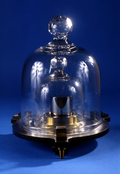 K20
K20 K4 left, K20 right
 IPK copies at NIST
 K20 and friends
 NIST employee Eddie Mulhern holding K92


_and_K4_(back).png)
