
Telephlebia cyclops is a species of dragonfly in the family Aeshnidae,[3] known as the northern evening darner.[4] It is a medium to large, dark chestnut brown dragonfly with dark markings on the leading edge of its wings.[5] It is endemic to eastern Australia,[4] where it has been found at tropical waterfalls,[6] and flies at dusk.[5]
| Northern evening darner | |
|---|---|
Scientific classification  | |
| Kingdom: | Animalia |
| Phylum: | Arthropoda |
| Clade: | Pancrustacea |
| Class: | Insecta |
| Order: | Odonata |
| Infraorder: | Anisoptera |
| Family: | Aeshnidae |
| Genus: | Telephlebia |
| Species: | T. cyclops |
| Binomial name | |
| Telephlebia cyclops | |
 | |

Telephlebia cyclops appears similar to Telephlebia godeffroyi.[4]
Etymology
editThe genus name Telephlebia is derived from the Greek τῆλε (tēle, "at a distance") and φλέψ (phleps, "vein"), referring to the unusually elongated vein near the leading edge of the wing.[7]
The species name cyclops refers to a Cyclops, a one-eyed being of Greek mythology, likely alluding to the large rounded marking on the front of the head.[2][8]
Gallery
edit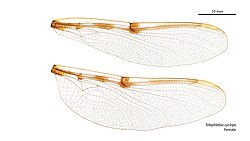 Female wings
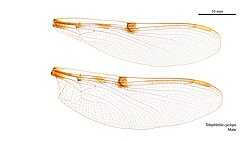 Male wings
.jpg)
.jpg)
See also
editReferences
edit- ↑ Dow, R.A. (2017). "Telephlebia cyclops". IUCN Red List of Threatened Species. 2017 e.T14259996A59256448. doi:10.2305/IUCN.UK.2017-1.RLTS.T14259996A59256448.en.
- 1 2 Tillyard, R.J. (1916). "Life-histories and descriptions of Australian Aeschninae, with a description of a new form of Telephlebia by Herbert Campion". Journal of the Linnean Society of London. Zoology. 33: 1–83 [36]. doi:10.1111/j.1096-3642.1916.tb00253.x – via Biodiversity Heritage Library.
- ↑ "Species Telephlebia cyclops Tillyard, 1916". Australian Faunal Directory. Australian Biological Resources Study. 2022. Retrieved 24 August 2024.
- 1 2 3 Theischinger, Günther; Hawking, John (2006). The Complete Field Guide to Dragonflies of Australia. Collingwood, Victoria, Australia: CSIRO Publishing. p. 144. ISBN 978-0-64309-073-6.
- 1 2 Watson, J.A.L.; Theischinger, G.; Abbey, H.M. (1991). The Australian Dragonflies: A Guide to the Identification, Distributions and Habitats of Australian Odonata. Melbourne: CSIRO. ISBN 0-643-05136-8.
- ↑ Theischinger, Gunther; Endersby, Ian (2009). Identification Guide to the Australian Odonata (PDF). Department of Environment, Climate Change and Water NSW. p. 238. ISBN 978-1-74232-475-3.
- ↑ Endersby, Ian; Fliedner, Heinrich (2015). The Naming of Australia's Dragonflies. Eltham, Victoria, Australia: Busybird Publishing. ISBN 9781925260625.
- ↑ Endersby, Ian (2012). "Etymology of the Dragonflies (Insecta: Odonata) named by R.J. Tillyard, F.R.S." Proceedings of the Linnean Society of New South Wales. 134: 1–16.
