This article is within the scope of WikiProject Computing, a collaborative effort to improve the coverage of computers, computing, and information technology on Wikipedia. If you would like to participate, please visit the project page, where you can join the discussion and see a list of open tasks.ComputingWikipedia:WikiProject ComputingTemplate:WikiProject ComputingComputing
Google Books can only locate four books that mention the VAX-11/788, and only one of them provides a preview which states:
Page 632: "If we allocate one unit to a microvax S. processor CPU time, then we find that a VAX 11/788 (a 788 is similar to that of a 780) is 1.2 times of a microvax ..." (Emphasis is mine).
The book is "International Symposium Digest, Antennas and Propagation," by Institute of Electrical and Electronics Engineers, International Union of Radio Science, IEEE Antennas and Propagation Society (1976).
I see a few mentions in other documents, generally referring to printer support of all things. However, it may be that even those references are bad OCRs of "780", which will turn up many hits on "788". I cannot find any references at all to VISQ except wiki related pages. 20:53, 27 October 2020 (UTC)Maury Markowitz (talk)
There's a very brief mention of a 787 and 788 in the reference below. No further details.
"The Virtual Address eXtension (VAX) was a family of minicomputers produced by DEC from the mid-1970s up to the late 1980s. This family used processors implementing the VAX instruction set architecture, and its members included minicomputers such as the VAX-11/780, VAX-11/782,VAX-11 /784, VAX-11/785, VAX-11/787, VAX-11/788, VAX-11/750, VAX-11/725 and VAX-11/730." O'Regan, Gerard (2015). "Digital Equipment Corporation". Pillars of Computing. pp.69–74. doi:10.1007/978-3-319-21464-1_11. ISBN978-3-319-21463-4.
For what it's worth, this HP document for OpenVMS print software speaks on page 2 of the software not being supported on the VAX-11/785 and the VAX-11/788, and the last "8" looks like an 8, not a 0. That may be the document Maury Markowitz referred to above.
Not sure why those two models are singled out, nor whether the person who wrote that knew of the existence of an 11/788 or just heard it from a friend of a friend.:-) Guy Harris (talk) 21:11, 24 February 2026 (UTC)Reply
The serial ports were typically implemented via DH-11 or DZ-11 cards on Unibus(es), so at least the hardware was virtually unlimited. BMJ-pdx (talk) 18:36, 26 April 2022 (UTC)Reply
Latest comment: 5 years ago2 comments2 people in discussion
I think some mention of VAX-11 being the host hardware for BSD 4.x is warranted.
Also, many of the major UUCP mail relay points were Vax-11 hardware (i.e. ucbvax, mcvax).
Kevink707 (talk) 20:51, 10 April 2011 (UTC)Reply
3BSD and 4BSD were originally done on a VAX-11/780, but does that belong here or on VAX?
"these are 32 bits" Yes, they are. In what fashion does what's in the infobox not reflect that? It doesn't include all values from 31 to 00, but it presumably doesn't do so in order to limit the width of the infobox.
"the bit positions typography — 31 ... 00 — don't make much sense" In what fashion? They're showing the denotations 31, etc., they just happen to do it with small numbers on a diagonal.
But that infobox doesn't belong in this article in any case. It's already in VAX, which is the article about the instruction set architecture; this page isn't about the instruction set, it's about the machines implementing that instruction set that had names beginning with "VAX-11/" followed by a number. It should probably be removed, and further discussion of the infobox should be done on Talk:VAX, as a similar infobox appears in VAX#Processor architecture. Guy Harris (talk) 07:48, 29 May 2021 (UTC)Reply
The horizontal space-saving argument is rather funny... why not rather remove more numbers? There might be some other reason, why to have the digits on diagonals, which I don't yet understand; however, because of last eight bit group, it resembles bytebit notation with intended typography: …, 07, (…), 00, which would be correct but only up to that 07. —Mykhal (talk) 08:24, 29 May 2021 (UTC)Reply
"why not rather remove more numbers?" E.g., only showing 31, 23, 15, and 00? And in what fashion is 07 correct but 00 not correct, if that's what you mean by "correct but only up to that 07"? Guy Harris (talk) 08:47, 29 May 2021 (UTC)Reply
I mean up to, in numerical sense, from right. I.e. 07 correct, but (hidden) 08 wrong., as well as all higher indexed numbers from left. —Mykhal (talk) 08:52, 29 May 2021 (UTC)Reply
As one of the editors who put a lot of time into making the CPU architecture boxes (several years back now, ca.May 2013), I intended the boxes to look pretty much the same across all of the CPU articles. The bit positions were an attempt to keep an already cramped horizontal space as small as possible while still showing useful register bit widths. See the articles for the 8080, 6502, Z-80, 8086, 68000, IBM 360, PDP-10, PDP-11, and several others. Note that some of the manufacturers number the bits from left to right, instead of the more usual right to left order. I'd really like to see every CPU architecture article feature such a box, but I'll leave that noble task for others to complete. I can't take credit for the original design of the CPU box (I don't even remember which article first featured it), but I did add improvements to it. If you think changing the layout of the bit numbers will improve things, that's fine, but please be sure you make the changes across all of the other existing CPU articles to maintain a consistent look within WP. —Loadmaster (talk) 23:32, 10 June 2021 (UTC)Reply
Latest comment: 7 months ago3 comments2 people in discussion
When the 11/782 was first created, I remember hearing/reading that it was a project of UCB. They basically replaced the terminator of the MA780 bus with a second CPU (the first CPU was at the other end of the bus, providing termination at that end). One CPU was dedicated to system mode, the other to user mode (that differs somewhat from the description of the production version in the article).
Can any UCB old-timers confirm this, particularly, the roles of each CPU?
There was a dual-11/780 system - developed at Purdue University, not the University of California, Berkeley - whose hardware description sounds like that,[1]:292–293 but whose software description is similar to that of the 11/782, with both CPUs running user-mode code and one designated CPU running kernel-mode code.[1]:293–294
Thank you -- that user-mode/kernel-mode duty makes more sense, given that a lot more time in spent in user mode. I remember thinking that one running only kernel-mode would be very underutilized. BMJ-pdx (talk) 01:52, 16 November 2025 (UTC)Reply
References
12Goble, George H.; Marsh, Michael H. (April 1982). A dual processor VAX 11/780. 9th Annual Symposium on Computer Architecture. IEEE Computer Society Press. pp.291–298. doi:10.1145/1067649.801738.
Latest comment: 3 months ago6 comments3 people in discussion
In the VAX-11/780 section, I just changed "PDP-11/03" to "LSI-11" (used for bootstrapping), and inadvertently terminated the reason. It's because that's how the cited Hardware User's Guide consistently refers to it. I don't want anyone freaking out because I edited a cited statement. BMJ-pdx (talk) 01:41, 16 November 2025 (UTC)Reply
To quote page 2-1 of the LSI-11, PDP-11/03 user's manual, "The PDP-11/03 is a packaged LSI-11 system, including a processor, 4K memory, enclosure, H9270 backplane, and H780 power supply." I couldn't find any pictures of the 11/780 that showed the console processor, but I suspect DEC didn't bother with the 11/03 packaging, so it was probably just an LSI-11 board without that packaging. Guy Harris (talk) 16:52, 16 November 2025 (UTC)Reply
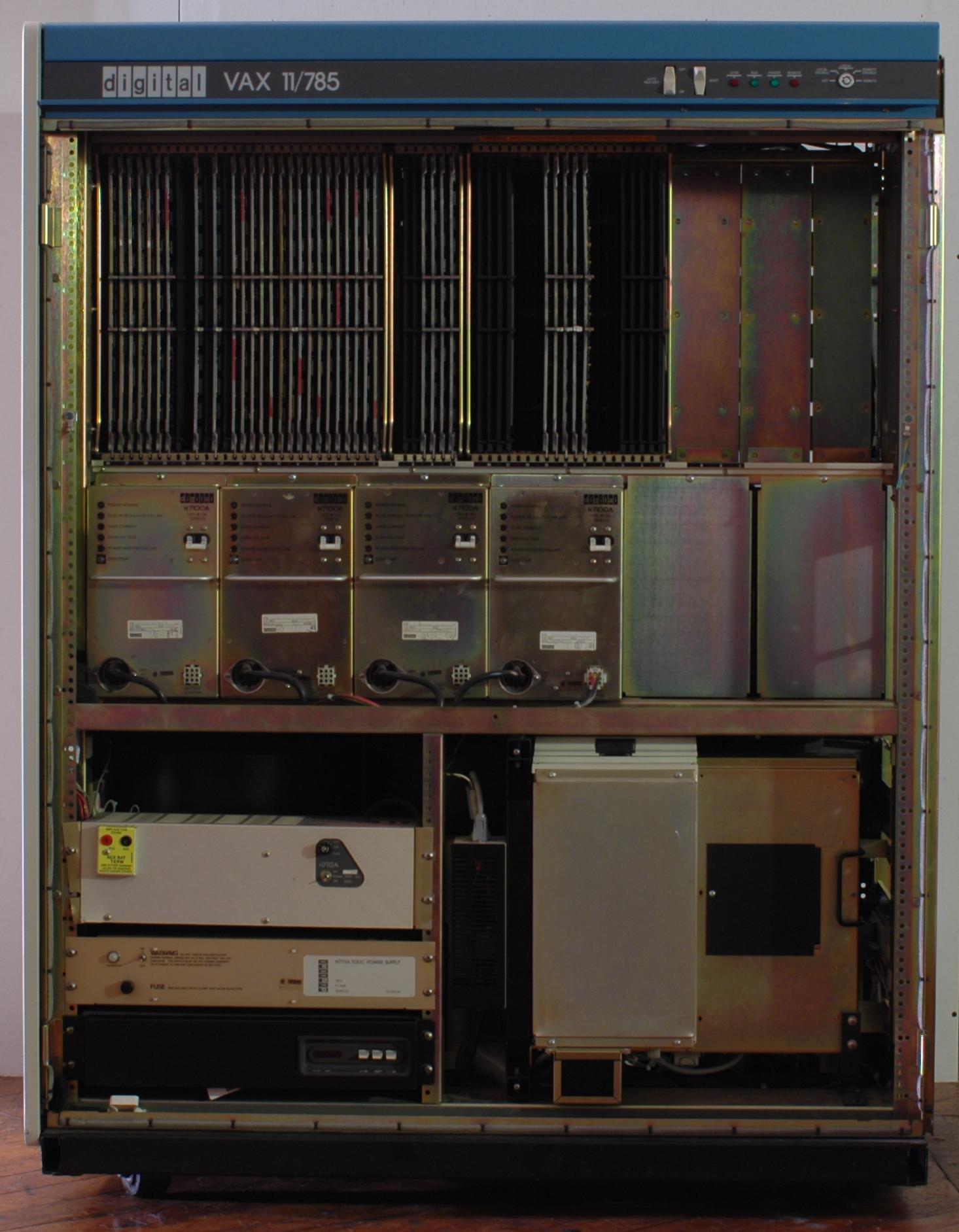
@BMJ-pdx:@Guy Harris: Take a look at this VAX-11/785. (All of the 78x are similarly configured.) The 11 is at lower left in this image. I'll take some closeup photos of it later this afternoon. Compare to figure 2-1 on page 2-1 at the VAX-11/780 Hardware User's Guide where it is labeled LSI-11 and the RX01 8" floppy is labelled DX-01 at lower right. In section "5.9 LSl-11 MICROCOMPUTER" on page 5-65 it states: "The PDP-11/03 is a packaged version of the LSl-11 microcomputer." The term PDP-11/03 is only mentioned once in the manual. LSI-11 is mentioned more than a dozen times, as in LSI-11 microprocessor or microcomputer. --mikeutalk19:10, 16 November 2025 (UTC)Reply
LSl-11 system components (Figure 1-1) include separate modules (printed circuit boards), backplanes, cables, etc., which are available separately. This allows the user to purchase only the system components required for a specific application. Original equipment manufacturers (OEM's), for example, can purchase LSI-11 system components to function in a specific computer-controlled system environment.
and shows a picture of a PDP-11/03 system on page 1-3. I don't know how much of the PDP-11/03 packaging was used in the VAX-11/780 console processor system, although the three toggle switches look a little similar. Guy Harris (talk) 20:13, 16 November 2025 (UTC)Reply
Here's a closeup photo of the lower left of a VAX-11/785. The front end processor is the black box at bottom. There's no nameplate on the front. It doesn't look different from any other LSI-11 that I've seen. Usually they are labeled on the back as "Model: 11/03-EE" or similar. I can't easily get at the back of the console shown here. IMHO, the two terms are synonyms. I would include both terms with one in parenthesis after the other. --mikeutalk20:21, 16 November 2025 (UTC)Reply
All that's quite true, but beside the point that the 780 hardware manual I cited refers to it as "LSI-11", many times.
I took care of a 780 for many years. We (myself and the DEC service people) always referred to the "LSI-11", never the "PDP-11/03". BMJ-pdx (talk) 20:04, 24 February 2026 (UTC)Reply