This is an archive of past discussions about Serbian Empire. Do not edit the contents of this page. If you wish to start a new discussion or revive an old one, please do so on the current talk page.
Latest comment: 18 years ago4 comments3 people in discussion
Imbris, please stop inserting the incorrect flag. That is not the Serbian Empire's flag. It was (and only partially) used in the Serbian Kingdom. Despite the fact that I have explained it to you, you again returned. --PaxEquilibrium (talk) 22:32, 1 March 2008 (UTC)
You have not explained anything. You have pushed for the change from the day before. Both flags :Image:Serbian Empire flag.svg and this one which you push for should be deleted as unsourced. I do not know why do you think we should let you change something just to make your image un-orphaned. -- Imbris (talk) 00:12, 2 March 2008 (UTC)
I put it here not as a Flag (Flags in common sense were invented only with the passing of the Industrial Age), but as a symbol of the Nemanyiden - what do you mean not sourced? I have posted sources to you for how many times I don't even remember, but you constantly ignore them and very aggressively push to delete them. --PaxEquilibrium (talk) 11:48, 2 March 2008 (UTC)
Latest comment: 14 years ago4 comments4 people in discussion
I have one objection. I am from Romania, town Ovidiu near Constanţa and I am historic. I know that Dobruja (Constanţa County and Tulcea County) was part of Serbian Empire (actually Bulgarian Empire which was vassal). So, Serbian Empire was twice times long than your map say. —Preceding unsigned comment added by Blexandar (talk • contribs) 12:53, 2 October 2010 (UTC)
So, you are either no historian or have been misled by a book or a person because the Bulgarian Empire was never a vassal of Serbia. --Gligan (talk) 12:31, 9 December 2010 (UTC)
Actually Bulgaria was a Serbian vassalage at that timr, even more, because of the Bulgarians that supported him as their ruler, Tsar Dusan the Mighty became a Tsar, and Serbia an Empire. Bulgarian Slavs and Serbs are more or less the same people, just that Serbs call themselves by their native name, while Bulgarians adopted a denomination by proto-Bulgars that ruled them, in the course of the history they had a great mutual relationship, between culture, churches, tradition. From a Bulgarian. — Preceding unsigned comment added by 178.190.75.114 (talk) 13:37, 18 June 2012 (UTC)
Byzantine Empire and Serbian Empire
Latest comment: 12 years ago2 comments2 people in discussion
The Byzantine Empire was neither a predecessor nor a successor of the Serbian Empire, so I will remove that now. --Gligan (talk) 12:31, 9 December 2010 (UTC)
Latest comment: 11 years ago2 comments2 people in discussion
Which part of Croatia was under the rule of the Serbian Empire because I can't see well on the map?
Thank you — Preceding unsigned comment added by 95.116.23.33 (talk) 13:17, 26 May 2012 (UTC)
Latest comment: 12 years ago8 comments4 people in discussion
This coat of arms is a joke, it has nothing to do with the medieval Serbian Empire. It's probably a product of national romanticism. — Preceding unsigned comment added by N Jordan (talk • contribs) 02:47, 13 October 2012 (UTC)
Absolutely. Be WP:BOLD remove such nonsense when you see it.
The flag also seems a bit too "stylish", for the period. That shape of the two-headed eagle is actually based on the modern-day flag of the Greek Orthodox Church. The kind of two-headed eagle from the present-day Serbian coat of arms would probably be more accurate. But we know that the flag was a red two-headed eagle on yellow, and that's all, so I'm fine with this. -- Director(talk)02:40, 21 October 2012 (UTC)
Correction: there is an actual 14th century flag (wow). We probably shouldn't replace it with the Greek Orthodox Church version. That said, I suppose we could use a stylized version. -- Director(talk)02:46, 21 October 2012 (UTC)
Well, that original "flag" is way to simply drawn to be used here... It was only a minor detail on that original map. And we have a link to Flags of Serbia article below it, where everything is explained and marked. I am also for current version. --WhiteWriterspeaks17:09, 21 October 2012 (UTC)
Someone put in Nemanjic flag as the empire flag. It is a difference between a family weapon and empire flag. If the user does not give me a source, I will replace it with the Byzantine flag. — Preceding unsigned comment added by 2A02:9A0:7:751:14E3:98C3:264:FD9D (talk) 20:30, 17 July 2013 (UTC)
Bulgaria and maps
Latest comment: 11 years ago3 comments2 people in discussion
Are you sure about that information? It sounds too much like a fringe view. I noticed you have added a single source, but how does it support the 1331-1365 claim? Ivan Alexander was not considered a vassal and a royal marriage is hardly proof for such a thing. --LaveolT04:00, 2 November 2014 (UTC)
I haven't said that the marriage was the reason for the vassal relationship, just that the marriage of Dushan with Helena extended the influence of Serbia at Second Bulgarian Empire aerticle (maybe that part can be reworded, no problem). But the main issue, the vassal relationship, is blacked by this source, which says: "But in 1330, the Serbs... ...stretching from the Danube to the gulf of Arta, and including Bulgaria as a vassal state, 1331-1365." something that would mean that Bulgaria became vassal shortly after the Battle of Velbazhd, and this source, which says (pag. 35 by the middle): "Bulgarias tsar, whose sister Dushan had married, became his vassal." Tomorrow I will try to see more of this and make different searches. FkpCascais (talk) 04:48, 2 November 2014 (UTC)
I doubt that Bulgarian state become vassal its simply the bulgarian king will not be TSAR if he is vassal.... This is way never serb has the title TSAR exsept Dusan... In this time the title, the yerarchi are from absolute importance and the people care about them.... Its imposibel a monarch to be TSAR and vassal in same time...
Infobox
Latest comment: 11 years ago26 comments6 people in discussion
The historical name of the state wasn't "Serbian Empire", but rather "Empire of the Serbs and Greeks". Hence the infobox should be headed with that name per convention. "Serbian Empire" is the commonname.
The "native_name=" entry should not be filled with modern-day names, but with "native names" used at the time. I very much doubt there are any contemporary attestations to the name in the Medieval Serbian (Serbo-Croatian) language. The only thing that should be found in that entry is the name "Empire of the Serbs and Greeks" in Byzantine Greek (I don't know what that looks like, so I left the entry blank).
It is Template:Infobox former country that explains how this infobox is properly filled. It does not mention "historical name". It says "conventional_long_name". Your addition is challenged. Per WP:BURDEN you should either present proof (reliable source) for your addition or to remove it.
Are you sure director for your changes? Arent you mixing the title Dusan had with the name of the country? What sources do you have for the name you introduced and the point you are making regarding the language? FkpCascais (talk) 21:41, 6 November 2014 (UTC)
Removed "long name" as this was his title rather than appellation of his state (according to historiography).--Zoupan23:07, 6 November 2014 (UTC)
The appellation is the only contemporary name. "Serbian Empire" is a modern term that belongs in the title and lead - not the former country infobox. -- Director(talk)14:23, 8 November 2014 (UTC)
@Antid. #1 This obviously has nothing to do with reliable sourcing or WP:BURDEN, please spare me the stock nonsense. The {{Infobox former country}} template states that the entry in question is to be filled with the "full name". I've told you what that means and presented evidence as to the accuracy of my interpretation, showing that it is shared by everyone on this project. #2 Modern syntax means we won't write it like they would in the Middle Ages. Not that we wouldn't use the contemporary name. That's why I asked you whether you knew the meaning of what you're quoting... it seems you didn't. -- Director(talk)14:23, 8 November 2014 (UTC)
Director. Incorrect.#1 Take a better look at Template:Infobox former country. At the top of infobox it says that full name in English should be {{{conventional_long_name}}}. Not "historical name" as you insist. Your opinion that that "historical name" = conventional_long_name = "Empire of the Serbs and Greeks" is challenged. So yes, per WP:BURDEN you should present proof (reliable source) for your position. Wp:BURDEN says "All content must be verifiable." That includes infoboxes. #2 When you insisted on the " contemporary attestations to the name in the Medieval Serbian (Serbo-Croatian) language" I quoted what Template:Infobox former country says about native name ("Name in a modern syntax of native language") and I don't see any reason to continue (unnecessarily personalized by you) discussion about this point. Especially after you confirmed that "Modern syntax means we won't write it like they would in the Middle Ages.". --Antidiskriminator (talk) 17:21, 8 November 2014 (UTC)
Stop telling me what the entry's htlm code is - and start figuring out the fact that you have no idea how to fill it. It is not filled with the commonname - "conventional_long_name" refers to the full contemporary name of the entity: ET CAETERA. Our job is to inform, not to take care Dusan's historical glory isn't diminished by the mention of Greeks.
Antidiskriminator, you've been posting on Wikipedia for too long now to still be annoying people with a lack of understanding of basic policy. This is not a question of sourcing, of burden, or of verifiability. There is nothing to source. Its a strictly Wikipedia-related question regarding infobox use. Get that straight. I'm getting far too old to deal with that brand of bull. As for syntax, that means we won't write "Imperium Romanum" "IMPERIUMROMANUM". I'm sure you can figure out the meaning of the word "syntax" if you really really try... -- Director(talk)18:43, 8 November 2014 (UTC)
Director, you can't find "name in a modern syntax of native language(s)" in the " contemporary attestations to the name in the Medieval Serbian (Serbo-Croatian) language". Not because I say so, but because it is simply impossible. All editors are, of course, expected to follow wikipedia policies, including you and WP:V policy. I think I gave fairly clear explanation for my position and I don't really have much to add to that now. You are of course free to disagree, but I don't think you should expect me to be now somehow obliged to keep discussing this with you for as long as you are dissatisfied with it. All the best. --Antidiskriminator (talk) 21:01, 8 November 2014 (UTC)
Well then I must point out that WP:NAME equally clearly supports my position, and that you must now produce a scholarly source or are wrong... bah
You have no idea what "syntax" is or what policies apply where. I'll say this one last time:
WP:V!??? WP:V refers to the verifiability of sources. Like, say, some book or other. There is no information that needs sourcing here. This is an issue that pertains solely to the use of a Wikipedia template. It is not up to sources, it is up to Wikipedia itself to decide what goes where in its infoboxes. Period.
"Syntax" means "way words are put together". You may rest assured that if any name is introduced in the "native_name=" entry, it will be introduced in modern syntax, whether you know what that means or not. There is no issue here. Period #2.
Now please go bother Peacemaker or some other poor soul. Your posts, as always, are not arguments, they do not constitute discussion - they are disruptive. I am amazed you are still going on like this, and should this continue input from WP:AE will become both warranted and worthwhile. Take a hike, please. -- Director(talk)21:30, 8 November 2014 (UTC)
Director#1 Multiple editors challenged your addition. You failed to respect WP:V (its WP:BURDEN section) and to present proof (citation to reliable sources) that historical name you found ("Empire of the Serbs and Greeks") is conventional_long_name per Template:Infobox former country. You pointed to other articles and actually refuted yourself. Those articles do not present any historical name with a couple of GBS hits (like the name you added - link to 3 GBS hits for "Empire of the Serbs and Greeks") as conventional_long_name. The conventional_long_names presented in the infoboxes of the articles you pointed to have 5,060,000 hits, 1,740,000 hits, 3.430.000 hits, 4,070,000 hits, 9,490 hits, 717,000, 4,600 hits23,800 hits .... Who knows how many historical names those countries had, but only conventional are presented in the infobox, per Template:Infobox former country. It is not enough to find any historical name and to put it in the infobox just because it is historical. Especially if it is supported with only 3 GBS hits. That is my honest opinion which is grounded in common sense and wikipedia policies and guidelines. #2 Please believe me, it is impossible to find "name in a modern syntax of native language(s)" in the " contemporary attestations to the name in the Medieval Serbian (Serbo-Croatian) language".
The long name is still unsourced. I am not aware, but was that really the official name of the empire? I am realy asking, without any taking of sides. FkpCascais (talk) 23:04, 8 November 2014 (UTC)
There were no "official names" then, states were personal domains. The only thing we know is that Dusan himself assumed the title "Emperor of the Serbs and Greeks", the state itself had no name as far as I can tell. Probably if you asked them they'd say they were in the Roman Empire, ruled in this part by its rightful Emperor, Stephen. "Empire of the Serbs and Greeks" directly corresponds to said title and is certainly attested in sources... -- Director(talk)15:33, 9 November 2014 (UTC)
It is not that simple. Louis of Hungary proclaimed himself ruler of Hungary, Bosnia, Serbia, Croatia, etc. but that doesn't mean the kingdom he ruled was named by his title. I guess it is possible to see how the state was refered in the documents, seals, and other written forms. Don't take me wrong, but for time being we don't have even one source for your edit, let it be by now. If we find that it was really the name of the state I will be the first to support you for its inclusion in the article in the proper places. FkpCascais (talk) 16:24, 9 November 2014 (UTC)
It is that simple. As I said, none of these states actually had formal names in and of themselves, and were defined by their ruler. Hence, if we had an article about the entity ruled by Louis I(?) of Hungary, we'd name it by its most common name in scholarship (probably just "Hungary"), and have "Kingdom of Hungary and Dalmatia" or something up in the infobox... I gave you a source up there, I think.
All I'm trying to do is bring this article up to standard. This informs the reader as to the "actual", contemporary (as opposed to common historiographic) name of the entity.. that's why its used everywhere. Commonname applies only to the title.
P.s. My suggestion to improve this article would be to try and figure out the original name used for Dusan's titles in Byzantine sources. Like Kingdom of Croatia has "Regnum Croatiae", etc.. Finding out that bit of obscure info, in Byzantine Greek, would really be interesting. Tried myself for an hour or so, couldn't uncover it. -- Director(talk)18:32, 9 November 2014 (UTC)
Sorry, it was Louis the Great I was referring. Anyway, I am perfectly fine with your intention, I myself am also interested in the issue of knowing the name of the state. I haven't seen any mention of the name in any places I looked, but I only looked at English-language sources, will search further. FkpCascais (talk) 20:44, 9 November 2014 (UTC)
I had a look in Volume III of the excellent Le monde byzantin series (L. Maksimovic, chapter "La Serbie", pages 334-336), and found some interesting stuff, although not a direct answer to the discussion above. There is no reference to a state title, which is to be expected, as Director explained, because Dushan's empire was a) pretty much a personal creation, like the "Empire of Alexander the Great", and b) because it did not differentiate itself from the ecumenical Roman empire of the Byzantines, but claimed to be a direct successor. Dushan's law code explicitly places him in the line of succession from Constantine the Great. The imperial title of Stefan Dushan was "[blagoverni] car' srbliem i gr'kom" ("Tsar of the Serbs and the Greeks", Greeks being habitually used by the Serbs for the "Romans" of Byzantium) in Serbian, and "en Christo to Theo pistos basileus kai autokrator Serbias kai Romanias" ("in Christ the God faithful emperor and autocrat of Serbia and Romania") in Greek. In the Greek formula, the only notable change in comparison to the usual Byzantine formula, apart from the addition of "Serbias", is the use of "Romanias" instead of "Romaion", i.e. "of Romania" instead of "of the Romans", which Maksimovic explains as a deliberate differentiation, since the only legitimate emperor "of the Romans" had to control Constantinople and the Ecumenical Patriarchate. The contemporary Byzantine writers also clearly distinguished between the ancestral Serbian lands, where Stefan Urosh ruled as king, and the conquered lands "in Romania", which Dushan (and Stefan Milutin before him) continued to administer on the Byzantine model. How clear this duality was in practice is open to question, however it should be noted that (in contrast to modern Serbian nationalism) Dushan's proclamation of empire was not well received in Serbia proper, which is also one of the reasons he was never sanctified by the Serbian Church, or why his biography, alone among the medieval Serbian rulers, was never completed. Also, when the Byzantines came around to recognizing Dushan's imperial title, it was only for Serbia proper, pretty much as they had done with the Bulgarian Empire 400 years earlier. Constantine ✍ 21:05, 9 November 2014 (UTC)
Thanks for joining in, Cplakidas. So far as I can gather, then, we have "Carstvo Srblia i Grka" (Царство Срблиа и Грка) for Medieval Serbo-Croatian in modern syntax, and "Autokratia Serbias kai Romanias" (Αθτοκρατια Σερβιασ και Ρομανιασ), correct me if I'm wrong, its all Greek to me:). -- Director(talk)22:26, 9 November 2014 (UTC)
It would be "Basileia Serbias kai Romanias" (Βασιλεία Σερβίας καὶ Ῥωμανίας), but this is very much ahistorical AFAIK. To the Byzantines under Constantinople, Dushan was and remained "Emperor of Serbia"; to the Byzantines under Dushan's rule, he was a dual monarch, king of Serbia and emperor in the "lands of Romania"; Dushan himself considered himself to be "Emperor of Serbs and the Romans" even though he did not use the latter part too officially. Unless we can find a chancery document with a contemporary name, I don't see a reason in not using the established historiographical term, " Serbian Empire". Constantine ✍ 18:04, 10 November 2014 (UTC)
Either way the historical full name in English is more customary for the top of the infobox. What we're concerned with is what he himself, i.e. his state, considered his titles to be. If he considered himself basileos, then we should refer to his state as "basileia", I don't think that's ahistorical at all. Its certainly more accurate than the commonname at any rate. The Byzantines in what little remained of the Empire certainly did not recognize anyone as "baslieos", but that should not factor into our considerations.
What I would do is have "Basileia Serbias kai Romanias" and "Carstvo Srblia i Grka" up there. I don't think it would be an error to translate into contemporary parlance a name that is sourced as being the more accurate, contemporary variant - even if we do not have explicit attestation of the name in that form. In either case, I think "Empire of the Serbs and Greeks" ought to be the English name in the infobox. -- Director(talk)00:59, 11 November 2014 (UTC)
Direktor, for time being you are just doing OR. If I am not wrong, Constantine suggests using the "Serbian Empire" term as it is the only certain by now, and until we have a confirmation by some RS we should not go into OR and name the Empire by the title Dushan had. FkpCascais (talk) 02:45, 11 November 2014 (UTC)
Yes FkpCascais, that's my opinion. The issue is rather complex and "plausible" extrapolation is not what we are here for. I'll have a further look in some other sources over the next few days, but I don't really expect to find something like what Direktor has in mind. Constantine ✍ 10:26, 11 November 2014 (UTC)
Latest comment: 11 years ago4 comments2 people in discussion
I have been watching several articles of other nations and I noticed that when they have a sort of "maximum extent" map, or sometimes they don't even mention that, that they add the vassal states in the map as well, sometimes in a different color. I have found several sources claiming Bulgaria became vassal state of Serbia in this period. It would be good to have it in a map.
Sources:
The Cambridge Medieval History Series Volumes I-V by J. B. Bury: "But for the ruler (referring to Dushan) of so vast realm, the title of King seemed insignificant, specially as his vassal, the ruler of Bulgaria, bore the great name of Tsar."
Europe in the 19th and 20th Centuries by E. Upson: "...including (talking of Dushan Empire) Bosnia, the Herzegovina, Macedonia, and the vassal State of Bulgaria herself."
The Balkans: A History of Bulgaria, Serbia, Greece, Rumania, Turkey by Clarendon Press: "From 1331 to 1365 Bulgaria was under one John Alexander, a noble of Tatar origin, whose sister became the wife of Serbias greatest ruler, Stephen Dusan; John Alexander moreover recognized Stephen as his suzerain, and from thenceforward Bulgaria was a vassal-state of Serbia."
Churches Of Eastern Christendom by B. J. Kidd: "But in 1330, the Serbs... ...stretching from the Danube to the gulf of Arta, and including Bulgaria as a vassal state, 1331-1365."
These are just some sources found on this and all in English from neutral authors, and the search is not easy because of the amount of results which are provided for Serbia and Bulgaria becoming vassals of Ottomans soon after this period. It also seems that the fact that Dushan was crowned, among others, by Bulgarian Patriarch Simeon, was not an act of almost help or favour like it is written in Bulgarian articles, but actually a sign of recognition of Dushans suvereignity over Bugaria.
If maps of SE presented in modern contemporary sources (preferrably 21st century) do not present Bulgaria as SE vassal territory I don't think wikipedia shuold do it, though a note with indicated period of vassalage might be informative.--Antidiskriminator (talk) 18:32, 22 November 2014 (UTC)
State insignia
Latest comment: 10 years ago5 comments2 people in discussion
If instead, an emblem should be used (which I support), I only see that a faithful reconstruction be made of the eagle depicted on Emperor Dušan's plate (seen here).--Zoupan22:06, 16 March 2015 (UTC)
This is a good point, but: I think that treating historic banners and emblems like modern flags is an anachronism. A feudal empire would have many "flags", flown by different people and in different places and under different circumstances. Worse, they are often poorly sourced, based on notoriously shaky contemporary sources. bobrayner (talk) 00:19, 22 March 2015 (UTC)
I don't think an image like this is suitable for an infobox. However, I think it's reasonable to explain various flag images in the body of the article, explaining the nuances of uses and sources and their weaknesses. You have done great work on that. bobrayner (talk) 02:11, 22 March 2015 (UTC)
Latest comment: 10 years ago2 comments2 people in discussion
Inaccurate map without context and explanation shouldn't be allowed to stand.
Map from late XIX century (Allgemeiner historischer Handatlas 1886), by Gustav Droysen is obsolete and inaccurate - why would anyone use this map, anyway?! Even file description acknowledge that this map is inaccurate & doesn't comply with worldwide view! WP:SPS Also read: Wikipedia:Using_maps_and_similar_sources_in_Wikipedia_articles
It's very simple - this map, with present article format and context shouldn't be allowed to stand because it is misleading piece of (dis)information!
This is particularly interesting problem when other, more accurate & reliable, maps exists.--Santasa99 (talk) 20:04, 24 December 2015 (UTC)
I replaced the map for time being while a consensus is established here. The problem is not as serios as you put it, since at the begining of the article we have the infobox that includes a map, and that one ends up being the most representative of the article. The map you are disputing is a map which was included here to show how at different periods the view over the exact extent and the relation with Bulgaria was different. What is called "modern historiography" on the description of the German map is basically the map which was being presented and lectured during the Yugoslav period, and that map has been copied over and over. It contans some open questions, like, the inconsistency regarding Bulgaria and the extenssion limits, speciially in the South-East where we know by the narrative that Dušan had its troops stationed in areas not included in the modern maps. Also, there has been a tendency in the articles of some other European continental Empires to include maps indicating maximal extent and/or include vassal states, however Serbian Empire clearly lacks more quality maps. FkpCascais (talk) 22:06, 24 December 2015 (UTC)
Ruler title
Latest comment: 10 years ago2 comments2 people in discussion
I changed the ruler title from "Emperor of the Serbs and Greeks" to "Emperor of the Serbs and Romans" it is how it was. Romans originally used "Bασιλεὺς καὶ αὐτoκράτωρ Σερβίας καὶ Pωμανίας" and whoever can read Greek (as I can) can clearly see that it is not Greeks but Pωμανίας (Romanias - Romans).--Aryanprince (talk) 04:19, 6 March 2016 (UTC)
@Aryanprince: I don't think you can read/understand Greek. Romania is used for the Byzantine Empire. The other styles, in Serbian, include Emperor of the Serbs and Greeks.--Zoupan03:50, 21 March 2016 (UTC)
"The construction of Dusan's empire opened the door for later subjugation of Serbia by the Turks"
Latest comment: 9 years ago4 comments4 people in discussion
The exceptional claim from the title of this section is added by Ktrimi991 with this diff and sourced with non-exceptional source whose author was not specialized in the topic. Based on WP:EXCEPTIONAL I propose to either provide exceptional source or delete the above assertion.--Antidiskriminator (talk) 23:36, 11 February 2017 (UTC)
He is using a book from a very criticized author for strong bias. It can all be reverted without problem and replced by neutral scholar authors. FkpCascais (talk) 01:27, 12 February 2017 (UTC)
Again, as with Ktrimi's other edits, I have no problem with including the hypothesis as long as it is attributed properly and devoid of the POV-ish tone that usually accompanies his contributions. 23 editor (talk) 19:38, 12 February 2017 (UTC)
External links modified
Latest comment: 8 years ago1 comment1 person in discussion
Hello fellow Wikipedians,
I have just modified 3 external links on Serbian Empire. Please take a moment to review my edit. If you have any questions, or need the bot to ignore the links, or the page altogether, please visit this simple FaQ for additional information. I made the following changes:
When you have finished reviewing my changes, you may follow the instructions on the template below to fix any issues with the URLs.
This message was posted before February 2018. After February 2018, "External links modified" talk page sections are no longer generated or monitored by InternetArchiveBot. No special action is required regarding these talk page notices, other than regular verification using the archive tool instructions below. Editors have permission to delete these "External links modified" talk page sections if they want to de-clutter talk pages, but see the RfC before doing mass systematic removals. This message is updated dynamically through the template {{source check}} (last update: 5 June 2024).
If you have discovered URLs which were erroneously considered dead by the bot, you can report them with this tool.
If you found an error with any archives or the URLs themselves, you can fix them with this tool.
Latest comment: 7 years ago4 comments3 people in discussion
{User placed this on my talk page. Moving it to correct forum.}
Hello Laszlo,
The changes that you keep reverting are the correct ones from historical point of view.
Current text is suggesting that the Bulgarian Empire was a vassal to the Serbian Empire after the Battle of Velbazhd, which is totally incorrect. The first source "The Fall of Constantinople 1453" ( https://books.google.bg/books?id=CJz8BCdxlfEC&pg=PA37&redir_esc=y ) is just a cover web page for the book and its text are not visible, unless one buys the actual book. The reason for existance of this source is not clear as when you click on it, you cannot actually see the proof for the statement "Bulgaria had never recovered since its defeat by the Serbs at the Battle of Velbazhd,".
Second source "A History of the Balkan Peoples" (https://books.google.bg/books?id=S5TAr1t6_g0C&pg=PA35&redir_esc=y#v=onepage&q&f=false) is for the statement: "and the Bulgarian czar, whose sister Dušan later married, became his vassal," . The issue with this source is that it is an outdated (1971) work of René Ristelhueber - unknown historian whose work has been put as reference for just one additional sentence in whole of Wikipedia. The source is unreliable and it cannot be a proof for a statement of such historical importance.
Third source is "Churches Of Eastern Christendom" (https://books.google.bg/books?id=zeNFAAAAQBAJ&pg=PT228&redir_esc=y#v=onepage&q&f=false) by B. J. Kidd, (https://en.wikipedia.org/wiki/Beresford_Kidd) who is a recipient of the Order of St. Sava - serbian/yugoslavian state order awareded for the following reason: "recognize civilians for meritorious achievements to the Church, to arts and sciences, the royal house and the state." and it was " awarded by the king of Yugoslavia.." . This is the only official award that this man has received during his lifetime and it is obvious that his work is not reliable as it is not unbiased.
The changes that I'm doing are the correct historical evidence about the outcome of the battle of Velbazhd and are supported by numerous historical sources that are cited in all other articles in Wikipedia, which are related to this topic.
So, I'm revirting the article back to the correct text and map until you have provided a proper and unbiased historical sources.
--TheManiacBG (talk) 11:55, 13 September 2018 (UTC)
There are plently of sources saying Bulgaia was in a vassal relationship towards Swerbia for Dushan´s period.
this source that says: "From 1331 to 1365 Bulgaria was under one John Alexander, a noble of Tatar origin, whose sister became the wife of Serbias greatest ruler, Stephen Dusan; John Alxande moreover recognized Stephen as his suzerain, and from thenceforward Bulgaria was a vassal-state of Serbia."
The Cambridge Medieval History Series Volumes I-V by J. B. Bury: "But for the ruler (Dushan) of so vast realm, the title of King seemed insignificant, specially as his vassal, the ruler of Bulgaria, bore the great name of Tsar."
Europe in the 19th and 20th Centuries by E. Upson: "...including (talking of Dushan Empire) Bosnia, the Herzegovina, Macedonia, and the vassal State of Bulgaria herself."
The Balkans: A History of Bulgaria, Serbia, Greece, Rumania, Turkey by Clarendon Press: "From 1331 to 1365 Bulgaria was under one John Alexander, a noble of Tatar origin, whose sister became the wife of Serbias greatest ruler, Stephen Dusan; John Alexander moreover recognized Stephen as his suzerain, and from thenceforward Bulgaria was a vassal-state of Serbia."
Churches Of Eastern Christendom by B. J. Kidd: "But in 1330, the Serbs... ...stretching from the Danube to the gulf of Arta, and including Bulgaria as a vassal state, 1331-1365."
The first source is not showing the text that you mentioned. It is showing two pages that are not relevant to the topic at hand.
As I previously have mentioned - there are a many sources which are indeed saying that after the Battle of Velbazhd, Serbia has gained great influence and even hegemony over Bulgaria until the collapse of the Serbian Empire in 1371, but it is not saying that Bulgaria was a vassal state of Serbia, because that is just not the case. The only country that was able to achieve this is the Golden Horde of which Bulgaria was a vassal state for a couple of years, especially during the reign of Chaka.
And to clarify, if there are any doubts, hegemony means that one country has great deal of influence over a specific area and countries, but it is not directly controlling that area or country/countries. Vassal state is a country that is under the political control of another country.
Those sources are purely professional and unbiased. So, we have a situation where it seems that there are sources for both arguments. Either we make a compromise and put into the article that some historians believe that Bulgaria became vassal and some believe it just led to greater influence of Serbia in Bulgaria until 1371 AD. The other option is to continue this argument and I will NOT leave this article like that and I'm going to report you for trying to spread propaganda, instead of knowledge, using Wikipedia as resource. --TheManiacBG (talk) 17:47, 14 September 2018 (UTC)
Contrary to what you state, the first source cited and linked by FkpCascais does indeed include the quote he reproduces here. Meanwhile, the page of Fine that you link to (pg 259) does not mention Bulgaria, while the previous page merely mentions it in passing. FkpCascais cites several sources and gives quotes in support. I do not find support for your proposition at any of the links you provided. Please provide the quotes from those sources that you believe support your view. Laszlo Panaflex (talk) 18:39, 14 September 2018 (UTC)
Maps
Latest comment: 6 years ago1 comment1 person in discussion
I favor an inclusion of reliable maps that may differ from the more standardised ones. The ones most common are the ones basically showing Serbian empire version in its shortest form. Ignoring the inclusion of Bulgaria despite many sources confirming after Velbuzhd Serbian took over Bulgaria for a period. Usually older maps from older encyclopedias show a much different and enlarged Serbian empire which includes vassal states as well, while most modern ones remove vassal states and show Serbia in its more concise form. There are sources saying Serbian empire for a while exercided major power over most of Balkans, and older maps usually do correspond to that, while more modern ones don´t. There must be plenty of reasons, but I am against the total removal of elder maps as they were at this point at the article. FkpCascais (talk) 03:43, 28 July 2019 (UTC)
Incorrect map added by IP edit-warrior
Latest comment: 2 years ago7 comments4 people in discussion
I have removed this incorrect and outdated map older then 150 years. The description of this map on Wikimedia commons clearly states: Map from late XIX century, representing a view about boundaries of Serbian empire during Stefan Dušan, about 1350. (Modern historiography has a stance that borders of Serbian empire were somewhat different. For the view of modern historiography,please see this map File:Map of the Serbian Empire, University of Belgrade, 1922.jpg, etc. Wikipedia is not a place for outdated and fringe views presented as leading theory. Jingiby (talk) 13:32, 20 August 2021 (UTC)
Mauro Orbini's 'Kingdom of the Slavs' is considered a reliable source and it mentions the Serbian expansion into Bosnia. Norsx (talk) 11:25, 21 April 2024 (UTC)
That sources is not always considered as reliable source. It has many dubious claims, and we have sources from 14th century that clearly show that Dusan never took anything to the east beyond Kavala. We also have no real proof that Bulgaria had any legal obligations to Serbia during Dusan's rule, as for Bosnia, Dusan never managed to take over Bosnia because he was attacked by Byzantines in the south in 1350. Serbian1331 (talk) 14:10, 21 April 2024 (UTC)
To borrow from Joy, who explained it in another TP discussion on Orbini: "Orbini lived 400 years ago and is documented to have advocated for various mythological positions. It's not a secondary source comparable to the works of numerous trained historians who've lived and died since." ౪ Santa ౪99°05:17, 28 April 2024 (UTC)
Skopje was already part of the Serbian Kingdom as it was conquered by king Uros II Milutin towards the end of the 13th century. Norsx (talk) 11:32, 21 April 2024 (UTC)
Biggest problem with that map is that 1331 borders are very wrong, Serbs in 1331 already had Branicevo, Kucevo, Velbazd, Uzice, Rudnik, Skoplje. Nothern border of Byzantium was Strumitsa, Prilep, Ohrid, Kruje (there were still Byzantine controlled cities until 1333-4, Kruje was taken in period of 1337-43) Serbian1331 (talk) 14:13, 21 April 2024 (UTC)
Picture of the armour is incorrect for the time
Latest comment: 3 years ago1 comment1 person in discussion
I would, if possible, swap out the image of serbian medieval armour for armour that better represents the armour they had at the time the empire was actually around and not something from 2 centuries later.
Latest comment: 3 years ago1 comment1 person in discussion
Can anyone provide an RS stating that the Serbian Empire had a capital city? I thought that the capital was wherever Stefan was. AlexBachmann (talk) 21:38, 29 April 2023 (UTC)
Arbitrary reversion
Latest comment: 2 years ago6 comments3 people in discussion
Based on a previous readings on this page, lots of maps were removed because they were violating Wikipedia copy rights, this old map that stands here has a free public domain, so other editors always reverted to that map. I am not sure about this new map you've posted, if it doesn't violate any wiki rules you can maybe post it below the old map and see what happens Theonewithreason (talk) 09:15, 4 April 2024 (UTC)
I am the author of that new map and I released it under a CC license, so I don't think it stands to violate any wiki rules Cattette (talk) 10:28, 4 April 2024 (UTC)
It's incomprehensible for the majority of English speakers and is effectively just a big purple blob left up to interpretation. Even if it was legible I think a bit too detailed to be a infobox map. I'll attach the map in question in case anyone else is curious and wants to add their thoughts to the issue. Serbian Cyrillic mapCattette (talk) 05:41, 5 April 2024 (UTC)
Biggest problem with your map is that 1331 borders are very wrong, Serbs in 1331 already had Branicevo,Kucevo, Velbazd, Uzice, Rudnik, Skoplje. Nothern border of Byzantium was Strumitsa, Prilep, Ohrid, Kruje (there were still Byzantine controlled cities until 1333-4) Serbian1331 (talk) 12:30, 21 April 2024 (UTC)
Religion section: Stefan the Mighty’s attempt to unify with Rome and seek communion with the Latin Church?
Latest comment: 1 year ago1 comment1 person in discussion
Latest comment: 1 year ago13 comments2 people in discussion
I have recently added a new (sourced) map that would be way easer to read then older map from university of Belgrade that is in Serbian. I suggest that main map of the page would be new one (English) while current (Serbian Cyrillic) map would be moved to gallery bellow. Serbian1331 (talk) 21:26, 22 August 2024 (UTC)
—Preceding unsigned comment added by Serbian1331 (talk • contribs) 21:30, 22 August 2024 (UTC)
Hi Serbian1331, the map you provided, even thought sourced, is tehnically wrong. The way you drew the administrative divisions is not accurate, as you can't put provinces AND local lords at the same time, because it does not make sense. It would be like drawing an administrative division of modern Serbia, and you put for "Vojvodina" the name of its president. Besides, the article itself states that the empire was divided between "lands, cities, zupe and krajista (counties)". A correct map would include a three-province division, that is: "Serbian lands, Maritime lands and Greek/Roman lands" (+ cities), since that's what Dusan (and other Serbian monarchs) used in their charters. I will not remove the map, but I kindly ask to fix this innaccuracy. Norsx (talk) 20:26, 13 September 2024 (UTC)
Firstly altho it was known that Dušan's state was nominaly split between newly taken (Byzantine) and old (Serbian) lands and that laws did apply differently, most historians note that this was only official and that it is very unlikely that Stefan Dusan would share power with his (still minor) son.
Now with the note of provinces, I will clerify that some provinces shown on the map (coloured same as central govenment) that were owned by central government were shown as they had notable autonomy (like lower Zeta, which was held by empress Jelena), as for the rest of internal divisions, I focused more on what nobility had within the state and to depict defacto situation within the state, which is why some nobles were governors of well defined provinces like Preljub (governor of Thessly) or Simeon (governor of Epirus), while others held several Zupas or cities like Branko Mladenovic ( who held both city of Ohrid and zupa od Drenica).
Also I would clerify that one of reasons why I posted this map is that I plan to actively update and improve the map, which would be impossible with old Serbian map from university of Belgrade, as I would note that external borders are very simplified on that map. Serbian1331 (talk) 06:46, 15 September 2024 (UTC)
Even thought the division, as historian say, is nominal, I still think it would be correct to add that to the map, to show a "de iure" situation (it doesn't matter if Dusan didn't share power, the division legally existed). While I understand where you come from, I think it would be more accurate to either use a map that only shows nobility, or a map with all the zupas (which is harder since much info is missing), since a zupa was in fact held by a nobleman. Also if I may ask, are you sure that Epirus and Thessaly were formally defined regions in the empire and not modern-day terms? Norsx (talk) 10:50, 15 September 2024 (UTC)
Problem with that would be that division wont depict internal situation accurately, and even we have no exact source on where exacly was nominal border between Serbian and Byzantine sides of the state, closest thing to assumption would be 1331 Serbo-Byzantine border, but that would be empty presumption.
I think I could change instead of Drenica and Ohrid being shown as seperate possesions of Mladenovici, I could depict them simply as possesions of Branko Mladenovic therefore It would show just defacto situation.
As for Epirus and Thessaly they were even seperate states and ethities post 4th crussade, Epirus being annexed by Byzantines in 1337 and then incoporated into Serbian Empire in 1347, while Thessaly had authonomy until it was integrated into Byzantium in early 14th centuary. For example during civil war in Byzantium in 1340s Thessaly had their own governor (John Angleos) until it was taken over by Dusan's general Preljub who became governor of Thessaly under Dušan. Simeon Uroš (Dušan's half brother) also became despot of Epirus in 1347. You can check out sources like John A V Fine's "Late medieval Balkans" or other authors about the subject. Serbian1331 (talk) 10:15, 16 September 2024 (UTC)
I think I read on a related article that the division line was around Skoplje, but it doesn't matter. As for the accuracy of the border, keep in mind that many medieval maps (sometimes early modern too) also contain minor mistakes since we can't know every exact border. But again, it is up to you. You could also just put words in the northen part as "Serbian lands", while "Roman lands" in the south and Maritime lands on the west coast. I personally would just put the names of the nobles for every province to avoid causing confusing. Norsx (talk) 16:33, 16 September 2024 (UTC)
Reason why a lot of nobility was depicted by the regional name would be as they had titles like Vojislav Vojinovic who was Duke of Hum (even tho Vojislav did not rule over Hum region) until he took Hum out of his title in late 1350s as he didnt want to be restricted to his current holdings, while others simply had titles of Duke, Sir(Gospodin) ,Despot (like for example Despot Oliver), count etc.
Eprius and Thessaly were provinces, not župas, as they were somewhat sizeable provinces in the ("Byzantine") part of the Empire, as Dušan did not change the structure much there. Župas were old slavic administrative divisions that would be better compared to counties rather then southern provinces like Epirus (that was ruled by a Despot) Serbian1331 (talk) 20:55, 19 September 2024 (UTC)
I understand what you are trying to say. But I'm interesting in knowing what kind of "province" Epirus and Thessaly were. Dusan in his code said that "lands, cities and zupas/krajinas" were the official administrative division of the empire. I have a hard time trying to fit Epirus and Thessaly in these four categories. Related to this, what was the name of the "regions" ruled by Alexander Komnenos Asen and Radoslav Hlapen? Norsx (talk) 15:21, 28 September 2024 (UTC)
Epirus was province governed by a Despot, Thessaly was a province ruled by Kesar, those structures were from Byzantine Empire, as I said Dusan didn't change administration much in Greek provinces, except that Greeks were forbidden from having highest positions.
For Hlapen I used the fact that his court was set in Veria, but I could change that to his name, John Kosmin Asen ruled from Valona under title of Despot. Serbian1331 (talk) 21:17, 10 October 2024 (UTC)


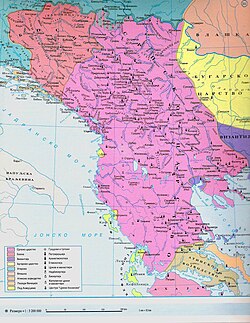

 — Preceding unsigned comment added by Serbian1331 (talk • contribs) 21:30, 22 August 2024 (UTC)
