
Talk:Proxima Centauri b
| This is the talk page for discussing improvements to the Proxima Centauri b article. This is not a forum for general discussion of the subject of the article. |
Article policies
|
| Find sources: Google (books · news · scholar · free images · WP refs) · FENS · JSTOR · TWL |
| Archives: 1, 2 |
 | This article is written in British English with Oxford spelling (colour, realize, organization, analyse; note that -ize is used instead of -ise) and some terms may be different or absent from other varieties of English. According to the relevant style guide, this should not be changed without broad consensus. |
 | Proxima Centauri b has been listed as one of the Natural sciences good articles under the good article criteria. If you can improve it further, please do so. If it no longer meets these criteria, you can reassess it. | |||||||||||||||||||||
| ||||||||||||||||||||||

| This  level-5 vital article is rated GA-class on Wikipedia's content assessment scale. level-5 vital article is rated GA-class on Wikipedia's content assessment scale.It is of interest to the following WikiProjects: | |||||||||||||
| ||||||||||||||
.jpg)


 | The following reference(s) may be useful when improving this article in the future: |
New images from James Webb
edithttps://science.nasa.gov/resource/proxima-b-3d-model and https://science.nasa.gov/wp-content/uploads/2023/09/proxima_b_th.jpg?w=480 etc.
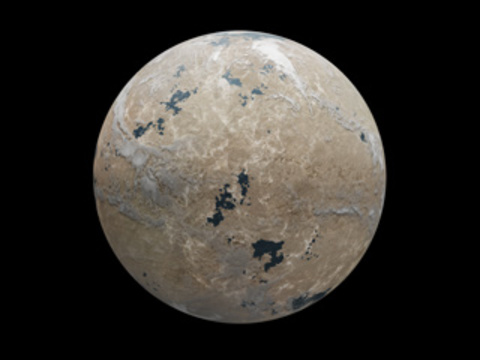
Can someone update the hypothetical pic from this article please. I don't know enough about public domain images to do it myself. Sandman1142 (talk) 20:30, 14 October 2024 (UTC)
- That's just an artist's impression, there are already some in the article. SevenSpheres (talk) 20:40, 14 October 2024 (UTC)
The exoplanet's proximity to Earth offers an opportunity for robotic space exploration.
editShould we add density?
editBecause we know its size* and its mass, so should we add density? Fred1000000000 (talk) 05:56, 26 May 2025 (UTC)
- Mass** Fred1000000000 (talk) 05:57, 26 May 2025 (UTC)
- I have also calculated the density witch is 7.1072138165419 g/cm Fred1000000000 (talk) 06:23, 26 May 2025 (UTC)
- (if it’s mass is 1.07 earth masses and 0.94 earth radius) Fred1000000000 (talk) 07:12, 26 May 2025 (UTC)
- We don't know its size; the values given are based on assumed compositions. 21 Andromedae (talk) 18:11, 26 May 2025 (UTC)
- (if it’s mass is 1.07 earth masses and 0.94 earth radius) Fred1000000000 (talk) 07:12, 26 May 2025 (UTC)
- No, that would be highly misleading. There is no radius measurement so the density is unknown. The article lists a range of plausible radii. SevenSpheres (talk) 16:40, 26 May 2025 (UTC)
"dubious" in View from Proxima b
edit@Renerpho: A statement has been tagged as dubious, From the surface of Proxima Centauri b, the binary stars Alpha Centauri would be considerably brighter than Venus is from Earth,
with a reason Venus reaches an apparent magnitude of −4.92, which is not "considerably fainter" than −5.2
. I'll comment that each of A and B would be brighter than Venus at maximum brightness, and A at -6.8 would be considerably brighter than we ever see Venus (about 5 times brighter). The pair would be spectacular in the night sky. Tarl N. (discuss) 03:16, 4 May 2026 (UTC)
- @Tarl N.: No doubt about component A, or the pair together. The problem specifically is B, which is very close in brightness to Venus at maximum.
- We could avoid the problem by using the comparison to Sirius (the brightest star in our night sky) given in our other source. Quote from there:
At a distance of just 0.21 light years, they would have a brightness of -6.8 and -5.2 magnitudes, respectively, meaning they're 140 and 30 times brighter than Sirius, the brightest star in our night sky. They would appear separated by about 0.3 degrees from one another on the sky, or about half the diameter of the full Moon.
That source also has the advantage of being much more accessible. (The other source is in German and is not available online.) Renerpho (talk) 08:42, 4 May 2026 (UTC)- How about we re-word it to:
- From the surface of Proxima Centauri b, the
two components of
Alpha Centauri wouldeach
be brighter than themaximum brightness of
Venus seen from Earth.
- From the surface of Proxima Centauri b, the
- I feel the comparison to Venus is more apt than the comparison to Sirius, both because of closer resemblance and familiarity. Most non-astronomers have probably never seen (or at least identified) Sirius, while most will have at some point seen a brilliant Venus in the evening sky. Tarl N. (discuss) 21:46, 4 May 2026 (UTC)
- Sounds like "considerably" is the problem? I mean, -4.92 is fainter than -5.2. To be clear, the source says
Von diesem Planeten würde man α und β Centauri als helle Sterne, viel heller als Venus am Himmel sehen.
which translates toFrom this planet alpha and beta Centauri would be bright stars, much brighter than Venus in the sky.
Jo-Jo Eumerus (talk) 12:54, 6 May 2026 (UTC)
- Sounds like "considerably" is the problem? I mean, -4.92 is fainter than -5.2. To be clear, the source says
- How about we re-word it to: