
Talk:Istanbul/Archive 12
 | This is an archive of past discussions about Istanbul. Do not edit the contents of this page. If you wish to start a new discussion or revive an old one, please do so on the current talk page. |
| Archive 5 | ← | Archive 10 | Archive 11 | Archive 12 |
Name
It's Constantinople (Κωνσταντινούπολη), not Instabul. 46.177.152.130 (talk) 14:04, 23 November 2024 (UTC)
- Absolutely not. The name of the city is Istanbul. Constantinople is the old name, that is no longer used in English to refer to the modern city of Istanbul. 81.173.126.239 (talk) 22:54, 30 November 2024 (UTC)
Semi-protected edit request on 30 November 2024
 | This edit request to Istanbul has been answered. Set the |answered= parameter to no to reactivate your request. |
Change "Constantinople" to "Istanbul". Constantinople is not the official name of the city, Istanbul is. 81.173.126.239 (talk) 22:50, 30 November 2024 (UTC)
 Not done: it's not clear what changes you want to be made. Please mention the specific changes in a "change X to Y" format and provide a reliable source if appropriate. There are 47 instances of Constantinople in the article; which text is to be changed? LizardJr8 (talk) 00:25, 1 December 2024 (UTC)
image improvements
can somebody replace the 'topkapi palace' with dolmabahce palace? topkapi is also visible in the first picture, the 'historical peninsula' one, so it can be mentioned there. also, it's worth mentioning the yalıs in the last picture, the one with the ortakoy mosque. 83.9.117.65 (talk) 20:39, 26 December 2024 (UTC)
Citation style change
Unless no objections, I'd like to change the citation style of this article to match Turkey. Short inline citation format for books and long reports with {{cite book}} and {{cite report}} templates. Full inline citations for everything else, such as newspaper articles. {{harvc}} for book chapters.
Turkey has much better sourcing than this article that can be used in several sections, such as history. Bogazicili (talk) 17:13, 20 May 2025 (UTC)
Returning the lead largely back to the FA version
Last year, we discussed returning the lead largely back to the FA promotion version: Talk:Istanbul/Archive_11#Too_much_toponomy_and_history_in_the_lead?
There was agreement, but it seems none of us got around to it. Is there still agreement to revert back to the FA promotion version, followed by several changes to update the text (and various other changes)?
Pinging people who have commented on the now-archived topic: @Chidgk1, Licks-rocks, and Remsense: Bogazicili (talk) 18:54, 27 February 2025 (UTC)
- It should be mentioned that it was founded by Greek settlers from Megara, as that is not "too much history and toponymy". On the other hand, the mention of the attempt to host the 2020 Olympics is really lede material. Khirurg (talk) 20:39, 27 February 2025 (UTC)
- Mention Constantine the Great and that he moved the capital of the Roman Empire there is also probably due. Khirurg (talk) 20:42, 27 February 2025 (UTC)
- I don’t have an opinion on that but given the size and wealth of the city maybe someone who lives there might have the time and energy to make some improvements to the whole article and then nominate it as a good article. I find good article reviewers almost always make excellent suggestions. Chidgk1 (talk) 09:57, 28 February 2025 (UTC)
- I might start improving this article for GA status later this year or next year after I'm done with Turkey.
- But restoring sections to FA version would make the work easier, as it establishes a good template in terms of WP:DUE etc. Updating parts of the article is easier than writing from scratch. Bogazicili (talk) 16:42, 1 March 2025 (UTC)
- Changes made. Bogazicili (talk) 17:12, 20 May 2025 (UTC)
- The lead is now much more in line with MOS:LEAD and MOS:LEADREL. Entire sections were previously ignored in the lead, such as climate, earthquakes, education, etc
- I used large parts from the FA promotion version.
- I also looked at WP:Tertiary sources for MOS:LEADREL and WP:PROPORTION, such as the Istanbul entry in The Wiley Blackwell Encyclopedia of Urban and Regional Studies Bogazicili (talk) 17:22, 20 May 2025 (UTC)
Istanbul vulnerable to earthquakes
I removed the part that mentions that the city is vulnerable to earthquakes on the lead section. Not only does it not fit there due to the fact that it suddenly goes from sports clubs to earthquakes, its also due to the fact that no other earthquake vulnerable or natural disaster prone cities, like Tokyo, Los Angeles and Athens, have anything mentioned on their own lead sections like this here. Its already fully writing down below at the Geography and environment section. Woxic1589 (talk) 00:10, 14 June 2025 (UTC)
- @Woxic1589: see WP:otherstuffexists.
- The relevant policy here are MOS:LEADREL and WP:PROPORTION. Earthquake risks are mentioned in considerable length in WP:Tertiary source, the Istanbul entry in The Wiley Blackwell Encyclopedia of Urban and Regional Studies.
- The lead is supposed to repeat what the body says, so not sure what you mean by "Its already fully writing down below at the Geography and environment section". Everything in the lead should be explained by the body in detail. That's not a reason for deleting parts of the lead.
- Per WP:ONUS, consensus is needed for adding material. However, if you want to remove sourced material, you still need a valid reason per WP:PAGs. "Its already fully writing down below at the Geography and environment section" is not a valid reason.
- Do you have a valid reason per WP:PAGs for removing the first row? Then you can remove it per WP:ONUS. However removal of sourced content without a valid reason could also be problematic. If you disagree, you can proceed to Wikipedia:Dispute resolution. Bogazicili (talk) 18:34, 14 June 2025 (UTC)
- I don’t think you get my point at all. You suddenly go from ‘’The city hosts a large part of Turkish football and sports in general, with clubs such as Galatasaray, Fenerbahçeand Beşiktaş.’’ to ‘’ Istanbul is vulnerable to earthquakes as it is in close proximity to the North Anatolian Fault.’’. Thats NOT a great lay out at all and makes the lead look forced. As if you try to prop in as much as information as possible.
- It needs to be either moved to somewhere else or just deleted like how I did it. You also didn’t explain why the pages of Los Angeles and Athens don’t have anything like that mentioned on their own lead sections. It just makes no sense. Woxic1589 (talk) 20:48, 14 June 2025 (UTC)
- I really do not care what Los Angeles and Athens say.
- While it's ok to look at other Wikipedia article for hints, content is not defined by other Wikipedia articles. This is why I linked WP:OTHERSTUFFEXISTS. Also see Wikipedia:When to use or avoid "other stuff exists" arguments
- Los Angeles and Athens are not even WP:GA or WP:FA, they are not even good examples in Wikipedia to begin with. And I have no idea what tertiary sources about those articles say.
- WP:Lead:
The lead section is an introduction to an article and a summary of its most important contents
. Earthquake vulnerability is an important content, per the source above. Bogazicili (talk) 18:15, 15 June 2025 (UTC)- You again skip a important part of my argument about the fact that: You suddenly go from ‘’The city hosts a large part of Turkish football and sports in general, with clubs such as Galatasaray, Fenerbahçe and Beşiktaş.’’ to ‘’ Istanbul is vulnerable to earthquakes as it is in close proximity to the North Anatolian Fault.’’. How is this a good looking page then? You are forcing in as much as information as possible to the lead section and completely forget about the lay out of it. Woxic1589 (talk) 19:44, 15 June 2025 (UTC)
- There is not enough space in the lead to have a dedicated paragraph for every topic. A single paragraph can cover multiple topics. Last paragraph in the lead is about economy and modern-day issues and information. We can rearrange the sentences in the last paragraph. Bogazicili (talk) 15:11, 20 June 2025 (UTC)
- You again skip a important part of my argument about the fact that: You suddenly go from ‘’The city hosts a large part of Turkish football and sports in general, with clubs such as Galatasaray, Fenerbahçe and Beşiktaş.’’ to ‘’ Istanbul is vulnerable to earthquakes as it is in close proximity to the North Anatolian Fault.’’. How is this a good looking page then? You are forcing in as much as information as possible to the lead section and completely forget about the lay out of it. Woxic1589 (talk) 19:44, 15 June 2025 (UTC)
Restoring parts of FA version of the article
As I edit the article, it might be easier to simply revert parts of the article back to the FA promotion version, especially parts such as History and Architecture sections.
Much easier to update from the FA version. Bogazicili (talk) 18:53, 22 June 2025 (UTC)
- possible edits by this sock https://en.wikipedia.org/wiki/Wikipedia:Sockpuppet_investigations/Shuppiluliuma Shadow4dark (talk) 19:03, 22 June 2025 (UTC)
The article is ridiculous, there is random info about Industrial Revolution in Istanbul#Istanbul_Metropolitan_Municipality.
I'll be reverting the following sections for starters
- Entire history
- Cityscape. The current version has sources such as commercial websites, like propin.com.tr
Other sections will be trimmed and might be reverted too. Bogazicili (talk) 20:58, 23 June 2025 (UTC)
Climate section
I'll remove this source and rewrite the first paragraph. If you want to re-add this source, please ask if it's reliable in WP:RSN. It seems quite dated. Bogazicili (talk) 20:15, 30 July 2025 (UTC)
- I'll rewrite now, and you can check. I will not use the MGM source, and instead I will use the sources you have provided and/or haven't objected to. Uness232 (talk) 22:08, 30 July 2025 (UTC)
- I haven't looked at the sources for the wording, WP:CLOP, etc, but the sourcing looks great when I quickly looked at them. Thanks for this!
- This article is also a great find. It's open source, so we can use its high quality maps in multiple Turkey-related articles. Bogazicili (talk) 05:31, 31 July 2025 (UTC)
Removal of sourced information
Uness232, what is your rationale for this edit ?
About as horrible of an idea as it gets
is not an adequate explanation per WP:PAGs when it comes to sourced information.
This is what the source says, Landscapes and Landforms of Turkey p. 250:
İstanbul has a modified Mediterranean climate (Csa in the Köppen–Geiger climate classification) that is both wetter (humid subtropical: Cfa) and stormier (oceanic: Cfb) because of its distance to the Mediterranean and the influence of the two seas bordering it although the cyclones mostly move in from the west.
Bogazicili (talk) 18:37, 20 July 2025 (UTC)
- We can rephrase above as "Istanbul's climate is a stormier and wetter Mediterranean climate." Was that your concern? Bogazicili (talk) 20:44, 20 July 2025 (UTC)
- Mediterranean alone is simply not an applicable term for Istanbul. Köppen defines Mediterranean climates with either 30mm or 40mm for a dry summer month. Most of the city falls above the 30mm threshold and below the 40mm one, so a simple Mediterranean designation is impossible. Also the source is wrong: oceanic climates have to do with summer temperature per Köppen, and has nothing to do with "storminess". Technically Cfa climates are often the stormier of the Cfx climates.
- Istanbul has regions that fit into all of the three, but most of the city falls into the Cfa range if a 30mm threshold is used, which is more common in Turkey. Uness232 (talk) 21:27, 20 July 2025 (UTC)
- Also per WP:LEDE, complicated and nuanced information like this is not necessary in the lede. Uness232 (talk) 21:38, 20 July 2025 (UTC)
- Please provide sources for claims above, about Istanbul's climate. I have shared more sources in Talk:Climate_of_Istanbul#Low_quality_or_outdated_sources_in_the_article.
- Per WP:LEAD, we should provide a summary. I think that includes saying a sentence about climate. I really don't see the "complicated and nuanced" part in newer sources, Istanbul's climate is generally described as Mediterranean.
- I can reword the sentence in the lead to:
Istanbul's climate is generally considered a form of Mediterranean climate p. 250 that is stormier and wetter.p. 250
- Or if you insist, you can remove the current sentence in the lead, and we can proceed to WP:DR. Bogazicili (talk) 19:06, 21 July 2025 (UTC)
- @Bogazicili
- If you really need sources directly spelling it out:
- Peel et al, depending on the version used, considers Istanbul humid subtropical. This paper considers Istanbul the example for humid subtropical climates in the Middle East. The newly updated (from 2023) article of the Alisov classification lists Istanbul's area as PmSm; the Köppen equivalence of which is Cfb (Oceanic) and Dfb (Humid continental). The demarcation for Mediterranean (Csa, Csb) is SmSm, and is nowhere to be found near Istanbul. This article refers to Istanbul's climate as humid temperate. Strahler (unfortunately no link to this one) also refers to Istanbul as a marine west coast climate in his book. So yes, even by your metrics, it always was and remains a nuanced and complicated issue.
- But I'd argue we need none of that, due to a concept called empirical climate classification. Empirical climate classifications (rather than genetic) use set, replicable rules for finding climates that Wikipedians can replicate using WP:CALC. The most common one of these is the Köppen climate classification system, which we use in every major city article (see New York, Tokyo, Ankara, London etc.) The rule for Mediterranean in Köppen is, depending on the source, either:
- "Temperature of warmest month greater than or equal to 10 °C, and temperature of coldest month less than 18 °C but greater than –3 °C, precipitation in driest month of summer half of the year is less than 30 mm and less than one-third of the wettest month of the winter half"
- or
- (paraphrased to match first source) Temperature of warmest month greater than or equal to 10 °C, and temperature of coldest month less than 18 °C but greater than 0 °C, precipitation in driest month of summer half of the year is less than 40 mm and less than one-third of the wettest month of the winter half
- .
- We can see through MGM and NOAA (accessible through the weather boxes in the Climate of Istanbul page) data that most places in Istanbul do not have a summer month drier than 30mm, but do have a summer month drier than 40mm, which is why the divergence exists. Depending on the criteria used, most of the city becomes Mediterranean (Csa/Csb) or oceanic and humid subtropical (Cfa/Cfb); henceforth it is transitional. This is verifiable data that is verified through the rules of Köppen, a weatherbox and routine calculation, and often overrides singular expert statements in Wikipedia because almost all climate pages use Köppen (see oceanic, humid subtropical, continental). You can protest against this (as I have), but this is the status quo.
- As you can see, this is a complicated issue, and it should not be summarized in the lede this way. If it is to be summarized, it should incorporate all three climate zones. Uness232 (talk) 23:11, 21 July 2025 (UTC)
- Thanks for providing sources, I undid my edit.
- Now that we have several sources, we can get more granular and apply another concept, WP:RSCONTEXT:
Each source must be carefully weighed to judge whether it is reliable for the statement being made in the Wikipedia article and is an appropriate source for that content
- If you want to make a claim about Istanbul's climate, it should come from someone with expertise in climate. This is similar to the fact that if you want to add medical content into Wikipedia, it should come from medical experts, not from random people in other fields.
- For example, this source you shared is authored by people that are not experts in climate. Affiliation of its authors are Faculty of Architecture and Urban Planning, School of Mechanical & Materials Engineering, and Mechanical Engineering Department. Similar situation with another source you shared: (Department of Architecture).
- The source I shared above The Geology and Geomorphology of İstanbul in Landscapes and Landforms of Turkey is authored by Celâl Şengör & Tayfun Kındap.
- Tayfun Kındap seems to be an expert in climate .
- Look at the authors of the other study I shared in Talk:Climate_of_Istanbul#Low_quality_or_outdated_sources_in_the_article: . Its authors are from Department of Meteorological Engineering.
- I highly doubt WP:CALC applies to climate type. Even if the formulas may be simple, there may be other factors with data collection that climate experts contribute. You can ask that in WP:NORN
- But given the sources about Alisov classification etc above, this is what I'd suggest:
Under Köppen climate classification, Istanbul's climate is considered a form of Mediterranean climate, with aspects of other temperate climate types.p. 250
- This still can be verified by the quote above, and I don't think it conflicts with any of the sources you shared. Temperate climate includes Cfa or Cfb. What do you think? Bogazicili (talk) 17:24, 22 July 2025 (UTC)
- Another option would be to paraphrase below:
Winters are typically cold and wet, while summers are hot and humid; the average temperature ranges between approximately 24 °C in summer and 5–10 °C in winter.
- This would add something about the climate into the lead without getting into climate types. Bogazicili (talk) 17:39, 22 July 2025 (UTC)
- I would not like to argue the granularity of source quality for expert statements (for the two articles you objected to, I see your point, however Alisov, Peel et. al., and Strahler sources still demonstrate my point nicely), neither am I interested in arguing at length whether finding climate type is WP:CALC. Short answer to the latter though:
- There may be other factors with data collection that climate experts contribute.
- There really isn't, which is why practically every major city page uses Köppen rules and WP:CALC for climate type, not expert statements. Look at some list at lists of cities and you will see.
- Anyway, your first wording is still inaccurate, as Under Köppen climate classification, Istanbul's climate is considered a form of Mediterranean climate is wrong. Under Köppen's classification, as I demonstrated above, Istanbul has equal stakes to all three climate zones, depending on variant. Peel et. al. uses Köppen after all.
- The second compromise wording seems nice, although I would omit the temperature ranges and descriptors. The former because they conflict with our NOAA source (see the climate section in the article), and the latter because cold and hot are highly subjective, and from a global perspective, Istanbul's summers are not that hot (today's the exception if you happen to live nearby), and neither are its winters that cold. I suggest the following:
- Istanbul experiences summers with high humidity, and frequent precipitation between October and March.
- All of this is in the source, does not conflict with any of our other sources, and is hard to challenge. It is also appropriately short per WP:DUE; most cities have nothing in the lede for their climate, and Istanbul really does not have the extremes to justify something longer in my opinion. Uness232 (talk) 06:56, 23 July 2025 (UTC)
- Peel et al is OLD. It's from 2007. That's almost 20 years. You didn't provide a link from Strahler. What year is that from?
- Once again, please note WP:AGE MATTERS. This is especially important given climate change. Istanbul's climate will be even more typical Mediterranean due to climate change p. 6
- Do you have a recent high quality source that "Under Köppen's classification, as I demonstrated above, Istanbul has equal stakes to all three climate zones"? Bogazicili (talk) 16:37, 25 July 2025 (UTC)
- The recent high quality sources are the rules of Köppen and the weatherbox information cited from NOAA, and the resulting WP:CALC. This is how it works in every climate page; there's no expert statement in London, none in Bucharest, none in Moscow, none in NYC, none in Antalya, etc. I can go on. On Wikipedia, we calculate Köppen weather types using the rules of Köppen (ideally relaiably sourced), and the reliably sourced weatherbox info provided in the article. Until we get through this issue, I am done arguing. Uness232 (talk) 17:26, 25 July 2025 (UTC)
On Wikipedia, we calculate Köppen weather types
- Who's this "we"? Was there a RfC or something similar about this?
- Can you explain your methodology again?
- 1) You use Britannica definition of Köppen climates?
- 2) You use NOAA data.
- Is that it? WP:ONUS seems to be on you that this is not WP:OR. That was why I suggested asking it in WP:NORN. This is especially important since the calculation you claim is contradicted by multiple reliable sources. Bogazicili (talk) 17:34, 25 July 2025 (UTC)
- We, the community of Wikipedians. Not an ironclad argument I'm aware, but all I'm saying is that by purporting that this may be WP:OR, you are making an argument with very far reaching consequences: you're basically claiming that almost all climate sections on Wikipedia are WP:OR, and generally speaking that's not a good argument to have in a single article page, if at all.
- Secondly, that's not what WP:ONUS means. If you mean WP:BURDEN, that still doesn't apply. There was a bold edit, I reverted it, and now we are discussing it. I am not the one inserting new contentious material.
- 'My methodology' does not involve Britannica or NOAA data necessarily, and is also not mine. It is the one used to calculate climate types all over Wikipedia. I have not seen many city articles with expert statements verifying their climate zone; instead most Wikipedians do this. I also did not insert any claim of three climate types into this article. That was years before I started editing.
- The argument therefore is as such:
- If,
- 1) The editor cites the rules of climate zone calculation in a way that anyone can verify;
- 2) The editor also has reliably sourced data in the article of the climate data required for the calculation;
- There should be no argument of WP:OR or WP:SYNTH, because nothing has been synthesized that can not directly be calculated from the two sources. In fact, I believe you should verify these calculations yourself, using the rule-source and the weatherbox in the article. I am actually wondering what your result will be.
- If you still have a problem with this, you can definitely argue against it in another venue. I have, at times, proposed alternatives to this method, actually, but that went nowhere. I am therefore not interested in starting that, though I would most definitely join discussions related to such a proposal.
- By the way, believe it or not, none of the Köppen sources, neither mine, nor yours, contradict each other. If you look at your sources, you will see that all of them use the 40mm threshold for differentiating Cs and Cf climates, and indeed if 40mm is used Istanbul is almost entirely Mediterranean. If not and we use 30mm (which is a threshold also supported by reliable sources), Istanbul suddenly becomes mostly humid subtropical. Uness232 (talk) 18:14, 25 July 2025 (UTC)
- Yes, if what you are saying true, climate parts of large number of articles in Wikipedia may be WP:OR
- As you can see in the methodology of this study , it's not as straightforward as using random and limited NOAA data:
2.2 Data sets
ERA5-Land is a reanalysis data set providing an accurate description of the climate of the past, created by the European Centre for Medium-Range Weather Forecasts. It has been produced by replaying the land component of the ERA5 climate reanalysis, at an enhanced horizontal resolution of 0.1° × 0.1° (i.e., native spatial resolution is 9 km) and hourly temporal resolution (Muñoz Sabater, 2019). Reanalysis combines model data with observations from across the world into a globally complete and consistent data set using the laws of physics, and it produces data that goes several decades back in time. The ERA5-Land data set, as with any other simulation, provides estimates that have some degree of uncertainty that grows as we go back in time, because the number of available observations is lower.
E-OBS is a daily gridded land-only observational data set over Europe, with horizontal resolution of 0.1° × 0.1°. The blended time series from the station network of the European Climate Assessment & Dataset (ECA&D) project forms the basis for the E-OBS gridded data set (Cornes et al., 2018). All station data are sourced directly from the European National Meteorological and Hydrological Services or other data-holding institutions. The observations cover 24 h per time step, but the exact period can be different per region and the reason for this is that some data providers measure from midnight to midnight while others might measure from morning to morning. However, it is made sure that the largest part of the measured 24-h period corresponds to the day attached to the time step in E-OBS. While it remains an important data set for the validation of climate models, E-OBS is also used more generally for monitoring the climate across Europe.
In this study, we used both ERA5-Land and E-OBS climate data sets, from 1961 to 2020, for Southeastern Europe.- Assessing the climate type of an area is not a Routine calculation
- Do you have any RfC where such climate type calculations were considered routine? Bogazicili (talk) 18:47, 27 July 2025 (UTC)
- Changing venue; my answer is at Wikipedia:No original research/Noticeboard Uness232 (talk) 10:15, 28 July 2025 (UTC)
- The recent high quality sources are the rules of Köppen and the weatherbox information cited from NOAA, and the resulting WP:CALC. This is how it works in every climate page; there's no expert statement in London, none in Bucharest, none in Moscow, none in NYC, none in Antalya, etc. I can go on. On Wikipedia, we calculate Köppen weather types using the rules of Köppen (ideally relaiably sourced), and the reliably sourced weatherbox info provided in the article. Until we get through this issue, I am done arguing. Uness232 (talk) 17:26, 25 July 2025 (UTC)
- The data in Peel et al is even older:
Long-term station records of monthly precipitation and monthly temperature were obtained from the Global Historical Climatology Network (GHCN) version 2.0 dataset (Peterson and Vose, 1997).
- And even in Peel et al, Istanbul is shown completely in Csa. See: page 471 Bogazicili (talk) 16:52, 25 July 2025 (UTC)
Uness232, below is my proposal again:
Under Köppen climate classification, Istanbul's climate is considered a form of Mediterranean climate, with aspects of other temperate climate types.p. 250
Do you have any sources that contradict this?
I don't want to get into your personal calculations (or whether you used 30mm or 40mm) as discussed in Wikipedia:No_original_research/Noticeboard#Editor_claims_Köppen_climate_classification_is_WP:CALC. Please only provide reliable sources in line with WP:RSCONTEXT if you have any. Thank you. Bogazicili (talk) 18:14, 29 July 2025 (UTC)
- I am not interested in continuing this discussion here if you're dismissing the most common way of finding climate types on Wikipedia before the discussion on NORN is over. I oppose the change for now, and that's all I will say. Uness232 (talk) 21:35, 29 July 2025 (UTC)
- Uness232, I'll proceed to WP:DR. You did not provide any source, can you please confirm you oppose the change because of your personal calculations? Bogazicili (talk) 19:58, 30 July 2025 (UTC)
- I do confirm this, although I disagree with your framing of this as 'personal calculations'. Nothing I do was done with a personal method. However, I am not in a place to argue on DR, and I will simply yield to you about this wording: Under Köppen climate classification, Istanbul's climate is considered a form of Mediterranean climate, with aspects of other temperate climate types.
- I do not believe this is a fair representation of the sources, but I have no energy to argue otherwise. I could very well dig for sources but again, I am not interested in that anymore. Uness232 (talk) 21:49, 30 July 2025 (UTC)
- I actually don't care what Istanbul's Köppen climate classification is. I was only annoyed at the original research part, and rejection of reliable sources based on WP:CALC claims.
- Ideally, the lead should have something short for climate. I don't care what it is as long as it is sourced with high quality sources and is concise.
- If you find high quality sources that contradict that wording, you can always change it. Bogazicili (talk) 05:33, 31 July 2025 (UTC)
- Added Bogazicili (talk) 19:35, 3 September 2025 (UTC)
- Uness232, did you read the source (page 250 in the source given) before you made this change? Bogazicili (talk) 19:11, 9 September 2025 (UTC)
- My mistake. I meant to use another source, not that one. Thanks for pointing it out! Uness232 (talk) 19:19, 9 September 2025 (UTC)
- Uness232, You claimed Köppen is WP:UNDUE, but it is in a source that can be considered an overview WP:Secondary source for Istanbul's climate and geography: The Geology and Geomorphology of İstanbul. It's not like there were several climate classifications there and I randomly picked Köppen
- This is what the source you added says
Although the climatic structure varies regionally due to the influence of the Marmara Sea and the Bosphorus, the city has a Mediterranean climate. Winters are typically cold and wet, while summers are hot and humid; the average temperature ranges between approximately 24 °C in summer and 5–10 °C in winter. The total annual long-term precipitation is 677 mm, observed to be intense between October and March
- whereas you added:
Istanbul's climate features moderate temperatures, high humidity in summer and frequent winter precipitation
- The source says summers are hot and humid, whereas you said "moderate temperatures"
- The source says precipitation "between October and March". This is not only winter
- Even the source you picked says "the city has a Mediterranean climate"
- In short, I think your edit was problematic. It misrepresents the source and omits Mediterranean climate part. Bogazicili (talk) 20:30, 9 September 2025 (UTC)
- @Bogazicili I do not believe that mentioning the word Mediterranean in the lede is a good idea. What you have may be an overview secondary source, but there are plenty of other secondary sources using other climate classifications. I have detailed these in the climate section as per your request, and putting one in the lede when there are many competing 'terminologies' so to speak is a bad idea. In the same vein; we could do this exact same process for Seattle or Portland, Oregon, two other cities that have Mediterranean climates according to Köppen, but this would rightfully face a lot of backlash, because Köppen's Mediterranean zone (especially when the 40mm line is used) extends to places far beyond what many other climatologists consider Mediterranean, as seen in this case, in Portland's case, and in Seattle's case. Furthermore:
- On moderate temperatures: The main factor of the regional climate here is the proximity of the territory to large bodies of water that surround it from the north (the Black Sea), from the south (the Sea of Marmara), and through the Bosphorus Strait. This has a moderating effect on the local climate, which takes on maritime features similar to the Mediterranean climate. If you think closer paraphraasing is needed, I can change moderate to maritime, but that could be mistaken for maritime climate. I can also say hot summers and cold winters, but this would conflict well... common sense. Istanbul's winters are, in a global scale, not that cold, and neither are its summers that hot. For a global encylopedia it's hardly fitting. But if you really wish to include it, we can go with that strict wording.
- On winter precipitation: 'winter' commonly means 'the winter half-year' (6 colder months of the year) in climatology. Granted, it would be misleading to the average reader except the source also says winters are typically cold and wet. If you want to, I can specify October-March.
- One the fact that the source says Mediterranean: I'm not making a claim one way or another about Istanbul's climate type. I didn't say it wasn't Mediterranean. I simply said that that's not lede material for a city as transitional as Istanbul, and the fact that my source takes a certain stance on that means close to nothing. More 'controversial', less 'straightforward' material in a source can be elided in a lede. That's not misrepresenting.
- Uness232 (talk) 22:02, 9 September 2025 (UTC)
- October and March is not winter. Hot summer is not "moderate temperatures". "moderating effect on the local climate, which takes on maritime features" does not mean "moderate temperatures".
- I do think your wording misrepresents the source. Maybe we should proceed with WP:Dispute resolution. You had agreed to the earlier wording and now you changed your mind.
- For now I am removing your addition into the lead per WP:NOR. Bogazicili (talk) 22:07, 9 September 2025 (UTC)
- Uness232, can you find me an overview WP:Secondary source about Istanbul's climate or geography or Istanbul in general that mentions other climate classifications other than Köppen? Bogazicili (talk) 22:10, 9 September 2025 (UTC)
- Uness232, other climate classifications in climate section are from sources such as , and . These are not overview secondary sources about Istanbul or Istanbul's climate.
- Unless you find these in a source about Istanbul or Istanbul's climate, these other classifications are UNDUE in the lead. Köppen climate classification is simply the most widely used one :
The Köppen climate classification system is the most widely used and understood classification.
- It is included in overview secondary sources about Istanbul's geography. Bogazicili (talk) 22:16, 9 September 2025 (UTC)
- @Bogazicili I reinstated your wording. I do believe something is to be said about your style of argumentation, and your refusal to entertain a point. I had changed my mind simply because I thought I had the strength to argue, but the way you pedantically swerve around things like October and March is not winter. Hot summer is not "moderate temperatures". when I have pointed out numerous points of compromise regarding the potential issues with my wording is frankly not bearable. I also do not appreciate challenges being thrown at me as if this was a political debate. I am trying to put forward my best argument for the betterment of the encylopedia, and yes sometimes my approach is a little WP:IAR-ish, but frankly I do not see a person trying to understand my concern for the encylopedia on the other side, and I haven't for the majority of this Istanbul climate debate. Uness232 (talk) 22:27, 9 September 2025 (UTC)
- I read your arguments but disagreed with them. It didn't make sense to me in terms of sourcing (overview secondary about Istanbul or its geography) and what the sources say. Two people can disagree.
- If you do not feel comfortable, we can simply proceed to WP:DR, such as an RfC so other people can comment as well. That's the whole point of dispute resolution. When two people are stuck in discussion, more people can comment. Bogazicili (talk) 22:33, 9 September 2025 (UTC)
- The only reason I asked multiple times if you want WP:DR is WP:RFCBEFORE. Things like RfCs are time-consuming so I was asking if you are OK with proceeding to DR.
- We could have tried 3rd opinion too, but previously we had discussed some of this at: Wikipedia:No_original_research/Noticeboard/Archive_54#Editor_claims_Köppen_climate_classification_is_WP:CALC Bogazicili (talk) 22:39, 9 September 2025 (UTC)
- @Bogazicili No need. I am sure you have read them, and perhaps I am mistaken about my claims on your lack of interest in productive compromise, or maybe not. I don't know. Either way, my issue is not disagreement itself, but how that disagreement has taken shape, and how it has been treated.
- None of that matters though: I am not the editor I once was, I'll say that much. I still have my opinions, but there's only so much I can contribute, which is why I am not very partial to DR. I won't be able to keep up with it, time-wise, and probably also with your knowledge of policy. You can keep the wording. Uness232 (talk) 22:47, 9 September 2025 (UTC)
- @Bogazicili I reinstated your wording. I do believe something is to be said about your style of argumentation, and your refusal to entertain a point. I had changed my mind simply because I thought I had the strength to argue, but the way you pedantically swerve around things like October and March is not winter. Hot summer is not "moderate temperatures". when I have pointed out numerous points of compromise regarding the potential issues with my wording is frankly not bearable. I also do not appreciate challenges being thrown at me as if this was a political debate. I am trying to put forward my best argument for the betterment of the encylopedia, and yes sometimes my approach is a little WP:IAR-ish, but frankly I do not see a person trying to understand my concern for the encylopedia on the other side, and I haven't for the majority of this Istanbul climate debate. Uness232 (talk) 22:27, 9 September 2025 (UTC)
- @Bogazicili I do not believe that mentioning the word Mediterranean in the lede is a good idea. What you have may be an overview secondary source, but there are plenty of other secondary sources using other climate classifications. I have detailed these in the climate section as per your request, and putting one in the lede when there are many competing 'terminologies' so to speak is a bad idea. In the same vein; we could do this exact same process for Seattle or Portland, Oregon, two other cities that have Mediterranean climates according to Köppen, but this would rightfully face a lot of backlash, because Köppen's Mediterranean zone (especially when the 40mm line is used) extends to places far beyond what many other climatologists consider Mediterranean, as seen in this case, in Portland's case, and in Seattle's case. Furthermore:
- My mistake. I meant to use another source, not that one. Thanks for pointing it out! Uness232 (talk) 19:19, 9 September 2025 (UTC)
- Uness232, I'll proceed to WP:DR. You did not provide any source, can you please confirm you oppose the change because of your personal calculations? Bogazicili (talk) 19:58, 30 July 2025 (UTC)
Panoramic images in the article
Which panoramic image should be used in the article? Or should both be used?
The bottom one pretty much shows the entire city and provides a good overview


.svg)
They were previously in different sections Bogazicili (talk) 19:44, 21 October 2025 (UTC)
- The aerial panoramic image is one of the ugliest pictures of Istanbul I have ever seen, probably because it's brutally honest. It tells us that we have ruined the city (e.g. the hideous reclaimed (filled) land additions in the Yenikapı area, which altered the shoreline of the historical peninsula, against UNESCO's preservation rules). It's better to avoid wide-view aerial panoramas of chaotic cities like Istanbul or Athens, in my opinion. The reality on the ground actually looks better in both cities. PleiadesOrion (talk) 20:16, 21 October 2025 (UTC)
- I actually don't think it's ugly.
- But you seem to admit that
it's brutally honest
. That's exactly what we want per MOS:IMAGERELEVANCE:Images should look like what they are meant to illustrate
- That means it has a clear preference to top image if there is to be one panoramic image based on WP:PAGs. Bogazicili (talk) 20:21, 21 October 2025 (UTC)
- Also keep in mind that Wikipedia is an encyclopedia, it's not a travel website. Bogazicili (talk) 20:24, 21 October 2025 (UTC)
- Just my two cents here; beyond the fact that we are not here to make a travel guide to Istanbul, nor make an argument for the UNESCO-integrity of Istanbul, I genuinely think that this photo is perfectly fine cityscape-wise, perhaps generous to Istanbul even. What I see here is a pretty typical Southern European urbanization pattern, good infrastructure, business districts on the horizon illustrating scale, adequate if not extensive urban green space etc. Go to most of interior Istanbul and I bet you wouldn't be able to find a photo with all of these qualities. Uness232 (talk) 03:15, 22 October 2025 (UTC)
- Okay, case closed. PleiadesOrion (talk) 18:50, 22 October 2025 (UTC)
- And why are you changing Hagia Sophia image when there is a featured one? File:Hagia Sophia Mars 2013.jpg See Wikipedia:Featured pictures. You said "better resolution", but File:Hagia Sophia (228968325).jpeg has lower resolution. Bogazicili (talk) 10:58, 23 October 2025 (UTC)
- Okay, case closed. PleiadesOrion (talk) 18:50, 22 October 2025 (UTC)

.jpeg)
References
- ↑ "Panoramic view of the modern skyline of Istanbul's European side, with the skyscrapers of Levent at the center and the Bosphorus Bridge (1973) at right". Retrieved 2 December 2020.
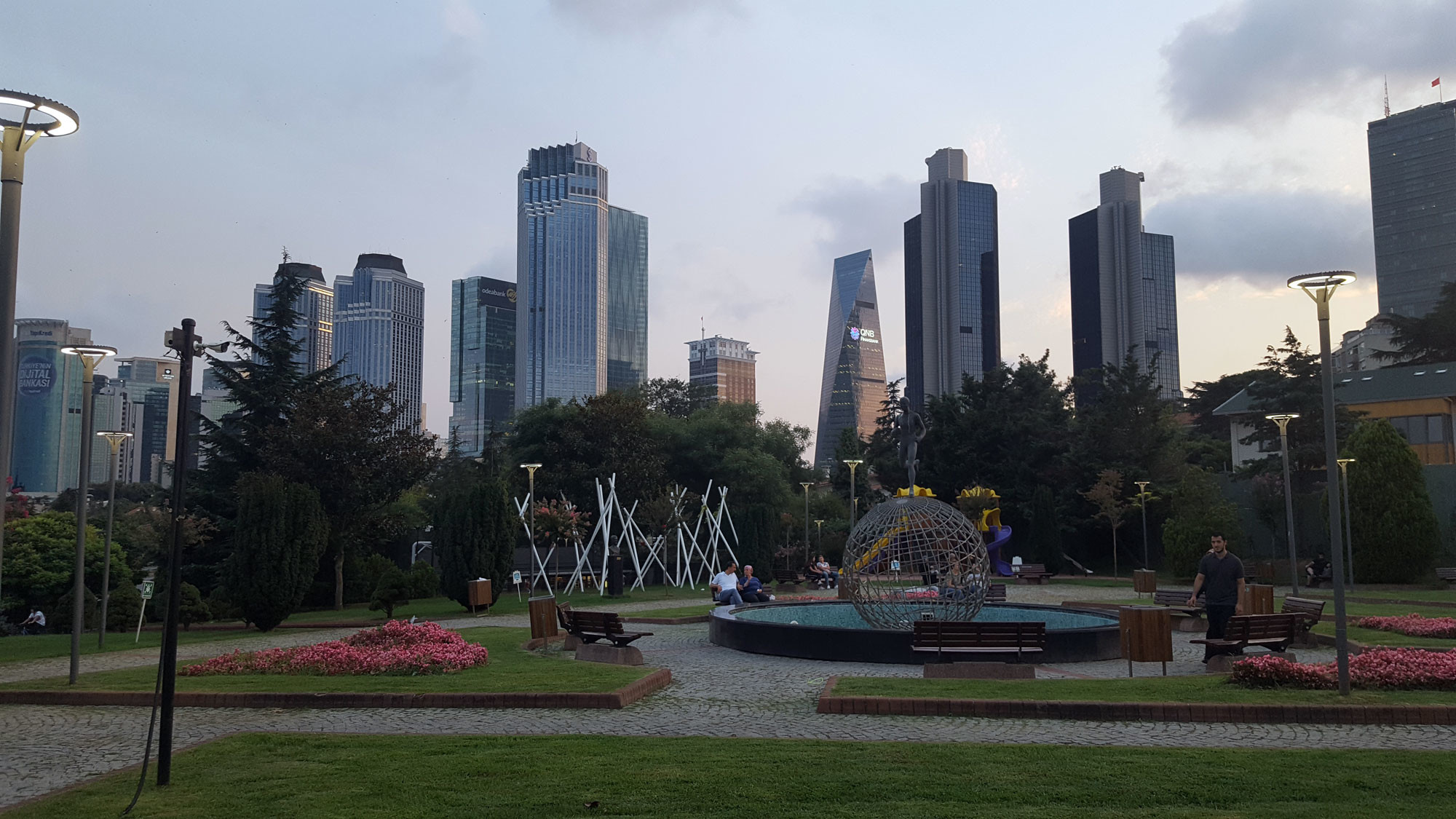
- ↑ "A view of the skyscrapers in Levent from Sporcular Park". Retrieved 2 December 2020.
- ↑ Cite error: The named reference
hisdicwas invoked but never defined (see the help page).

History correction
In the section on the Turkish Republic, the article cites the Istanbul progrom against the Greek as "US-incited".
I could find no reliable information on this allegation. Shouldn't such a strong allegation be removed unless well documented? ~2025-34259-93 (talk) 08:24, 17 November 2025 (UTC)
Arrest of Imamoglu
Why is the arrest of mayor Ekrem Imamoglu not mentioned in the politics section?
Despite having its own WP article?
https://en.wikipedia.org/wiki/Arrest_of_Ekrem_%C4%B0mamo%C4%9Flu ~2025-34259-93 (talk) 08:54, 17 November 2025 (UTC)
Mistake: proper and colloquial pronunciations have been swapped around
At footnote [b] in the first paragraph, it says:
Turkish: İstanbul (Turkish pronunciation: [isˈtanbuɫ] ⓘ, colloquial Turkish pronunciation: [ɯsˈtambuɫ])
However, in the "Names" section, it says:
İstanbul (Ottoman Turkish: استانبول; pronounced [ɯsˈtambuɫ] or colloquially [isˈtanbuɫ] ⓘ)
Both of these cannot be listed as colloquial and proper at the same time. It seems to be that both of them were the first version originally, but one of them was edited to the second one, and the editor didn't notice that the other one had to be changed too. I'm not sure which claim is more accurate, but these should be made consistent again. Not without text (talk) 18:04, 9 December 2025 (UTC)
- Thanks for flagging this! I'm pretty certain the version in the initial footnote (with initial [i] vowel and medial [n] in the formal pronunciation) is the correct one. The other one was swapped earlier this year by an editor who claimed to be "fixing" the pronunciation, but without further explanation or discussion. I've swapped those back. Fut.Perf. ☼ 20:10, 9 December 2025 (UTC)
Still not convinced about climate class mention in first paragraph/lede
I am aware that I have discussed this with @Bogazicili before, which is why I'm shying away from a WP:BOLD edit, but I am still not convinced that we need a mention of Istanbul's climate class in the first paragraph of the lede, and I believe that it is actively hurting and contrasting the nuance of the climate section of the article.
Saying this, I am acknowledging per our previous discussion that per the constraints given by Bogazicili, the statement appears factual enough for Wikipedia; when using the 40mm dividing line between Cs and Cf climates (which most sources now use) Köppen would classify Istanbul as a Mediterranean climate. My intent is not to reignite that part of the debate, as I have four other issues with this wording.
1) The vast majority of city articles have nothing to say about climate in the lede, and even fewer, if any, give climate classifications. Of the 50 "core city" articles, some of which are GA class, none of them make mention of any climate classification, and 48 of them make no mention of climate or weather at all. The two that do, namely San Francisco and Nairobi, mention the especially "mild/temperate climate" of their city only, and give no more detail. I fail to see why this description of Istanbul's climate is necessary per WP:LEDE, especially as no notable or significant part of Istanbul's climate has been singled out, and instead a fact has been thrown randomly into the lede.
2) Even if we are to add something to the lede about climate, Istanbul's climate has very little to single out on a global scale anyway: its temperature is the average temperature of the world, its precipitation is just a tiny bit more than the global average over land, it has four seasons (unlike SF and Nairobi) but none of them are extreme, etc. There is nothing needing mention here.
3) Even as one concedes that under the specific conditions provided by Bogazicili Köppen would classify Istanbul as purely Mediterranean, Köppen would be alone in doing that. As noted by the sources of the climate section of this article, Trewartha puts the city in humid subtropical territory, Alisov considers the city oceanic, and Bohn considers it "sub-continental sub-Mediterranean". In no way is Istanbul a typical Mediterranean climate, in fact nobody agrees on what climate it has, and unlike somewhere like Palermo or İzmir, which are unambiguous cases, shoehorning the word Mediterranean into the lede looks about as nonsensical as when it would be done to Seattle, only because Köppen, and Köppen alone, also classifies Seattle as Mediterranean.
4) The wording of the statement ("aspects of other temperate climate types") is nonsensical when applied to Köppen, and the source contradicts other reliable sources and their guidance on Köppen. Köppen is fundamentally binary in nature: it considers no "aspects". It has set rules that determine output "letters" which are then combined into a climate type. For example "C" means "Temperate", "s" means "Dry summer", and "a" means "hot summer". Combined together "Cs" is called "Mediterranean climate" and "Csa" is called Hot-summer Mediterranean climate". It is impossible for a city to have "aspects of another climate" and not be that climate according to Köppen.
Anyway, long story short, I don't see the reason why this is necessary and find it hurts to more nuanced description later on in the article. Uness232 (talk) 04:07, 13 December 2025 (UTC)
- If a climate classification needs to specifically identify an authority to be understood (and even then, is it?), then I agree it's too detailed for the lead. The article does a better job in providing an understandable 'lead' with "Istanbul's climate is temperate". CMD (talk) 04:44, 13 December 2025 (UTC)
- I would actually say that all climate classification relies on authority to be understood by definition, perhaps except for basic temperature/precipitation qualifiers backed up by reliable sources (i.e. "mild", "rainy" etc.). This is probably a good reason why mentions of climate type in city article ledes are so rare. Uness232 (talk) 09:02, 13 December 2025 (UTC)