
Talk:C/2024 E1 (Wierzchoś)
 | This article is rated Start-class on Wikipedia's content assessment scale. It is of interest to the following WikiProjects: | |||||||||||||
| ||||||||||||||
.jpg)


 | On 23 February 2026, it was proposed that this article be moved to Comet Wierzchoś. The result of the discussion was not moved. |
Requested move 23 February 2026
edit- The following is a closed discussion of a requested move. Please do not modify it. Subsequent comments should be made in a new section on the talk page. Editors desiring to contest the closing decision should consider a move review after discussing it on the closer's talk page. No further edits should be made to this discussion.
The result of the move request was: not moved. The argument for moving is that the proposed title is the WP:COMMONNAME, but no evidence in support of this assertion has been presented and some evidence against it has been. (non-admin closure) BilledMammal (talk) 03:32, 4 April 2026 (UTC)
C/2024 E1 (Wierzchoś) → Comet Wierzchoś – This is the common name of this comet. A redirect from its technical name would be a good idea, but the current article name is nonstandard, and confusingly similar to the standard name for a subpage of the article C. Andrewa (talk) 07:02, 23 February 2026 (UTC) — Relisting. Jeffrey34555 (talk) 00:09, 3 March 2026 (UTC)
- There are six other comets also named Wierzchoś — C/2020 H3, P/2021 R4, P/2021 U1, P/2022 B1, C/2024 G1 and C/2024 J2 — I think it's still too early to name any one of them by their common name alone, it just happened that as of today, only C/2024 E1 is notable enough to have its own Wiki article. KyloRen2017 (talk) 13:11, 23 February 2026 (UTC)
- If only one is notable enough to have its own Wiki article then the proposed title is unambiguous. We do not assume that others may in the future become more notable.
- But in my opinion a list of these other comets by that name would be a very useful addition to the article. I am assuming that we can attribute this information to reliable secondary sources. Andrewa (talk) 20:22, 23 February 2026 (UTC)
- The relevant guideline that should be cited here is WP:COMETNAMES. If you're proposing a change to that guideline then that should be discussed elsewhere (I suggest WP:ASTRONOMY). In the case of "Comet Wierzchoś", the claim that this is the common name for this object has not yet been established. Renerpho (talk) 14:59, 9 March 2026 (UTC)
- Here is JPL SBDB's list of seven objects with the name Wierzchos: https://ssd.jpl.nasa.gov/tools/sbdb_lookup.html#/?sstr=Wierzchos -- Kheider (talk) 13:55, 23 February 2026 (UTC)
- That appears to me to be a primary source, not to you? Andrewa (talk) 20:24, 23 February 2026 (UTC)
- That is a database lookup at the JPL Small-Body Database. JPL does not name the objects. The original source would be the Minor Planet Center that does name the objects. -- Kheider (talk) 20:04, 24 February 2026 (UTC)
- That database would still be a primary source, if it simply follows the naming of this other authority. There's no evidence I can see that it is a secondary source. I could be wrong... what is this evidence? Andrewa (talk) 23:34, 8 March 2026 (UTC)
- For the past 20+ years, Wikipedia treats the JPL database as a secondary source (in fact, as one of the best secondary source we have) in nearly all articles about small Solar System objects. They don't just take the names "from the other authority". They have their own standards and idiosyncrasies -- for better or for worse, as we learned in this debacle; the relationship between JPL, MPC and WGSBN is a bit more complicated, and they won't shy away from calling out each other for getting it wrong. Also see the email exchange quoted at Talk:List of minor planets#Typos in JPL SBDB?. Renerpho (talk) 14:06, 9 March 2026 (UTC)
- That database would still be a primary source, if it simply follows the naming of this other authority. There's no evidence I can see that it is a secondary source. I could be wrong... what is this evidence? Andrewa (talk) 23:34, 8 March 2026 (UTC)
- That is a database lookup at the JPL Small-Body Database. JPL does not name the objects. The original source would be the Minor Planet Center that does name the objects. -- Kheider (talk) 20:04, 24 February 2026 (UTC)
- That appears to me to be a primary source, not to you? Andrewa (talk) 20:24, 23 February 2026 (UTC)
- NEUTRAL. I am basically neutral on a move as one could make a list article for the different Wierzchos comets similar to Comet ATLAS or it could just remain more like Comet Elenin which is also a re-direct. Periodic comets "P/" eventually get numbered as did P/2011 NO1 when it became 479P/Elenin. It is a semantics debate.-- Kheider (talk) 18:34, 27 February 2026 (UTC)
- OPPOSE. Better reserve it as an index article or disambiguation page for comets with the same name, though a redirect link is still OK imho KyloRen2017 (talk) 11:13, 1 March 2026 (UTC)
- So, you are happy with the current name, or can you suggest a better one? Andrewa (talk) 20:08, 1 March 2026 (UTC)
- The C/YEAR is the standard way comets are named since 1995 (). This is (so far) the only comet Wierzchos that is notable, but still it hasn't received much coverage in non-astronomy related news sites IMHO to consider "comet Wierzchos" the common name of the comet. C messier (talk) 06:37, 3 March 2026 (UTC)
- The two sites to which you link both seem to document the convention for an official name, which is not necessarily the same as the article name that Wikipedia uses... Sometimes it is, sometimes it isn't.
- But why should we restrict ourselves to non-astronomy related news sites? Astronomy related news sites are acceptable English sources, in fact IMHO they are exactly what we should be seeking. Andrewa (talk) 21:29, 3 March 2026 (UTC)
- The sites we've linked were catalogs straight from NASA / JPL's Small-Body Database Lookup site, and the Minor Planet Center, which records every known asteroid and comet ever discovered. Per the convention of naming of comets established by the IAU,[1] it is normal for comets to have the same names, however in Wikipedia, we only reserve formal names for truly great comets like Comet Hale–Bopp, Comet Tsuchinshan–ATLAS, Halley's Comet and Comet McNaught. All others are reserved as disambiguation/set articles (e.g. Comet ATLAS, Comet Swift, etc.) KyloRen2017 (talk) 02:08, 4 March 2026 (UTC)
- So we agree that the current name of the article on Halley's Comet meets the article naming policy, and that the comet under discussion here is the only one that currently qualifies for an article. But you seem to think that Comet Wierzchoś is not an acceptable name for the article on this comet, and your reasoning seems to be that it's not the official name, citing these sites as evidence. But the English Wikipedia article policy is to prefer the common name to any official name where these differ. Why does this not apply here? Andrewa (talk) 21:00, 4 March 2026 (UTC)
- If you read what Kheider, C messier and others were also pointing out, C/2024 E1 is hardly noticeable enough for it to be called by its informal name. Halley and other great comets like Hale–Bopp were highly exceptional with that. That's like calling a certain comet "PanSTARRS" or "ATLAS" when there's literally hundreds of them already discovered KyloRen2017 (talk) 21:12, 4 March 2026 (UTC)
- So we agree that the current name of the article on Halley's Comet meets the article naming policy, and that the comet under discussion here is the only one that currently qualifies for an article. But you seem to think that Comet Wierzchoś is not an acceptable name for the article on this comet, and your reasoning seems to be that it's not the official name, citing these sites as evidence. But the English Wikipedia article policy is to prefer the common name to any official name where these differ. Why does this not apply here? Andrewa (talk) 21:00, 4 March 2026 (UTC)
- Astronomy related news site have the habbit of using the official name/designation quite a lot. C messier (talk) 11:58, 4 March 2026 (UTC)
- Yes, juat as general news sites have the "habit" of using the common name. As a general encyclopedia, it makes sense for us to use the common name too, and it's our policy to do so. Andrewa (talk) 21:09, 4 March 2026 (UTC)
- Sorry, but you need to show that the common name you suggest is in reality the common name. Websites that use both the official and simplified name are not enough to justify the proposed move. C messier (talk) 18:23, 17 March 2026 (UTC)
- Yes, juat as general news sites have the "habit" of using the common name. As a general encyclopedia, it makes sense for us to use the common name too, and it's our policy to do so. Andrewa (talk) 21:09, 4 March 2026 (UTC)
- The general public will not remember this comet in 3 months and that could be why I prefer the more technical name. -- Kheider (talk) 15:13, 4 March 2026 (UTC)
- The general public already do not remember quaternions but we still keep that article, for the moment at least. Andrewa (talk) 21:13, 4 March 2026 (UTC)
- The sites we've linked were catalogs straight from NASA / JPL's Small-Body Database Lookup site, and the Minor Planet Center, which records every known asteroid and comet ever discovered. Per the convention of naming of comets established by the IAU,[1] it is normal for comets to have the same names, however in Wikipedia, we only reserve formal names for truly great comets like Comet Hale–Bopp, Comet Tsuchinshan–ATLAS, Halley's Comet and Comet McNaught. All others are reserved as disambiguation/set articles (e.g. Comet ATLAS, Comet Swift, etc.) KyloRen2017 (talk) 02:08, 4 March 2026 (UTC)
- Are there examples of a previous rename along these lines? I'm confused why the current name is nonstandard, C/1917 F1 (Mellish) follows the official format as does 12P/Pons–Brooks (even though it is referred to in-article as Comet Pons–Brooks, is this against policy?) That being said, what of the aforementioned Comet Elenin? It currently redirects to C/2010 X1 (Elenin), which would apparently also be against policy and require a move/swap. Do we have any other examples? For this article specifically, there is only one source which isn't a scientific paper or JPL Horizons page, which is the BBC article, referring to it as "C/2024 E1 (Wierzchoś)". It appears the official designation functions as the common name until such time as a comet achieves individual significance. If you have sources to support the use of the name "Comet Wierzchoś" then by all means we should include them and discuss this further, but renaming the article to a name none of the cited sources use and without prior precedent does not seem productive. XiphosuraTalk∞Edits 22:31, 4 March 2026 (UTC)
- You say I'm confused why the current name is nonstandard. It's nonstandard according to Wikipedia article naming policy, conventions and practice. That's what the nomination says.
- By the official format I'm guessing you mean the external link provided above, to the IAU Comet-naming Guidelines. Wikipedia may well follow this standard for the article name, but only if it is consistent with our own article naming policy, conventions and practice. I think there may well be a case for a Wikipedia article naming convention for comets. But any new naming convention should be consistent with our other policies etc, and the current article name is not, for the reasons given in the nomination. Andrewa (talk) 20:00, 8 March 2026 (UTC)
- Had this comet been a very notable one (i.e. reaching levels of Halley or Hale–Bopp notability), then sure we'd agree to the proposal of renaming this article by its common, informal name. However, C/2024 E1 is not even the only comet with that name, there are seven in total as of 2026. It is highly impractical to assign "Comet Wierzchoś" to any of them, unless a future discovery warrant it a "great comet" status. Even so, historically even great comets have namesakes of their own (see C/1861 J1 (Tebbutt) and C/1881 K1 (Tebbutt) as further examples.)
- Furthermore, leaving the current article name as is will help readers get introduced with how the internationally agreed naming policy of the IAU work, not just for comets, but all other space objects as well.
- That being said, I'm not against the "Comet Wierzchoś" proposal purely as a REDIRECT link to this specific comet, until at least a future namesake comet becomes notable enough to call for the creation of a disambiguation page or a set article index. (Again, see Comet ATLAS, Comet Lemmon, Comet PanSTARRS, etc. for further examples) KyloRen2017 (talk) 10:34, 9 March 2026 (UTC)
- You did not address the examples of extant articles I or anyone else listed (Should we change all of them as against policy? This is important.) Nor did you provide any sources with the comet named "Comet Wierzchoś", but considering you are dismissing the arguments of multiple other users I suppose this is one of those cases where we need to shut up and kowtow to whatever the admin desires. I apologize for wasting your precious time, which is better spent renaming most of the comet articles on Wikipedia as they mostly seem to violate the precious policy per your reading of it. XiphosuraTalk∞Edits 10:48, 9 March 2026 (UTC)
- Majority of news articles and astronomy/spaceflight-related websites like the BBC,[2] Space.com,[3] NDTV,[4] The Economic Times,[5] The News International,[6] Sky & Telescope,[7] and others all primarily use its official term C/2024 E1 (Wierzchoś) whenever referring to this comet. KyloRen2017 (talk) 15:03, 9 March 2026 (UTC)
- Oppose -- Per KyloRen2017, mainly (including what they say about making it a redirect instead). And we don't need to throw away
20+ yearsalmost 20 years of established practice on this site just because one user thinks it doesn't follow our general guidelines. Long standing consensus is worth something. Renerpho (talk) 14:14, 9 March 2026 (UTC) -- Changed the duration. The relevant change to what has eventually turned into WP:COMETNAMES, which is to use the IAU designation, has been in place since 14 September 2006, not quite 20 years ago. While the guideline as a whole has gone through many iterations, some (like this one) challenging the role of IAU and its authority, the general rule for comet names has stood firm. Renerpho (talk) 15:09, 9 March 2026 (UTC)
- Oppose per the reasonings given by the landslide of oppose statements by astronomy editors. Not sure why this discussion has been dragging out for this long despite the snowball consensus, this is silly. Renerpho lays it down quite well. If you so strongly insist on giving WP:COMMONNAME precedence to laymen media, you might as well have to move thousands of astronomy pages whose names have been previously established by WP:NCASTRO. That is to say; rename this page and you better rename the other arguably more notable comets, like 29P/Schwassmann-Wachmann, C/2014 UN271 (Bernardinelli-Bernstein), and 2060 Chiron. Nrco0e (talk • contribs) 18:08, 9 March 2026 (UTC)
- (tsk tsk, Wikipedia is *not* a bureaucracy. You're enforcing the guidelines as "rules" too strictly.) Nrco0e (talk • contribs) 18:10, 9 March 2026 (UTC)
- Rename per nom. I'm not following any of the opposers' logic. * Pppery * it has begun... 21:34, 14 March 2026 (UTC)
- @Pppery: I'm happy to explain it to you: The relevant guideline is WP:COMETNAMES, which asks us to first establish if a WP:COMMONNAME exists that's different from the IAU's official designation. If no clear common name exists then the title should be the IAU designation. The nominator is citing commonname, but they have failed to demonstrate that "Comet Wierzchoś" is actually the common name for this comet; in fact, KyloRen2017 has demonstrates the opposite (see their comment from 15:03, 9 March 2026). Nominator was asked multiple times to provide any evidence to back up their argument, but have not done so. We've been following this guideline for decades, and I've never heard anyone express "confusion with subpages of C". If that argument were relevant then we should be discussing the general guideline, not rename one random comet article. Nominator is claiming that the current title is nonstandard, when in fact renaming it would make it a clear outlier among the many dozens of articles about comets, almost all of which have the official IAU designation as their article title. Even the argument that C/2024 E1 is Wierzchoś's only notable comet doesn't make a difference. The same is true for lots of comets, like at C/2025 D1 (Gröller), making this here the wrong place for such a discussion. We can think about changing the whole guideline, and make sweeping changes to all our comet articles, but again, I strongly suggest to not do so here. Renerpho (talk) 22:00, 14 March 2026 (UTC)
References
- ↑ International Astronomical Union (March 2003). "Comet Naming Guidelines". Retrieved 4 March 2026.
- ↑ "How to see comets 24P/Schaumasse and C/2024 E1 Wierzchoś". BBC Sky at Night Magazine. Retrieved 9 March 2026.
- ↑ A. Wood (17 February 2026). "Comet C/2024 E1 Wierzchos makes its closest approach to Earth tomorrow: Here's what you need to know". Retrieved 9 March 2026.
- ↑ "Green Comet C/2024 E1 Brightens Near Mars as Scientists Forecast a Permanent Exit From the Solar System". NDTV. 15 February 2026. Retrieved 9 March 2026.
- ↑ A. Suresh (17 February 2026). "Forget 3I/ATLAS — a city-sized green comet called C/2024 E1 is racing toward Earth". The Economic Times. Retrieved 9 March 2026.
- ↑ P. Afreen (15 February 2026). "Bright green comet C/2024 E1 nears closest approach before leaving solar system". The News International. Retrieved 9 March 2026.
- ↑ M. Olason (3 December 2025). "Comet C/2024 E1 (Wierzchoś) in Evening Twilight". Sky & Telescope. Retrieved 9 March 2026.
Comet has disintegrated
editI am hearing reports that the comet has completely disintegrated. I've seen images to that effect from the 1-meter Siding Spring Observatory taken on March 15th, but waiting for official confirmation. Renerpho (talk) 17:50, 21 March 2026 (UTC)
- Okay, here's the official source, dated 2026 March 17: http://www.cbat.eps.harvard.edu/iau/cbet/005600/CBET005669.txt, quote:
Q.-Z. Ye and M. S. P. Kelley, University of Maryland, College Park, on behalf of the Zwicky Transient Facility (ZTF) Solar System Working Group; Q. Zhang, Lowell Observatory; and C. Schmidt, Boston University, report an apparent disruption of comet C/2024 E1 based on images obtained with the 4.3-m Lowell Discovery Telescope (LDT) and by the ZTF survey using the Oschin 1.2-m Schmidt telescope at Palomar Observatory. The comet first showed a lack of clear central condensation in LDT images taken on 2026 Mar. 12.15 UT (see website URL https://pages.astro.umd.edu/~qye/shared/2024E1_LDT_20260312.png). A review of observations from the ZTF Twilight Survey beginning on 2026 Feb. 25 showed a brief brightening of -0.19 mag between Feb. 28 and Mar. 6, followed by a rapid decline in brightness. The fading became more pronounced after Mar. 6 ...
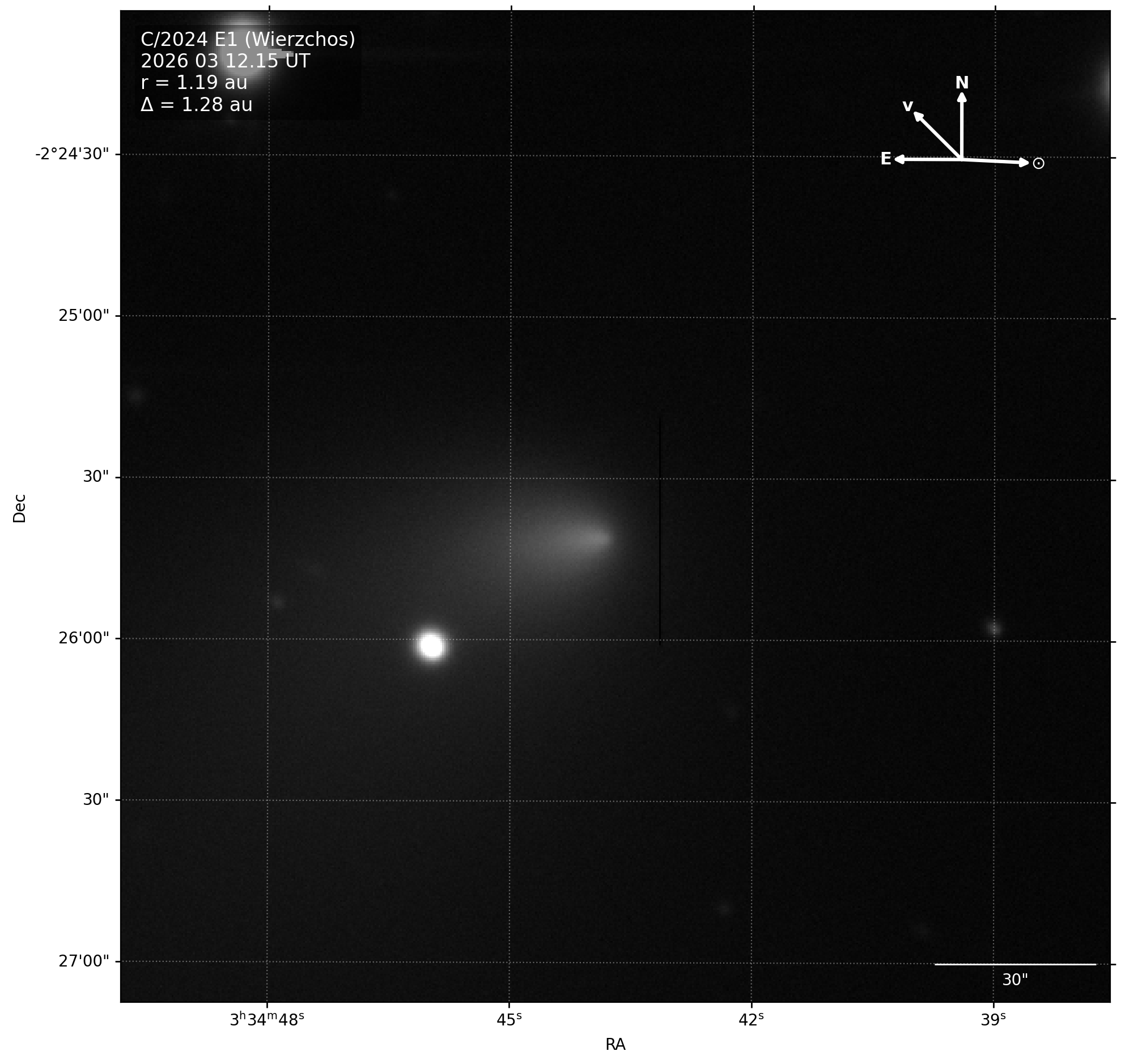
Renerpho (talk) 18:01, 21 March 2026 (UTC)
- I think we are just waiting for more follow-up observations to confirm it stays diffuse and gets notably fainter. From 39N, 2024E1 is still 39 degrees high when it gets dark at 20:10 PDT. -- Kheider (talk) 18:59, 21 March 2026 (UTC)
- There is no shortage of observations. The COBS lightcurve shows a very rapid fading in the past two weeks. Renerpho (talk) 19:30, 21 March 2026 (UTC)
- Between March 18 and March 20 there are estimates varying between magnitude 9.5 to 13. Will the remaining nucleus become more visible when the dust clears (even if notably fainter)? Will there be a fragment-B detected by larger scopes? It might be a little premature for absolutes. -- Kheider (talk) 19:41, 21 March 2026 (UTC)
- Hard to say, and I'm sure we'll hear more about it fairly soon. I have not much hope that anything remains, but who knows. I'd say what you added is good so far, anything beyond that may be OR. Renerpho (talk) 19:52, 21 March 2026 (UTC)
- Between March 18 and March 20 there are estimates varying between magnitude 9.5 to 13. Will the remaining nucleus become more visible when the dust clears (even if notably fainter)? Will there be a fragment-B detected by larger scopes? It might be a little premature for absolutes. -- Kheider (talk) 19:41, 21 March 2026 (UTC)
- There is no shortage of observations. The COBS lightcurve shows a very rapid fading in the past two weeks. Renerpho (talk) 19:30, 21 March 2026 (UTC)
- I think we are just waiting for more follow-up observations to confirm it stays diffuse and gets notably fainter. From 39N, 2024E1 is still 39 degrees high when it gets dark at 20:10 PDT. -- Kheider (talk) 18:59, 21 March 2026 (UTC)