Latest comment: 7 years ago6 comments2 people in discussion
Let me also park here a nice quote, which needs to be remembered:
Skylax and Hekataios may be considered to have been the earliest authors to refer to India ('Indoi). Their treatises are now known only in fragments. Their "India" seems to have been located on the river Indus.[8] A more detailed account of this territory is preserved in the History of Herodotus, where it is described as a satrapy of the Achaemenid empire under Darius I (522-486 BC) "India" ('Indoi) conquered by Darius I lay on the Indus, stretched up to the sea (Arabian sea), and was separate from the land of the Gandariai (Gandhāra, including the Peshawar and perhaps Rawalpindi districts). It had a desert on its east, which must be identified with the Thar desert of Rajasthan.[9] It appears that "India" of Herodotus (and perhaps also of Skylax and Hekataios) occupied the country on the lower Indus, corresponding largely to the modern province of Sind.[1]
Pataliputra, it is well and good that you have engaged in a fine analysis of Greek transliterations below, but it appears that you have missed the main point of the above post, viz., what is called "India" in the Greek sources of that time is Sindh. I have made numerous corrections to your text now, where you have used "India" without any acknowledgement of this fact. -- Kautilya3 (talk) 19:28, 13 October 2018 (UTC)
Ancient Gandhara and modern Sindh..... How do we make sense of all this? Mukherjee himself first clearly says that "India" (Ἰνδία) 1) is separate from Gandhara 2) lay on the Indus 3) stretched up to the sea (Arabian sea) 4) had the Thar desert on its east. To me this sounds like a fair description of the Indus valley, probably the middle and lower portions of it. Please note he does not strictly equate that area with modern Sindh, he just says "corresponds largely", which leaves room for a "Greater Sindh" which could indeed correspond to the Indus valley, and to the original meaning of Sindh (Sindhus), and better correspond to his own precise topographical description above. Indeed narrowly equating "India" (Ἰνδία) with modern Sindh seems problematic: 1) the Thar desert is not east of Sindh (it is North/ Northeast), which contradicts Mukherjee's topographical description of the area for "India" (Ἰνδία). 2) A simple map shows how far Gandhara and modern Sindh are spread appart (close to 1000 km...). How do we account for the space in between? Is it all Sattagydia? Or was it unoccupied?... it doesn't make much sense and contradicts standard maps showing the eastern possessions of the Achaemenid Empire. My impression is that "India" (Ἰνδία) was a "larger Sindh", still coherent with Mukherjee's description, which could be more appropriately described as Indus valley for example, or just Indus. The definitions are fuzzy, and here India, of course, means India as the ancients understood it, ie the Indus Valley, so there is no need to try to eradicate any mention of the word "India". Academics don't either. Finally a note on methodology: you cannot modify quotes from sources, as you did for example for the translation of Darius I's Dna inscription, in which you changed "India" to "Sindh" : that's unacceptable on Wikipedia. Please respect quotes and sources as they are.पाटलिपुत्र (talk) 05:14, 14 October 2018 (UTC)
That is a good question. If you follow proper historian sources instead of the primary sources, as you have been doing, you will know the answer. Mukherjee himself describes Hindush as the "lower Indus basin" and does not fix any boundaries. Remember that the modern boundary of Sindh essentially comes from the Maharaja Ranjit Singh's conquests. That is not the ancient boundary. Even at the time of Muhammad bin Qasim, Sindh stretched up to "Kashmir".
I kind of agree actually... I was simply reacting to your introduction of modern Sindh everywhere in the article . In that case we both agree that it is clearly meaningless to link the Achaemenid Hidus with modern Sindh anymore. But linking Hidus to History of Sindh everywhere is also awfully strange . Why don't we simply translate and link Hidus to Indus (its fundamental meaning) when we can, which sometimes will also have to be India (in the ancient Greek and Achaemenid sense) or possibly Sindhu or Sindh in the largest sense, depending on the context and the sources we are relying on? पाटलिपुत्र (talk) 11:32, 14 October 2018 (UTC)
Ok, I am glad we agree on something. There was a historical Sindhu country. We just don't have a good page that talks about it. Sindhu Kingdom could have been it, but it is in bad shape. I think that, for the time being, History of Sindh is adequate, just as we use History of India to refer to ancient India.
You used a quote Amelie Kuhrt (Susan Alcock volume) for the DNa inscription, where she translates Hindush as "India". But the source she cites (Kent, 1953, p.138) actually translates it as "Sind". -- Kautilya3 (talk) 19:58, 14 October 2018 (UTC)
Gandhara was supposedly made up of a "large number of small farming communities". Where did he get that from? From Sanskrit sources, we know that it was a Mahajanapada. It might have some sort of a political system to be clubbed as a mahajanapada? Not just "farming communities"?
Darius's "Sindh" (Hindush) was supposedly between the Indus and Jhelum rivers, because "Sindhu" means the Indus. What kind of OR is that? There are numerous Sanskrit sources calling Sindh by the name Sindhu. He is contradicting well-accepted facts. For example, see:
I also find an incredible amount of OR in this article about satrapies and capitals. Gandhara was part of the 7th satrapy, not a satrapy on its own. We have no idea if the satrapy had an all-encompassing name.
Actually Gandhara finds its proper, independent, place in the traditional list of satrapies of the Achaemenids for example. Herodotus seems to diverge in that he only lists two Provinces (just for purpose of taxation??) in his account on tributes, the 20th Province (India), and the 7th Province (Sattagydae, Gandarii, Dadicae, and Aparytae). I tried to reflect that divergence in the article in a paragraph "List of Provinces". पाटलिपुत्र (talk) 13:38, 10 October 2018 (UTC)
You need to keep in mind that web sites are not reliable sources, especially not for history. See:
To summarise, the 7th province was called Paruparaesanna (as noted in the Babylonian and Elamite versions of the inscription). It means "beyond the Hindu Kush". In Greek, it was called Parapamisadae. All of this was conquered by Alexander when he came around, but Seleucus gave it all up to Chandragupta Maurya, a fact witnessed by an Asokan inscription in Kandahar!
The region was bounded by the Indus. Apparently, Darius apparently saw the Indus river as the boundary between Iran and India. So the great majority of Punjab was not included. The region to the south of Gandara till about Multan (but only to the west of Indus) was called Sattagydia/Thattagush. Then Sindhu/Hindush covered the area from Multan to the sea. So, there were no gaps between the 7th province and the 20th province.
An interesting question is whether Hindush was also bounded on the east by the Indus. I don't know the answer to that. -- Kautilya3 (talk) 05:03, 15 October 2018 (UTC)
In this connection I suppose that the Persian conquerors used to call their easternmost province Gandāra instead of Paruparaesanna after the plain situated opposite to the independent territory of the king of Taxila,in the same way as e.g. the Kingdom of the Netherlands is usually called Holland after the province(s) properly so called. (p.177)
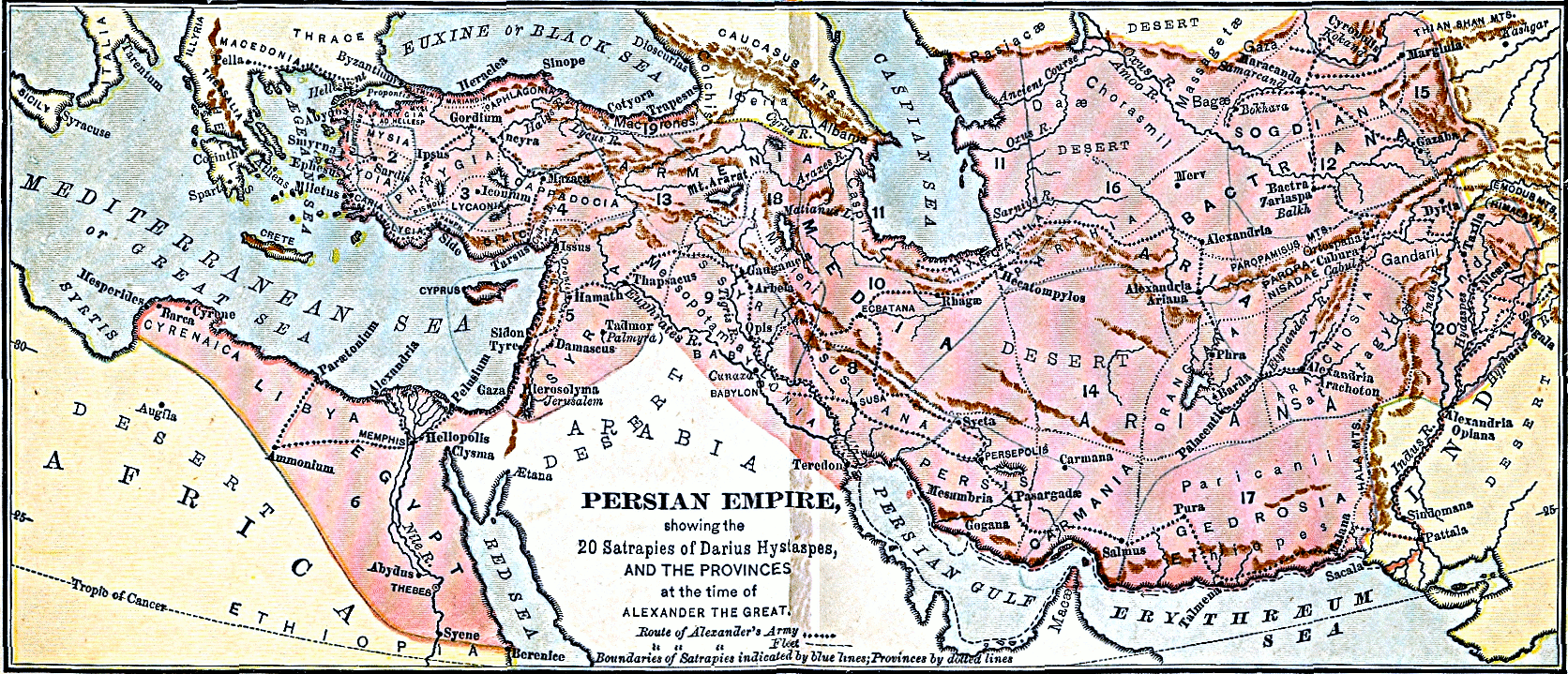
Standard map from the Achaemenid Empire article.What is your point Kautilya3 in deleting the map, with the following edit summary "The maps need to be modified to show the boundary at the Indus river"? Are you trying to say that Taxila for example was not a part of the Achaemenid Empire??? If so, I am afraid that's another unfounded theory of yours (after your false theory that Ἰνδός was pronounced Hindos, discussed below under "Greek transliteration", for which you clearly corrupted Mukherjee, something which is hardly acceptable on Wikipedia. You could get blocked for this kind of behaviour). I think most academics consider that Taxila was indeed Achaemenid (because of the ruins of Bhir Mound etc...) and in my understanding, because of this archaeological evidence, they conservatively see Achaemenid territory extending to the Jhelum River, after the conquests of Darius I that is. I attach the map from the Achaemenid Empire article, from which the one you deleted is derived. Your quote above only refers to Gandhara, probably at the time of Cyrus when "Hidus" was not conquered yet. Please respect the sources, don't currupt them as you've done repeatedly (Mukherjee, DNa inscription ), and everything will be fine... पाटलिपुत्र (talk) 14:25, 15 October 2018 (UTC)
Pataliputra, over the last few weeks, you have doubled or trebled the size of this article and added a lot of material and images. All the new content is subject to review, just as all edits to Wikipedia are. I have provided my source, an authentic one with in-depth analysis, about five days ago. You haven't said whether you have read it, and harmonised everything else you have read or assumed. Please do that now. And, please provide sources that make contrary claims so that we can evaluate them. Cheers, Kautilya3 (talk) 14:39, 15 October 2018 (UTC)
Your source above (Eggermont) is only a discussion limited to the Paropamisadae area, roughly corresponding to Gandhara (p.177), and bordered by the Indus to the east, and in the author's own words "identical" with the 7th district listed by Herodotus (p.177 and 181). There is no discussion of the 20th district of Hidus (ie the Indus valley) conquered by Darius I, hence no attempt to define the general boundaries of the Achaemenid Empire. The sentence mentioning "their easternmost province Gandhara ... opposite to the independent territory of the Taxila" seems to refer to the first conquest of the Achaemenids under Cyrus (who is mentioned in the same breath) and their first naming of the region at that time, before the expansion of Darius I.
The question of the occupation of the Taxila region is complex, since the Achaemenids haven't left many undisputable archaeological remains (besides their claims in inscriptions). According to Pierfrancesco Callieri though (Indo-Achaemenid relations), the Achaemenid presence is clearly attested by "aspects of the material culture which are directly associated with the exercise of political power": 1)The diffusion in Taxila of coinage techniques which are widely considered as Achaemenid in character 2)The spread of the Aramaic language (including the development of the Kharoshthi script) to the region of Taxila 3) The presence of characteristic Greco-Persian seals.
India in 500 BCE
Eastern territories of the Achaemenids
I guess these are the reasons why many maps show an Achaemenid expansion slightly beyond the Indus in the north, including Taxila, roughly to the area of the Jhelum river (or often much beyond , ). The maps you deleted (attached) are not my own invention: they are just based on the standard maps which have been used in the Achaemenid Empire article (attached in the previous post, sourced in: Brill's New Pauly Historical Atlas of the Ancient World (2010). p. 87 Atlas of the Ancient Near East (2016). pp. 228-229). Similar modern published maps abound:
Many sources confirm this analysis, or even go significantly beyond:
"More probably, Hindu lay east of Gandhara, perhaps as a wedge of territory between it, the Jana-padas of Eastern Punjab, and the deserts of Rajasthan. It thus occupied much of what is now the Panjab province of Pakistan".[1]
"Beyond the Indus, in the district between this river and the Jhelum (the ancient Vitasta, Greek Hydaspes), was Takshasila (Greek Taxila). Under Darius I and his first successors the district of Taxila was probably incorporated in the satrapy of Gandhara-Parapamisadae (...) Nevertheless the Jhelum (Hydaspes) was evidently always considered the easternmost boundary of the Persian empire".[2]
"Hidus could be the areas of Sindh, or Taxila and West Punjab."[3]
I'm not sure why it would be particularly legitimate to replace them with maps which are strictly following the Indus. And per Callieri above, excluding Taxila from the Achaemenid sphere would be particularly problematic. पाटलिपुत्र (talk) 05:01, 16 October 2018 (UTC)
Thanks for a detailed response. I will make some general remarks and sign off, because I have other things to attend to.
You should not give random web sites as sources for controversial issues. Even museum web sites are no good because they seem to want to tell a story to the public, and don't employ language like "perhaps", "probably", "could be" and so on. Many scholars are not convinced about the evidence at Taxila. For example, Karttunen says:
But even in the Åchaemenian period the western element in Taxila is remarkably small.[4]
If the scholars are uncertain, we should also employ uncertain language and avoid story language, like "Darius crossed the Indus" etc. The usage of Aramaic and the Persian coinage don't clinch the issue. They could as well imply trade with Persia, not necessarily a conquest. To claim that Taxila was a part of Hindush is a big stretch, because nobody has claimed Aramaic and Persian coinage were found in Sindh. If the two were part of the same province, one needs to explain why they were found in one part but not the other.
You should also not depend on the other web pages, because as is well-known WP:Wikipedia is not a reliable source. This page is on the Achamenid conquest of the Indus valley. It should provide authentic information about the subject, including its shades of certainty and uncertainty. -- Kautilya3 (talk) 23:28, 16 October 2018 (UTC)
There is also the very real possibility which nobody seems to talk of, viz., that Taxila could have voluntarily submitted to Persia, just like Ambhi submitted to Alexander later. Taxila's prosperity depended on trade with Bactria and the Tarim Basin. So it made sense for Taxila to have good relations with its neighbours. At the same time, Taxila was warring with the far-off Avanti (which seems to have been a trading centre at the other end of the north Indian zone). So, Taxila was by no means a "small farming community". But it knew where its interests lay. -- Kautilya3 (talk) 00:00, 17 October 2018 (UTC)
Latest comment: 7 years ago15 comments2 people in discussion
Pataliputra, After reviewing, I find the section titled Greek and Achaemenid coinage entirely confused.
First of all there is a large subsection on Kabul hoard. Since Kabul is not in the Indus valley, I don't see the point of this section.
You seem to have completely missed the point of the Schlumburger quote, which is saying that the bent bars were locally minted in Gandhara. Bopearachchi is saying, in addition, that these bent bars were preceded by local coins "of a new kind" (presumably not found elsewhere in the Achaemenid empire). From the sound of it, it seems like Pushkalavati wasn't allowed to mint its own coins. So it switched to bars. Why they were bent, I have no idea. Apparently Gandhara is the only place where these bent bars are found. The rest of India was using punch-marked coins.[1]
The Pushkalavati hoard is covered in much more detail in this paper.[2] Contrary to your idea of strong Achaemenid imperial control, all this points to weak imperial control/significant local autonomy, which Bopearachchi clearly acknowledges.
I can't find in Elizabeth Errington any of the information you mention. Please provide quotations.
Kabul is clearly part of the same general area as far as the Achaemenid Empire and numismatics are concerned. Numismatic research of the area generally discusses the various hoards from Kabul to the southern Indus valley as a way to understand the monetary situation in this geographical area. (“Coin Production and Circulation in Central Asia and North-West India (Before and after Alexander’s Conquest)”, The Crossroads of Asia etc...). Actually, the Kabul hoard is highly relevant to the history of coinage in the whole of northwestern India.
Schlumburger says what he says, and the quote is very clear (I don't dismember critical portions of sentences to push personal theories as you did above in "Greek transliterations").
The local coins "of a new kind" were Achaemenid coins minted locally. "In the same hoard there were also discovered two series of local silver coins which appear to be the product of local Achaemenid administration. One series (...) was made in a new way, which relates it to the punch-marked silver coins of India. It appears that it was these local coins, using technology adapted from Greek coins, which provided the prototypes for punch-marked coins made in India." Errington p.57
I don't see what you are saying about Pushkalavati.
Your sentence "The rest of India was using punch-marked coins" is advocated by some, but denied by others (often numismats or archaeologists, in face of the evidence, such as Schlumberger or Bopearachchi). If I remember well, none of the Indian bents bars are securely dated to before the 4th century, although there are regular hypothetical claims to the 6th-7th centuries. The Kabul hoard, which is dated, gives a secure anchor regarding the early circulation of bent bars in the northwest.
I rather do tend to agree that it looks like "weak imperial control/significant local autonomy", but that's conjecture. The only "strong" I am using is in "the strong Achaemenid dynasty then took an interest into the region"...
You say "I can't find in Elizabeth Errington any of the information you mention." You should probably rather say "I do not have access to Elizabeth Errington". You make it sound like you searched but did not find the information in the book, whereas the reality is just that you did not read the book in the first place. Elizabeth Errington is the editor, the articles in question are jointly written by Joe Cribb and Osmund Bopearachchi, two of the most prominent authorities on coinage in the area. Here are a few of the quotes, which you can confirm on Goggle Books (although the full pages are not visible there):
"The discovery of fifth- and fourth-century BC Greek coins in Afghanistan and Pakistan demonstrates in a tangible way the depth of Greek penetration in the century before Alexander the Great's conquest of the Achaemenid satrapies..." p.57
"..coin hoards from Afghanistan show clearly that, through the Achaemenid administration and the commercial life it oversaw, the use of Greek coins had penetrated as far as the Indus." p.57
About the Kabul hoard "In the same hoard there were also discovered two series of local silver coins which appear to be the product of local Achaemenid administration. One series (...) was made in a new way, which relates it to the punch-marked silver coins of India. It appears that it was these local coins, using technology adapted from Greek coins, which provided the prototypes for punch-marked coins made in India." p.57
"In the territories to the south of the Hindu Kush the punch-marked coins, descendants of the local coins of the Achaemenid administration in the same area, were issued by the Mauryan kings of India for local circulation." p.59
I've updated the information and the references in the paragraph to include mentions of Bhir Mound, since most of the Archaemenid coins and bent-bar punch-marked coins found in the Kabul Hoard were also found, sometimes in large quantities in the Bhir Mound hoard in Taxila. पाटलिपुत्र (talk) 07:53, 24 October 2018 (UTC)
For the cup-shaped coin, you have labelled "Achaemenid Empire coin minted in the Kabul Valley. Circa 500-380 BCE" and cited the Errington book pages 57-59 for it. What is the caption that is in the book? -- Kautilya3 (talk) 21:12, 24 October 2018 (UTC)
The Errington label for the coin is: "Local silver coin of Kabul region under the Achaemenid Empire, c.350 BC" p.57. The wider date 500-380 BCE is from the CNG website referenced on the coin page . I'll put the CNG reference directly into the caption as well. पाटलिपुत्र (talk) 21:28, 24 October 2018 (UTC)
How exactly does "local silver coin" become an "Achaemenid Empire coin"? And, "Kabul region" become "Kabul valley"?
You have also misrepresented the source by calling it an "Article" whereas it is just a gallery with pithy captions.
The coin production article says We have seen that the local coins of the Achaemenid era named “of a new kind” were the precursors of the bent and punch-marked bars. So, they were from the "Achaemenid era". They were not from the "Achaemenid Empire". Those of the Empire were Darics and Siglos, and we know what they look like.
The Achaemenids and Mauryans article says The presence of virgin flans and of silver ingots in this hoard is proof that these coins were struck on the spot, i.e. in the ancient town of Pushkalavati (Shaikhan Dehri), an important crossroads of the ancient network of trade. The Pushkalavati coins and perhaps Taxila coins too, would have been used "locally" to trade with the regions that Gandhara needed to trade with. The meaning of "local" is perfectly clear. And it has nothing to do with the Achaemenid Empire. -- Kautilya3 (talk) 00:09, 25 October 2018 (UTC)
"Kabul Valley" is the term used on the coin site at CNG Coins, but I don't mind using either "Kabul Valley" or "Kabul region". The "local silver coins" are "Achaemenid silver coins" because it is what Errington says: the coins were "the product of local Achaemenid administration" per Errington p.57, or "local coins of the Achaemenid administration" p.59. Cannot be clearer. Now we can phrase it differently of course, we can even use Errington verbatim if you wish, but beware of plagiarism and copyright.
Your "just a gallery with pithy captions". Very strange and unwarranted. The book is actually a succession of fairly long articles by reputable authors around various artifacts. The article on the cup-shaped coin just happens to be quite short (the quote I gave you is the title of the article), and includes essentially technical information.
The articles I quoted above clearly present these coins as "the product of local Achaemenid administration", "local coins of the Achaemenid administration", so it is very straightforward. Osmund Bopearachchi says essentially the same thing in his Coin production article (p.311), and, remember, he is also joint author with Joe Cribb of the articles quoted above, so the conclusions are his as well.
I am not sure what you are saying about Pushkalavati. I guess there were also coins minted locally in Pushkalavati, why not? I don't see how your Pushkalavati comment relates to the above discussion...
By what criteria does CNG Coins become a reliable source? If that was your source for the caption, why didn't you cite it? Where did "minted in Kabul Valley" come from? It is quite inexplicable that you continue to argue without recognizing the WP:SYNTHESIS and distortions you have added. -- Kautilya3 (talk) 09:53, 25 October 2018 (UTC)
The Coin production article says: the regions to the north of the Hindu Kush did not start striking coins before the last decade of the 4th century bc, that is at least twenty years after the death of Alexander, despite that fact that there was a well developed monetary system in the regions to the south of the Hindu Kush even before the arrival of Alexander.[3]
The notices of CNG Coins are referenced from scholarly sources , and their organization is mostly composed of numismats of high standing , but I agree it's better to get to the actual sources themselves, when possible (the attribution of this specific coin is referenced by them from Bopearachchi & Rahman). The Commons page for the coin does give the source for the attribution. The "minted in Kabul Valley" comes from their mention "Uncertain mint in the Kabul Valley." It is also rather confirmed by Errington (p.57) who writes "local silver coin of Kabul valley region". The two references are now used in the caption for the coin in the article.
You are misunderstanding your own quote from Coin production. First Kabul is NOT north of the Hindu Kush, it is south of it . So there is zero contradiction. Bopearachchi indeed explains that the monetary system was well developed in the south of the Hindu Kush: your quote is actually his transition sentence to the full chapter on "Coin Production in Northwest India under the Achaemenids" p.309. Again, this cannot be clearer.
What cannot be clearer? In this paper, the Kabul hoard is discussed quite thoroughly. Is there any mention of anything being minted in Kabul? -- Kautilya3 (talk) 14:24, 25 October 2018 (UTC)
Ok, he mentions coins "attributed to Paropamisadae" and in a map published in another paper, he puts the Paropamisadae west of Jalalabad. So, this would include "Kabul valley".
But, it is funny that he never mentions that "double weight" (2 siglos) means Satamana for the Indians (100 ratis).[4] So the Gandharans picked a weight that made sense to both the Achaemenians and the Indians.
If I google for Satamana there are tons of hits, including this one. Since this is from Taxila, it may be a better image to use than the ones you have uploaded for Kabul. These are fractional weights, but the bent bar is a full satamana. -- Kautilya3 (talk) 20:13, 25 October 2018 (UTC)
Good. For info, the coins in question, showing the evolution from simple strike to multiple punches (1-13) and increased symbolism, are also listed under the title "Local silver coins of Kabul region under the Achaemenid Empire" in this plate of Bopearachchi, Osmund; Rahman, Aman ur (1995). Pre-Kushana Coins in Pakistan. IRM Associates Limited. In Crossroads of Asia p.57, Bopearachchi further specifies that these same local coins discovered in Kabul were "the product of local Achaemenid administration". पाटलिपुत्र (talk) 17:41, 26 October 2018 (UTC)
Yes, but "local coin" does not necessarily mean locally minted, much less "minted in Kabul valley". It is the fact that he says "attributed to", which settles the issue.
I don't see "the product of local Achaemenid administration" bit. Where is that? Nobody knows what kind of Achaemenid administration there was. If it was really Achaemenid, we wouldn't they mint royal Achaemenid sigloi, instead of these crude punched-sheets of metal? -- Kautilya3 (talk) 20:10, 26 October 2018 (UTC)
Coin type of series no.8
Coin type of series no.9
This is in the Errington article about the Kabul hoard, after discussing the presence of Greek and Achaemenid royal coinage: "In the same hoard there were also discovered two series of local silver coins which appear to be the product of the local Achaemenid administration. One series (no.8) was made in the same way as the Greek coins in the hoard, but with novel designs of local origin, and the other (no.9) had similar local design but made in a new way, which relates it to the silver punch-marked coins of India. It appears that it was these local coins, using technology adapted from Greek coins, which provided the prototypes for punch-marked coins, the earliest coins made in India." (Errington, p. 57). Group No.8 refers to the cup-shaped coins, group no.9 refers to the bent-bar punch-marked coins we have presented in the Kabul hoard article. पाटलिपुत्र (talk) 21:35, 26 October 2018 (UTC)
Latest comment: 7 years ago19 comments2 people in discussion
Apparently Darius used Hidūš (𐏃𐎡𐎯𐎢𐏁, H-I-DU-U-Š in Old Persian cuneiform25th line of the DNa, but apparently sometimes transliterated as hindūš for a reason I don't understand, but possibly in light of the Sanskrit origin of the word) in his inscriptions, and Herodotus used Indos (Nominative: ἸνδόςIndos, genitive: Ἰνδῶν Indoi), which is his general term otherwise used for India. पाटलिपुत्र (talk) 13:25, 10 October 2018 (UTC)
Yes, it was spelt that way, but pronounced as Hindush. Likewise, "Indos" was pronounced Hindos. The tick mark in front of "I" denotes the H sound. See Names of India#India for a full explanation.
By the way Hindoi was not India, but rather "Indians". It was a plural form of Hindos. Hinduan was another. Greeks were apparently not comfortable with using the same term for the land and its people. The land was occasionally called Hindikos, but more often Hindike Khore (the "Indian land" or, more accurately, the "Sindhian land"). -- Kautilya3 (talk) 18:00, 10 October 2018 (UTC)
@Kautilya3: I thought there were two possibilities in Greek for the "tick mark" before a vowel: Ἱ with a forward tick mark does mean there is a /h/ (Rough breathing), but Ἰ with a backward tickmark means there is no /h/ (Smooth breathing, or Psili). It seems it is the second sort we have here in Ἰνδός, hence the pronounciation Indos only, even back to the 5th century BCE as seen in the article Ἰνδός. पाटलिपुत्र (talk) 20:26, 10 October 2018 (UTC)
We are talking about Greek as spoken in Herodotus's time, not how it is spoken today. You are welcome to dig into the Vox Graeca book cited below and see if you find any such distinctions. -- Kautilya3 (talk) 20:41, 10 October 2018 (UTC)
Yeah, the keyword is "later". The page 52 doesn't say that these distinctions were pesent in Herodotus's time. This is not unusual for us English speakers: we say honest but high (just to pick two random words that occur to me at this moment). No difference in spelling. If you see old English texts, you will find that many of these /h/ sounds were pronounced. Many Indian historians say that there was an aspiratum in Herodotus's time:
... there having been no letter in Greek of the period concerned to represent correctly the sound h, which was to be indicated only by a sign of aspiration above the first vowel in Greek texts but not in later Latin writings in Roman characters.[1]
Logic dictates that there must have been an aspiratum. If it was a borrowed term from Persian, there is no reason why the aspiratum would immediately disappear. Over time, it can, because the language evolves. -- Kautilya3 (talk) 21:36, 10 October 2018 (UTC)
@Kautilya3: The "later" in the sentence from Graeca Vox above only means that the design of the symbol evolved in time, hence the reason it is usually written Ἰνδός, whereas it was written ┤Ινδός archaically. But the fact that these two are the symbol for Smooth breathing, or Psili ("no /h/") remains entirely. As far as I know, Ἰνδός was or is never pronounced with an /h/, at least for readers of Greek. Have you checked the combinations " Ἰνδός Hindos " or " Ἰνδοῦ Hindoi ", or even the words "Hindos" or "Hindoi" on Google Books? The relevant results are zero. पाटलिपुत्र (talk) 05:08, 11 October 2018 (UTC)
No, Vox Graeca is telling you that in 'pre-Euclidean times', the full letter 'H' was used. There was presumably no Smooth breathing then. I gave you a reliable source that says that Hindos had an aspiratum initially. It got lost later. I don't see Vox Graeca contradicting it. -- Kautilya3 (talk) 09:30, 11 October 2018 (UTC)
Where is your "reliable source that says that Hindos had an aspiratum initially"? Your quote above from Mukherjee only states that in Greek the sound /h/ was represented by "a sign of aspiration above the first vowel", which is nothing new and doesn't enlighten us. Would you have the full quote? (it's not visible on Google Books) पाटलिपुत्र (talk) 10:59, 11 October 2018 (UTC)
Mukherjee probably didn't know that the letter 'H' was written fully in Herodotus's time. We only have manuscripts from later times. As a historian, he assessed the most likely scenario. You are trying to back-project the later evolution of the Classical Greek in post-Euclidean times to Herodotus. That is WP:SYNTHESIS. Shall we call a halt to this pointless debate until you actually find a source that talks about Herodotus's rendering the word? -- Kautilya3 (talk) 11:40, 11 October 2018 (UTC)
Apparently the same territory was referred to as Hi(n)du(sh) in the Naqsh‐i‐Rustam inscription of Darius I as one of the countries in his empire.[10] The terms Hindu and India ('Indoi) indicate an original indigenous expression like Sindhu. The name Sindhu could have been pronounced by the Persians as Hindu (replacing s by h and dh by d) and the Greeks would have transformed the latter as Indo‐ (Indoi, Latin Indica, India) with h dropped, there having been no letter in Greek of the period concerned to represent correctly the sound h, which was to be indicated only by a sign of aspiration above the first vowel in Greek texts but not in later Latin writings in Roman characters.[1]
Actually, I realized that even Herotodus's time is not early enough. It was Skylax that brought the Persian term over to Greek, and we don't have any texts from Skylax, let alone manuscripts. Greek was evolving at roughly the same time as these events, and we can't tell exactly when the transition occurred. But we know that the letter 'H' was written fully at that time. There is no way to tell how the Greeks would have pronounced it, except to go by what the historians assess. -- Kautilya3 (talk) 12:12, 11 October 2018 (UTC)
@Kautilya3: Thank you for the quote! As you correctly said above "Mukherjee probably didn't know that the letter 'H' was written fully in Herodotus's time" . Actually, as is clear from your complete quote, Mukherjee never says that the Greeks pronounced the /h/, on the contrary, he says that they "dropped" it from the Persian pronunciation, out of convenience. We now know (as per Vox Graeca) that H actually existed, which was later abbreviated in ├ and then in forward tick (῾) (Rough breathing), so Herodotus actually could have written a /h/ sound anytime, had he wished to. On the contrary, the lack of /h/ was either shown by the absence of any sign, or ┤, or the backward tick (᾿) (Smooth breathing). Transliterations of Herodotus's Indus are always Ἰνδός, with a backward tick (even in Mukherjee's books as a scan shows ), hence no /h/ sound, and is always given as Indos and never as Hindos in the sources. As a conclusion I think we should generally transliterate Ἰνδός as Indos, as all sources do, and give up the claim that an /h/ was pronounced, a claim which even Mukherjee doesn't make. Is that OK with you? पाटलिपुत्र (talk) 15:05, 11 October 2018 (UTC)
Because there are no such known occurences from Herodotus. As far as I know, all transliterations from his work, including those made by Mukherjee, are reported as Ἰνδός, with a backward tick (Smooth breathing), which is only Indos and properly presented as such. Somebody could fantasize that Herodotus sometimes used a /h/ to make it Hindos and that all such instances conveniently disappeared from history records, but I don't know of any academic making such an improbable claim. पाटलिपुत्र (talk) 21:08, 11 October 2018 (UTC)
Do you realize that this is the same kind of argument that the naysayers used to claim that Indians fantasized about having had a zero before 900 AD? The absence of direct evidence doesn't necessarily make something false. You just have to interpret the available evidence correctly.
In any case, here is a contemporary source that mentions Hindos rather directly:
Hawley, John Stratton (Summer 1991), "Naming Hinduism", The Wilson Quarterly (1976-), 15 (3): 20–34, JSTOR40258117
Well, claiming something in the absence of evidence could be a "theory" or an "hypothesis", and it can be mentioned on Wikipedia as long as it is expressed by a reputable source. Thanks for your link, but I am afraid we cannot use it: the author doesn't explain at all what his supposed hindoi known by the Greeks comes from: no mention of Herodotus, no mention of Ἰνδός, no mention of India, and he is apparently only speaking of "an ancient version of the word" Hindus (of Hinduism). He probably has in mind comparatively recent Greek authors (3rd-4th century CE I would say, such as Philostorgius who used the term in a religious context in Historia ecclesiastica 4.1-4.2a Paragraph 57, 1st line). Shall we put this to rest and make the necessary correction Ἰνδός = Indos in Names for India, and possibly other articles, with proper referencing (including your complete quote from Mukherjee above)? पाटलिपुत्र (talk) 05:30, 12 October 2018 (UTC)
Apparently the reason why the Greeks "dropped the h" from the Persian word Hindus is because the Ionian (i.e. easternmost) dialect of Greek does not use aspirated "h"s. Quote: "Professor Morgenstierne writes, "From the Persians the East Ionians (who dropped their aitches) got the form Indus"" in Greece and Rome. No good sources yet, but this is a lead... पाटलिपुत्र (talk) 07:21, 30 October 2018 (UTC)
Yeah, well, they didn't drop it from the name "Herodotus".
There were dozens of Greek dialects. Some dropped /h/ and some didn't. But because the Ionic dialect and alphabet became the dominant one (which had dropped /h/ "early"), the /h/ got lost in the majority of the words. But the Italian Greeks (Magna Grecia) persisted with /h/ and passed it into the Roman alphabet. If not for them, the whole western civilization would ave been h-less. -- Kautilya3 (talk) 11:52, 30 October 2018 (UTC)
Bopearachchi, Marshall et al.
Latest comment: 7 years ago6 comments3 people in discussion
Regarding this revert, we have seen that Enclyclopedia Iranica is not accepting Marshall's conclusions. WP:HISTRS requires historians as sources, and archaeologists and numismats aren't historians. They are rather the WP:PRIMARY sources, whose evidence is considered and evaluated by historians in constructing history, who also use various other sources: literary, political, economic, religious etc. Please remember that verifiability does not guarantee inclusion. -- Kautilya3 (talk) 23:29, 24 October 2018 (UTC)
You do not seem to understand that various historians can have various interpretations of one subject. On Wikipedia, the way to do deal with this is by writing something like: "this author says ....., while this one says....". We do not delete one reputable author simply because another said something different somewhere, we present the various reputable views. By the way Osmund Bopearachchi is a numismat and a historian. Anyway, I trust that reputable numismats are valuable sources, especially for articles related to numismatics. They are certainly not Primary Sources. पाटलिपुत्र (talk) 05:23, 25 October 2018 (UTC)
People that you call "historians" (as might any man on the street) are not "historians" in the sense of WP:HISTRS. You need to read that page thoroughly to understand what it says. An average journalist might equate Romila Thapar and B. B. Lal and say that they differ in their opinions. But only one of them is a "historian" and the other is an archaelogist.
Even if we were to accept Marshall's opinion, filtered via Bopearachchi, we would attribute it as an opinion. And, we would also list the contrary opinions as per WP:NPOV. We can't go around writing "Achamenid city Taxila", "capital of Achaemenid province" etc.
If respect for differing opinions of historians is your real concern, why did you corrupt this statement about Sophytes sourced to the Cambridge History of India without citing anything? -- Kautilya3 (talk) 11:15, 25 October 2018 (UTC)
Very happy to describe various opinions as pertaining to specific historians. No problem with that, quite the contrary. For Sophytes, I only added standard modern knowledge that the Sophytes of the coins is generally not considered the same as the Sophytes met by Alexander (see p.96-97p.127p.163), whereas you were trying to say that it was the same person. You actually replaced a fairly balanced intro with this single outdated one-sided view that they are the same person (written a hundred years ago (1922) by Rapson, a numismat who died in 1937), despite the various references in the article. I've now developped the intro a bit in order to present properly the two stories, with references.पाटलिपुत्र (talk) 12:01, 25 October 2018 (UTC)
Latest comment: 7 years ago3 comments2 people in discussion
From Romila Thapar:
General opinion however still adheres to the sixth century BC as the start of coinage. In any case they would have been in circulation prior to the Mauryas. The symbols on the coins are suggestive of an indigenous origin although the notion of coined metallic money was probably known from West Asian usage. Pre-Mauryan literary evidence, with the exception of Pãnini, does not confirm the use of coins, but is familiar with using weights of gold and silver with a designated value. Punchmarked coins would have increased in number with the greater availability of silver and this may have required close connections with West Asia and Afghanistan, apart from the more sporadic mining in the sub-continent.... The date should be determined by dated coinage in the Chaman Huzuri hoard and by the reference to Alexander receiving telents of marked silver. An examination of the symbols suggests that there were local issues of varying weight which are rare in northern India and national issues with a standard weight found all over the sub-continent. The coins were developed in the north-west and were imitated in the Ganges towns. However, the pre-Mauryan use of coins is suggested in other sources. The Nandas are said to have standardized weights and this is likely to have included coins. Coins were a familiar item to Pänini, which would date them to at least the fifth century." (Ashoka and the Decline of Mauryas, pp. 288-89).[2]
In other words, she doesn't see anything inconsistent with the "coins" starting from the north-west, but it wasn't a totally new idea. Pieces of metal were used as a medium of exchange earlier.
If I understand Panini right, he is saying that rupa becomes rupyam when it is stamped. And, rupa is not a generic word for metal, rather for a formed piece of metal. So, the transition from rupa to rupyam is what the north-west could have engendered.
Moreover, I don't see India producing enough silver of its own. Most of the silver would have been what you call "imported". But you don't "import" precious metal. You would have to give real stuff in exchange. If we extrapolate from what we know from historical times, Indians would have been running "trade surplus" all the time, and the international buyers would have been forced to cough up precious metal in exchange for the goods. Some of the metal would have been rupa and some of it rupyam. So, coins would have been known, even if their significance wasn't fully recognized.
The Greek coins were the majority of the coins in the Kabul hoard as well as Pushkalavati. The Achaemenid component was insignificant, even though it was supposedly the imperial authority. The conclusion is that the Greeks were buying stuff from India and paying for it with precious metal. The 170 talents of gold that the Achaemenids were earning from Paruparaesanna/Gandhara was their share of the tax on this trade.
If we believe that Buddha lived before the time of Darius I, then we learn that Magadha's Bimbisara and Taxila's Pukkusati were warring with Avanti's Pradyota, and Bimbisara and Pukkusati became allies. Now Magadha, Taxila and Avanti are at the three corners of the north Indian economic zone. Why were they bothered about each other? Trade is the only answer. Magadha had a monopoly on the Bay of Bengal trade, Taxila that on the Central Asian trade and Avanti on the Arabian Sea trade. And, Avanti was the stronger of the bunch, i.e., the Arabian Sea trade was more profitable than the others. So the start of the Achaemenid empire under Cyrus the Great already stimulated India's international trade and generated internal rivalries. Silver was flowing into India from three directions and it would have been increasingly used for exchange. The Achaemenids had this impact on India even without occupying anything. -- Kautilya3 (talk) 20:59, 26 October 2018 (UTC)
Schaps[3] makes the important point that "money" is distinct from coins (reminiscent of Panini's rupa and rupyam). Ancient Babylonia had money without coinage, and experienced all the phenomena associated with a monetary economy, such as inflation and deflation. There is a lot of study of the Babylonian economy because they left us written records.
Vogelsang[4] makes another important point that there were four routes into India from the west. In addition to the Gandhara route, there was one through Bannu, another via Sindh, and finally the sea-route. He cautions against interpreting all western influences as coming via Gandhara. In particular notes, India developed two distinct scripts, Karoshti and Brahmi, only one of which came via Gandhara. We still don't know the antecedants of Brahmi, but it is clear that they weren't the same as those of Karoshti. Money too could have arrived via two routes. International trade is the one most in need of money. Barter is only good for local economy. -- Kautilya3 (talk) 11:15, 5 November 2018 (UTC)
"We still don't know the antecedants of Brahmi, but it is clear that they weren't the same as those of Karoshti."
The main article on the Brahmi script lists it as a derivative of the Aramaic alphabet. "Most scholars believe that Brahmi was likely derived from or influenced by a Semitic script model, with Aramaic being a leading candidate. However, the issue is not settled due to the lack of direct evidence and unexplained differences between Aramaic, Kharoṣṭhī, and Brahmi. Though Brahmi and the Kharoṣṭhī script share some general features, but the differences between the Kharosthi and Brahmi scripts are "much greater than their similarities," and "the overall differences between the two render a direct linear development connection unlikely", states Richard Salomon." Dimadick (talk) 11:58, 5 November 2018 (UTC)
References
12Cite error: The named reference Mukherjee was invoked but never defined (see the help page).
↑Goyal, Shankar (1999), "The Origin and Antiquity of Coinage in India", Annals of the Bhandarkar Oriental Research Institute, 80 (1/4): 125–154, JSTOR41694581
Latest comment: 7 years ago17 comments2 people in discussion
Hidush or Hindush?
Hi @Kautilya3: It seems you have now decided to change all the transliterations of the Old Persian 𐏃𐎡𐎯𐎢𐏁 from "Hidūš" to "Hindush", and 𐎥𐎭𐎠𐎼 from "Gadâra" to "Gandhara" . This is problematic, because Old Persian sources only use "Hidush" or "Hiduya" in their inscriptions, "Hindush" never appears as you can see easily with this lexicon: Old Persian: Dictionary, Glossary and Concordance, or, if you wish, by going to the sources themselves: TitusLivius. So the transliteration of Old Persian cuneiform: 𐏃𐎡𐎯𐎢𐏁has to be Hidūš (it spells H𐏃-i𐎡-du𐎯-u𐎢-š𐏁), because it is what it is, just as the transliteration of 𐎥𐎭𐎠𐎼, has to be Gadāra (it spells Ga𐎥-da𐎭-a𐎠-ra𐎼), for the same reason. Doing otherwise would mean corrupting the sources, and would be very un-encyclopedic. If still in doubt, you can check the syllabary at Old Persian cuneiform: the script is actually very easy to read. If you're interested, "Hindush" only appears in Elamite or Avestan or Egyptian, but the spelling is always "Hidush" with Old Persian inscriptions, as you can see with this source describing the variations across languages: Lexicon, variations and occurences. So let's keep transliterations exact please, that's really not something we should play with. पाटलिपुत्र (talk) 05:53, 7 November 2018 (UTC)
The Encyclopedia Iranica writes the names as Hinduš and Gandāra, which are the forms I am using. When writing without diacritics, I am using Hindush and Gandara, as per Olmstead[1]. (Note that d is not aspirated in both cases.) These are the right level of sources to be used for Wikipedia.
How to transliterate the Old Persian inscriptions is not a concern for this page. I expect that all the coverage of those inscriptions will get deleted eventually anyway. -- Kautilya3 (talk) 08:42, 7 November 2018 (UTC)
You also seem to be missing the key information that many of these inscriptions are written in multiple languages. They are written differently in these languages, and the scholars discern what was actually meant. Please use reliable WP:SECONDARY sources for interpretation, not transliterations of one inscription or the other. -- Kautilya3 (talk) 09:13, 7 November 2018 (UTC)
It's fine to use "Hindush" or "Gandara" in the text as many sources do, but when giving the precise transliteration of an Old Persian word we do not have any right to mispell it. पाटलिपुत्र (talk) 05:57, 8 November 2018 (UTC)
Why do you now change the spelling of all instances of "Gandhara" to "Gandara" ? This is getting weird. The only proper spelling for the region is "Gandhara" in English as well as in the standard transliteration of Sanskrit. "Gandara" is NOT a proper noun in English: it is only used very rarely, to express the prononciation in some foreign languages, NOT in a general sentence such as "The Achaemenids invaded the general region of Gandhara" . However, you could write "The Achaemenids invaded the general region of Gandhara, which they called Gandara or Gadara", and in that case you should use italics. पाटलिपुत्र (talk) 05:56, 8 November 2018 (UTC)
On the one hand, you keep removing the n in Hindush, claiming that it isn't there in the Persian inscriptions, but, on the other hand, you want to add h to Gandara, despite it not being in any Persian, Greek or Roman transcription. Aren't you being a tad bit inconsistent?
As your favourite web site explains it, Gandara is how the Persian province is written. We use Gandhara to talk about the Indian conception of Gandhara, which is not necessarily the same. -- Kautilya3 (talk) 00:34, 10 November 2018 (UTC)
We have to give the exact transcriptions when dealing with the inscriptions: Hidūš or Hindūš, simplified as "Hindush", and Gadāra or Gandāra, simplified as "Gandara" (the nasal "n" before consonants was omitted in the Old Persian script), but use the English terms Indus and Gandhara when translating or making a general statement about these regions, just like most sources do. For example writing "Gandara" as the translation of "Gadāra" in the article is meaningless, because "Gandara" is not an English translation of "Gadāra": these are just two variants of transliterations of the Old Persian. If we want to refer to an actual geographical area, we can only use a standard term such as Gandhara, possibly with qualifiers when necessary: "greater Gandhara", an area "encompassing Gandhara" etc... since "Gandara" as such has no meaning whatsoever in English. Same thing for Hindush: we should use a term such as Indus, with qualifiers if necessary, like "Indus valley", "middle and lower Indus" "Indus region" etc... as again Hindush or the SanskritSindhu have no meaning in standard English. पाटलिपुत्र (talk) 07:50, 10 November 2018 (UTC)
There is rather too much use of inscriptions in this article, which shouldn't be there. (But I don't want to get into that just at this time.) The article should be based on secondary sources, not the inscriptions. And, these sources invariably write Gandara for the Persian name. -- Kautilya3 (talk) 00:27, 12 November 2018 (UTC)
"These sources invariably write Gandara for the Persian name".... Of course, but we are on the English Wikipedia, not Persian Wikipedia: when designating the same general area in English, the word proper spelling is Gandhara. पाटलिपुत्र (talk) 06:13, 12 November 2018 (UTC)
Neither Gandhara nor Gandara is an English word. So, please stop pushing this.
The reasons for the Gandara spelling are as follows:
This is a page on the Achaemenid Empire. So, as far as possible, we should use the Achaemenid names and the specific meanings they attached to them.
Sorry, but Gandharais the standard English spelling for the region. I'm really in favour of using Gandara, or Gadāra, when describing the Persian sources, or when explaining that the Persian Gandara was not necessarily strictly identical with our understanding of Gandhara (probably a bit larger), but when translating the Persian word or speaking about the region in modern terms, the only appropriate term is the standard geographical name Gandhara, possibly with qualifiers such as "greater" etc..., to which anybody with some culture can refer to. What you are trying to do is comparable to forcing the usage of the Persian word Hindush throughout the article, without ever allowing the use of the words "Indus" or "Sindh" or "Punjab" to explain to which known regions it corresponds, on the ground that "This is a page on the Achaemenid Empire, so we should use the Achaemenid names"... पाटलिपुत्र (talk) 14:52, 12 November 2018 (UTC)
???? I don't see your point at all. The diff you're giving was about correcting your wrong attribution of the short bent bars to Gandhara, whereas they belong to the Kabul region. I don't see how it is related to this discussion. पाटलिपुत्र (talk) 06:00, 13 November 2018 (UTC)
I am asking you to expand your sentence, "but Gandhara is the standard English spelling for the region", into a full description. What "region" are you referring to? -- Kautilya3 (talk) 23:23, 13 November 2018 (UTC)