
The smooth-sided toad (Rhaebo guttatus), also known commonly as the spotted toad, is a species of amphibian in the family Bufonidae. It is native to the Amazon basin of South America.
| Smooth-sided toad | |
|---|---|
 | |
Scientific classification  | |
| Kingdom: | Animalia |
| Phylum: | Chordata |
| Class: | Amphibia |
| Order: | Anura |
| Family: | Bufonidae |
| Genus: | Rhaebo |
| Species: | R. guttatus |
| Binomial name | |
| Rhaebo guttatus (Schneider, 1799) | |
| Synonyms | |
| |

Taxonomy
editThe first description of the species was published in 1799 by Johann Gottlob Schneider, who placed it in the genus Bufo. Edward Drinker Cope moved the species to the genus Rhaebo in 1865.[2]
The species taxonomic status is unclear, as it is likely that Rhaebo guttatus as currently defined actually encompasses several distinct species of toad.[1] Rhaebo glaberrimus was for a time considered a subspecies of Rhaebo guttatus.[3] Some specimens from southern Peru, Bolivia, and Brazil that were considered to belong to the species may actually represent Rhaebo ecuadorensis, the first description of which was published in 2012.[2][4]
Description
editMales growth to about 15 cm (5.9 in) snout–vent length.[5][6] Females are larger, at up to 17.4 cm (6.9 in),[4][5] possibly even 25 cm (10 in), in snout–vent length.[6] The dorsal color is cream colored or very light brown to reddish brown. The belly is a darker shade. The species has a characteristically prominent preocular ridge that is present even in juveniles.[5]
The smooth sided toad secretes a toxin from a gland behind their eyes known as a bufotoxin, it has been known to cause heart failure in humans if ingested. This toxin is the toad's main line of defense against predators.[7]
Distribution and habitat
editThe species is found in the Amazon basin of South America, in Bolivia, Brazil Colombia, Ecuador, French Guiana, Guyana, Peru, Suriname and Venezuela.[1]
Its natural habitats are tropical moist lowland forests, in particular mature gallery forests. It occurs on the ground or in deep leaf-litter on the forest floor, at elevations of 50–860 m (160–2,820 ft). It is locally threatened by habitat loss, but overall is assessed as a least-concern species on the IUCN Red List.[1]
Gallery
edit Red colouration of head
 Visible spotting
 Dorsum
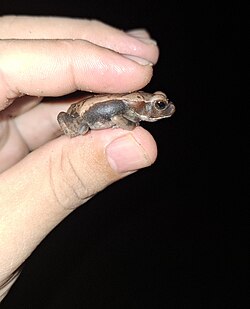 Juvenile

_Figure_3_(cropped).jpg)


References
edit- 1 2 3 4 Claudia Azevedo-Ramos, Enrique La Marca, Marinus Hoogmoed, Steffen Reichle (2010). "Rhaebo guttatus". IUCN Red List of Threatened Species. 2010 e.T54658A11183165. doi:10.2305/IUCN.UK.2010-2.RLTS.T54658A11183165.en. Retrieved 14 November 2021.
{{cite journal}}: CS1 maint: multiple names: authors list (link) - 1 2 Frost, Darrel R. (2026). "Rhaebo guttatus (Schneider, 1799)". Amphibian Species of the World: an Online Reference. Version 6.2. American Museum of Natural History. Retrieved 29 May 2026.
- ↑ Frost, Darrel R. (2026). "Rhaebo glaberrimus (Günther, 1869)". Amphibian Species of the World: an Online Reference. Version 6.2. American Museum of Natural History. Retrieved 29 May 2026.
- 1 2 Coloma, L. A.; Mueses-Cisneros J. J. "Rhaebo guttatus". Archived from the original on 31 January 2016. Retrieved 30 January 2016.
- 1 2 3 Mueses-Cisneros, J. J.; D. F. Cisneros-Heredia & R. W. McDiarmid (2012). "A new Amazonian species of Rhaebo (Anura: Bufonidae) with comments on Rhaebo glaberrimus (Gunther, 1869) and Rhaebo guttatus (Schneider, 1799)". Zootaxa. 3447: 22–40. doi:10.11646/zootaxa.3447.1.2. hdl:10088/21442.
- 1 2 "Smooth-Sided Toad". Animal Fact Sheets. Woodland Park Zoo. Retrieved 30 January 2016.
- ↑ "Smooth sided toad (Rhaebo guttatus)". Frogs.cc. 25 January 2014. Retrieved 28 July 2015.
