
This article includes a list of general references, but it lacks sufficient corresponding inline citations. (January 2010) |
Sikh architecture is a distinctive style of architecture that developed under the Sikh Confederacy and later flourished during the Sikh Empire in the 18th and 19th centuries, primarily in the Punjab region.[1] Due to its progressive nature, Sikh architecture has continued to evolve over time, giving rise to several new branches and influencing various contemporary architectural styles.[2] Although Sikh architecture was originally developed as part of the religious and cultural expression within Sikhism, its aesthetic richness and symbolic elements have led to its adoption in many secular and non-religious buildings as well, admired for their beauty and structural harmony.[3] 300 years ago, Sikh architecture was distinguished for its many curves and straight lines; Keshgarh Sahib and the Harmandir Sahib (Golden Temple) are prime examples of traditional Sikh architecture.[4]
Sikh architecture
ਸਿੱਖ ਸਥਾਪਤਕ ਕਲਾ Sikh monuments and shrines | |
|---|---|
Cultural and religious architectural style | |
| Sikh Architectural Heritage | |
From top, left to right: Harmandir Sahib (Golden Temple), Amritsar; Gurudwara Bangla Sahib, Delhi; Fatehgarh Sahib Sarovar; Interior of Samadhi of Ranjit Singh, Lahore; Tarn Taran Sahib; Takht Sri Patna Sahib, Bihar; Hazur Sahib, Nanded; Kartarpur Sahib, Pakistan; Fateh Burj; Gurdwara Dera Sahib, Lahore; Gurdwara Janam Asthan, Nankana Sahib |
.jpg)

_at_Fatehgarh_Sahib_Gurdwara,_Punjab,_India.jpg)
_of_Ranjit_Singh,_Lahore._04.jpg)


History
editBackground
editThe manifestation of Sikh architecture is sourced to the religion itself and relevant tenets and principles influencing the religious spaces associated with the community.[5] Studying historical Sikh architecture is rendered difficult due to how little of it dating to the gurus' period remains extant presently. In Punjab, architecture traditionally was constructed using small and thin brick (made from local-earth and low-fired in wood-burning kilns to be fully baked) rather than stone. Binding of the bricks to one another tended to be done by mud-mortar as lime-mortar was a luxury that had to be brought from Rajasthan, usually used for mud-mortared joints. More expensive mud-mortar structures had lime plaster and were decorated with murals. Only the most expensive building projects used lime-mortar throughout the structure. Due to the usage of mud-mortar, most historical Sikh structures did not survive the passage of time and due to the fact that the Punjab was subject to a series of invasions, destroying much of its architecture as a result. During Sikh-rule, such as in the 19th century, many original sites were rebuilt and renovated by Sikh rulers, destroying the original guru-era structures but building grander sites in their place. The destruction of historical Sikh architecture and edifices under the guise of renovation continued into the 20th and 21st centuries, especially at the most pivotal sites. Neglected sites (such as the Thatte Khera tank complex) are more likely to have surviving Sikh historical architecture as a result and textual evidence can be consulted to form an understanding of the historical evolution of Sikh architecture.[6]
Sikh architecture was heavily influenced by elements of Mughal and Islamic styles. Features such as the onion dome, frescoes, inlay work, and multi-foil arches are derived from the Mughal period, particularly during the reign of Shah Jahan. In contrast, features like chattris, oriel windows, bracket-supported eaves at the string-course, and decorative friezes reflect the influence of Rajput architecture.[7]
Sikh gurus
editSince the era of Guru Nanak, congregations of Sikhs constructed modest halls (Dharamsals) for religious functions.[6] The dharamsals were simple constructions that housed a gathering space for the local community (sangat) to listen to the guru's discourses, to meet others, eat together (langar), and to sing hymns. Later gurus had baolis (stepwells, notably the one in Goindwal built by Guru Amar Das) and sarovars (tanks or pools, notably by Guru Ram Das and Guru Arjan) constructed along trade-routes to spread the growing religion and to practice isnaan (bathing). Dharamsals were succeeded by gurdwaras that housed the community's sacred scripture compiled by Guru Arjan, the most notable of which is the Darbar Sahib in Amritsar.[5]

Guru Arjan constructed a number of temple tanks. His father Guru Ram Das had constructed the tank of Amritsar (Amrit Sarovar) but it was Arjan's idea to construct a central shrine edifice at the site, designing the shrine's architecture himself, consisting of a causeway to the domed shrine placed in a natural depression (showcasing humility), which had four entry points. The project to build the Darbar Sahib shrine at Amritsar was a rallying point for the early Sikh community of the time. A mason was hired and brick-kilns were utilized for the project. However, the current gold and marble construction dates to the reign of Maharaja Ranjit Singh (renovated between 1802 and 1839) and may have little in common with the original edifice constructed under Guru Arjan, with the original building being blown up by invading Afghans in 1762.[6]
Sikh rule
edit,_Punjab,_ca.1875_(published_in_'Piety_and_Splendour;_Sikh_Heritage_in_Art',_2000).jpg)
During Sikh rule, a number of habitational and military structures (such as forts) were built. The Darbar Sahib was reconstructed under Jassa Singh Ahluwalia in 1765 after it was destroyed. The Darshani Deori of the site was built in 1776 and the parkarma in 1784. The site was renovated by being embellished with gold-plated copper-sheets and marble starting in 1803 under Maharaja Ranjit Singh, with decorative artwork.[5] During the reign of Maharaja Karam Singh and his successors of Patiala, a unique Phulkian style of Sikh architecture developed, characterized by being influenced by Bengali roofs rather than onion-style domes. Some gurdwaras originally rebuilt in this Phulkian style include Gurdwara Qila Mubarak, Bathinda, Gurdwara Fatehgarh Sahib and Gurdwara Tilak Asthan (Garhi Sahib) in Chamkaur, and Gurdwara Sri Patshahi Nauvin Sahib Qila Bahadurgarh. However, most of these gurdwaras have since been rebuilt by Kar Seva renovators and lost their Phulkian appearance.[8]
Colonial period
editEarly British authors, such as Thomas Henry Thornton, wrote disparaging reports on Sikh architecture, which impacted its reception and these views continue to the present-day.[9] After colonization, European styles of architecture was introduced, such as Classical and Victorian Gothic. Furthermore, the Indo-Saracenic style developed, being promoted by the British. All of these styles competed with indigenous architectural styles in the princely states. Maharaja Jagatjit Singh of Kapurthala, a Francophile who travelled to Europe, utilized Western architectural styles with French influences.[10]
Description
edit
Apart from religious buildings, Sikh architecture includes secular forts, bungas (residential places), palaces, and colleges.[11] The religious structure is called gurdwara (a place where the Guru dwells). The word gurdwara is a compound of guru (guide or master) and dwara (gateway or seat). So, it has an architectural connotation. Sikh gurdwaras are generally commemorative buildings connected with the ten gurus in some way, or with places and events of historical significance. Some examples are Gurdwara Dera Sahib (encampment place), in Batala in Gurdaspur district. It was erected in memory of the brief stay of Guru Nanak along with his companions on the occasion of his marriage. Gurdwara Shahid Ganj (Martyrdom Memorial) in Muktsar in Faridkot district commemorates the cremation spot of Sikhs who were killed in a battle between Guru Gobind Singh and the Mughals in 1705. The Gurdwara Shish Mahal (Palace of Mirrors) in Kiratpur, located in the Ropar district of Punjab, marks the birthplace of the eighth Sikh Guru, Guru Har Krishan.[12] The key room in the gurdwara is the Darbar Sahib Hall, which houses the scripture and congregation.[13] There are over 500 historical gurdwaras across India and Pakistan, many of which are associated with significant events in the lives of the Sikh Gurus.[14]

There are four broad categories regarding shape and layout of Sikh shrine architecture:[11]
- square
- rectangular
- octagonal (ex. Gurdwara Baba Atal in Amritsar)
- cruciform (ex. Gurdwara Nanak Jhira in Bidar, Karnataka)
List of types of Sikh architecture
edit- Gurdwara
- Dharamsaal
- Baradari
- Sarai/Niwas
- Qila
- Burj
- Bunga
- Samadhi
Samadhs
editAccording to Zulfiqar Ali Kalhoro, studying the samadhs of Pothohar, states that Sikh samadhis were often decorated with frescoes, which usually depict both Sikh and Hindu themes, such as the Sikh gurus or Indic deities. During Sikh-rule, samadhis tended to be costly, grand structures with ribbed domes and elaborate paintings. However, Sikh samadhis erected during British-rule tended to be simpler, with fewer frescoes and shikhara or squat domes.[15][16]
Conservation
editMany priceless Sikh heritage sites (including their architecture) have been destroyed or altered beyond recognition under the guise of "kar seva" renovations by various institutions and groups in recent-times,[17][18][19][20][21][22] especially vulnerable are Sikh heritage sites in both India and Pakistan according to one scholar, who states it is due to "...the lack of will on the part of the authorities concerned to preserve them".[23] An example of these haphazard and destructive renovations is an incident involving the top section of the historical Darshani Deori gatehouse at the Gurdwara Tarn Taran Sahib complex, which was demolished by Kar Seva groups in March 2019.[24][25][26][27] Many groups are rushing to digitize what historical architecture and structures remains for posterity before they are lost, such as Panjab Digital Library.[28] In July 2021, the SGPC launched a project to archive and document the heritage structures of the community and have set up the old doors of the Golden Temple as museum display when they were replaced.[29][30][31] However, around the same time the SGPC denied the importance of a historical Sikh structure discovered underground near the Golden Temple complex, which experts at the Archaeological Survey of India (ASI) deemed as 'historic'.[32] Also, the SGPC made plans to raze a historical building known as Guru Ram Das Sarai, even in the face of criticism of the decision by experts.[33][34] As many as ninety percent of Sikh heritage monuments have been destroyed in Punjab in the name of renovation and kar seva.[35] Many historical Sikh structures that were destroyed by Kar Seva renovations include original houses of the Sikh gurus and their relatives.[36]
According to the Sikh historian, Harjinder Singh Dilgeer:[36]
Though kar seva babas had been renovating gurudwaras ever since anyone can remember, it was after Operation Bluestar, when the Sikh community donated generously for the massive rebuilding of the Golden Temple premises, that 'babas' began to appreciate the money-making opportunities such rebuilding threw up. The trend then spread across Punjab and in the last two decades, old heritage structures began to be demolished and replaced by garish, opulent marble gurudwaras. These pseudo-babas are armed with so much money but they spend it foolishly on rebuilding instead of restoration, because they are absolutely ignorant about the historical value of these old monuments. Somewhere along the line, the original, unpretentious Sikh architecture has begun to be perceived as something to be ashamed of. Our Gurus were simple, down-to-earth men of the soil, and their buildings reflect the simplicity and harmony which Sikhism is all about.
— Harjinder Singh Dilgeer, Sikh historian
According to Sikh scholar, Gurtej Singh, on who is to blame for the plight of Sikh historical heritage:[36]
Whether it is the Shiromani Gurudwara Prabandhak Committee or the Akal Takht or even the political Akali Dal which draws its strength from the former two, there is no appreciation for our heritage. Scholars like us do not matter in the scheme of things, because we obstruct their commercial aspirations. The SGPC patronises these babas and they do not realise that they are converting history into mythology by destroying historical evidence.
— Gurtej Singh
Peter Bance, when evaluating the status of Sikh sites in present-day India, where the majority of Sikhs live today, criticizes the destruction of the originality of 19th-century-era Sikh sites under the guise of "renovation", whereby historical structures are toppled and new buildings take their former place.[37] An example cited by him of sites losing their originality relates to nanakshahi bricks, which are characteristic of Sikh architecture from the 19th century, being replaced by renovators of historical Sikh sites in India by marble and gold.[37] Bance advocates that a grassroots movement advocating for the proper restoration and preservation of historical Sikh sites and their original architecture is necessary, which works together with private enthusiasts and government bodies in-cooperation with one another.[37] Bance further claims that a lack of willpower rather than a lack of funds is responsible for the poor conservation of Sikh historical sites.[37] Bance believes that the way forward in the modern-age to conserve Sikh heritage must be a digital approach, where social networking and technology is utilized to share research, build-up archives, and promote tourism to these sites.[37] Increased tourism has the potential to increase efforts to preserve and restore Sikh heritage sites.[37] Bance uses the Instagram platform to bring light to forgotten Sikh heritage lying in Pakistan with the wider community, using engagements there to generate social awareness and passion.[37] Through his Instagram account, Bance has been contacted by persons interested in restoring Sikh heritage sites, which have allowed them to be connected with others who specialize in this field.[37] Furthermore, he claims that on a weekly-basis hundreds of members of the general public from both India and Pakistan contact him through social media requesting him to visit their locality to document the Sikh heritage located there, as they lack the know-how on how to do this themselves.[37]
Shahid Shabbir is a Pakistani historian and journalist who has documented countless Sikh heritage sites (most often neglected, dilapidated, or abandoned) located in his country, including their extant artwork and architecture.[38][39] Sikh architecture remains a seldom studied or researched subject.[40]
Virasati Asthan Seva is a Sikh charity dedicated toward preserving historical Sikh sites, known as Asthāns.[41][42] Some of their current restoration projects are the Havelī Kavī Santokh Singh in Kaithal, Haryana and Gurdwara Bābā Bikram Singh Bedi in Amritsar, Punjab.[41][42]
Gallery
edit Golden dome of Gurdwara Dera Sahib in Lahore
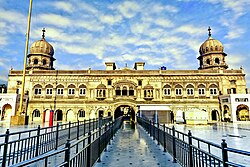 The Gurdwara Janam Asthan in Nankana Sahib, Pakistan, commemorates the site where Guru Nanak is believed to have been born. It was rebuilt by the Pakistani Government

 Gurudwara Bangla Sahib is one of the most prominent Sikh gurdwara in Delhi, India and known for its association with the eighth Sikh Guru, Guru Har Krishan, as well as the pool inside its complex, known as the "sarovar."
 Original structure of Gurudwara Sri Sheesh Mahal Sahib, Kiratpur Sahib
 True-colour photograph of Gurdwara Dera Sahib in Lahore, India (now Pakistan), taken in 1914 by Stéphane Passet.
 True-colour photograph titled ‘Interior decoration of the western door of the Darbar Sahib’, taken on 15 January 1914 by Stéphane Passet.


_in_Bengal,_India_(now_Bangladesh),_circa_1920–21.jpg)
._Sikh_Temple_in_1914_(Gurdwara_Dera_Sahib_in_Lahore).jpg)
’,_15_January_1914.jpg)
See also
editReferences
edit- ↑ Singh, Khushwant (2004). A History of the Sikhs, Volume 1: 1469–1839. Oxford University Press. p. 331. ISBN 978-0-19-567308-1.
- ↑ Subhash Parihar (2001). Golden Temple: History, Art, and Architecture. Aryan Books International. p. 102.
- ↑ Malik Arshi (2012). Sikh Architecture. Himalaya Publishing House. p. 47.
- ↑ Kartar Singh. "Sikh Architecture". SikhMuseum.com. Retrieved 2 July 2025.
- 1 2 3 Rai, Gurmeet S.; Kaur, Manpreet (March 2017). Lambah, Abha Narain (ed.). "Sikh Architecture: Identity and Symbolism". Marg. 68 (3): 36–49.
- 1 2 3 Rai, Gurmeet; Singh, Kavita (June 2003). "Brick by Sacred Brick: Architectural Projects of Guru Arjan and Guru Hargobind". Marg. 54 (4): 12–29.
- ↑ Subhash Parihar (1996). The Golden Temple: Past and Present. Publication Bureau, Punjabi University. p. 58.
- ↑ Singh, Harmilan (June 2026). "The King of the Arts: Karam Singh". Sahapedia. Retrieved 16 June 2026.
- ↑ Khan, Nadhra Shahbaz Naeem (2018). THE SAMĀDHI OF MAHARAJA RANJIT SINGH IN LAHORE: A Summation of Sikh Architectural and Decorative Practices (PDF). Berlin: EB-Verlag. pp. 20–22. ISBN 9783868932713.
- ↑ Sharma, Jyoti Pandey (March 2017). Lambah, Abha Narain (ed.). "The Architectural Legacy of Maharaja Jagatjit Singh of Kapurthala". Marg. 68 (3): 94–107.
- 1 2 Singh, Gurmukh (2004). "SIKH ARCHITECTURE". In Singh, Harbans (ed.). The Encyclopedia of Sikhism. Vol. IV: S–Z (2nd ed.). Punjabi University. pp. 131–133. ISBN 817380530X.
- ↑ Harbans Singh (1998). The Encyclopaedia of Sikhism. Vol. 2. Punjabi University. p. 228.
- ↑ Rai, Gurmeet S.; Kaur, Manpreet (March 2017). Lambah, Abha Narain (ed.). "Sikh Architecture: Identity and Symbolism". Marg. 68 (3): 37.
- ↑ "List of Historical Gurdwaras". World Gurudwaras. Retrieved 2 July 2025.
- ↑ Kalhoro, Zulfiqar Ali (19 February 2021). "Samadhis of Pothohar". The Friday Times. Retrieved 20 April 2026.
- ↑ Kalhoro, Zulfiqar Ali (19 April 2019). "Of Sikhs and a Sultan". The Friday Times. Retrieved 20 April 2026.
- ↑ Singh, Gurnam (2021-04-21). "Who's really destroying Sikh heritage?". Asia Samachar. Retrieved 2023-01-08.
- ↑ Singh, I. P.; Rana, Yudhvir (August 23, 2021). "Sikhs wake up late to the loss of religious heritage". The Times of India. Retrieved 2023-01-08.
- ↑ "Stop 'kar seva': SAD-A to SGPC". The Times of India. TNN. Apr 15, 2003. Retrieved 2023-01-08.
- ↑ "Sikhs aghast with tearing down of historic Sikh site in name of 'kar seva'". asiasamachar.com. Asia Samachar Team. April 2019. Retrieved 2023-01-08.
{{cite web}}: CS1 maint: others (link) - ↑ "UPDATE: Kar Seva's Baba Jagtar Singh Evicted from Sri Tarn Taran Sahib". Sikh24.com. Sikh24 Editors. 2019-04-01. Retrieved 2023-01-08.
{{cite web}}: CS1 maint: others (link) - ↑ IP Singh (Oct 7, 2018). "Heritage under the hammer". The Times of India. Retrieved 2023-01-08.
- ↑ "Sikh heritage sites in India, Pak facing ruin, says scholar". Tribuneindia News Service. Retrieved 2023-01-08.
- ↑ Yudhvir Rana (Mar 31, 2019). "Karsewa group demolish historical darshani deori". The Times of India. Retrieved 2023-01-08.
- ↑ "Historic Tarn Taran gurdwara's 'darshani deori' razed, row erupts". Hindustan Times. 2019-04-01. Retrieved 2023-01-08.
- ↑ "10 months on, no progress on restoration of Darshani Deori in Tarn Taran gurdwara". Hindustan Times. 2020-01-25. Retrieved 2023-01-08.
- ↑ Kaur, Mejindarpal (2019-04-05). "Stop the Destruction of Sikh Heritage". United Sikhs. Retrieved 2023-01-08.
- ↑ Sethi, Chitleen K. (2018-12-19). "In Punjab, a library's silent digital revolution is preserving the state's heritage". ThePrint. Retrieved 2023-01-08.
- ↑ "Beleaguered over Destruction of Heritage, SGPC Plans to Initiate Sikh Archives Project". Sikh24.com. Sikh24 Punjab Bureau. 2021-07-31. Retrieved 2023-01-08.
{{cite web}}: CS1 maint: others (link) - ↑ Paul, G.S. "200-year-old doors of Golden Temple's 'Darshani Deori' on display". Tribuneindia News Service. Tribune News Service. Retrieved 2023-01-08.
- ↑ "Jathedar dispels rumours on Darshani Deori doors". Tribuneindia News Service. Tribune News Service. Retrieved 2023-01-08.
{{cite web}}: CS1 maint: others (link) - ↑ "SGPC Continues to Deny Historic Importance of Old Structure Found at Darbar Sahib". Sikh24.com. Sikh24 Editors. 2021-07-31. Retrieved 2023-01-08.
{{cite web}}: CS1 maint: others (link) - ↑ "SGPC Revives Plan of Razing Darbar Sahib Sarai Where Sikhs Were Martyred During '84 Holocaust". Sikh24.com. Sikh24 Editors. 2021-07-20. Retrieved 2023-01-08.
{{cite web}}: CS1 maint: others (link) - ↑ "SGPC plans to demolish Guru Ram Dass Sarai near Darbar Sahib; Sikh groups obejct". Sikh Siyasat News. Sikh Siyasat Bureau. 2016-06-29. Retrieved 2023-01-08.
{{cite web}}: CS1 maint: others (link) - ↑ Glover, William J. "Shiny new buildings: rebuilding historic sikh gurdwaras in Indian Punjab." Future Anterior, vol. 9, no. 1, summer 2012, pp. 32+. Gale Academic OneFile, link.gale.com/apps/doc/A313972601/AONE?u=anon~bc4b7e36&sid=googleScholar&xid=807b241c. Accessed 8 Jan. 2023.
- 1 2 3 Dogra, Chander Suta (3 May 2016). "Have You the Eyes for It?". SikhNet (republished, originally published by Outlook Magazine). Retrieved 21 September 2023.
- 1 2 3 4 5 6 7 8 9 Bakshi, Artika Aurora (2023). "Discovering the Forgotten Heritage of the Panjabs With Peter Bance". Nishaan Nagaara (11): 28–37.
- ↑ Aslam, Irfan (28 May 2019). "Narowal haveli has nothing to do with Baba Guru Nanak". Dawn. Retrieved 28 August 2023.
- ↑ Singh, Inderjeet (18 September 2015). "Research Into Sikh Heritage in Pakistan – Shahid Shabbir (aka Baba Ji)". Sikh Net. Retrieved 28 August 2023.
- ↑ Kang, Kanwarjit Singh (1988). "16. The Sikh Shrines of Anandpur Sahib". Punjab Art and Culture. Atma Ram & Sons. p. 82. ISBN 9788170430964.
- 1 2 "The Saṃbhāl of GurSikh Asthāns". The Vital Anjan. 31 May 2024. Retrieved 6 August 2025.
- 1 2 "Home". Virasati Asthan Seva. Retrieved 6 August 2025.
Bibliography
edit- Arshi, Pardeep Singh, Sikh Architecture in the Punjab, Intellectual Pub. House, 1986.
- Brown, Percy, Indian Architecture (Islamic Period), Fifth Edition, 1965, Bombay.
- Brown, Percy, Indian Architecture (Hindu and Buddhist Period), Fifth Edition, 1965, Bombay.
- Singh, Mehar, Sikh Shrines In India, Publications Division, Government of India, 1974, New Delhi.
- Singh, Darshan, The Sikh art and architecture, Dept. of Guru Nanak Sikh Studies, Panjab University, 1987.
- Marg, Volume XXX, Number 3, June 1977, Bombay.
Further reading
edit- Rajwant Singh Chilana (2005). International Bibliography of Sikh Studies. Springer Netherlands. ISBN 978-1-4020-3043-7.
- Kerry Brown, ed. (1999). Sikh Art and Literature. Routledge. ISBN 978-0-415-20289-3.
External links
edit