
Sharif University of Technology (SUT) (Persian: دانشگاه صنعتی شریف, romanized: Dāneshgāh-e San'ati-ye Sharif) is a public research university in Tehran, Iran. The university is an institution for science, technology, engineering, and mathematics (STEM) fields.
Dāneshgāh-e San'ati-ye Sharif | |
 | |
Former name | Aryamehr University of Technology |
|---|---|
Motto in English | The Place of Intellectuals and Elites Transforming National Talents into Global Bests |
| Type | Public Research University |
| Established | 1966[1] |
| Affiliations | MSRT FUIW IAU ICTP TWAS |
| Endowment | US$ 0.5 billion (2021)[2] |
| President | Abbas Mousavi[3] |
Academic staff | 460 (Full-time) (Fall 2022) |
Administrative staff | 395 (2021) |
| Students | 10,812 (fall 2022) |
| Undergraduates | 5,659 (2021) |
| Postgraduates | 3,390 (2021) |
| 989 (2021) | |
| Location | , Tehran province , Iran 35°42′6.47″N 51°21′5.18″E / 35.7017972°N 51.3514389°E |
| Campus | Urban, 74 acres (29.9 ha) |
| Newspaper | Sharif Daily Scientia Iranica |
| Colors | Dark Blue |
Sporting affiliations | 19 sports IUSF |
| Website | sharif.ir |
 | |

Established in 1966 under the reign of Mohammad Reza Shah Pahlavi, it was formerly named in his honor as Aryamehr University of Technology (Persian: دانشگاه صنعتی آریامهر, romanized: Dāneŝgāhe Sannatiye Āryāmehr) and for a short period after the 1979 revolution, the university was called Tehran University of Technology but then it was renamed to Sharif University of Technology after Majid Sharif Vaghefi, a leading dissident member of People's Mojahedin Organization of Iran.
Sharif University of Technology is widely regarded as the leading engineering and STEM-focused university in Iran and one of the most prestigious technical universities in the Middle East. The university is known for its highly selective admissions process through Iran’s national university entrance examination (Konkur), and is often referred to as the “MIT of Iran” or the “MIT of the Middle East[4]” due to its emphasis on science, engineering, and technology education.
Today, the university provides both undergraduate and graduate programs in 15 main departments. The student body consists of about 6,000[5] undergraduate students and 4,700[5] graduate students from all the 31 provinces of Iran. Funding for Sharif University is provided by the government and through private funding. Undergraduate admission to Sharif is limited to the top 800 of the 500,000 students who pass the national entrance examination administered annually by the Iranian Ministry of Science, Research and Technology.[6]
In 2023, according to U.S. News & World Report, the world ranking of this university reached 598.[7][8]
History
edit
The university was founded in 1966 with the name Aryamehr University of Industry by Mohammad Ali Mojtahedi. At that time, there were 54 faculty members and a total of 412 students who were selected by national examination. Four departments were established: Electrical, Metallurgical, Mechanical, and Chemical Engineering.[9]
In 1972, Mohammad Reza Pahlavi appointed Hossein Nasr as president of the university with the goal of modeling the school based on the Massachusetts Institute of Technology, but with roots in Iranian culture.[10][11] In 1974 a new campus of the university was established in Isfahan. But later, that campus became an independent university, named Isfahan University of Technology (IUT).
Following the revolution, the university was named after Majid Sharif Vaghefi, who was one of the People's Mujahedin of Iran group's leaders who was killed by the members of a splinter group (later renamed to Peykar Organization) who had recently converted from Islam to Marxism and were adamant to forcefully change the Mujahedin's organization's ideology to Marxism.
As of 2020, the university has about 12,000 students and over 700 faculty members in 16 main departments.[12]
During the Mahsa Amini protests in 2022, many students participated, with video footage of the protest and subsequent response by Iranian security forces published first to social media and then by major news organizations. Iranian state news agency IRNA reported that at least 37 students were arrested and most were released shortly afterwards.[13][14][15]
On 6 April 2026, in the 2026 Iran war, the campus was attacked by the US and Israel.[16]
Campuses
editMain campus
editThe main campus of the university is located in the Tarasht neighborhood, near Azadi Square, Tehran, Iran. It is located close to the Azadi Tower, which is the symbol of Tehran and one of the main transportation hubs. The endowment of Sharif University of Technology has been estimated at $25 million.[17]
International campus
editدانشگاه صنعتی شریف پردیس بین الملل Dāneshgāh-e San'ati-ye Sharif | |
| Type | Public |
|---|---|
| Established | 2005 |
| Affiliation | Sharif University of Technology |
| Chancellor | Reza Yousefi |
| Students | ~1,000 |
| Location | , , 26°32′44.65″N 54°00′43.63″E / 26.5457361°N 54.0121194°E |
| Campus | Urban, 1.12 ha |
| Language | English language |
| Colours | Light Blue |
| Website | www.kish.sharif.edu |
| |

Sharif University also has an International Campus on Kish Island in the Persian Gulf. The International Campus of Sharif University of Technology was established in 2005. Today there are two faculties active in this campus: Faculty of Engineering and Science, and Faculty of Management. The campus is currently admitting students for bachelor's, master's, and Ph.D. degrees in engineering courses and a master's degree in management.
Admissions and selectivity
editUndergraduate admission to Sharif University of Technology is conducted primarily through Iran’s highly competitive national university entrance examination, known as the Konkur. Admission is generally limited to students achieving the highest national ranks among hundreds of thousands of applicants annually. Only students within the top percentile[18] of the examination are typically admitted to Sharif’s most competitive engineering and computer science programs.
World rankings
edit| University rankings | |
|---|---|
| Sharif University of Technology | |
| Global – Overall | |
| ARWU World[19] | 501–600 (2021) |
| CWTS World[20] | 371 (2021) |
| QS World[21] | =375 (2026) |
| THE World[22] | 401–500 (2022) |
| USNWR Global[23] | 598 (2023) |
In the 2020 Academic Ranking of World Universities[24] (also known as Shanghai Ranking), the university ranked between 501 and 600 in the world and first in Iran. According to the QS Ranking,[25] Sharif University of Technology has stood in the first place of Iran and maintained its international rank 334th. In the 2022-2023 U.S. News & World Report Best Global University Ranking, the university ranked 598th in the world.

Student life
editPolitical activities
editThrough the student political movement after the 2nd of Khordad Movement, Sharif students were also actively involved. The major groups with political intentions at Sharif, during 1997–2003, were Basij students and the Association of Muslim students, briefly called Anjoman (Association). Most other smaller groups were allies of either Basij or Anjoman. Basij was a serious opponent of Mohammad Khatami, the president at the time. Whereas Anjoman was a loyal follower. There have been several clashes between member students of the two groups. Free speech tribunes occasionally end in harsh, quarrel-like debates. However, the major clash between Anjoman and Basij occurred while the student movement was silent in most other universities. In 2006, a serious controversy resulting in physical tensions occurred after Basij attempted to bury the bodies of unknown martyrs of the Iran–Iraq War at the university's mosque court.[26]
Sharif University of Technology Association (SUTA)
editThis non-profit organization is registered in the state of California, USA and has many chapters and affiliates around the world. Its mission is to enhance professional, academic, and social contacts among its membership, and to strengthen the ties between the association members living outside of Iran and the university.[27]
Faculty and alumni
editChancellors
edit- Mohammad Ali Mojtahedi, 1965–1967
- Fazlollah Reza, 1967–1968
- Mohammad Reza Amin, 1968–1972
- Seyyed Hossein Nasr, 1972–1975
- Mehdi Zarghamee, 1975–1977
- Alireza Mehran, 1977–1978
- Hossein Ali Anvari, 1978–1979
- Ali Mohammad Ranjbar, 1979–1980
- Abbas Anvari, 1980–1982
- Ali Akbar Salehi, 1982–1985
- Abbas Anvari, 1985–1989
- Ali Akbar Salehi, 1989–1993
- Mohammad Etemadi, 1993–1995
- Sayed Khatiboleslam Sadrnezhaad, 1995–1997
- Saeed Sohrabpour, 1997–2010
- Reza Roosta Azad, 2010–2014
- Mahmud Fotuhi Firuzabad, 2014–2021
- Rasool Jalili, 2021–2023
- Abbas Mousavi, 2023–present
Notable alumni
editAlumni in academics include the late Maryam Mirzakhani, professor of mathematics at Stanford University and the first woman to be awarded a Fields Medal.
Imprisoned human rights blogger Kouhyar Goudarzi was an aerospace student at Sharif University until pressure from state security forces allegedly caused his dismissal.[28] Omid Kokabee, an applied physics and mechanics alumnus,[29] was arrested while visiting Iran during his postdoctoral research in University of Texas at Austin.[30] He was sentenced to 10 years in prison for "communicating with a hostile government" and "illegitimate/illegal earnings."[31] Mohammad-Ali Najafi ranked first in the Iranian national university entrance exam, and enrolled in Sharif University.[32] He became a mathematician, reformist politician, and murderer, as he was the Mayor of Tehran for eight months, became a professor at the university, and then in May 2019 murdered one of his two wives.[33].
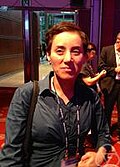 Maryam Mirzakhani: professor of mathematics at Stanford University and the first woman to be awarded a Fields Medal
 Elshan Moradi: chess grandmaster
 Ali Daei: former member and later head coach of Iranian national football team
 Adel Ferdosipour: football commentator
 Mohammad-Javad Larijani: Iranian conservative politician, mathematical logician, and former diplomat

 Mohammad-Ali Najafi, mathematician, professor, reformist politician, Mayor of Tehran, and murderer


.jpg)
.jpg)
See also
edit- List of Islamic educational institutions
- Higher education in Iran
- Pardis Technology Park
- Shahbal, unmanned aerial vehicle (UAV) developed at SUT
- Iranian Machine Design Competition
References
edit- ↑ "Sharif University of Technology – Introduction". Archived from the original on 25 December 2018. Retrieved 3 February 2017.
- ↑ "Financial information". FarsNews. 10 December 2014.
- ↑ "انتخاب ۷نفر از روسای دانشگاهها تایید شد" (in Persian). Mehr News. 3 March 2024. Retrieved 9 March 2024.
- ↑ Desk, India Today Education (10 March 2026). "Academics call it the MIT of Middle East: The university that built world's top engineers". India Today. Retrieved 25 May 2026.
{{cite web}}:|last=has generic name (help) - 1 2 "Archived copy" (PDF). Archived from the original (PDF) on 22 July 2011. Retrieved 2 November 2009.
{{cite web}}: CS1 maint: archived copy as title (link) - ↑ "Iran Makes the Sciences A Part of Its Revolution". The Washington Post.
- ↑ "Aryamehr University of Technology in Iran – US News Best Global Universities". U.S. News. 27 May 2024. Archived from the original on 28 May 2024. Retrieved 28 May 2024.
- ↑ "Discover Sharif University: A Leading Institution in Iran". Iran Brands Review. 27 May 2024. Archived from the original on 28 May 2024. Retrieved 28 May 2024.
- ↑ Mirzayi, Mohammad (2005). Aryamehr University of Technology Booklet (in Persian). Aryamehr University Press.
- ↑ "Biography / Dr. Seyyed Hossein Nasr". Retrieved 28 May 2008.
- ↑ Leslie, Stuart W.; Robert Kargon (2006). "Exporting MIT: Science, Technology, and Nation-Building in India and Iran". Osiris. 21 (1): 123. doi:10.1086/507138. S2CID 146272994.
- ↑ "Sharif University Introduction". Archived from the original on 25 December 2018. Retrieved 5 December 2020.
- ↑ "Iran protests: riot police use teargas on students at Aryamehr university". the Guardian. 3 October 2022. Retrieved 18 October 2022.
- ↑ Rebane, Teele; Ritchie, Hannah; Karadsheh, Jomana; Fox, Kara (3 October 2022). "'It was a warzone.' Iranian security forces beat, shot and detained students of elite Tehran university, witnesses say, as crackdown escalates". CNN. Retrieved 18 October 2022.
- ↑ Ershad, Alijani (4 October 2022). "'They shot at us': An Sharif University student recounts 'apocalyptic' repression of protests in Iran". The Observers - France 24. Retrieved 18 October 2022.
- ↑ "Israel Mounts Wave of Strikes on Iran". WSJ. 6 April 2026. Retrieved 6 April 2026.
- ↑ "Sharif University International Campus Website". Retrieved 17 November 2008.
- ↑ "Admission & Fee - Sharif University of Technology - پورتال دانشگاه شریف". Sharif University of Technology. Retrieved 25 May 2026.
- ↑ Academic Ranking of World Universities 2021, Shanghai Ranking Consultancy, retrieved 24 September 2021[permanent dead link]
- ↑ CWTS Leiden Ranking 2020, Centre for Science and Technology Studies, Leiden University, retrieved 24 September 2020
- ↑ "QS World University Rankings".
- ↑ World University Rankings 2021, THE Education Ltd, 25 August 2020, retrieved 2 September 2020
- ↑ Best Global Universities in Iran, U.S. News & World Report, retrieved 24 March 2022
- ↑ "Academic Ranking of World Universities – 2013". Shanghai Ranking Consultancy. Archived from the original on 6 October 2020. Retrieved 23 August 2013.
- ↑ "QS World University Rankings". Top Universities. Retrieved 29 December 2020.
- ↑ Esfandiari, Golnaz. "Iran: Students Protest Burials Of War Dead On Tehran Campuses". Radio Free Europe, Radio Liberty. Retrieved 28 May 2008.
- ↑ "SUTA Vision and Mission". Retrieved 22 February 2011.
- ↑ "Kouhyar Goudarzi: "I Won't Be Released Any Time Soon," Trial Date Unknown". International Campaign for Human Rights in Iran. 12 April 2010. Retrieved 1 January 2012.
- ↑ "Omid Kokabee (personal homepage)". Archived from the original on 19 September 2012. Retrieved 12 April 2013.
- ↑ Shuster, Mike (7 October 2011). "Iran Charges Student Who Was In the U.S." NPR.
- ↑ Maly, David (8 January 2013). "UT student Omid Kokabee gains more international support amid prison sentence". The Daily Texan. Archived from the original on 18 January 2017. Retrieved 12 April 2013.
- ↑ "نجفی رئیس سازمان میراث فرهنگی و". Fars News.
- ↑ "The Rise and Fall of Mohammad Ali Najafi". iranwire.com. Retrieved 17 June 2025.
