
The San Francisco Maritime National Historical Park is located in San Francisco, California, United States. The park includes a fleet of historic vessels, a visitor center, a maritime museum, and a library/research facility. Formerly referred to as the San Francisco Maritime Museum, the collections were acquired by the National Park Service in 1978. The San Francisco Maritime National Historical Park was authorized in 1988; the maritime museum is among the park's many cultural resources. The park also incorporates the Aquatic Park Historic District, bounded by Van Ness Avenue, Polk Street, and Hyde Street.
| San Francisco Maritime National Historical Park | |
|---|---|
 Historic ships docked at Hyde Street Pier, San Francisco Maritime National Historic Park | |
    | |
| Location | San Francisco, California, United States |
| Coordinates | 37°48′23″N 122°25′25″W / 37.80639°N 122.42361°W |
| Area | 50 acres (20 ha)[1] |
| Established | June 27, 1988 |
| Visitors | 2,944,483 (in 2025)[2] |
| Governing body | National Park Service |
| Website | www |
Official name | Aquatic Park Historic District |
| Designated | January 26, 1984 |
| Reference no. | 84001183[3] |
Official name | San Francisco Maritime National Historic Site |
| Designated | June 27, 1988 |
| Reference no. | 01000281[4] |
History
editPhilanthropist Alma de Bretteville Spreckels' last major project was the construction of the San Francisco Maritime Museum. When it opened in 1951, her collection of model ships that had been on display at the 1939–40 Golden Gate International Exposition was the main exhibit. She had had a feud with museum founding director, Karl Kortum,[5] and as a result, did not receive much recognition for her role in the museum's establishment.[6][7][8][9]
Historic vessel fleet
editThe historic fleet of the San Francisco Maritime National Historical Park is moored at the park's Hyde Street Pier.[citation needed] The fleet consists of the following major vessels:
- Balclutha, an 1886 built square rigged sailing ship.
- C.A. Thayer, an 1895 built schooner.
- Eureka, an 1890 built steam ferryboat.
- Alma, an 1891 built scow schooner.[10]
- Hercules, a 1907 built steam tug.
- Eppleton Hall, a 1914 built paddlewheel tug.
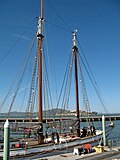

 Square rig sailing ship Balclutha

 Lumber schooner C.A. Thayer
_2.JPG)
.JPG)
.JPG)
.jpg)
.JPG)

The fleet also includes over one hundred small craft.
Visitor center
edit.jpg)

The visitor center is housed in the park's 1909 waterfront warehouse, located at the corner of Hyde and Jefferson streets (499 Jefferson[11]). The City of San Francisco declared the four-story brick structure a historic landmark in 1974, and the building was listed on the National Register of Historic Places in 1975. Inside, exhibits (including a first order Fresnel lighthouse lens and a shipwrecked boat) tell the story of San Francisco's colorful and diverse maritime heritage. The visitor center also contains a theater and an information desk.[citation needed] SFGate described the visitors center as containing ‘museum-quality exhibits’ that show the importance of maritime history for the West Coast.[12]

Maritime Museum
edit
The maritime museum is housed in a Streamline Moderne (late Art Deco) building in the shape of an ocean liner that is the centerpiece of the Aquatic Park Historic District,[13] a National Historic Landmark at the foot of Polk Street and a minute's walk from the visitor center and Hyde Street Pier. The building was originally completed in 1939[13] by the WPA as a public bathhouse, and its interior is decorated with fantastic and colorful mosaics and murals,[13] created primarily by artist and color theoretician Hilaire Hiler.[14] Some of the artwork was rediscovered during restoration projects in the 2010s.[15] In 2024, The New York Times listed the museum on its recommendations for what to do in San Francisco in 36 hours.[16] The Aquatic Park Bathhouse building that has housed the museum since 1951[12] was the focus of a 2025 documentary.[17]
Maritime Research Center
edit
According to SFGate, the Maritime Research Center has the largest and best collection of materials on ships and the sea on the Pacific Coast.[19] It is considered a top-4 maritime research center nationally[18] and it also claims to be the largest museum and research collection in the National Park Service.[20]
The Center says it started collecting in 1939[20] and has previously been known as the J. Porter Shaw Library and informally as the San Francisco Maritime Museum Library.[21] The J. Porter Shaw Library started in 1951 without a name in a closet tucked under a staircase.[22] In 1959, after J. Porter Shaw’s collections were acquired, it became the J. Porter Shaw Library.[22] Many of the acquisitions were made by a friends group, including on topics ranging from World War II to commercial cruises.[22] Its materials date back to 1536, including more than:[20]
- 35,000 published titles[21] comprising over 74,000 items
- 500,000 photographs[22]
- 7,000 archival and manuscript collections
- 150,000 naval architecture and marine engineering drawings[22]
- 3,000 maps and charts dating from 1650[21]
- 150,000 feet of motion picture film and video
- 6,000 historical archaeology artifacts
- 2,500 pieces of folk and fine art
- 40,000 history objects
- 100 small craft
- 50,000 pieces of ephemera (e.g. menus, brochures)[23][21]
- 600 oral histories and audio recordings (including hundreds of albums of sea chanteys[22])[21]
The Center houses significant resources on topics such as the history of the Port of San Francisco[24] (including its laborers[25]), the whaling trade in the Bay Area,[26][27] the types of ships that traversed the Bay[28] and information on the locations of sunken ships.[18] The Center does not have passenger lists.[10]
In 1983, the Center moved to a historic warehouse in Fort Mason Center.[22][18] The Center became available by appointment-only starting in 2006 due to budget constraints.[19] The Center also has storage facilities in San Francisco and San Leandro.[10]
Location and access
edit.jpg)
The visitor center, Hyde Street Pier, and Maritime Museum are all situated adjacent to the foot of Hyde Street and at the western end of the Fisherman's Wharf district. The park headquarters and Maritime Research Center are located in Fort Mason, some 10 minutes walk to the west of the other sites. The Beach and Hyde Street terminal of the San Francisco cable car system adjoins the main site, while the Jones Street terminal of the F Market historic streetcar line is some 5 minutes walk to the east.
Open-water swimming
editAquatic Park is a popular place for open water swimming, both for recreation and training. The South End Rowing Club and Dolphin Club are located in Aquatic Park.

See also
edit
- 49-Mile Scenic Drive
- San Francisco Maritime National Park Association, the primary nonprofit partner to the Park
References
edit- ↑ "Listing of acreage – December 31, 2011" (XLSX). Land Resource Division, National Park Service. Retrieved March 23, 2012. (National Park Service Acreage Reports)
- ↑ "NPS Annual Recreation Visits Report". National Park Service. Retrieved March 23, 2026.
- ↑ "Aquatic Park Historic District". National Historic Landmarks Program. Archived from the original on July 10, 2014.
- ↑ "National Register Information System". National Register of Historic Places. National Park Service. July 9, 2010.
- ↑ Fisher, Lawrence M. (September 15, 1996). "Karl Kortum, 79, Who Founded San Francisco Maritime Museum". The New York Times. Retrieved January 2, 2023.
- ↑
- Craig, Christopher. "Part 1: Spreckels (née de Bretteville), Alma Emma". Encyclopedia of San Francisco. Archived from the original on December 26, 2007. Retrieved January 9, 2008.
- Craig, Christopher. "Part 2: Spreckels (née de Bretteville), Alma Emma". Encyclopedia of San Francisco. Archived from the original on December 26, 2007. Retrieved January 9, 2008.
- ↑ Scharlach, Bernice (1990). Big Alma: San Francisco's Alma Spreckels. Scottwall Associates. ISBN 0-942087-11-9.
- ↑ "San Francisco Maritime Museum. Archive by Alma de Bretteville Spreckels". Alan Wofsy Fine Arts. Archived from the original on January 2, 2023. Retrieved January 2, 2023.
- ↑ Craig, Christopher. "Alma Spreckels". FoundSF. Retrieved January 2, 2023.
- 1 2 3 "Outside Lands San Francisco Podcast Episode 121: San Francisco Maritime Research Center". Western Neighborhoods Project. May 9, 2015. Retrieved November 11, 2025.
- ↑ "See U.S.A. vs. N.Z. in America's Cup final". Orange County Register. August 28, 2013. Retrieved April 16, 2026.
- 1 2 Doyle, Jim (September 9, 2005). "SAN FRANCISCO / 50th anniversary fete for ship used in film 'Mutiny on the Bounty' / Fisherman's Wharf festival to feature 3-masted Balclutha". SFGATE. Retrieved April 16, 2026.
- 1 2 3 Hession, Stephanie Wright (June 16, 2011). "Beach and Hyde streets, S.F.:". SFGATE. Retrieved April 16, 2026.
- ↑ "San Francisco Maritime Museum". U.S. National Park Service.
- ↑ Salazar, James (August 12, 2025). "Ship-shaped SF landmark gets its due in new doc". SFWeekly. Retrieved April 16, 2026.
- ↑ Moon, Freda (November 7, 2024). "36 Hours in San Francisco". The New York Times. ISSN 0362-4331. Retrieved April 21, 2026.
- ↑ Salazar, James (August 11, 2025). "Ship-shaped SF landmark gets its due in new doc". San Francisco Examiner. Retrieved April 16, 2026.
- 1 2 3 4 Carroll, Glenda (November 10, 1995). "Library stores rare maritime history". Marin Independent Journal.
- 1 2 Nolte, Carl (September 15, 2006). "SAN FRANCISCO / Maritime Museum makes library appointment only". SFGATE. Retrieved April 15, 2026.
- 1 2 3 "Maritime Research Center". National Park Service.
- 1 2 3 4 5 Shuttleworth, James (Summer 2008). "The J. Porter Shaw Library: Portal To Great Maritime Collections". Nautical Research Journal. 53 (2).
- 1 2 3 4 5 6 7 Overmier, Judith A. (June 2006). "Cultural Record Keepers". Libraries & the Cultural Record. 41 (3): 395–400. doi:10.1353/lac.2006.0052. ISSN 1932-9555.
- ↑ Schwartz, Stephen (May 15, 1995). "Big Gift of Memorabilia To S.F. Maritime Museum". San Francisco Chronicle. Retrieved April 21, 2026.
- ↑ Glueck, Gabriela (February 27, 2025). "Ever Heard of a 'Frisco Biscuit'? Neither Had Many Maritime Historians". www.kqed.org. Retrieved April 14, 2026.
- ↑ Nolte, Carl (March 20, 2021). "A tribute to the Chinese laborers from S.F. who worked in Alaska's salmon canneries". San Francisco Chronicle. Retrieved April 14, 2026.
- ↑ Fiore, Mark (August 30, 2019). "Commercial Whaling's Last Holdout: The Bay Area?". www.kqed.org. Retrieved April 14, 2026.
- ↑ Demoro, Harre W. (July 3, 1992). "Museum in S.F. Gets Whaling Library". SF Chronicle.
- ↑ Fitzgerald, Michael. "Fitzgerald: A trove of Stockton boat photos". The Stockton Record. Retrieved April 14, 2026.
Bibliography
editBill Pickelhaupt, "San Francisco's Aquatic Park," Charleston, SC, 2005, ISBN 0-7385-3084-0
External links
edit