
Road signs in the Philippines are regulated and standardized by the Department of Public Works and Highways (DPWH).[1][2] Most of the signs reflect minor influences from American and Australian signs but keep a design closer to the Vienna Convention on Road Signs and Signals, to which the Philippines is an original signatory.[3][4] The Philippines signed the convention on November 8, 1968, and ratified it on December 27, 1973.[5]


Though the Philippines has signed the Vienna Convention on Road Signs and Signals, road signs "Priority Road", "End of priority road", "Give way to oncoming traffic" and "Priority over oncoming traffic", which are mainly found in European countries, are not used in this country as well as in the United States, Canada, and Latin American countries.
Part 2 of the Highway Safety Design Standards Manual mandates the use of the Standard alphabets, often referred to as Highway Gothic. It contains a reproduction of the former Australian implementation AS1744-1975 Standard Alphabets in the appendix pp A103-A146.[1] Clearview appears to have supplanted it, and other fonts are in use.
Regulatory signs
editRegulatory signs indicate the application of legal or statutory requirements. Disregarding these signs may constitute the road user to an offense.[1]
Priority signs
edit Stop
Stop Give way
 Magbigay-daan (Give way) (plate type)
 Left turner must give way


Directional signs
edit No turns
 One way (right)
 One way (left)
 Keep right
 Keep left
 Pass either side
 All traffic (right)
 All traffic (left)
 Merging traffic
 Two-way traffic
 No turns (plate type)
 One-way (right, plate type)
 One-way (left, plate type)
 Keep right (plate type)
 Keep left (plate type)
 All traffic (right, plate type)
 All traffic (left, plate type)
 Merging traffic (plate type)
 Two-way traffic (plate type)
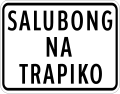 Salubong na Trapiko (Two-way traffic)
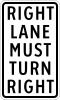 Right lane must turn right
 Left lane must turn left


Restrictive signs
edit No entry for all vehicles
 No entry for all vehicles (plate type)
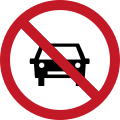 No entry for cars
 No entry for jeepneys
 No entry for bicycles
 No entry for motorcycles
 No entry for tricycles
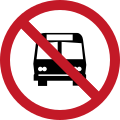 No entry for buses
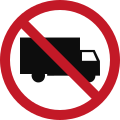 No entry for trucks
 No entry for vehicles with trailer
 No pedestrian crossing
 No entry for animal drawn vehicles
 No entry for pushcarts
 No crossing, use overpass (plate type)
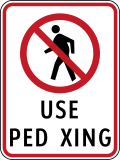 No pedestrian crossing (plate type)
 Bawal tumawid, gamitin ang overpass (No crossing, use overpass) (plate type)
 No right turn
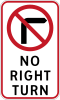 No right turn (plate type)
 No left turn
 No left turn (plate type)
 No U-turn
 No U-turn (plate type)
 No overtaking
 Bawal lumusot (No overtaking) (plate type)


Speed signs
edit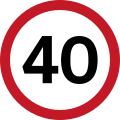 Speed restriction (maximum)
 Speed limit de-restriction (plate type)
 Speed restriction (minimum)
.svg)
.svg)
.svg)
Parking signs
edit No parking
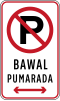 Bawal pumarada (No parking)
 No parking, loading only
 No parking anytime
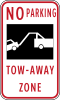 No parking, tow-away zone
 Time restricted parking
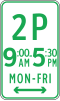 Time restricted parking
 Loading zone
 Loading and unloading zone
 No waiting anytime
 No waiting
 Bawal maghintay ano mang oras (No waiting anytime)
 No loading and unloading anytime
 Bawal magsakay at magbaba (No loading and unloading)
 No loading unloading anytime
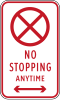 No stopping anytime
 No parking, public utility bus stop
 No parking, public utility jeepney stop
 No parking, public utility jeepney stop
 Do not block intersection
 Right turners cross at broken white lines


Miscellaneous signs
edit No blowing of horns
 Width restriction
 Height restriction
 Weight restriction (by tonnes)
 Weight restriction (per axle)
 Length restriction
 End of all restrictions
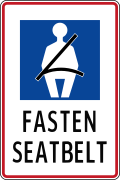 Fasten seatbelt
 Pedestrian crossing
 Children crossing
 Bicycles lane
 Persons with disabilities crossing


Warning signs
editWarning signs are used to warn road users to the potential hazard along, or adjacent to, the road.[1] They are triangular and red-bordered, similar to warning signs used in Europe.[6]
Horizontal alignment signs
edit Sharp turn (right)
 Sharp turn (left)
 Reverse turn (right)
 Reverse turn (left)
 Curve (right)
 Curve (left)
 Reverse curve (right)
 Reverse curve (left)
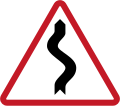 Winding road (right)
 Winding road (left)
 Hairpin bend (right)
 Hairpin bend (left)


Intersection and junction signs
edit Intersection
 Staggered intersection (right)
 Staggered intersection (left)
 Skewed intersection (right)
 Skewed intersection (left)
 T-junction
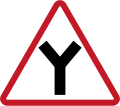 Y-junction
 Half Y-junction (right)
 Half Y-junction (left)
 Reverse half Y-junction (right)
 Reverse half Y-junction (left)
 Side junction (right)
 Side junction (left)
 Roundabout
 Priority, side junction (right)
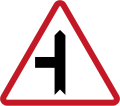 Priority, side junction (left)
 Priority, merging traffic (right)
 Priority, merging traffic (left)
 Priority, intersection


Advance warning of traffic control devices signs
edit Traffic lights ahead
 Stop sign ahead
 Give way sign ahead


Road width signs
edit Narrow bridge
 Narrow bridge (plate type)
 Road narrows
 Road narrows (plate type)
 Start of divided traffic
 End of divided traffic


Road obstacle signs
edit Opening bridge
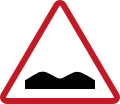 Uneven road
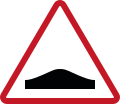 Hump
Hump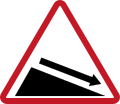 Steep descent (right)
 Steep descent (left)
 Steep climb (right)
 Steep climb (left)
 Spill way
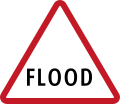 Flood
Flood Falling debris (right)
 Falling debris (left)
 Slippery road
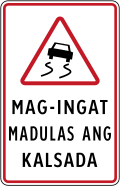 Mag-ingat, madulas ang kalsada (Slippery road) (plate type)
 Cattle crossing
 Low flying aircraft


Pedestrian signs
edit Pedestrian crossing ahead
 Slow down, pedestrian crossing ahead (plate type)
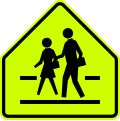 Children crossing ahead
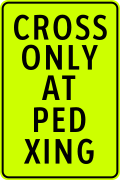 Cross only at pedestrian crossing
 Handicapped crossing
 Bike lane ahead

.svg)


Railroad crossing signs
edit Railroad crossing position
 Railroad crossing advance warning (unsignalled)
 Railroad crossing advance warning (signalled)
 Railroad crossing position (alternative)


Supplementary signs
edit Advisory speed
 On side road (right)
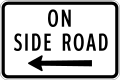 On side road (left)
 Distance (meter)
 Distance (kilometer)
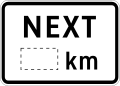 Next distance (kilometer)
 When wet
 Blind
Blind Aged
Aged Playground
 School
 Disabled
 For public utility jeepneys
 For buses


Other warning road signs
edit Vertical clearance
 Low clearance
 Slow down, accident prone area
 Bumagal, madalas ang aksidente dito (Slow down, accident prone area)
 Slow down, merging traffic ahead
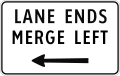 Lane ends, merge left
 Slow down, weighbridge ahead


Guide or information signs
editGuide or information signs are used to inform road users about the direction and distances of the route that they are following.[1]
Advance direction signs
edit Stack direction (multiple)
 Stack direction (single)
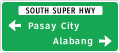 Stack direction (with road name)
 Diagrammatic direction
 Diagrammatic direction (roundabout)


Intersection direction signs
edit Intersection direction (right)
 Intersection direction (left)
 Intersection direction (both sides)
 Intersection direction (with road name)


Reassurance direction signs
edit Reassurance direction
 Reassurance direction (with road name)


Finger board and direction signs for less important roads
edit Direction (place)
 Direction (road)
 Direction (tourist spot)


Street sign
editTown names and geographical feature signs
edit Town name
 Province name
 Geographical feature


Service signs
edit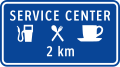 Service sign (with name of service, symbols, and distance)
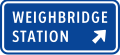 Service sign
 Service sign
 Service sign
 Service sign (advance sign with name of service)


Tourist information and tourist destination signs
edit Tourist spot Fort Santiago
 Tourist spot Taal Lake
 Tourist spot National Museum turn right
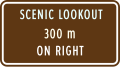 Tourist spot scenic lookout on right


Route marker signs
edit National Route marker
 Expressway Route marker
 Route markers
 Route markers
 Route markers
 Route markers
 Route markers
 Route markers
 Route markers
 End
End
.svg)
.svg)


Asian highway route marker signs
edit Asian highway marker
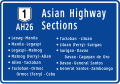 Asian highway segments
 Asian highway segment
 Asian highway maintenance jurisdiction
 Asian highway segment name


Expressway signs
editExpressway signs are signs that are used on, or near, controlled-access roads.[1]
Expressway approach signs
edit Expressway approach sign
 Expressway approach sign
 Expressway approach sign (small)


Expressway information signs
edit Prohibited on expressway
 Bawal pumasok sasakyang walang tail light (No entry for vehicles without tail light)
 Bawal bisikleta motorsiklo sa expressway (No bicycles or motorcycles allowed in expressway)
 Toll charges
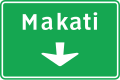 Lane direction


Advance exit signs
edit Advance exit with distance
 Advance exit with distance and lane
 Supplementary advance exit


Exit direction signs
edit Exit with destination
 Next exit
 Exit
Exit Exit (numbered)


Expressway service signs
edit Rest area 2 km right lane
 Picnic site 15 km right lane


End of expressway signs
edit Expressway ends after 1 km
 Expressway ends after 2 km
 Start of Expressway
 End of Expressway


Toll signs
edit Toll Plaza Ahead (with distance)
 Stop at Toll Gates
 Pay Toll Ahead


Expressway traffic instruction and regulatory signs
edit Wrong way, go back
 Reduce speed now
 Right lane ends, merge left
 Lane ends, merge left


Traffic instruction signs
editTraffic instruction signs are used to instruct a road user to follow a direction or perform an action. These are also used as a supplement for regulatory and warning signs.[1]
Supplementary signs
edit Use overpass
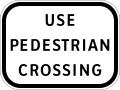 Use pedestrian crossing
 Trucks use low gear


Movement instruction signs
edit Reduce speed
 Stop here on red signal
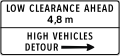 Low clearance ahead, high vehicles detour
 No right turn on red signal
 Slow vehicles use right lane
 Mabagal na sasakyan mamalagi sa kanan (Slow vehicles keep right)
 Trak at bus mamalagi sa kanan maliban kung lulusot (Trucks and buses keep right unless overtaking)
 No through road
 Road closed
 Form 1 lane
 Form 2 lanes


Hazard markers
editHazard markers are signs that are usually used in places with obstructions and curves. These signs may be used with or after a warning sign.[1]
 Black and white chevron (right)
 Black and white chevron (left)
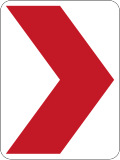 White and red chevron (right)
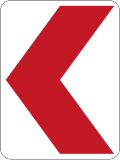 White and red chevron (left)
 One way hazard marker (right)
 One way hazard marker (left)
 Obstruction marker
 Two way hazard marker (large)
 Two way hazard marker (small)
 Two-way hazard marker
 Width marker (right)
 Width marker (left)


Criticism
editSome writers and motorists have commented on problems with Philippine road signs, such as unclear wording, inconsistent placement, and limited use of Filipino. In 2000, columnist Al S. Mendoza argued that traffic signs should be changed from English to Filipino to improve comprehension.[7] Later articles in the Philippine Daily Inquirer criticized obscure or poorly placed road signs as a safety hazard.[8][9]
See also
editSources
edit This article incorporates text from this source, which is in the public domain: "Highway Safety Design Standards Manuals: Part 1 – Road Safety Design Manual and Part 2 – Road Signs and Pavement Markings Manual". Department of Public Works and Highways. May 2012.
References
edit- 1 2 3 4 5 6 7 8 The Highway Safety Design Standards Manual of the Department of Public Works and Highways (DPWH):
- Part 1: Road Safety Design Manual. Department of Public Works and Highways. May 2012.
- Part 2: Road Signs and Pavement Markings Manual. Department of Public Works and Highways. May 2012.
- ↑ Consunji, Robby (August 18, 2018). "How to contest a violation because of a hidden 'No Entry' sign". Top Gear Philippines. Retrieved February 26, 2021.
- ↑ "Presidential Decree No. 207 – Ratifying the 1968 Vienna Conventions of the United Nations on Road Traffic and Road Signs and Signals, Respectively". Official Gazette. President of the Philippines. June 6, 1973. Retrieved February 26, 2021.
- ↑ Hermoso, Tito F. (November 6, 2018). "Built against the odds (3)". The Manila Times. Archived from the original on November 19, 2021. Retrieved February 26, 2021.
- ↑ "United Nations Treaty Collection". treaties.un.org. Retrieved December 10, 2023.
- ↑ Forbes, Ronel (February 6, 2024). "Road Signs for Motorists in the Philippines". MGS Insurance. Retrieved July 29, 2024.
- ↑ Mendoza, Al S. (August 3, 2000). "Change traffic signs from English to Filipino". Full Tank. Philippine Daily Inquirer. p. 7. Retrieved September 4, 2022 – via Google Books.
- ↑ "Signs of the times". Philippine Daily Inquirer. February 9, 2007. p. 2. Retrieved September 4, 2022 – via Google Books.
- ↑ Santiago, Revy (November 19, 2007). "Obscure road signs, dangerous traffic hazard". Philippine Daily Inquirer. p. 16. Retrieved September 4, 2022 – via Google Books.
External links
edit- A quick guide to safe driving by recognizing standard road signs in the Philippines by the Manila Bulletin
