
The red and blue damsel, (Xanthagrion erythroneurum) is a damselfly in the family Coenagrionidae.[4][1] It is the only member of the monotypic genus Xanthagrion.[5][6]
| Red and blue damsel | |
|---|---|
 | |
| Male, Tasmania, Australia | |
 | |
| Female | |
Scientific classification  | |
| Kingdom: | Animalia |
| Phylum: | Arthropoda |
| Clade: | Pancrustacea |
| Class: | Insecta |
| Order: | Odonata |
| Suborder: | Zygoptera |
| Family: | Coenagrionidae |
| Genus: | Xanthagrion Selys 1876[2] |
| Species: | X. erythroneurum |
| Binomial name | |
| Xanthagrion erythroneurum | |
 | |

Description
editDistribution and habitat
editEtymology
editThe genus name Xanthagrion is derived from the Greek ξανθός (xanthos, "yellow") and Agrion, a genus name derived from the Greek ἄγριος (agrios, "wild"). Agrion was the name applied by Johan Christian Fabricius in 1775 to all damselflies.[2][10]
The species name erythroneurum is derived from the Greek ἐρυθρός (erythros, "red") and νεῦρον (neuron, "nerve" or "sinew"), referring to the colour of the major wing veins.[3][10]
Gallery
edit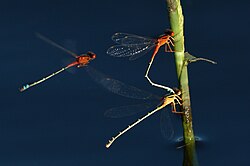 Mating I. The male holds the female behind her head.
 Mating II. The male pushes the female under the water.
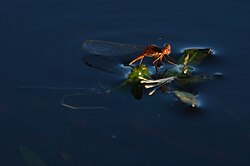 Mating III. The female is completely under the water. Both male and female dragonflies go under.
 Male
Male Female wings
 Male wings
.jpg)
.jpg)
.jpg)

.jpg)
.jpg)
References
edit- 1 2 Dow, R.A. (2017). "Xanthagrion erythroneurum". IUCN Red List of Threatened Species. 2017 e.T83152243A83381754. doi:10.2305/IUCN.UK.2017-1.RLTS.T83152243A83381754.en. Retrieved 20 November 2021.
- 1 2 Selys-Longchamps, E. (1876). "Synopsis des Agrionines (suite du genre Agrion)". Bulletin de la Classe des Science, Académie Royale de Belgique (in French). 42: 490–531, 952–991 [520] – via Biodiversity Heritage Library.
- 1 2 Selys-Longchamps, E. (1876). "Synopsis des Agrionines (suite du genre Agrion)". Bulletin de la Classe des Science, Académie Royale de Belgique (in French). 42: 490–531, 952–991 [521] – via Biodiversity Heritage Library.
- ↑ "Species Xanthagrion erythroneurum (Selys, 1876)". Australian Faunal Directory. Australian Biological Resources Study. 2012. Retrieved 3 April 2017.
- ↑ "Genus Xanthagrion Selys, 1876". Australian Faunal Directory. Australian Biological Resources Study. 2012. Retrieved 3 April 2017.
- ↑ Paulson, D.; Schorr, M.; Abbott, J.; Bota-Sierra, C.; Deliry, C.; Dijkstra, K.-D.; Lozano, F. "World Odonata List". OdonataCentral. University of Alabama. Retrieved 3 April 2026.
- 1 2 3 "Red and Blue Damselfly - Xanthagrion erythroneurum". Brisbane Insects. Retrieved 2009-07-25.
- 1 2 3 Daley, Elizabeth (2007). Wings: An introduction to Tasmania's winged insects. Riffles Pty Ltd.
- ↑ Watson, J.A.L.; Theischinger, G.; Abbey, H.M. (1991). The Australian Dragonflies: A Guide to the Identification, Distributions and Habitats of Australian Odonata. Melbourne: CSIRO. ISBN 978-0-643-05136-2.
- 1 2 Endersby, Ian; Fliedner, Heinrich (2015). The Naming of Australia's Dragonflies. Eltham, Victoria, Australia: Busybird Publishing. ISBN 9781925260625.

Wikimedia Commons has media related to Xanthagrion erythroneurum.

Wikispecies has information related to Xanthagrion erythroneurum.