

_Wikivoyage_Banner.JPG)
The United Kingdom Portal
.svg) |
 |
 | |
The United Kingdom of Great Britain and Northern Ireland, commonly known as the United Kingdom (UK) or Britain, is a country in northwestern Europe, off the coast of the continental mainland. It comprises England, Scotland, Wales and Northern Ireland, with a population of over 69 million in 2024. The UK includes the island of Great Britain, the north-eastern part of the island of Ireland, and most of the smaller islands within the British Isles, covering 94,354 square miles (244,376 km2). It shares a land border with the Republic of Ireland and is surrounded by the Atlantic Ocean, the North Sea, the English Channel, the Celtic Sea and the Irish Sea, while maintaining sovereignty over the Crown Dependencies and the British Overseas Territories. The capital and largest city of England and the UK is London; Edinburgh, Cardiff and Belfast are the national capitals of Scotland, Wales and Northern Ireland, respectively.
The British Isles have been continuously inhabited since the Neolithic. In AD 43 the Roman conquest of Britain began. The Roman departure between 383 and 410 was followed by Anglo-Saxon settlement beginning around 450. In 1066 the Normans conquered England. Over the 17th century the role of the British monarchy was reduced, particularly as a result of the English Civil War. In 1707 the Kingdom of England and the Kingdom of Scotland united under the Treaty of Union to create the Kingdom of Great Britain. The Acts of Union 1800 incorporated the Kingdom of Ireland to create the United Kingdom of Great Britain and Ireland in 1801. Most of Ireland seceded from the UK in 1922 as the Irish Free State, and the Royal and Parliamentary Titles Act 1927 created the present United Kingdom.
The UK became the first industrialised country and was the world's foremost power for the majority of the 19th and early 20th centuries, particularly during the Pax Britannica between 1815 and 1914. The British Empire was the leading economic power for most of the 19th century, a position supported by its agricultural prosperity, its role as a dominant trading nation, a massive industrial capacity, significant technological achievements, and the rise of 19th-century London as the world's principal financial centre. At its height in the 1920s, the empire encompassed around a quarter of the world's landmass and population, and was the largest in history. However, its involvement in the First World War and in the Second World War damaged Britain's economic power, and a global wave of decolonisation led to the independence of most British colonies. (Full article...)
Featured article

The Talyllyn Railway is a narrow-gauge preserved railway in Wales running for 7.25 miles (11.67 km) from Tywyn on the Mid-Wales coast to Nant Gwernol near the village of Abergynolwyn. The line was opened in 1866 to carry slate from the quarries at Bryn Eglwys to Tywyn, and was the first narrow gauge railway in Britain authorised by Act of Parliament to carry passengers using steam haulage. Despite severe under-investment, the line remained open, and in 1951 it became the first railway in the world to be preserved as a heritage railway by volunteers. Since preservation, the railway has operated as a tourist attraction, significantly expanding its rolling stock through acquisition and an engineering programme to build new locomotives and carriages. In 1976 an extension was opened along the former mineral line from Abergynolwyn to the new station at Nant Gwernol. In 2001 the preservation society celebrated its 50th anniversary, and in 2005 a major rebuilding and extension of Tywyn Wharf station took place, including a much expanded facility for the Narrow Gauge Railway Museum. The fictional Skarloey Railway, which formed part of the Railway Series of children's books by the Rev. W Awdry, was based on the Talyllyn Railway. The preservation of the line inspired the Ealing Comedy film The Titfield Thunderbolt. (Full article...)
Featured biography
.jpg)
John Churchill, 1st Duke of Marlborough (1650–1722) was a prominent English soldier and statesman whose career spanned the reigns of five monarchs throughout the late 17th and early 18th centuries. Churchill's role in defeating the Monmouth Rebellion in 1685 helped secure James, the Duke of York on the throne, yet just three years later he abandoned his Catholic mentor for the Protestant Dutchman, William of Orange. Churchill served with distinction in the early years of the Nine Years' War, but persistent charges of Jacobitism brought about his fall from office and temporary imprisonment in the Tower. His marriage to Sarah Jennings – Queen Anne's friend – ensured Marlborough's rise to a dukedom. Becoming de facto leader of Allied forces during the War of the Spanish Succession, his victories in battles ensured his place in history as one of Europe's great generals. But his wife's stormy relationship with the Queen, and her subsequent dismissal from court, was central to his being forced from office and into self-imposed exile. He returned to England and to influence under the House of Hanover with the accession of George I to the British throne in 1714, but his health gradually deteriorated, and he died on 16 June 1722 (O.S). (Full article...)
General images -
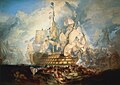 The Battle of Trafalgar is an oil painting executed in 1822 by J. M. W. Turner (c.1775–1851). The experience of military, political and economic power from the rise of the British Empire led to a very specific drive in artistic technique, taste and sensibility in the United Kingdom. (from Culture of the United Kingdom)
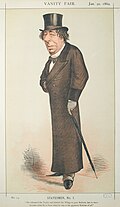 Caricature of British Prime Minister Benjamin Disraeli in Vanity Fair, 30 January 1869 (from Culture of the United Kingdom)
 McVitie's chocolate digestive is routinely ranked the UK's favourite snack, and No. 1 biscuit to dunk in tea. (from Culture of the United Kingdom)
 The full breakfast is among the best known British dishes, consisting of fried egg, sausage, bacon, mushrooms, baked beans, toast, fried tomatoes, and sometimes white or black pudding. (from Culture of the United Kingdom)
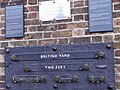 Yard, foot and inch measurements at the Royal Observatory, London. The British public commonly measure distance in miles and yards, height in feet and inches, weight in stone and pounds, speed in miles per hour. (from Culture of the United Kingdom)
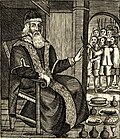 The Examination and Trial of Father Christmas (1686), published after Christmas was reinstated as a holy day in England (from Culture of the United Kingdom)
 Union Flag being flown on The Mall, London looking towards Buckingham Palace (from Culture of the United Kingdom)
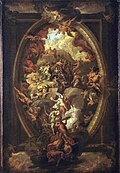 William III and Mary II Presenting the Cap of Liberty to Europe, 1716, Sir James Thornhill. Enthroned in heaven with the Virtues behind them are the royals William and Mary who had taken the throne after the Glorious Revolution and signed the English Bill of Rights of 1689. William tramples on arbitrary power and hands the red cap of liberty to Europe where, unlike Britain, absolute monarchy stayed the normal form of power execution. Below William is the French king Louis XIV. (from Culture of the United Kingdom)
 Stonehenge, Wiltshire at sunset (from Culture of the United Kingdom)
 Jack in the Green, a traditional English folk custom being celebrated in Hastings Old Town, known for its many historic buildings. (from Culture of the United Kingdom)
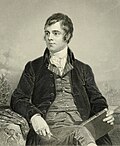 Robert Burns is regarded as the national poet of Scotland.
 Music hall evolved into variety shows. First performed in 1912, the Royal Variety Performance was first held at the London Palladium (pictured) in 1941. Performed in front of members of the Royal Family, it is held annually in December and broadcast on television. (from Culture of the United Kingdom)
 The British Heart Foundation is the biggest funder of cardiovascular research in the UK. (from Culture of the United Kingdom)
 One of Britain's oldest indigenous breeds, the Bulldog is known as the national dog of Great Britain. (from Culture of the United Kingdom)
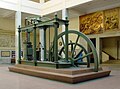 A Watt steam engine, the steam engine that propelled the Industrial Revolution in Britain and the world (from Culture of the United Kingdom)
 Tea, biscuits, jam and cakes. Tea is the most popular beverage in the UK. (from Culture of the United Kingdom)
 Emmeline Pankhurst. Named one of the 100 Most Important People of the 20th Century by Time, Pankhurst was a leading figure in the suffragette movement. (from Culture of the United Kingdom)
 Two of the current Ravens of the Tower of London. The ravens' presence is traditionally believed to protect the Crown and the tower; a superstition holds that "if the Tower of London ravens are lost or fly away, the Crown will fall and Britain with it". (from Culture of the United Kingdom)
 The Old English heroic poem Beowulf is located in the British Library. (from Culture of the United Kingdom)
 Sunday league football (a form of amateur football). Amateur matches throughout the UK often take place in public parks. (from Culture of the United Kingdom)
 English Heritage blue plaque commemorating Sir Alfred Hitchcock at 153 Cromwell Road, London (from Culture of the United Kingdom)
 Queen Victoria's Christmas tree at Windsor Castle, published in the Illustrated London News, 1848 (from Culture of the United Kingdom)
 Queen Victoria in her white wedding dress with Prince Albert on their return from the marriage service at St James's Palace, London, 10 February 1840 (from Culture of the United Kingdom)
 Naomi Campbell appeared on the era-defining January 1990 cover of British Vogue. (from Culture of the United Kingdom)
 Scouts, Brownies, and Cubs with the local community in Tiverton, Devon on Remembrance Sunday (from Culture of the United Kingdom)
 Smeaton's Eddystone Lighthouse, 9 miles out to sea. John Smeaton pioneered hydraulic lime in concrete which led to the development of Portland cement in England and thus modern concrete. (from Culture of the United Kingdom)
 Ice dancers Torvill and Dean in 2011. Their historic gold medal-winning performance at the 1984 Winter Olympics was watched by a British television audience of more than 24 million people. (from Culture of the United Kingdom)
 Terraced houses are typical in inner cities and places of high population density. (from Culture of the United Kingdom)
 An award-winning Victoria sponge from an English village fête. Competitive baking is part of the traditional village fête, inspiring The Great British Bake Off television series. (from Culture of the United Kingdom)
 The Glastonbury Festival at night in 2025. The festival has an average daily attendance of 175,000 people with millions more watching live on BBC. (from Culture of the United Kingdom)
 The Royal Stewart tartan. It is also the personal tartan of Queen Elizabeth II Tartan is used in clothing, such as skirts and scarves, and has also appeared on tins of Scottish shortbread. (from Culture of the United Kingdom)
 The red telephone box and Royal Mail red post box appear throughout the UK. (from Culture of the United Kingdom)
 R. White's soft drinks sold in London. Selling carbonated lemonade in 1845, by 1887 they sold strawberry soda, raspberry soda and cherryade. (from Culture of the United Kingdom)
 William Shakespeare has had a significant impact on British theatre and drama. (from Culture of the United Kingdom)
 Statue of Minnie the Minx, a character from The Beano, in Dundee, Scotland. Launched in 1938, The Beano is known for its anarchic humour, with Dennis the Menace appearing on the cover. (from Culture of the United Kingdom)
 Titanic Belfast museum on the former shipyard in Belfast where the RMS Titanic was built (from Culture of the United Kingdom)
 Welsh native Roald Dahl is frequently ranked the best children's author in British polls.
 A 21st-century detached Mock Tudor house in Scotland. Its timber framing is typical of English Tudor architecture. (from Culture of the United Kingdom)
 The Christmas Pantomime 1890. Pantomime plays a prominent role in British culture during the Christmas and New Year season. (from Culture of the United Kingdom)
 A Christmas dinner plate in Scotland, featuring roast turkey, roast potatoes, mashed potatoes and brussels sprouts (from Culture of the United Kingdom)
 Cricketer W. G. Grace, with his long beard and MCC cap, was the most famous British sportsman in the Victorian era. (from Culture of the United Kingdom)
 The wizard Merlin features as a character in many works of fiction, including the BBC series Merlin. (from Culture of the United Kingdom)
 Old Bushmills Distillery, County Antrim, Northern Ireland. Founded in 1608, it is the oldest licensed whiskey distillery in the world. (from Culture of the United Kingdom)
 Concorde (and the Red Arrows with their trail of red, white and blue smoke) mark the Queen's Golden Jubilee. With its slender delta wings Concorde won the public vote for best British design. (from Culture of the United Kingdom)
 Westminster Abbey is an example of English Gothic architecture. Since 1066, when William the Conqueror was crowned, the coronations of British monarchs have been held here. (from Culture of the United Kingdom)
 The Forth Railway Bridge is a cantilever bridge over the Firth of Forth in the east of Scotland. It was opened in 1890, and is designated as a Category A listed building. (from Culture of the United Kingdom)
 The Oxford Union debate chamber. Called the "world's most prestigious debating society", the Oxford Union has hosted leaders and celebrities. (from Culture of the United Kingdom)
 Wembley Stadium, London, home of the England football team and FA Cup finals. Wembley also hosts concerts: Adele's 28 June 2017 concert was attended by 98,000 fans, a stadium record for a music event in the UK. (from Culture of the United Kingdom)
 Typical 20th-century, three-bedroom semi-detached houses in England (from Culture of the United Kingdom)
 The British Shorthair was an inspiration for the Cheshire Cat in Lewis Carroll's Alice in Wonderland. (from Culture of the United Kingdom)
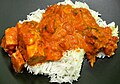 Chicken tikka masala, served atop rice. An Anglo-Indian meal, it is among the UK's most popular dishes. (from Culture of the United Kingdom)
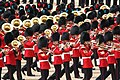 The Grenadier Guards band playing "The British Grenadiers" at Trooping the Colour. Formed in 1685 the band performs at British ceremonial events. (from Culture of the United Kingdom)
 Featherweight champion "Prince" Naseem Hamed was a major name in boxing and 1990s British pop culture. (from Culture of the United Kingdom)
 John Speed's Genealogies Recorded in the Sacred Scriptures (1611), bound into first King James Bible in quarto size (1612) (from Culture of the United Kingdom)
 Trooping the Colour is an annual ceremony, most notably associated with the British Army, and involves a grand parade featuring hundreds of soldiers, horses, and musicians. (from Culture of the United Kingdom)
 Hadrian's Wall was built in the 2nd century AD. It is a lasting monument from Roman Britain. It is the largest Roman artefact in existence. (from Culture of the United Kingdom)
 The founder of modern nursing Florence Nightingale tending to a patient in 1855. An icon of Victorian Britain, she is known as The Lady with the Lamp. (from Culture of the United Kingdom)
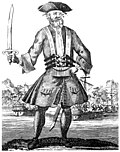 Engraving of the English pirate Blackbeard from the 1724 book A General History of the Pyrates. The book is the prime source for many famous pirates of the Golden Age. (from Culture of the United Kingdom)
 Physicist Stephen Hawking set forth a theory of cosmology explained by a union of the general theory of relativity and quantum mechanics. His 1988 book A Brief History of Time appeared on The Sunday Times best-seller list for a record-breaking 237 weeks. (from Culture of the United Kingdom)
 Charles Darwin established that all species of life have descended over time from common ancestors. (from Culture of the United Kingdom)
 Centre Court at Wimbledon. The world's oldest tennis tournament, it has the longest sponsorship in sport with Slazenger supplying tennis balls to the event since 1902. (from Culture of the United Kingdom)
 The Beatles are the most commercially successful and critically acclaimed band in popular music, with estimated sales of over one billion.
 The Notting Hill Carnival is Britain's biggest street festival. Led by members of the British African-Caribbean community, the annual carnival takes place in August and lasts three days. (from Culture of the United Kingdom)
 English novelist Jane Austen was held by literary critic Harold Bloom to be one of the greatest Western writers of all time. (from Culture of the United Kingdom)
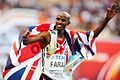 Mo Farah is the most successful British track athlete in modern Olympic Games history, winning the 5000 m and 10,000 m events at two Olympic Games. (from Culture of the United Kingdom)
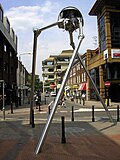 Statue of a tripod from The War of the Worlds in Woking, England, the hometown of author H. G. Wells. The book is a seminal depiction of a conflict between mankind and an extraterrestrial race. (from Culture of the United Kingdom)
 Millennium Stadium, Cardiff, Wales prior to a Wales vs England Six Nations Championship game. The annual rugby union tournament (which includes Scotland and Ireland) takes place over six weeks from late January/early February to mid March. (from Culture of the United Kingdom)
 King Alfred the Great statue in Winchester, Hampshire. The 9th-century English king encouraged education in his kingdom, and proposed that primary education be taught in English, with those wishing to advance to holy orders to continue their studies in Latin. (from Culture of the United Kingdom)
 Highland dancing in traditional Gaelic dress with its tartan pattern (from Culture of the United Kingdom)
 Peter O'Toole as T. E. Lawrence in David Lean's 1962 epic Lawrence of Arabia (from Culture of the United Kingdom)
 Bodiam Castle is a 14th-century moated castle in East Sussex. Today there are thousands of castles throughout the UK. (from Culture of the United Kingdom)
 One of the UK's many stately homes, Chatsworth House in Derbyshire, surrounded by an English garden. The house is one of the settings of Jane Austen's novel Pride and Prejudice. (from Culture of the United Kingdom)
 King Edward's Chair in Westminster Abbey. A 13th-century wooden throne on which the British monarch sits when he or she is crowned at the coronation, swearing to uphold the law and the church. The monarchy is apolitical and impartial, with a largely symbolic role as head of state. (from Culture of the United Kingdom)
 The first colour photograph in 1861. Produced by the three-colour method suggested by James Clerk Maxwell in 1855, it is the foundation of all colour photographic processes. (from Culture of the United Kingdom)
 Josiah Wedgwood was a leading entrepreneur in the Industrial Revolution. (from Culture of the United Kingdom)
 The Proms are held annually at the Royal Albert Hall during the summer. Regular performers at the Albert Hall include Eric Clapton who has played at the venue over 200 times. (from Culture of the United Kingdom)
.jpg)


.jpg)


.jpg)


.jpg)


.jpg)


_zoom.jpg)


.jpg)


_Moscow_2013.jpg)


Subportals


WikiProjects
Things you can do
- Visit the British Wikipedians' notice board.
- The noticeboard is the central forum for information and discussion on editing related to the United Kingdom.
- Comment at the British deletion sorting page.
- This page lists deletion discussions on topics relating to the United Kingdom.
Featured pictures
![Image 1George IVArtist: Sir Thomas LawrenceAn oil on canvas portrait of George IV of the United Kingdom as the Prince Regent, by Sir Thomas Lawrence. In 1814, Lord Stewart, who had been appointed ambassador in Vienna and was a previous client of Thomas Lawrence, wanted to commission a portrait by him of the Prince Regent. He arranged that Lawrence should be presented to the Prince Regent at a levée. Soon after, the Prince visited Lawrence at his studio in Russell Square. Lawrence wrote to his brother that: To crown this honour, [he] engag'd to sit to me at one today and after a successful sitting of two hours, has just left me and comes again tomorrow and the next day.More featured pictures](http://wiki.nitrosworld.org/proxy-img/http%3A%2F%2Fupload.wikimedia.org%2Fwikipedia%2Fcommons%2Fthumb%2F9%2F9f%2FGeorge_IV_bust1.jpg%2F120px-George_IV_bust1.jpg) Artist: Sir Thomas LawrenceAn oil on canvas portrait of George IV of the United Kingdom as the Prince Regent, by Sir Thomas Lawrence. In 1814, Lord Stewart, who had been appointed ambassador in Vienna and was a previous client of Thomas Lawrence, wanted to commission a portrait by him of the Prince Regent. He arranged that Lawrence should be presented to the Prince Regent at a levée. Soon after, the Prince visited Lawrence at his studio in Russell Square. Lawrence wrote to his brother that: To crown this honour, [he] engag'd to sit to me at one today and after a successful sitting of two hours, has just left me and comes again tomorrow and the next day.
Artist: Sir Thomas LawrenceAn oil on canvas portrait of George IV of the United Kingdom as the Prince Regent, by Sir Thomas Lawrence. In 1814, Lord Stewart, who had been appointed ambassador in Vienna and was a previous client of Thomas Lawrence, wanted to commission a portrait by him of the Prince Regent. He arranged that Lawrence should be presented to the Prince Regent at a levée. Soon after, the Prince visited Lawrence at his studio in Russell Square. Lawrence wrote to his brother that: To crown this honour, [he] engag'd to sit to me at one today and after a successful sitting of two hours, has just left me and comes again tomorrow and the next day. Photograph: David IliffSgùrr nan Gillean is a mountain in the northern section of the Cuillin range on the Isle of Skye in Scotland. With a height of 964 m (3162 feet), it is one of eleven Munros on the Cuillin ridge.
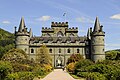 Photograph: Son of GrouchoInveraray Castle is a country house near Inveraray in the county of Argyll, in western Scotland, on the shore of Loch Fyne, Scotland’s longest sea loch. Designed in part by William Adam and Roger Morris, work on the Gothic Revival castle began in the 1740s. The castle, the seat of the Duke of Argyll, chief of Clan Campbell, is open to the public.
 Photo credit: Chalmers ButterfieldShaftesbury Avenue from Piccadilly Circus, in the West End of London, c. 1949. The Circus, a famous traffic intersection and public space in the City of Westminster was built in 1819 to connect Regent Street with the major shopping street of Piccadilly. Its status as a major traffic intersection has made it a busy meeting point and a tourist attraction in its own right.
 Poster: Parliamentary Recruiting Committee; restoration: Adam CuerdenA British recruitment poster from the First World War, featuring imagery of Saint George and the Dragon. Britain in the First World War fielded more than five million troops. Enrollment was initially voluntary, and in 1914 and 1915 the British military released numerous recruitment posters to attract troops. As the war progressed there were fewer volunteers to fill the ranks, and in 1916 the Military Service Act, which provided for the conscription of single men aged 18–41, was introduced. By the end of the war the law's scope had been extended to include older and married men.
 Painting: John Everett MillaisOphelia is an oil painting on canvas completed by Sir John Everett Millais between 1851 and 1852. It depicts the character Ophelia, from Shakespeare's play Hamlet, singing before she drowns in a river in Denmark; this death scene is not seen onstage, but is instead described in a speech by Queen Gertrude. The painting was completed in two stages: first, the setting (drawn from the Hogsmill River in Surrey) then Ophelia (portrayed by Elizabeth Siddal). The painting is now owned by Tate Britain and valued at more than £30 million.
 The "Hampden" portrait of Elizabeth I of England was painted by the Flemish artist Steven van der Meulen in the mid to late 1560s. Art historian Sir Roy Strong has suggested that this is "one of a group produced in response to a crisis over the production of the royal image" as a number of old-fashioned and unflattering portraits of the queen were then in circulation. This is the earliest full-length (2 m or 7 ft tall) portrait of the young queen, and depicts her in red satin trimmed with pearls and jewels. It represents a phase in the portraiture of Elizabeth I before the emergence of allegorical images representing the iconography of the "Virgin Queen". In November 2007 it was auctioned by Sotheby's for ₤2.6 million, more than twice the maximum predicted.
 The Ruins of Holyrood Chapel is an oil painting on canvas completed by Louis Daguerre in c. 1824. It depicts Holyrood Abbey, once the official residence of the Monarch of the United Kingdom in Edinburgh, Scotland, lit by moonlight. The painting is now held by the Walker Art Gallery in Liverpool.
 Photo: David IliffA panoramic view of Skiddaw mountain, the town of Keswick, and Derwentwater, as viewed from Walla Crag on a clear autumn afternoon in the Lake District. Located in North West England, the district is a popular tourist destination and is famous for its lakes and mountains, especially those within its national park.
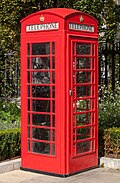 Photograph: Christoph BraunA 'K6' model red telephone box outside of St Paul's Cathedral in London. These kiosks for a public telephone were designed by Sir Giles Gilbert Scott and painted "currant red" for easy visibility. Although such telephone boxes ceased production when the KX series was introduced in 1985, they remain a common sight in Britain and some of its colonies, and are considered a British cultural icon.
 Photo credit: Jürgen MaternPanoramic view of the geodesic dome structures of the Eden Project, a large-scale environmental complex near St Austell, Cornwall, England. The project was conceived by Tim Smit and is made out of hundreds of hexagons (transparent biomes made of ETFE cushions) that interconnect the whole construction together. The project took 2½ years to construct and opened to the public in March 2001.
 Photo: David IliffCrib Goch is an arête in Snowdonia national park, Wales, reaching 923 m (3,028 ft) above mean sea level. It is a popular destination for mountaineering, but even experienced climbers have suffered fatalities on it. It is also the wettest spot in the United Kingdom, with an average of 4,473 millimetres (176.1 in) rainfall a year over the past 30 years.
 Image credit: Alfred BryanGilbert and Sullivan created fourteen comic operas, including H.M.S. Pinafore, The Pirates of Penzance, and The Mikado, many of which are still frequently performed today. However, events around their 1889 collaboration, The Gondoliers, led to an argument and a lawsuit dividing the two. In 1891, after many failed attempts at reconciliation by the pair and their producer, Richard D'Oyly Carte, Gilbert and Sullivan's music publisher, Tom Chappell, stepped in to mediate between two of his most profitable artists, and within two weeks he had succeeded. This cartoon in The Entr'acte expresses the magazine's pleasure at the reuniting of D'Oyly Carte (left), Gilbert (centre), and Sullivan (right).
 Caterpillar, Alice's Adventures in WonderlandArtist: Sir John TennielSir John Tenniel's illustration of the Caterpillar for Lewis Carroll's classic children's book, Alice's Adventures in Wonderland. The illustration is noted for its ambiguous central figure, which can be viewed as having either a human male's face with pointed nose and protruding lower lip or as the head end of an actual caterpillar, with the right three "true" legs visible. The small symbol in the lower left is composed of Tenniel's initials, which was how he signed most of his work for the book. The partially obscured word in the lower left-center is the last name of Edward Dalziel, the engraver of the piece.
 Painting: Anthony van DyckCharles I (19 November 1600 – 30 January 1649) was monarch of the three kingdoms of England, Scotland, and Ireland from 1625 until his execution in 1649. The second son of King James VI of Scotland, he spent most of his life in England after his father inherited the English throne in 1603. His reign was marked by quarrels with the Parliament of England, which sought to curb his royal prerogative. From 1642, Charles fought the armies of the English and Scottish parliaments in the English Civil War. His defeat led to his execution, followed by establishment of a republic called the Commonwealth of England.
This painting, titled Equestrian Portrait of Charles I, is an oil-on-canvas work by Charles's Principal Painter in Ordinary, Anthony van Dyck. The portrait, now in the National Gallery in London, is thought to have been painted in about 1637–38, and is one of many portraits of Charles by van Dyck, including several equestrian portraits.
![Image 1George IVArtist: Sir Thomas LawrenceAn oil on canvas portrait of George IV of the United Kingdom as the Prince Regent, by Sir Thomas Lawrence. In 1814, Lord Stewart, who had been appointed ambassador in Vienna and was a previous client of Thomas Lawrence, wanted to commission a portrait by him of the Prince Regent. He arranged that Lawrence should be presented to the Prince Regent at a levée. Soon after, the Prince visited Lawrence at his studio in Russell Square. Lawrence wrote to his brother that: To crown this honour, [he] engag'd to sit to me at one today and after a successful sitting of two hours, has just left me and comes again tomorrow and the next day.More featured pictures](http://wiki.nitrosworld.org/wiki/File:George_IV_bust1.jpg)


,_1824_(Google_Art_Project).jpg)


Did you know -

- ... that Elizabeth II's childhood toys at 145 Piccadilly included 30 toy horses and a farm set collected from Woolworths?
- ... that former Scottish Conservative leader Ruth Davidson said that she would swim in Loch Ness naked if the SNP won more than 50 seats at the 2019 United Kingdom general election?
- ... that Change UK had eleven elected members of Parliament despite never actually winning an election?
- ... that Graham Fraser pioneered cochlear implantation in the United Kingdom?
- ... that South African president Jacob Zuma requested a tour of a Sainsbury's supermarket during his state visit to the United Kingdom in 2010?
- ... that before Michael Shanks became Member of Parliament for Rutherglen and Hamilton West, he ran along all of Glasgow's 6,143 streets?
In the news

- 20 June 2026 – Terrorism in the United Kingdom
- Five people are injured in Islamophobic attacks in Edinburgh, Scotland. A 36-year-old man is arrested and counter-terrorism police are investigating. (DW)
- 19 June 2026 – 2026 Labour Party leadership crisis
- British home secretary Shabana Mahmood, energy secretary Ed Miliband, and transport secretary Heidi Alexander meet with prime minister Keir Starmer and reportedly urge him to set out a timetable for his departure following Andy Burnham's win in the 2026 Makerfield by-election. (The Herald) (The Telegraph)
- 18 June 2026 – Economic impact of the 2026 Iran war
- The United Kingdom lifts its travel advisory for Bahrain, Kuwait, Qatar, the United Arab Emirates, and the Riyadh and Eastern provinces of Saudi Arabia after the signing of the peace deal. (The Independent)
- 18 June 2026 – 2026 Labour Party leadership crisis
- Former Greater Manchester mayor Andy Burnham is elected to the House of Commons of the United Kingdom after winning a by-election in Makerfield, setting up a leadership challenge to prime minister Keir Starmer. (The Guardian)
- 15 June 2026 –
- British prime minister Keir Starmer announces a ban on social media for children under 16. (The Guardian) (The New York Times)
- 14 June 2026 – Russia–United Kingdom relations
- British Royal Marines storm and seize a Russian shadow fleet tanker in the English Channel. (BBC News)
Categories

Other UK-connected Wikipedias
Wikimedia
The following Wikimedia Foundation sister projects provide more on this subject:
-
 Commons
Free media repository -
 Wikidata
Free knowledge base -
 Wikiquote
Collection of quotations -
 Wikisource
Free-content library -
 Wikiversity
Free learning tools -
 Wikivoyage
Free travel guide -
 Wiktionary
Dictionary and thesaurus


