

The Rocketry Portal

A rocket (from Italian: rocchetto, lit. ''bobbin/spool'', and so named for its shape) is an elongated flying vehicle that uses a rocket engine to accelerate without using any surrounding air. A rocket engine produces thrust by reaction to exhaust expelled at high speed. Unlike jet engines, rockets are fuelled entirely by propellant which they carry, without the need for oxygen from air; consequently a rocket can fly in the vacuum of space, indeed rocket engines operate more efficiently outside the atmosphere.
Multistage rockets are capable of attaining escape velocity from Earth and therefore can achieve unlimited maximum altitude. Compared with airbreathing engines, rockets are lightweight and powerful and capable of generating large accelerations. To control their flight, rockets may use momentum, airfoils, auxiliary reaction engines, gimballed thrust, momentum wheels, deflection of the exhaust stream, propellant flow, and spin, or may simply fly in a ballistic trajectory under the influence of gravity.
Rockets for military and recreational uses date back to at least 13th-century China. Significant scientific, interplanetary and industrial use did not occur until the 20th century, when rocketry was the enabling technology for the Space Age, including setting foot on the Moon. Rockets are now used for fireworks, missiles and other weaponry, ejection seats, launch vehicles for artificial satellites, human spaceflight, and space exploration.
Chemical rockets are the most common type of high-power rocket, typically creating a high-speed exhaust by the combustion of fuel with an oxidizer. The stored propellant can be a simple pressurized gas or a single liquid fuel that disassociates in the presence of a catalyst (monopropellant), two liquids that spontaneously react on contact (hypergolic propellants), two liquids that must be ignited to react (like kerosene (RP1) and liquid oxygen, used in most liquid-propellant rockets), a solid combination of fuel with oxidizer (solid fuel), or solid fuel with liquid or gaseous oxidizer (hybrid propellant system). Chemical rockets store a large amount of energy in an easily released form, and the consequences of accidents can be severe.
The term "rocket" is also used for small fireworks, which are the subject of article rocket (firework). (Full article...)
Selected article -

A hybrid-propellant rocket is a rocket with a rocket motor that uses rocket propellants in two different phases: one solid and the other either gas or liquid. The hybrid rocket concept can be traced back to the early 1930s.
Hybrid rockets avoid some of the disadvantages of solid rockets like the dangers of propellant handling, while also avoiding some disadvantages of liquid rockets like their mechanical complexity. Because it is difficult for the fuel and oxidizer to be mixed intimately (being different states of matter), hybrid rockets tend to fail more benignly than liquids or solids. Like liquid rocket engines, hybrid rocket motors can be shut down easily and the thrust is throttleable. The theoretical specific impulse () performance of hybrids is generally higher than solid motors and lower than liquid engines. as high as 400 s has been measured in a hybrid rocket using metalized fuels. Hybrid systems are more complex than solid ones, but they avoid significant hazards of manufacturing, shipping and handling solid rocket motors by storing the oxidizer and the fuel separately. (Full article...)
In the news
- 31 May 2026 – Middle Eastern crisis
- Hezbollah launches drones and over 50 rockets at Northern Israel. (The Jerusalem Post)
Topics
General images -
 Simplified diagram of a solid-fuel rocket:(from Rocket engine)
- Solid fuel–oxidiser mixture (propellant) packed into casing
- Igniter initiates propellant combustion.
- Central hole in propellant acts as the combustion chamber.
- Exhaust nozzle expands and accelerates the gas jet to produce thrust.
- Exhaust exits nozzle.
 French Diamant rocket, the second French rocket program, developed from 1961 (from History of rockets)
 A battery of Katyusha launchers fires at German forces during the Battle of Stalingrad, 6 October 1942 (from History of rockets)
 Robert Esnault-Pelterie (1909). (from History of rockets)
 A "long serpent enemy breaking" fire arrow launcher as depicted in the Wubei Zhi (17th century). It carries 32 medium small poisoned rockets and comes with a sling to carry on the back. (from History of rockets)
- A simplified diagram of a solid-fuel rocket.(from Missile)
- A propellant is packed with a hole in the middle
- An igniter combusts the propellant
- The hole acts as a combustion chamber
- The hot exhaust is choked at the throat
- Exhaust exits the rocket
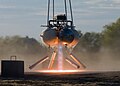 Armadillo Aerospace's quad vehicle showing visible banding (shock diamonds) in the exhaust jet (from Rocket engine)
 Rockets carrying the Space Shuttle Discovery into Earth orbit in 2007 (from History of rockets)
 Robert Anderson suggests using metal for rocket casing (from History of rockets)
 Von Braun's rocket team in 1961 (from History of rockets)
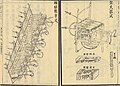 Rocket carts from the Wubei Zhi (17th century) (from History of rockets)
 Rocket thrust is caused by pressures acting in the combustion chamber and nozzle. From Newton's third law, equal and opposite pressures act on the exhaust, and this accelerates it to high speeds. (from Rocket engine)
 A Tomahawk cruise missile in flight (from Missile)
 The four expansion regimes of a de Laval nozzle:• under-expanded• perfectly expanded• over-expanded• grossly over-expanded (from Rocket engine)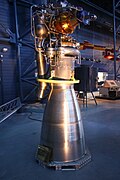
 Signatories of the International Code of Conduct against Ballistic Missile Proliferation. (from Missile)
 A V-1 flying bomb, amongst the first guided missiles (from Missile)
 The Congreve rocket (from History of rockets)
 Robert Goddard (from History of rockets)
 Opel RAK.1 - World's first public manned flight of a rocket plane on September 30, 1929. (from History of rockets)
 Rocket vehicle mechanical efficiency as a function of vehicle instantaneous speed divided by effective exhaust speed. These percentages need to be multiplied by internal engine efficiency to get overall efficiency. (from Rocket engine)
 Typical ballistic missile sequence:(from Missile)
- 1. Launches by firing motor1(A)
- 2. Stage1 drops, motor2(B) ignites & shroud(E) ejects
- 3. Motor3(C) ignites and separates
- 4. Stage3 terminates and post-boost vehicle(D) separates
- 5. Vehicle maneuvers itself and prepares re-entry vehicle (RV)
- 6. RV with decoys and chaffs deploys
- 7. RV re-enters the atmosphere
- 8. Warhead(s) detonate on target
 An illustration of fire arrow launchers as depicted in the Wubei Zhi (17th century). The launcher is constructed using basketry. (from History of rockets)
 Robert Goddard and the first liquid-fueled rocket. (from History of rockets)
 Layout of a V-2 rocket. (from History of rockets)
 Simplified diagram of a liquid-fuel rocket:(from Rocket engine)
- Liquid-fuel tank
- Liquid-oxidiser tank
- Pumps feed fuel and oxidiser under high pressure.
- Combustion chamber mixes and burns the propellants.
- Exhaust nozzle expands and accelerates the gas jet to produce thrust.
- Exhaust exits nozzle.
 A German V-2 rocket on a Meillerwagen. (from History of rockets)


.svg)


Categories

Selected picture


List articles

Things to do
 |
Here are some tasks awaiting attention:
|
Wikimedia
The following Wikimedia Foundation sister projects provide more on this subject:
-
 Commons
Free media repository -
 Wikidata
Free knowledge base -
 Wikiquote
Collection of quotations -
 Wikisource
Free-content library -
 Wikispecies
Directory of species -
 Wikiversity
Free learning tools -
 Wikivoyage
Free travel guide -
 Wiktionary
Dictionary and thesaurus


