

The Pop Music Portal
Pop music, or simply pop, is a genre of popular music that originated in its modern form during the mid-1950s in the United States and the United Kingdom. During the 1950s and 1960s, pop music encompassed rock and roll and the youth-oriented styles it influenced. Rock and pop music remained roughly synonymous until the late 1960s, after which pop became associated with music that was more commercial, ephemeral, and accessible.
Identifying factors of pop music usually include repeated choruses and hooks, short to medium-length songs written in a basic format (often the verse–chorus structure), and rhythms or tempos that can be easily danced to. Much of pop music also borrows elements from other styles such as rock, hip hop, urban, dance, Latin, and country. (Full article...)
 Selected artist -


John Maus (born February 23, 1980) is an American musician, composer, singer, and songwriter known for his baritone singing style and his use of vintage synthesizer sounds and medieval music church modes, a combination that often draws comparisons to 1980s goth-pop. His early lo-fi music recordings anticipated and inspired the late 2000s hypnagogic pop movement. On stage, he is characterized for his intense displays of emotion while performing. He is also a former teacher of philosophy at the University of Hawaiʻi, where he later earned his PhD in political science.
Maus' early influences included Nirvana, a-ha, Syd Barrett, Jim Morrison, and composers of the medieval music, Renaissance music, and Baroque music eras. In 1998, he left his hometown of Austin, Minnesota to study experimental music at the California Institute of the Arts. When he befriended and first worked alongside classmate Ariel Pink, he took a greater interest in pop music. He produced most of the music from his first two albums Songs (2006) and Love Is Real (2007) on cassette tape with an early 1990s sound bank. The albums generally drew negative reviews upon release, and it was not until the success of his third, We Must Become the Pitiless Censors of Ourselves (2011), that he became more widely accepted as an outsider music artist. Following a five-year absence from public appearances and releasing new music, he returned with the albums Screen Memories in 2017, and Addendum in 2018. His sixth studio album, Later Than You Think, was released in September 2025. (Full article...)
Selected album -
The Albums 2000–2010 is a box set by Australian recording artist Kylie Minogue. It was released by Parlophone Records on 18 July 2011. The five-disc box set was released in Europe, and Australasia, and included all of Minogue's studio albums from the years 2000 to 2010; Light Years (2000), Fever (2001), Body Language (2003), X (2007), and Aphrodite (2010). The cover sleeve for the album consisted of fragments from the original artworks inserted into Minogue's silhouette from her cover for Fever (2001). The Albums 2000–2010 marked Minogue's first box set collection until her October 2012 release, K25: Time Capsule.
Upon its release, The Albums 2000-2010 received positive reception from most of the reviewers, who complimented the overall packaging of the box set and her releases through Parlophone. Some of the critics were unimpressed with the exclusion of her work from the PWL and Deconstruction period. The box set charted on the UK Albums Chart at number 37, and on the Scottish Albums Chart at number 40. (Full article...)
General images
 American rapper and singer Nicki Minaj is known as the "Queen of Rap". (from Honorific nicknames in popular music)
 The 1960s British Invasion marked a period when the US charts were inundated with British acts such as the Beatles (pictured 1964). (from Pop music)
 Dominican singer Milly Quezada is known as the "Queen of Merengue". (from Honorific nicknames in popular music)
 Mexican singer Thalía is known as the "Queen of Latin Pop". (from Honorific nicknames in popular music)
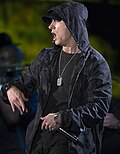 American rapper Eminem has gone by multiple honorifics, such as "King of Hip-Hop" and "King of Rap". (from Honorific nicknames in popular music)
 Cuban singer Celia Cruz is known as the "Queen of Salsa". (from Honorific nicknames in popular music)
 Amr Diab, Egyptian pop star, named "El-Hadaba", for achieving high records sales in the Middle East and Africa for the last three decades (from Pop music)
 American singer Ella Fitzgerald is known as the "Queen of Jazz" and "First Lady of Song". (from Honorific nicknames in popular music)
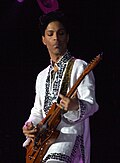 American musician Prince has been referred to as "The Artist", "The Purple One" and "His Royal Badness". (from Honorific nicknames in popular music)
 American singer-songwriter Bob Dylan has been called the "Crown Prince of Folk" and "King of Folk". (from Honorific nicknames in popular music)
 American singer and entertainer Michael Jackson is known as the "King of Pop". (from Honorific nicknames in popular music)
 South Korean singer G-Dragon is known as the "King of K-pop". (from Honorific nicknames in popular music)
 Spanish singer Enrique Iglesias is known as the "King of Latin Pop". (from Honorific nicknames in popular music)
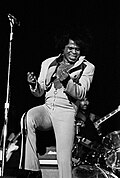 American musician James Brown was known as the "Godfather of Soul". (from Honorific nicknames in popular music)
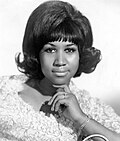 American singer Aretha Franklin is known as the "Queen of Soul". (from Honorific nicknames in popular music)
 American singer-songwriter Madonna is known as the "Queen of Pop". (from Honorific nicknames in popular music)
 The Oxford Dictionary of Music states that the term "pop" refers to music performed by such artists as the Rolling Stones (pictured here in a 2006 performance). (from Pop music)
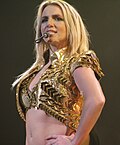 American singer Britney Spears is known as the "Princess of Pop". (from Honorific nicknames in popular music)
 Taiwanese singer-songwriter Jay Chou is known as the "King of Mandopop". (from Honorific nicknames in popular music)
 American rapper and singer Lauryn Hill is known as the "Queen of Hip Hop". (from Honorific nicknames in popular music)
 American singer Gloria Gaynor is known as the "Queen of Disco". (from Honorific nicknames in popular music)
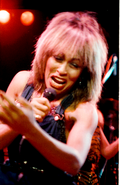 American singer Tina Turner is known as the "Queen of Rock and Roll". (from Honorific nicknames in popular music)
 English singer Ozzy Osbourne has been identified as the "Godfather of Heavy Metal" and the "Prince of Darkness". (from Honorific nicknames in popular music)
 American entertainer Cher is referred to as the "Goddess of Pop". (from Honorific nicknames in popular music)
 Kitty Wells is often referred to as the "Queen of Country Music". (from Honorific nicknames in popular music)
 American singer-songwriter Taylor Swift has been referred to as "America's Sweetheart". (from Honorific nicknames in popular music)
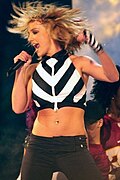 Britney Spears has been named "Princess of Pop" for revitalizing teen pop in the 2000s. (from Pop music)
 South Korean singer BoA is known as the "Queen of K-pop". (from Honorific nicknames in popular music)
 American singer Beyoncé is frequently referred to as "Queen Bey" (from Honorific nicknames in popular music)
 American singer Smokey Robinson has been called the "King of Motown". (from Honorific nicknames in popular music)
 Canadian singer Céline Dion is referred to as the "Queen of Power Ballads" and "Queen of Adult Contemporary". (from Honorific nicknames in popular music)
 American singer Aaliyah is known as the "Princess of R&B". (from Honorific nicknames in popular music)
 American singer Donna Summer has been referred to as the "Queen of Disco". (from Honorific nicknames in popular music)
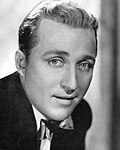 Bing Crosby was the first performer to pre-record his radio shows and master his recordings onto magnetic tape. (from Pop music)
 American singer Elvis Presley is known as the "King of Rock and Roll". (from Honorific nicknames in popular music)
 Known for his flamboyant style and virtuosic piano playing, Elton John became one of the biggest pop stars of the 1970s. (from Pop music)
 Filipino singer Pilita Corrales is referred to as "Asia's Queen of Songs". (from Honorific nicknames in popular music)
 English singer Vera Lynn was known as the "Forces' Sweetheart" for her popularity among the armed forces during World War II. (from Honorific nicknames in popular music)
 American singer and entertainer Whitney Houston is known as "The Voice". (from Honorific nicknames in popular music)
 American singer-songwriter Mariah Carey is known as the "Songbird Supreme" and "the Queen of Christmas". (from Honorific nicknames in popular music)
 Puerto Rican singers Don Omar (left) and Daddy Yankee (right) are both referred to as the "King of Reggaeton". (from Honorific nicknames in popular music)
 American singer Christina Aguilera is known as the "Voice of a Generation". (from Honorific nicknames in popular music)
 Egyptian singer Umm Kulthum is often referred to as the "Voice of Egypt". (from Honorific nicknames in popular music)
 Japanese singer Ayumi Hamasaki is known as the "Empress of J-pop" and the "Queen of J-pop". (from Honorific nicknames in popular music)
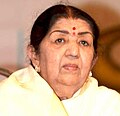 Indian singer Lata Mangeshkar is widely acknowledged as the "Queen of Melody". (from Honorific nicknames in popular music)
 The Beatles are known as "The Fab Four". (from Honorific nicknames in popular music)
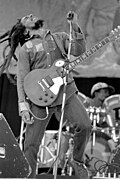 Jamaican musician Bob Marley is known as the "King of Reggae". (from Honorific nicknames in popular music)
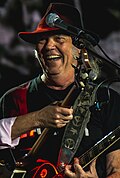 Canadian and American singer Neil Young is referred to as the "Godfather of Grunge". (from Honorific nicknames in popular music)


.jpg)


.jpg)
.jpg)


_(cropped).jpg)


_(cropped).jpg)

.jpg)

.jpg)


.jpg)

.jpg)


.jpg)
.JPEG)
_(cropped).jpg)
_(1,03_seg).png)

.jpg)
.png)


_(cropped).jpg)
Selected song -
"4 Minutes" is a song by American singer Madonna from her eleventh studio album Hard Candy (2008), featuring vocals by American musicians Justin Timberlake and Timbaland. It was released as the lead single from the album on March 17, 2008, by Warner Bros. Records. It marked the first time in Madonna's 25-year career that another artist was featured in a single. According to Madonna, the song is about saving the environment and "having a good time while we are doing it". She also cited the song as the inspiration for the documentary I Am Because We Are (2008).
The song was recorded at Sarm West Studios, in London, while the mixing of the track was finished at The Hit Factory studio in New York City. Sound engineer Demo Castellon first worked on the vocals and then on the beats, while the synths were composed by Timbaland and Danja. An uptempo dance-pop song with an urban and hip hop style, "4 Minutes" incorporates Timbaland's characteristic bhangra beats and the instrumentation used in the song includes brass, foghorns and cowbells. The lyrics carry a message of social awareness, inspired by Madonna's visit to Africa and the human suffering she witnessed. (Full article...)
Did you know (auto-generated)

- ... that the alt-pop musician Lucy Tun cites death metal and RuPaul's Drag Race as influences?
- ... that Pachelbel's Canon is notorious for being widespread in pop music, but it actually isn't?
- ... that Metropolitan Opera director Maurice Grau was "important in the growth of popular musical theatre in America"?
- ... that Eternal Blue, a metalcore album, was inspired in part by 1980s pop music?
Selected image -

Major topics
Subcategories

Related portals


Pop music by decade

WikiProjects
- Wikipedia:WikiProject Pop music was created with the purpose of assembling writers and editors interested in Pop music.
- The aim of this project is to standardize and improve articles related to the various genres of Pop music, as well as to create missing articles.
- To become a member of the WikiProject (anyone may join), simply click here and add your username.
 FA FA |  A A | GA | B | C | Start | Stub | FL | List | Category | Disambig | Draft | File | Portal | Project | Redirect | Template | NA | ??? | Total |
| 154 | 0 | 1,848 | 1,604 | 5,036 | 13,359 | 6,707 | 122 | 607 | 2,720 | 11 | 165 | 532 | 2 | 39 | 1,741 | 2,023 | 16 | 409 | 37,095 |
Associated Wikimedia
The following Wikimedia Foundation sister projects provide more on this subject:
-
 Commons
Free media repository -
 Wikidata
Free knowledge base -
 Wikiquote
Collection of quotations -
 Wikisource
Free-content library -
 Wikiversity
Free learning tools -
 Wiktionary
Dictionary and thesaurus


