

The Cartoon Portal

A cartoon is a type of visual art that is typically drawn, frequently animated, in an unrealistic or semi-realistic style. The specific meaning has evolved, but the modern usage usually refers to either: an image or series of images intended for satire, caricature, or humor; or a motion picture that relies on a sequence of illustrations for its animation. Someone who creates cartoons in the first sense is called a cartoonist, and in the second sense they are usually called an animator.
This article covers "static" cartoons; for moving ones see animation.
The concept originated in the Middle Ages, and first described a preparatory drawing for a piece of art, such as a painting, fresco, tapestry, or stained glass window. In the 19th century, beginning in Punch magazine in 1843, cartoon came to refer – ironically at first – to humorous artworks in magazines and newspapers. Then it also was used for political cartoons and comic strips. When the medium developed, in the early 20th century, it began to refer to animated films that resembled print cartoons. (Full article...)
In print media, a cartoon is a drawing or series of drawings, usually humorous in intent. This usage dates from 1843, when Punch magazine applied the term to satirical drawings in its pages,[1] particularly sketches by John Leech.[2] The first of these parodied the preparatory cartoons for grand historical frescoes in the then-new Palace of Westminster in London.[3]

Sir John Tenniel—illustrator of Alice's Adventures in Wonderland—joined Punch in 1850, and over 50 years contributed over two thousand cartoons.[4]


Selected article -
The Silver Age of Comic Books was a period of artistic advancement and commercial success in mainstream American comic books, predominantly those in the superhero genre. Following the Golden Age of Comic Books and an interregnum in the early to mid-1950s, the Silver Age is considered to cover the period from 1956 to circa 1970, and was succeeded by the Bronze and Modern Ages. A number of important comics writers and artists contributed to the early part of the era, including writers Stan Lee, Gardner Fox, John Broome, and Robert Kanigher, and artists Curt Swan, Jack Kirby, Gil Kane, Steve Ditko, Mike Sekowsky, Carmine Infantino, John Buscema, and John Romita, Sr. By the end of the Silver Age, a new generation of talent had entered the field, including writers Denny O'Neill, Mike Friedrich, Roy Thomas, and Archie Goodwin, and artists such as Neal Adams, Jim Steranko, and Barry Windsor-Smith. The popularity and circulation of comic books about superheroes declined following the Second World War, and comic books about horror, crime and romance took larger shares of the market. However, controversy arose over alleged links between comic books and juvenile delinquency, focusing in particular on crime and horror titles. In 1954, publishers implemented the Comics Code Authority to regulate comic content. In the wake of these changes, publishers began introducing superhero stories again, a change that began with the introduction of a new version of DC Comics's The Flash in Showcase #4 (Oct. 1956). In response to strong demand, DC began publishing more superhero titles including Justice League of America, which prompted Marvel Comics to follow suit beginning with Fantastic Four #1. Silver Age comics have become collectible; as of 2008 the most sought-after comic of the era is Spider-Man's debut in Amazing Fantasy #15.
Selected character -

Bugs Bunny is a funny animal cartoon character, best remembered for his starring roles in the Looney Tunes and Merrie Melodies series of theatrical shorts produced by Warner Bros. during the Golden Age of American animation. His popularity during this era led to his becoming a corporate mascot of Warner Bros. Entertainment. Bugs is an anthropomorphic gray hare or rabbit and is famous for his flippant, insouciant personality, a pronounced New York accent, his portrayal as a trickster, and his catch phrase "Eh... What's up, doc?" (usually said while chewing a carrot). Bugs has appeared in more films than any other cartoon character and is the ninth most portrayed film personality in the world. In reality, he was brought to life by the animators and staff of Leon Schlesinger Productions (later Warner Bros. Cartoons): including Tex Avery, who directed Bugs' "official" debut short A Wild Hare (1940); Robert McKimson, who created Bugs' definitive character design; and Mel Blanc, who originated the voice of Bugs.
Did you know... -

- ...that 1999's Scooby-Doo! Mystery of the Fun Park Phantom was the first commercial Scooby-Doo computer game for the Windows platform?
- ...that Czechoslovak communist censors banned publishing of the comic album Muriel a andělé?
- ...that the Sam Sheepdog and Ralph Wolf cartoons Sheep Ahoy, A Sheep in the Deep, and Don't Give Up the Sheep were censored by ABC to remove a dynamite stick, a smoke break scene, and a spanking scene respectively?
- ...that Banya: The Explosive Delivery Man is a Korean action comic that combines the styles of Mad Max, Dune and The Lord of the Rings?
Selected list -
The episodes of The Bellflower Bunnies, a children's animated series based on the Beechwood Bunny Tales books by Geneviève Huriet, Amélie Sarn and Loïc Jouannigot. It debuted on TF1, a French television network, on 24 December 2001. The series is written by Valérie Baranski, and produced by Patricia Robert. The show centres on the adventures and exploits of the Bellflower family, a clan of seven rabbits who live in Beechwood Grove. The two adults in the family, Papa Bramble and Aunt Zinnia, take care of their five children: Periwinkle, Poppy, Mistletoe, Dandelion and Violette. The series has also been broadcast on CBC Television and TFO in Canada, KI.KA in Germany, Portugal's RTP in the Azores, and in several other countries. The show has fifty-two episodes: four in the first season, twenty-two in the second, and twenty-six in the third. In the entire series, thirteen are based directly on installments in Beechwood Bunny Tales, published by Milan Presse of France and Gareth Stevens in the United States; the rest are based on scripts by Valérie Baranski. Distributors in Europe, North America, and South Korea have released DVDs of the first two seasons.
General images -

 Sir John Tenniel, chief cartoonist for Punch (from 1864) and the illustrator of Alice in Wonderland, was the first cartoonist to be knighted (from Cartoonist)
 Nast depicts the Tweed Ring: "Who stole the people's money?" / "'Twas him."
 A Rake's Progress, Plate 8, 1735, and retouched by William Hogarth in 1763 by adding the Britannia emblem (from Political cartoon)
- Thomas Nast depicts the Tweed Ring: "Who stole the people's money?" / "'Twas him." (from Political cartoon)
 1899 cartoon showing Uncle Sam lecturing four children labeled Philippines, Hawaii, Puerto Rico, and Cuba. The caption reads: "School Begins. Uncle Sam (to his new class in Civilization)!" (from Political cartoon)
 An editorial cartoon of Andrew Johnson and Abraham Lincoln, 1865, entitled The Rail Splitter at Work Repairing the Union. The caption reads: (Johnson): "Take it quietly Uncle Abe and I will draw it closer than ever!!" (Lincoln): "A few more stitches Andy and the good old Union will be mended!" (from Political cartoon)
 John Leech, Substance and Shadow (1843), published as Cartoon, No. 1 in Punch, the first use of the word cartoon to refer to a satirical drawing (from Cartoon)
 U.S. President Theodore Roosevelt introduces Taft as his crown prince: Puck magazine cover, 1906. (from Political cartoon)
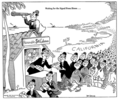 1942 political cartoon by Dr. Seuss. This cartoon depicts Japanese Americans as a "fifth column," lending support to Japan during its war against the United States. Bigotry against Japanese people was common among Americans at this time. (from Political cartoon)
 James Gillray's The Plumb-pudding in Danger (1805). The world being carved up into spheres of influence between Pitt and Napoleon. According to Martin Rowson, it is "probably the most famous political cartoon of all time—it has been stolen over and over and over again by cartoonists ever since." (from Political cartoon)
 Stop-motion animated character from 20 Million Miles to Earth (1957) (from Animator)
 1903 political cartoon. The U.S.'s intentions to influence the area (especially the Panama Canal construction and control) led to the separation of Panama from Colombia. (from Political cartoon)
 Benjamin Franklin's Join, or Die (May 9, 1754), credited as the first cartoon published in an American newspaper (from Cartoonist)
,_Artist_and_Cartoonist,_Lived_here.jpg)


.jpg)


_Ymir_2.png)


Selected biography -

Steve Jobs (b. 1955, d. 2011) was an American business magnate and inventor. He is co-founder, chairman, and former chief executive officer of Apple Inc. Jobs also previously served as chief executive of Pixar Animation Studios; he became a member of the board of directors of The Walt Disney Company in 2006, following the acquisition of Pixar by Disney. He was credited in the 1995 film Toy Story as an executive producer. In the late 1970s, Jobs, with Apple co-founder Steve Wozniak, Mike Markkula, and others, designed, developed, and marketed one of the first commercially successful lines of personal computers, the Apple II series. In the early 1980s, Jobs was among the first to see the commercial potential of Xerox PARC's mouse-driven graphical user interface, which led to the creation of the Macintosh. After losing a power struggle with the board of directors in 1985, Jobs resigned from Apple and founded NeXT, a computer platform development company specializing in the higher-education and business markets. Apple's subsequent 1996 buyout of NeXT brought Jobs back to the company he co-founded, and he served as its CEO from 1997 until 2011. In 1986, he acquired the computer graphics division of Lucasfilm Ltd which was spun off as Pixar Animation Studios. He remained CEO and majority shareholder at 50.1% until its acquisition by The Walt Disney company in 2006. In 2011, Apple announced that Steve Jobs had died at the age of 56.
Subcategories

WikiProjects
- Main projects
- Arts • Animation • Comics • Entertainment • Visual arts

- Related Projects
- Anime and manga • Biography • Film • Fictional characters • Media franchises • Music • Television • Video games
Selected quote -
Topics
- Comic book
- Comic strip
- Digital comics
- Graphic novel
- Mobile comic
- Motion comics
- Trade paperback
- Webcomic
- Animator
- Animation director
- Animation studios
- Animation film festivals
- Feature-length films
- Short films
- Television series
- Computer-animated films
- Stop-motion films
- Traditional animation
- Limited animation
- Rotoscoping
- Stop Motion
- Clay
- Cutout
- Graphic
- Model
- Object
- Pixilation
- Puppetoon
- Computer animation
- Flash animation
- PowerPoint animation
- SVG animation
- Cel-shaded animation
- Crowd simulation
- Morph target animation
- Motion capture
- Non-photorealistic rendering
- Skeletal animation
Things you can do

- Requested articles: Fenwick (comics), Khimaera (comics), Mutant Underground Support Engine, Bruce J. Hawker, Marc Dacier, Hultrasson, Frankenstein Comics, Dave Johnson (comics), Paco Medina, Dappere Dodo, New Adventures of the Space Explorers, Habatales, Musical Box, Foo-Foo (TV series), Bonne nuit les petits, The Adventures of Lariat Sam, More...
- Images and photos needed: Request images that are needed from Wikipedia requested images of comics and animation to included in each articles.
- Stubs: Work on stubs in articles in Comics and Animation stubs.
- Infobox: Add infobox that are needed from Category:Comics articles without infoboxes and Category:Animation articles needing infoboxes in articles.
- Deletion sorting: Please see the collection of discussions on the deletion of articles related to comics and animation - compiled by WikiProject Deletion sorting
Related portals


Associated Wikimedia
The following Wikimedia Foundation sister projects provide more on this subject:
-
 Commons
Free media repository -
 Wikidata
Free knowledge base -
 Wikiquote
Collection of quotations -
 Wikisource
Free-content library -
 Wikiversity
Free learning tools -
 Wiktionary
Dictionary and thesaurus


More portals


Sources
- ↑ Punch.co.uk. "History of the Cartoon". Archived from the original on 2007-11-11. Retrieved 2007-11-01.
- ↑ Adler & Hill 2008, p. 30.
- ↑ "Substance and Shadow: Original Editorial Accompanying "Cartoon, No. I"". Victorian web.org. Retrieved 29 October 2023.
- ↑ "Sir John Tenniel". National Portrait Gallery. Retrieved 26 August 2022.