
Pilumnoidea is a superfamily of crabs,[1][2] whose members were previously included in the Xanthoidea.[3] The three families are unified by the free articulation of all the segments of the male crab's abdomen and by the form of the gonopods.[2] The earliest fossils assigned to this group are of Eocene age.[4]
| Pilumnoidea Temporal range: | |
|---|---|
 | |
| Pilumnus hirtellus | |
Scientific classification  | |
| Kingdom: | Animalia |
| Phylum: | Arthropoda |
| Clade: | Pancrustacea |
| Class: | Malacostraca |
| Order: | Decapoda |
| Suborder: | Pleocyemata |
| Infraorder: | Brachyura |
| Subsection: | Heterotremata |
| Superfamily: | Pilumnoidea Samouelle, 1819 |
| Families | |
Classification
editPilumnidae is by far the largest of the three families, with 73 of the 78 genera:[2]
- Pilumnidae Samouelle, 1819
- Subfamily Calmaniinae Števčić, 1991
- Calmania Laurie, 1906
- Subfamily Pilumninae Samouelle, 1819
- Actumnus Dana, 1851
- Aniptumnus Ng, 2002
- Bathypilumnus Ng & L. W. H. Tan, 1984
- Benthopanope Davie, 1989
- Budapanopeus † Müller & Collins, 1991
- Cryptopilumnus Hsueh, Huang & Ng, 2009
- Danielum Vázquez-Bader & Gracia, 1995
- Eohalimede † Blow & Manning, 1996
- Eopilumnus † Beschin et al., 2002
- Eumorphactaea † Bittner, 1875
- Eurycarcinus A. Milne-Edwards, 1867
- Galenopsis † A. Milne-Edwards, 1865
- Glabropilumnus Balss, 1932
- Gorgonariana Galil & Takeda, 1988
- Heteropanope Stimpson, 1858
- Heteropilumnus De Man, 1895
- Latopilumnus Türkay & Schuhmacher, 1985
- Lentilumnus Galil & Takeda, 1988
- Lobogalenopsis † Müller & Collins, 1991
- Lobopilumnus A. Milne-Edwards, 1880
- Lophopilumnus Miers, 1886
- Nanopilumnus Takeda, 1974
- Neoactumnus T. Sakai, 1965
- Parapleurophrycoides Nobili, 1906
- Pilumnopeus A. Milne-Edwards, 1867
- Pilumnus Leach, 1816
- Priapipilumnus Davie, 1989
- Pseudactumnus Balss, 1933
- Serenepilumnus Türkay & Schuhmacher, 1985
- Serenolumnus Galil & Takeda, 1988
- Takedana Davie, 1989
- Viaderiana Ward, 1942
- Xestopilumnus Ng & Dai, 1997
- Xlumnus Galil & Takeda, 1988
- Subfamily Eumedoninae Dana, 1853
- Ceratocarcinus Adams & White in White, 1847
- Echinoecus Rathbun, 1894
- Eumedonus H. Milne Edwards, 1837
- Gonatonotus Adams & White, in White, 1847
- Hapalonotus Rathbun, 1897
- Harrovia Adams & White, 1849
- Permanotus D. G. B. Chia & Ng, 1998
- Rhabdonotus Milne-Edwards, 1879
- Santeella † Blow & Manning, 1996
- Tauropus D. G. B. Chia & Ng, 1998
- Tiaramedon D. G. B. Chia & Ng, 1998
- Viacarcinus † Blow & Manning, 1996
- Zebrida White, 1847
- Zebridonus D. G. B. Chia, Ng & Castro, 1995
- Subfamily Rhizopinae Stimpson, 1858
- Caecopilumnus Borradaile, 1902
- Camptoplax Miers, 1884
- Ceratoplax Stimpson, 1858
- Cryptocoeloma Miers, 1884
- Cryptolutea Ward, 1936
- Itampolus Serène & Peyrot-Clausade, 1977
- Lophoplax Tesch, 1918
- Luteocarcinus Ng, 1990
- Mertonia Laurie, 1906
- Paranotonyx Nobili, 1905
- Paraselwynia Tesch, 1918
- Peleianus Serène, 1971
- Pronotonyx Ward, 1936
- Rhizopa Stimpson, 1858
- Pseudocryptocoeloma Ward, 1936
- Pseudolitochira Ward, 1942
- Rhizopoides Ng, 1987
- Ser Rathbun, 1931
- Typhlocarcinops Rathbun, 1909
- Typhlocarcinus Stimpson, 1858
- Zehntneria Takeda, 1972
- Subfamily Xenopthalmodinae Števčić, 2005
- Arges † De Haan, 1835
- Xenopthalmodes Richters, 1880
- Galenidae Alcock, 1898
- Dentoxanthus Stephensen, 1946
- Galene De Haan, 1833
- Halimede De Haan, 1835
- Parapanope De Man, 1895
- Tanaochelidae Ng & P. F. Clark, 2000
- Tanaocheles Kropp, 1984
Gallery
edit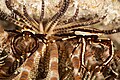
 Crinoid crab at Wakatobi National Park, 2018
 Crinoid crab at Wakatobi National Park, 2018
.jpg)
.jpg)
.jpg)
References
edit- ↑ Peter K. L. Ng; Danièle Guinot & Peter J. F. Davie (2008). "Systema Brachyurorum: Part I. An annotated checklist of extant Brachyuran crabs of the world" (PDF). Raffles Bulletin of Zoology. 17: 1–286. Archived from the original (PDF) on 2011-06-06. Retrieved 2010-01-04.
- 1 2 3 Sammy De Grave; N. Dean Pentcheff; Shane T. Ahyong; et al. (2009). "A classification of living and fossil genera of decapod crustaceans" (PDF). Raffles Bulletin of Zoology. Suppl. 21: 1–109. Archived from the original (PDF) on 2011-06-06. Retrieved 2010-01-04.
- ↑ Joel W. Martin & George E. Davis (2001). An Updated Classification of the Recent Crustacea (PDF). Natural History Museum of Los Angeles County. p. 132. Archived from the original (PDF) on 2011-07-27. Retrieved 2010-01-04.
- ↑ Carrie E. Schweitzer (2003). "Progress on the fossil Xanthoidea MacLeay, 1838 (Decapoda, Brachyura)". Contributions to Zoology. 72 (2/3).
- ↑ "Crinoid crabs - Family Pilumnidae". wildsingapore.com. 2019-12-31. Retrieved 2023-05-07.
| This Pilumnoidea article is a stub. You can help Wikipedia by adding missing information. |