Peperomia beccarii is a species of epiphyte in the genus Peperomia that is native to Sumatra.[1][2] It grows on wet tropical biomes.[1] Its conservation status is Threatened.[3]
| Peperomia beccarii | |
|---|---|
 | |
Scientific classification  | |
| Kingdom: | Plantae |
| Clade: | Embryophytes |
| Clade: | Tracheophytes |
| Clade: | Spermatophytes |
| Clade: | Angiosperms |
| Clade: | Magnoliids |
| Order: | Piperales |
| Family: | Piperaceae |
| Genus: | Peperomia |
| Species: | P. beccarii |
| Binomial name | |
| Peperomia beccarii | |
Description
editThe type specimen were collected at Ayer Mantjoer, Sumatra, at an elevation of about 360 m.[4]
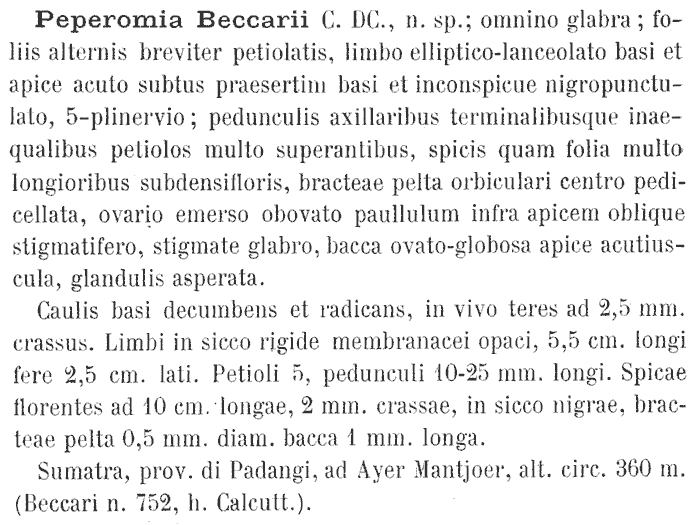
Peperomia beccarii is entirely glabrous, with a stem that is decumbent at the base and rooting, terete when living, up to 2.5 mm thick. The leaves are alternate with short petioles 5 mm long; the blade is elliptic-lanceolate, acute at both base and apex, measuring 5.5 cm long and nearly 2.5 cm wide, rigidly membranaceous and opaque when dry, 5-plinerved, inconspicuously black-punctulate beneath especially at the base. The peduncles are axillary and terminal, unequal, much exceeding the petioles, measuring 10–25 mm long. The spikes are much longer than the leaves, up to 10 cm long and 2 mm thick, subdensely flowered, black when dry. The bract has an orbicular pelt, pedicellate at the center. The ovary is emergent, obovate, bearing a stigma obliquely just below the apex; the stigma is glabrous. The berry is ovate-globose, somewhat acute at the apex, roughened with glands, 1 mm long.[4]
Taxonomy and naming
editIt was described in 1920 by Casimir de Candolle in the Annuaire du Conservatoire et du Jardin botaniques de Genève, from specimens collected by Odoardo Beccari. It was named in honor of the Italian botanist Odoardo Beccari.[4]
Distribution and habitat
editIt is native to Sumatra.[2] It grows as a terrestrial or epiphyte and is a herb.[1][4] It grows on wet tropical biomes.[1]
Conservation
editThis species is assessed as Threatened, in a preliminary report.[3]
References
edit- 1 2 3 4 "Peperomia beccarii C. DC". Plants of the World Online. Royal Botanic Gardens, Kew. Retrieved 23 March 2026.
- 1 2 "Peperomia beccarii C. DC". Global Biodiversity Information Facility. Retrieved 23 March 2026.
- 1 2 Bachman, Steven P.; Brown, Matilda J. M.; Leão, Tarciso C. C.; Lughadha, Eimear Nic; Walker, Barnaby E. (2024). "Extinction risk predictions for the world's flowering plants to support their conservation". New Phytologist. 242 (2): 797–808. doi:10.1111/nph.19592. PMID 38437880.
- 1 2 3 4 de Candolle, Casimir. "Annuaire du Conservatoire et du Jardin botaniques de Genève 21: 267. 1920". Annuaire Conserv. Jard. Bot. Genève. 21: 267.