
Parasynthemis regina is a species of dragonfly in the family Synthemistidae,[4] known as the royal tigertail.[5] It is a medium to large and slender dragonfly with a long body and black and yellow markings.[5][6] It inhabits stagnant pools and swamps in eastern Australia[7]
| Royal tigertail | |
|---|---|
 | |
| Male, Cessnock NSW | |
Scientific classification  | |
| Kingdom: | Animalia |
| Phylum: | Arthropoda |
| Clade: | Pancrustacea |
| Class: | Insecta |
| Order: | Odonata |
| Infraorder: | Anisoptera |
| Family: | Synthemistidae |
| Genus: | Parasynthemis Carle, 1995[2] |
| Species: | P. regina |
| Binomial name | |
| Parasynthemis regina | |
 | |
| Synonyms[4] | |
| |

Parasynthemis regina was originally named Synthemis regina in 1874 by Edmond de Sélys Longchamps.[8]
Etymology
editGallery
edit Male, Cessnock NSW
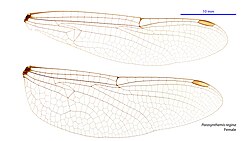 Female wings
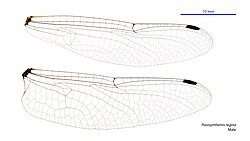 Male wings

.jpg)
.jpg)
See also
editReferences
edit- ↑ Hawking, J. (2009). "Parasynthemis regina". IUCN Red List of Threatened Species. 2009 e.T163570A5617416. doi:10.2305/IUCN.UK.2009-2.RLTS.T163570A5617416.en. Retrieved 20 November 2021.
- ↑ Carle, F.L. (1995). "Evolution, taxonomy, and biogeography of ancient Gondwanian libelluloides, with comments on anisopteroid evolution and phylogenetic systematics (Anisoptera: Libelluloidea)". Odonatologica. 24 (4): 383–424 [393] – via natuurtijdschriften.nl.
- ↑ Selys-Longchamps, E. (1874). "Additions au synopsis des Cordulines". Bulletin de la Classe des Science, Académie Royale de Belgique. 2 (in French). 37: 16–34 [31] – via Biodiversity Heritage Library.
- 1 2 "Species Parasynthemis regina Selys, 1874". Australian Faunal Directory. Australian Biological Resources Study. 2012. Retrieved 6 March 2017.
- 1 2 Theischinger, Günther; Hawking, John (2006). The Complete Field Guide to Dragonflies of Australia. Collingwood, Victoria, Australia: CSIRO Publishing. p. 202. ISBN 978-0-64309-073-6.
- ↑ Watson, J.A.L.; Theischinger, G.; Abbey, H.M. (1991). The Australian Dragonflies: A Guide to the Identification, Distributions and Habitats of Australian Odonata. Melbourne: CSIRO. p. 278. ISBN 0-643-05136-8.
- ↑ Theischinger, Gunther; Endersby, Ian (2009). Identification Guide to the Australian Odonata (PDF). Department of Environment, Climate Change and Water NSW. p. 232. ISBN 978-1-74232-475-3.
- ↑ Paulson, D.; Schorr, M.; Abbott, J.; Bota-Sierra, C.; Deliry, C.; Dijkstra, K.-D.; Lozano, F. "World Odonata List". OdonataCentral. University of Alabama.
- 1 2 Endersby, Ian; Fliedner, Heinrich (2015). The Naming of Australia's Dragonflies. Eltham, Victoria, Australia: Busybird Publishing. ISBN 9781925260625.

Wikimedia Commons has media related to Parasynthemis regina.