

Welcome to the Germany Portal!
Willkommen im Deutschland-Portal!
.svg) |
 |
 | |
Germany (German: Deutschland), officially the Federal Republic of Germany (German: Bundesrepublik Deutschland), is a country in Central and Western Europe, lying between the Baltic Sea and the North Sea to the north with the Alps to the south. It borders Denmark to the north, Poland and the Czech Republic to the east, Austria and Switzerland to the south, France to the southwest, and Luxembourg, Belgium and the Netherlands to the west.
Germany includes 16 constituent states, covers an area of 357,596 square kilometres (138,069 sq mi) and has a largely temperate seasonal climate. With over 83 million inhabitants, it is the second most populous state of Europe after Russia, the most populous state lying entirely in Europe, as well as the most populous member state of the European Union. Germany is a very decentralized country. Its capital and most populous city is Berlin, while Frankfurt serves as its financial capital and has the country's busiest airport.
In 1871, Germany became a nation-state when most of the German states unified into the Prussian-dominated German Empire. After World War I and the Revolution of 1918–19, the Empire was replaced by the parliamentary Weimar Republic. The Nazi seizure of power in 1933 led to World War II and the Holocaust. After the end of World War II in Europe and a period of Allied occupation, two new German states were founded: West Germany, formed from the American, British, and French occupation zones, and East Germany, formed from the western part of the Soviet occupation zone, reduced by the newly established Oder-Neisse line. Following the Revolutions of 1989 that ended communist rule in Central and Eastern Europe, the country was reunified on 3 October 1990.
Germany is a federal parliamentary republic led by a chancellor. It is a great power with the largest economy in Europe. As a global leader in several industrial, scientific and technological sectors, it is a major trading nation. The Federal Republic of Germany was a founding member of the European Economic Community in 1957 and the European Union in 1993. Read more...
Selected article

The Free Association of German Trade Unions (abbreviated FVdG; sometimes also translated as Free Association of German Unions or Free Alliance of German Trade Unions) was a trade union federation in Imperial and early Weimar Germany. It was founded in 1897 in Halle under the name Representatives' Centralization of Germany as the national umbrella organization of the localist current of the German labor movement. The localists rejected the centralization in the labor movement following the sunset of the Anti-Socialist Laws in 1890 and preferred grassroots democratic structures. The lack of a strike code soon led to conflict within the organization. Various ways of providing financial support for strikes were tested before a system of voluntary solidarity was agreed upon in 1903. During the years following its formation, the FVdG began to adopt increasingly radical positions. During the German socialist movement's debate over the use of mass strikes, the FVdG advanced the view that the general strike must be a weapon in the hands of the working class. Immediately after the November Revolution, the FVdG very quickly became a mass organization. It was particularly attractive to miners from the Ruhr area opposed to the mainstream unions' reformist policies. In December 1919, the federation merged with several minor left communist unions to become the Free Workers' Union of Germany (FAUD). More...
Selected picture
 The German Instrument of Surrender, the main portion of which was signed at Reims, France, at 02:41 on 7 May 1945, was the legal instrument that established the armistice ending World War II in Europe. It was signed by representatives of the Oberkommando der Wehrmacht, the Allied Expeditionary Force and Soviet High Command. Another act of military surrender was signed, shortly before midnight, on 8 May in the outskirts of Berlin, Germany, at the insistence of the Soviets.

The Deutsche Bank Twin Towers in Frankfurt 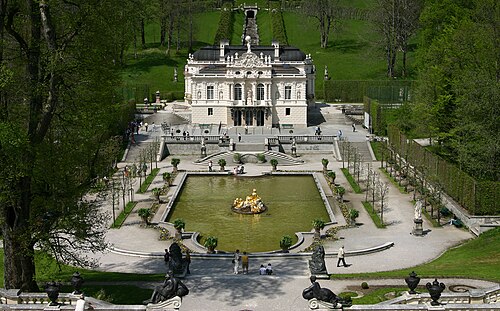
Linderhof Palace Linderhof, a palace built by Ludwig II of Bavaria Photo credit: SofteisSchloss Neuschwanstein ("new swan stone castle") in southwest Bavaria is one of Germany's most popular tourist destinations. Construction was started by King Ludwig II and took 17 years. After his death in 1886, the castle was opened to the public. During World War II, many valuable items (all stolen) were stored at the castle, destined for Adolf Hitler's personal collection.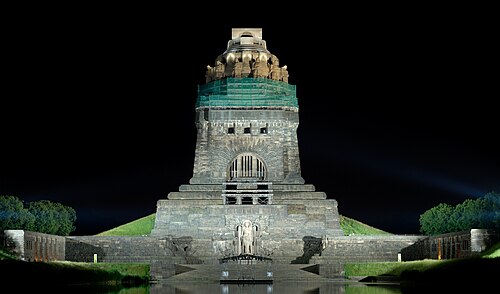
Völkerschlachtdenkmal in Leipzig A night shot of the Völkerschlachtdenkmal (Monument of the Battle of the Nations) in Leipzig, Germany. Photograph credit: Diego DelsoThe Walchensee Hydroelectric Power Station is a storage power station in Bavaria, Germany. The turbines, seen here, are fed by water from the Walchensee which is then released into the Kochelsee. The power station uses the hydraulic head of about 200 metres (660 ft) between the two natural lakes, and water from the Rißbach river is also used to augment the supply. The installed capacity is 124 MW with an annual production of 300 GWh; this is one of the largest of such power plants in Germany.
 Photo: Matthew FieldThe Reichstag building is a historical edifice in Berlin, Germany, constructed to house the Reichstag, parliament of the German Empire. It was opened in 1894 and housed the Reichstag until 1933, when it was severely damaged in a fire. After German reunification it underwent a reconstruction, completed in 1999, and now houses the modern Bundestag.
 Photo credit: Daniel Schwen/AntilivedThe marketplace of Göttingen, a city in Lower Saxony, Germany, with the old city hall, Gänseliesel fountain and pedestrian zone. Founded before 1200, the city is famous for Georg-August University, which was founded in 1737 and became the most visited university of Europe.
Snowed trees on the Brocken Snowed trees on the Brocken Photo credit: Daniel SchwenA portrait of a senior police officer in Hamburg, wearing the new blue uniform in accordance with the policy of using the same colour for police uniforms and vehicles throughout the European Union. Law enforcement in Germany is divided into two groups: the federal police and the state police.
 Photograph: Henry W. LaurischKadavar are a rock band from Berlin, Germany, founded in 2010. Their retro sound, incorporating psychedelic rock and stoner rock, has been compared to bands of the 1970s hard rock/heavy metal era. Kadavar currently consists of three members: guitarist and lead vocalist Christoph "Lupus" Lindemann, drummer Christoph "Tiger" Bartelt, and bassist Simon "Dragon" Bouteloup.
Hohenzollern Bridge and Cologne Cathedral The Hohenzollern Bridge crossing the Rhine in Cologne, Germany, with the Cologne Cathedral in the background. The bridge is a tied-arch railway bridge, as well as a pedestrian bridge. Originally built in 1911, it survived numerous Allied bombings in World War II, only to be destroyed by German engineers as the war drew to a close. Reconstruction began soon after and the bridge was opened to pedestrian traffic in 1948 and completely opened in 1959.
Cover of "Der Eigene", vol. 10 (1924-25), no. 4 Der Eigene was the first gay journal in the world, published from 1896 to 1932 by Adolf Brand in Berlin.
Buldern Castle in Buldern, Dülmen  Photograph: Michael KranewitterThomas Müller (b. 1989) is a German professional footballer who has played for Bayern Munich since 2009; he is also the team's vice-captain. A versatile player, Müller plays as a midfielder or forward but has also been deployed in attacking roles such as attacking midfielder, second striker, centre forward and on either wing. He has represented Germany on its national team since 2010.
 Photo credit: Daniel SchwenSparrenburg Castle, located in Bielefeld, Germany, as seen from the western lawn. The castle was constructed between 1240 and 1250 by the Counts of Ravensberg. The castle has been rebuilt many times. Although often under siege, it was never stormed. After extensive restoration work, the castle now presents itself as an imposing historic site.
 Photograph credit: Jörg BraukmammThe Hoher Göll is a mountain in the Berchtesgaden Alps. At 2,522 metres (8,274 feet), it is the highest peak of the Göll massif, which straddles the border between the German state of Bavaria and the Austrian state of Salzburg. This photograph shows the Hoher Göll (left) and the Hohes Brett (right) from the west.
 Photo credit: Andreas TilleThe Chicago based, German architect Helmut Jahn is best known for his efficiently designed modernist office blocks. Whilst many of these glass and steel buildings don't stand out from the crowd, some of his most eye-catching projects, such as the Sony Center in Berlin, with its tent-like roof covering the central Forum, border on post-modernism.
 Design credit: German New Guinea Company; photographed by the National Numismatic CollectionGerman New Guinea was a German colonial protectorate established in 1884 in the northeastern part of the island of New Guinea and several nearby island groups. The German New Guinea Company was founded in Berlin by Adolph von Hansemann and a syndicate of German bankers for the purpose of colonizing and exploiting the protectorate's resources. This gold coin, worth 20 New Guinean marks, was issued by the German New Guinea Company in 1895, and is now part of the National Numismatic Collection at the Smithsonian Institution.
 Painting credit: Albert BierstadtAlbert Bierstadt (1830–1902) was a German-American painter best known for his lavish, sweeping landscapes of the American West, such as this oil-on-canvas painting, entitled Among the Sierra Nevada, California, created in 1868. He painted the landscape in his Rome studio, and exhibited it in Berlin and London before shipping it to the United States. His choice of grandiose subjects was matched by his entrepreneurial flair; his exhibitions of individual works were accompanied by promotion, ticket sales, and, in the words of one critic, a "vast machinery of advertisement and puffery". This work is in the collection of the Smithsonian American Art Museum.
 Photo credit: Matthias SüßenMorning fog on the plains of East Frisia, a coastal region in the northwest of the German federal state of Lower Saxony. It connects Western Frisia (in the Netherlands) with the district of Nordfriesland ("Northern Frisia") in Schleswig-Holstein, all of which belong to the historic and geographic Frisia.
 Close-up of the quadriga (four-horse chariot) on top of the Brandenburg Gate in Berlin (Germany) at night. The sculpture was produced by Johann Gottfried Schadow in 1793. The word quadriga may refer to the chariot alone, the four horses without it, or the combination. All modern quadrigas are based on the Horses of Saint Mark, a Roman or Greek sculpture which is the only surviving ancient quadriga.


.jpg)


.jpg)


Related portals
- Parent portals
.svg)

- Regional


- History
 Holy Roman Empire (900–1806)
 East Germany (1949–1990)


- Neighbouring countries


Anniversaries for June 18

- 1887 – Germany and Russia agree on the Reinsurance Treaty
- 1916 – Death of World War I ace Max Immelmann
- 1927 – Inauguration of the Nürburgring race track
- 1929 – Birth of sociologist Jürgen Habermas
Did you know...

- ... that Beethoven's "Tremate, empi, tremate" was not performed for ten years after it was written?
- ... that the 1935 Free City of Danzig parliamentary election was seen as a setback for the Nazi Party, even though it won an absolute majority of seats?
- ... that every year in July, a whole German town is taken over by the Rudolstadt Festival and swept up in "folk fever"?
- ... that the pianist Alide Topp (pictured) once responded to claims that women lacked the "biceps of a man" for great music by stating she broke her pianos as well as any man?
- ... that Bernhard Waldenfels discussed "black holes of everyday life" in a book subtitled Challenges of Phenomenology?
- ... that Agostino Steffani missed the 1709 premiere of his opera Amor vien dal destino because he was in Rome mediating between the pope and the emperor?
- ... that Ruth Wagner, the minister of culture in Hesse from 1999 to 2003, was nicknamed Mother Courage of Hesse?
- ... that mathematician Grete Hermann wrote political philosophy articles for Der Funke and Sozialistische Warte under various pseudonyms during the German resistance to Nazism?
Germany news

- 16 June 2026 – 2026 FIFA World Cup
- In association football, Argentine forward and captain Lionel Messi becomes the first male player to appear in six FIFA World Cups and joins Germany's Miroslav Klose as the tournament's all-time leading scorer with 16 goals after scoring a hat-trick in Argentina's 3–0 win against Algeria in their opening match. (AFP via ABS-CBN News)
- 14 June 2026 – 2026 FIFA World Cup, Curaçao at the FIFA World Cup
- In association football, Curaçao, the smallest nation to qualify for a FIFA World Cup, make their tournament debut and score their first-ever goal in a 7–1 defeat against Germany. (Yahoo! Sports)
- 8 June 2026 – Sudanese civil war
- A U.S.-led coalition consisting of Belgium, France, Germany, Greece, Italy, Norway, and the United Kingdom endorses a civilian-led political dialogue for Sudan to end the war under the facilitation of the African Union, the Arab League, the European Union, IGAD, and the United Nations. (Capital FM Kenya) (Radio Tamazuj)
- 6 June 2026 – 2026 Ebola epidemic
- The American physician who contracted Ebola in the Democratic Republic of the Congo is discharged from the Charité hospital in Berlin, Germany. (The Independent)
- 3 June 2026 –
- German filmmaker Wim Wenders withdraws his 1975 film The Wrong Move from distribution after actress Nastassja Kinski objected to a nude scene filmed when she was 13 years old, calling for the film to be re-edited. (AP)
Selected cuisines, dishes and foods

Beer (German: Bier, pronounced [biːɐ̯] ⓘ) is a major part of German culture. According to the Reinheitsgebot (German beer purity law), only water, hops, yeast and malt are permitted as ingredients in its production. Beers not exclusively using barley-malt, such as wheat beer, must be top-fermented.
In 2023, Germany ranked fourth in beer exports and in 2020, Germany ranked third in Europe in terms of per-capita beer consumption, trailing behind the Czech Republic and Austria. (Full article...)Topics
Categories

Things you can do

A list of articles needing cleanup associated with this project is available. See also the tool's wiki page and the index of WikiProjects.
Here are some tasks you can do. Please remove completed tasks from the list.
- Requests: German Archaeological Institute at Rome, Deutsche Familienversicherung, Hermann Bachmann (Journalist), Dietlof von Arnim-Boitzenburg, Rolf von Bargen, Hennes Bender, Eduard Georg von Bethusy-Huc, Rolf Brandt (1886–1953), Jan Philipp Burgard, Rudolf Epp, Lisa Feller, Georg Gafron, Ferdinand Heribert von Galen, Gundula Gause, Wolfgang von Geldern, Karl-Heinz Hagen, Herbert Helmrich, Nils von der Heyde, Monty Jacobs (1875–1945), Siegfried Kauder, Klimbim Matze Knop, Wolfgang Kryszohn, Claus Larass, Isidor Levy (1852–1929), Richard Lewinsohn (1894-1968), Markus Löning, Tobias Mann, Julius Meyer (Kunsthistoriker), Mathias Müller von Blumencron ,Günther Nonnenmacher, Nord bei Nordwest, Günter von Nordenskjöld, Anke Plättner, Hans Heinrich X. Fürst von Pless, Günter Prinz, Ulrich Reitz, Hans Sauer (inventor), Franz August Schenk von Stauffenberg, Paul Schlesinger (1878-1928), Hajo Schumacher, Der Seewolf (1971), Otto Theodor von Seydewitz, Christoph Sieber (comedian), Dorothea Siems, Werner Sonne, Udo zu Stolberg-Wernigerode, Christoph Strässer, Karl Trimborn, Joseph von Utzschneider, Hedda von Wedel, Jürgen Wieshoff, Hans Wilhelmi, Dietmar Wischmeyer, Doris Wittner (1880-1937), Alexandra Würzbach
- Unreferenced: especially Unreferenced BLPs
- Cleanup: 53541 issues in total as of 2024-03-03
- Translate: Articles needing translation from German Wikipedia
- Stubs: the largest stub category is Category:German history stubs; see also 108 articles in Category:German MEP stubs
- Update: Deutsches Wörterbuch
- Portal maintenance: Update News, Did you know, announcements and the todo list
- Orphans:
Orphaned articles in Germany

- Photo: Take/Add requested photographs
- Help assess the quality of 839 unassessed articles
Associated Wikimedia
The following Wikimedia Foundation sister projects provide more on this subject:
-
 Commons
Free media repository -
 Wikidata
Free knowledge base -
 Wikiquote
Collection of quotations -
 Wikisource
Free-content library -
 Wikiversity
Free learning tools -
 Wikivoyage
Free travel guide -
 Wiktionary
Dictionary and thesaurus


