
Oesho (Bactrian: Οηϸο) is a deity found on coins of 2nd to 6th-century, particularly the 2nd-century Kushan era. He was apparently one of the titular deities of the Kushan dynasty. Oesho is an early Kushan deity that is regarded as an amalgamation of Shiva.[2]
| Oesho | |
|---|---|
 | |
| Bactrian script | ΟΗϷΟ / Οηϸο |
| Affiliation | Shiva |
| Consort | Ommo ("ΟΜΜΟ", Umā) |
By the time of the Kushan emperor Ooishki (Bactrian Οοηϸκι; often Romanised as Huvishka), who reigned in 140–180 CE, Oesho and the female deity Ardoksho (Ardoxsho; Ardochsho; Ardokhsho) were the only deities appearing on Kushan coins.
Connections
editConnections to several contemporaneous deities worshipped by neighbouring cultures have been suggested.
- During the Kushan era, Oesho was often linked to the Hindu concept of Ishvara, which was embodied by the god Shiva;[3] Oesho may share the same etymology as Ishvara and/or represent a variant of the word in the Bactrian language spoken by the Kushans.[4][5]
- Some later representations, evidently influenced by Greco-Bactrian culture, depict Oesho with a trishula, the traditional implement of Shiva, similar to a trident that is part of Poseidon's iconography.[6]
Consort
editDepictions of Oesho
edit

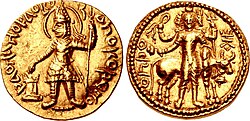 Oesho, with a second human face, and the head of a horned animal, on a coin of Vasudeva I
 Coin of the Kushan king Kanishka II with, on the reverse, a depiction of Oesho and the word "Oesho" in modified Greek script.
 Kushan worshipper with Oesho, Bactria, 3rd century CE.[12]


Notes
edit- ↑ Rosenfield, John M. (1967). The Dynastic Arts of the Kushans. University of California Press. p. 93.
- ↑ Carter, Martha L. (1994). A Treasury of Indian Coins. Marg Publications. ISBN 978-81-85026-25-1.
- ↑ Sivaramamurti, p. 56-59.
- ↑ The Dynasty Arts of the Kushans. University of California Press. 1967. pp. 92–93.
- ↑ Blurton, T. Richard (1993). Hindu Art. Harvard University Press. p. 84. ISBN 0-674-39189-6.
- ↑ "Coins of Vima Kadphises". Archived from the original on 2011-05-14. Retrieved 2010-12-05.
- ↑ Dani, Ahmad Hasan; Harmatta, János (1999). History of Civilizations of Central Asia. Motilal Banarsidass Publ. p. 326. ISBN 978-81-208-1408-0.
- ↑ "Ommo-Oesho coin of Huvishka British Museum". The British Museum.
- ↑ Dani, Ahmad Hasan; Harmatta, János (1999). History of Civilizations of Central Asia. Motilal Banarsidass Publ. p. 326. ISBN 978-81-208-1408-0.
- ↑ Dani, Ahmad Hasan; Harmatta, János (1999). History of Civilizations of Central Asia. Motilal Banarsidass Publ. p. 326. ISBN 978-81-208-1408-0.
- ↑ "Ommo-Oesho coin of Huvishka British Museum". The British Museum.
- ↑ Metropolitan Museum of Art exhibition
References
edit- Bopearachchi, Osmund (2003). De l'Indus à l'Oxus, Archéologie de l'Asie Centrale (in French). Lattes: Association imago-musée de Lattes. ISBN 2-9516679-2-2.