
The Noua-Sabatinovka-Coslogeni complex[a] was a late Bronze Age archaeological cultural complex located in Ukraine, Moldova and Romania, dating from the 16th to 11th centuries BC, consisting of the closely related Noua, Sabatinovka (Sabatynivka) and Coslogeni cultures.[1][2][3][4]
 | |
| Geographical range | Ukraine, Moldova, Romania |
|---|---|
| Period | Bronze Age |
| Dates | 16th century - 11th century BC |
| Preceded by | Multi-cordoned ware culture, Srubnaya culture, Monteoru culture, Wietenberg culture, Tei culture |
| Followed by | Urnfield culture, Gava culture, Bilozerka culture |
Characteristics
editOrigin
editThe Sabatinovka culture was formed on the basis of the Multi-Cordon Ware culture,[7][5] there is also the influence of the Srubnaya culture and Monteoru.[8][2] Noua culture and Coslogeni were formed as a result of the fusion of local cultures (Monteoru, Tei and Wietenbrg cultures) with the arriving carriers of the Sabatinovka culture.[6] The relationship of the archaeological complex as part of the Srubnaya culture is a subject of debate.[9]
Successors
editBilozerka culture was the successor of the Sabatinovka culture.[8]
Noua culture and Coslogeni was absorbed by Urnfield culture (Gava culture)[2]
Ethnicity
editGallery
edit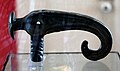 Noua-Sabatinovka-Coslogeni bronze sceptre, Moldova.[12]
 Noua-Sabatinovka-Coslogeni bronze artefacts, Moldova
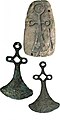 Bronze artefacts and casting mould, Ukraine


Genetics
editHaplogroups
editNoua culture and Sabatinovka culture had a male haplogroup R1a, from female haplogroups were present J1, U8a1a1, U2e1b.[13]
Autosomal DNA
editThe Noua and Sabatinovka cultures have a genetically similar origin, which distinguishes the Noua culture from its predecessor Monteoru, which was predominantly of Neolithic origin.
 Autosomal DNA Sabatinovka culture
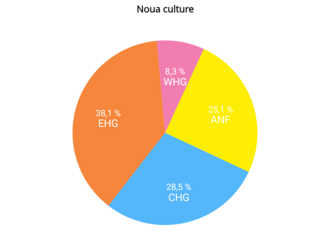 Autosomal DNA Noua Culture


See also
editNotes
edit- ↑ Ukrainian: Ноа-Сабатинівська-Кослодженьська культурна спільність, romanized: Noa-Sabatynivsjka-Koslodzhenjsjka kuljturna spiljnistj, lit. 'Noua-Sabatynivka-Coslogeni cultural circle'.
References
edit- ↑ "Bronze Age". The National Museum of History of Moldova. 2023.
- 1 2 3 Boroffka, Nikolaus (2013). "Chapter 47: Romania, Moldova, and Bulgaria". In Harding, Anthony; Fokkens, Harry (eds.). The Oxford Handbook of the European Bronze Age. OUP Oxford. pp. 888–890. ISBN 978-0-19-957286-1.
The Late Bronze Age is marked by two cultural groupings, a south-eastern (Noua-Sabatinovka-Coslogeni) and a western (channelled pottery). ... in Moldova and Ukraine, a specific settlement type of the Noua-Sabatinovka-Coslogeni complex is the so-called ash-mound
- ↑ Parzinger, Hermann (2013). "Chapter 48: Ukraine and South Russia in the Bronze Age". In Harding, Anthony; Fokkens, Harry (eds.). The Oxford Handbook of the European Bronze Age. OUP Oxford. ISBN 978-0-19-957286-1.
The absolute chronology of the Noua culture, based on radiocarbon dating and synchronisms with the Carpathian Basin, fits in the fourteenth to thirteenth/twelfth centuries BC. To a large extent this corresponds to the beginnings of the Sabatinovka culture and emphasizes the contemporaneity of the two cultures.
- ↑ "Noua culture". Internet Encyclopedia of Ukraine.
- 1 2 Kuzmina, Elena E. (2015). Great Russian Encyclopedia (in Russian) (29 ed.). Moscow. p. 173.
{{cite book}}: CS1 maint: location missing publisher (link) - 1 2 Sava, E.N. (2013). Great Russian Encyclopedia (in Russian) (23 ed.). Moscow. pp. 96–97.
{{cite book}}: CS1 maint: location missing publisher (link) - ↑ Kuzmina, Elena E. (2007). Mallory, J. P. (ed.). The Origin of the Indo-Iranians. BRILL. pp. 355–359. ISBN 978-90-04-16054-5.
- 1 2 Kuzmina 2007, pp. 356.
- ↑ Kuzmina 2007, pp. 355.
- ↑ Kuzmina 2007, pp. 355–359.
- ↑ Sulimirski, T. (1985). "The Scyths". In Gershevitch, I. (ed.). The Median and Achaemenian Periods. The Cambridge History of Iran. Vol. 2. Cambridge, United Kingdom: Cambridge University Press. pp. 152–183. ISBN 978-1-139-05493-5.
- ↑ "Bronze Age". The National Museum of History of Moldova. 2023.
- ↑ Lazaridis, Iosif; Alpaslan-Roodenberg, Songül; Acar, Ayşe; Açıkkol, Ayşen; Agelarakis, Anagnostis; Aghikyan, Levon; Akyüz, Uğur; Andreeva, Desislava; Andrijašević, Gojko; Antonović, Dragana; Armit, Ian; Atmaca, Alper; Avetisyan, Pavel; Aytek, Ahmet İhsan; Bacvarov, Krum (2022). "The genetic history of the Southern Arc: A bridge between West Asia and Europe". Science. 377 (6609) eabm4247. doi:10.1126/science.abm4247. ISSN 0036-8075. PMC 10064553. PMID 36007055. S2CID 251843620.