
Neustadt-Glewe (German pronunciation: [ˈnɔʏʃtat ˈɡleːvə]) is a town in state of Mecklenburg-Western Pomerania, in the district of Ludwigslust-Parchim, Germany.
Neustadt-Glewe | |
|---|---|
 Coat of arms | |
Location of Neustadt-Glewe
within Ludwigslust-Parchim district
| |
 Location of Neustadt-Glewe | |
  Neustadt-Glewe  Neustadt-Glewe | |
| Coordinates: 53°22′N 11°35′E / 53.367°N 11.583°E | |
| Country | Germany |
| State | Mecklenburg-Vorpommern |
| District | Ludwigslust-Parchim |
| Municipal assoc. | Neustadt-Glewe |
| Subdivisions | 8 |
| Government | |
| • Mayor | Arne Kröger (Ind.) |
| Area | |
• Total | 94.14 km2 (36.35 sq mi) |
| Elevation | 32 m (105 ft) |
| Population (2024-12-31)[1] | |
• Total | 6,566 |
| • Density | 69.75/km2 (180.6/sq mi) |
| Time zone | UTC+01:00 (CET) |
| • Summer (DST) | UTC+02:00 (CEST) |
| Postal codes | 19306 |
| Dialling codes | 038757 |
| Vehicle registration | LUP, HGN, LBZ, LWL, PCH, STB |
| Website | www.neustadt-glewe.de |

History
editNeustadt-Glewe was mentioned for the first time in a document in 1248.
Neustadt-Glewe was the site of a Nazi concentration camp (1944–1945) "KZ Neustadt-Glewe".[2] Among its prisoners was Stanisława Rachwał, a Polish resistance fighter transferred from Auschwitz-Birkenau.[3]
Hans Axel Holm, a Swedish writer and journalist, documented life in Neustadt-Glewe in the late 1960s when it was part of the German Democratic Republic. In his book The Other Germans: Report From an East German Town,[4] Holm documented various aspects of everyday life in the GDR, such as being an adult who worked at a VEB (industrial state-owned enterprise) or at an LPG (collective farm); being a child or teen going to school and participating in the FDJ (youth organization); being a soldier in the NVA (army); the GDR's relationship with the Soviets, including tensions within the Eastern Bloc and the threat of Soviet interventions; recreation; housing; socialist ideology and administration; the Nazi era and its consequences; interaction with West Germans, including the themes of who left the East, who stayed, and who came to the East; and other topics. LPG farming was big business in the Ludwigslust-Parchim region at the time, and the factories in the area included a large tannery (VEB Lederwerk "August Apfelbaum", which had formerly been a large plant of Adler and Oppenheimer), a hydraulic parts factory (for VEB Hydraulik Nord), and a factory for radio parts and telephone switchboard parts (for VEB Funkmechanik).
Sights and monuments
edit- The Alte Burg, a 13th-century castle, considered to be the oldest military castle in Mecklenburg.
- The Schloss (palace), completed in 1720 in Baroque style, today a hotel.
- Monument to victims of Neustadt-Glewe German-Nazi Concentration Camp
Population development
edit- 1855: 1,880
- 1890: 1,743
- 1925: 3,202
- 1984: 7,500
- 1995: 7,542
- 2010: 6,547
 Alte Burg (Old Castle)
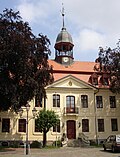 Town hall
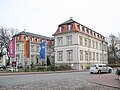 Neues Schloss (New Château)
 Church St. Marien


Transport
editThe Neustadt-Glewe railway station is served by the regional train line RB 14 (Hagenow Stadt–Parchim). There are connections to long-distance transport Berlin – Hamburg as well as regional transport to Schwerin and Wittenberge via the Ludwigslust railway station.
References
edit- ↑ "Bevölkerungsstand der Kreise und Gemeinden 2024" (XLS) (in German). Statistisches Amt Mecklenburg-Vorpommern.
- ↑ "Neustadt-Glewe concentration camp".
- ↑ "Stanisława Rachwał "Herbert", "Ryś", Zygmunt" –".
- ↑ Holm, Hans Axel (1973) [1969], The Other Germans: Report From an East German Town, translated by Thomas Teal, Pantheon, OL 5445359M
External links
edit Media related to Neustadt-Glewe at Wikimedia Commons
- Official website

 | This Ludwigslust-Parchim location article is a stub. You can help Wikipedia by adding missing information. |