
Neminātha (Devanagari: नेमिनाथ) (Sanskrit: नेमिनाथः), also known as Nemi and Ariṣṭanemi (Devanagari: अरिष्टनेमि), is the 22nd ford-maker (tirthankara) of Jainism in the present cosmic age (Avasarpini). Along with Mahavira, Pārśvanātha and Rishabhanatha, he is one of the most devotionally revered tirthankaras within the Jain tradition. Traditional accounts state he lived 84,000 years before the 23rd tirthankara, Pārśvanātha.
| Neminath | |
|---|---|
22nd Tirthankara | |
| Member of Tirthankar, Salakapurusha, Arihant and Siddha | |
 Idol of Neminath at Girnar Hill, Gujarat | |
| Other names | Nemi, Nem |
| Venerated in | Jainism |
| Predecessor | Naminatha |
| Successor | Parshvanatha |
| Symbol | Shankha (conch) [1] |
| Height | 10 bows – 98 feet (30 m)[2] |
| Age | 1000 |
| Color | Black |
| Gender | Male |
| Genealogy | |
| Born | Ariṣṭanemi |
| Died | |
| Parents |
|
| Dynasty | Yaduvaṁśa—Harivaṁśa [3][4] |
In Jain theology and literature, Neminatha is celebrated as a contemporary and cousin of the Hindu deity Krishna, born into the Yadu dynasty in the city of Śaurīpura. His parents are named as Samudravijaya and Shivadevi Jain epics, such as the Harivamsa Purana, utilize the dynamic between the two cousins to contrast Krishna's violent, worldly conquests with Neminatha's supreme spiritual asceticism. While secular historians generally debate his physical historicity, some Indologists connect him to the sage Ghora Angirasa mentioned in the Vedic Chandogya Upanishad, who instructed Krishna in the virtues of absolute nonviolence (ahimsa). Traditional accounts mention his date of birth as the fifth day of Shravan Shukla of the Jain calendar.
Neminatha's defining mythological narrative centers on his profound compassion. Jain tradition holds that upon hearing the cries of animals penned for slaughter at his wedding feast, he immediately renounced his betrothed, Rajmati, his royal lineage, and all worldly attachments (aparigraha). He retreated to Mount Girnar in the Saurashtra region of modern-day Gujarat, where he became an Jain monk and ultimately attained omniscience (Kevala Jnana) and liberation (moksha).
Due to his exclusive geographical association with his ascetic life and liberation, Mount Girnar evolved into one of the most prominent and historically contested Jain pilgrimage sites on the Indian subcontinent. In Jain iconography, Neminatha is traditionally identified by a dark-bluish complexion and the conch shell (shankha) emblem. He is frequently depicted alongside his dedicated guardian deities, the Yaksha Gomedha (or Sarvanha) and the highly venerated Yakshi Ambika.
Nomenclature
editThe name Neminatha consists of two Sanskrit words, Nemi which means "rim, felly of a wheel" or alternatively "thunderbolt",[5] and natha which means "lord, patron, protector".[6]
According to the 9th-10th century CE Jain text Uttarapurana of Jinasena (Digambara monk), as well as the explanation of Hemachandra (11th century CE Śvetāmbara monk), it was the ancient Indian deity Indra who named the 22nd tirthankara as Neminatha, because he viewed the Jina as the "rim of the wheel of dharma".[7]
In Śvetāmbara Jain texts, his name Aristanemi came from a dream his mother had during pregnancy, where she saw a "wheel of Arista jewels".[8] His full name is mentioned as Aristanemi which is an epithet of the sun-chariot.[9][10] Neminatha's name is spelled close to the 21st tirthankara Naminatha.[11]
Historicity and textual sources
editThe historicity of Neminatha presents a complex challenge for modern Indologists, situated at the intersection of epic mythology and the late Vedic period.[12] While secular historians generally accept the 23rd and 24th tirthankaras (Pārśvanātha and Mahavira) as verifiable historical figures, Neminatha's physical existence is heavily debated and largely tied to the historicity of the Vrishni heroes.[12]
Vedic references
editJain tradition frequently points to the appearance of the names "Neminatha" and "Arishtanemi" in the Rigveda and the Yajurveda as proof of his deep antiquity.[12][13][14][15] While orthodox scholars cite these hymns as direct references to the 22nd tirthankara, modern secular academics remain cautious, noting that these terms may have functioned as general Vedic epithets before being codified into Jain universal history.[12][13]
The Ghora Angirasa hypothesis
editThe most substantial academic framework supporting Neminatha's historicity is the "Ghora Angirasa hypothesis," derived from the Chandogya Upanishad (3.17.6).[12] The Upanishadic text documents a spiritual teacher named Ghora Angirasa who instructed Krishna in a doctrine heavily emphasizing asceticism, charity, truthfulness, and, most notably, nonviolence (ahimsa).[12] Because these exact ethical principles form the foundational vows of Jainism, prominent historians and Indologists, such as Dharmananda Kosambi, have proposed that Ghora Angirasa was either Neminatha himself or a historical proto-Jain ascetic of the Śramaṇa tradition upon whom the Neminatha narrative was later built.[12][16]
The Jain traditions about Neminatha are incorporated in the Harivamsa Purana of Jinasena.[17][18] A palm leaf manuscript on the life of Neminatha, named Neminatha-Charitra, was written in 1198-1142 AD. It is now preserved in Shantinatha Bhandara, Khambhat.[19] The incident where Neminatha is depicted as blowing Krishna's mighty conch is given in Kalpa Sūtra.[9]
Rajul's love for Neminatha is described in the Rajal-Barahmasa (an early 14th-century poem of Vijayachandrasuri).[20] The separation of Rajul and Neminatha has been a popular theme among Jain poets who composed Gujarati fagus, a poetry genre. Some examples are Neminatha Fagu (1344) by Rajshekhar, Neminatha Fagu (1375) by Jayashekhar and Rangasagara Neminatha Fagu (1400) by Somsundar. The poem Neminatha Chatushpadika (1269) by Vinaychandra depicted the same story.[21][22][23][24][25]
Arddha Nemi, the "Unfinished Life of Nemi", is an incomplete epic by Janna, one of the most influential Kannada poets of the 13th century.[26] Nemidutam composed by Acharya Jinasena, 9th century, is an adoration of Neminatha.[27]
Life
editNeminatha was the twenty-second Tirthankara (ford-maker) of the avasarpiṇī (present descending cycle of Jain cosmology).[28][29][30] Jain tradition place him as a contemporary of Krishna, the ninth and last vasudev.[31] There was a gap of 581,750 years between the Neminatha and his predecessor, Naminatha as per traditional beliefs.[16][11][32] He lived approx. 81,000 years before the 23rd Tirthankara, Parshvanatha as per the Trishashtishalakapursusha Charitra of Acharya Hemachandra.[16][32]
Birth
edit
Neminatha is mentioned as the youngest son of king Samudravijaya and queen Shivadevi of the Yadu lineage,[3][4] born at Sauripura (Dvaraka).[33] He is believed to have become fond of animals in his early life due to being in a cattle-herding family. Jain legends place him in the Girnar-Kathiawad (in Saurashtra region of modern-day Gujarat).[34][35][36] His birth date is believed to be the fifth day of Shravana Shukla of the Hindu calendar.[30]
Life before renunciation
editHe is believed to have been born with a dark-blue skin and complexion,[37] a very handsome but shy young man.[4][33] His height is mentioned as 10 dhanusha.[32] His father is mentioned as the brother of Vasudeva, Krishna's father, therefore he is mentioned as the cousin of Krishna in Trishashti-salaka-purusha-charitra.[28][38][39][40][41][42] Sculptures found in Kankali Tila, Mathura of Kushana period depicts Krishna and Balarama as cousins of Neminatha.[43]
In one of the legends, on being taunted by Satyabhama, wife of Krishna, Neminatha is depicted to have blown Panchajanya, the mighty conch of Krishna through his nostrils. According to the texts, no one could lift the conch except Krishna, let alone blow it.[44][33] After this event, the Harivaṃśapurāṇa, as composed by Jinasena (8/9th-century CE Digambara monk), states that Krishna decided to test Neminatha's strength and challenged him for a friendly duel. Neminatha, being a Tirthankara, is believed to have defeated Krishna easily.[45] He is also mentioned as spinning a great Chakra with the right leg toe during his childhood.[33]
Renunciation
edit

Jain tradition holds that the Neminatha's marriage was arranged with Rajulakumari or Rajimati or Rajamati, daughter of Ugrasena.[33] Ugrasena is believed to be the king of Dvārakā and maternal grandfather of Krishna.[33] He is believed to have heard animal cries as they were being slaughtered for the marriage feast. Taken over by sorrow and distress at the sight, he is believed to have given up the desire of getting married, and to have become a monk and gone to Mount Girnar.[46][47][40] His bride-to-be Rajulakumari is believed to have followed him, becoming a nun and his brother Rahanemi became a monk, joining his ascetic order.[33][41]
According to Kalpasutras, Neminatha led an ascetic life thereby eating only once every three days,[48] meditated for 55 days and then obtained omniscience on Mount Raivataka, under a Mahavenu tree.[37]
Disciples
editNirvana
editHe is said to have lived 1,000 years[51] and spent many years spreading his knowledge and preaching principles of ahiṃsā (nonviolence) and aparigraha (asceticism) in the Saurashtra region.[52][32] He is said to have attained moksha (nirvana) on the fifth peak or tonk (Urjayant Parvat) of Mount Girnar.[41][49][28] Of these 1,000 years, he is believed to have spent 300 years as a bachelor, 54 days as an ascetic monk and 700 years as an omniscient being.[48]
Cosmological context and past lives
editIn Jain theology, the attainment of the status of a tirthankara is not a sudden occurrence but the culmination of rigorous spiritual purification across multiple lifetimes.[53] According to classical Jain texts, such as the Trishashthishalakapurushacharitra, the soul of Neminatha underwent numerous cycles of rebirth (bhavas) before its final earthly incarnation.[53] Prominent past lives include his existence as King Supratishtha, during which the soul engaged in intense asceticism, and a subsequent rebirth as a celestial deity in the Aparajita heaven.[53] It was during these prolonged periods of meditation and spiritual discipline that the soul accumulated the specific karmic merit (Tirthankara-nama-karma) required to be reborn as a spiritual ford-maker in the human realm.[54]
Teachings and philosophy
edit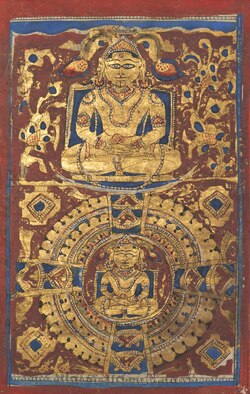
Neminatha's primary philosophical contribution to Jainism is the absolute embodiment and elevation of nonviolence (ahimsa).[55] While all tirthankaras preached nonviolence, Jain texts position Neminatha's life as the ultimate practical demonstration of this doctrine.[55] Upon hearing the cries of animals penned for his wedding feast, he experienced intense compassion (karuna) and realized that personal happiness could not be built upon the suffering and slaughter of other sentient beings.[56] This event shifted the Jain discourse of ahimsa from a strictly ascetic vow to a universal moral imperative that must supersede even royal, social, and familial obligations.[12]
Neminatha's teachings heavily emphasize non-possession or non-attachment (aparigraha).[57] By abandoning his betrothed, Rajmati, and his royal Yadava lineage at the peak of his youth, his life serves as a doctrinal template for absolute renunciation.[57] According to Jain theology, his teachings stressed that material accumulation and emotional attachments are the primary drivers of karmic bondage.[55][41] His asceticism directly inspired Rajmati to also renounce the world, illustrating the Jain philosophical view that spiritual liberation (moksha) requires breaking all worldly ties, regardless of one's expected societal duties.[55][41]
In comparative theology, several Indologists and Jain scholars identify Neminatha with Ghora Angirasa, a sage mentioned in the Hindu Chandogya Upanishad.[58][31] According to this text, Ghora Angirasa instructed Krishna in a philosophy that closely mirrors the Jain Great Vows.[59][31] He taught that the true spiritual sacrifice is not a Vedic fire ritual, but a life lived with asceticism (tapas), charity (dana), nonviolence (ahimsa), and truthfulness (satyavacana).[59] This historical and literary intersection is frequently cited to position Neminatha's early teachings as a foundational influence on the spiritual development of his cousin, Krishna, emphasizing inner purity over external ritualism.[59]
Mahabharata mentions him as the teacher of the path of salvation to king Sagara.[12] He may also be identified with a Scandinavian or Chinese deity, but such claims are not accepted generally.[12]
Temples and pilgrimage
editMount Girnar
edit
Mount Girnar, historically referred to as Urjayantagiri or Raivataka, serves as the epicenter of Neminatha's sacred geography.[60] While traditional universal histories locate his birth in the Gangetic plains, the entirety of his ascetic life—his renunciation, his attainment of omniscience, and his ultimate liberation (moksha)—is geographically anchored to the peaks of Girnar in the Saurashtra region of modern-day Gujarat.[60] The mountain features multiple distinct peaks (tonks), with the fifth peak traditionally venerated as the exact site of his nirvana.[61]
Because of its exclusive association with Neminatha, the mountain evolved into one of the most prominent Jain pilgrimage sites (tirthas) on the Indian subcontinent.[62] By the medieval period, immense mercantile patronage had transformed the mountain into a massive temple city.[62] Jain lay communities and ministers funded the construction of heavily fortified, elaborately carved stone and marble temple complexes along the mountain's peaks, serving as public demonstrations of both religious piety and socio-political capital.[62]
The supreme religious importance of Neminatha's liberation site also made Girnar a historical flashpoint for intense sectarian conflict.[60][63] From the 12th century onward, the Śvetāmbara and Digambara sects engaged in fierce, centuries-long ownership disputes over the primary shrines.[60][63] Inscriptions from the medieval period, followed by extensive legal battles continuing into the modern era, highlight how control over Neminatha's sacred geography was actively utilized by sectarian leaders to consolidate theological legitimacy, wealth, and regional influence in western India.[60][63]
Significant temples
editLakshmeshwara Jain temples (Shank basadi) were built by Kalyani Chalukyas in 7th century.[64] The temple derives its name from the image of Neminatha in kayotsarga posture standing on a large conch shell (shankha).[65] The unique feature of this temple is a monolithic pillar with the carving of 1008 tirthankaras known as Sahasrakuta Jinabimba.[66][67] Adikavi Pampa wrote Ādi purāṇa, seated in this temple during 9th century.[68][69]
Located in Jintur, Maharashtra, Nemgiri features a series of subterranean cave temples carved during the Rashtrakuta period in the 9th century.[70] It is uniquely dedicated to Neminatha and preserves a massive, elaborately carved seated idol that is highly venerated in regional folklore.[70]
Kulpakji is a Śvētāmbara pilgrimage center that flourished under the Rashtrakuta and Kalyani Chalukya dynasties in modern Telangana.[71] Renowned for its red sandstone architecture, the primary sanctum houses prominent historical idols of Neminatha alongside Rishabhanatha and Mahavira.[71]
Dating back to the 11th century and heavily patronized by the Chola dynasty, Tirumalai (Jain complex) houses the tallest Jain sculpture in Tamil Nadu—a 16-foot high monolithic rock-cut image of Neminatha.[72] The adjacent Arahanthgiri Jain Math serves as a major regional center for the Digambara tradition.[72]
Bhand Dewal is an 11th-century temple situated in Arang, Chhattisgarh notable for its rare Bhumija style of stellate (star-shaped) architecture.[73] The heavily ornamented sanctum preserves three finely polished black stone images of tirthankaras, with Neminatha featured as one of the primary deities.[73]
Luna Vasahi in Dilwara Temples was built in 1230 by two Porwad brothers - Vastupala and Tejpal.[74] It is considered famous for ellaborate architecture and intricate carvings.[74] The ceilings of the temple depicts scenes of the life of Neminatha with images of his betrothed, Rajmati and his cousin, Krishna.[65][75][49]
Odegal Basadi is situated on Vindhyagiri Hill in Shravanabelagola, Karnataka.[76] This 14th-century triple-shrined (trikuta) temple features three separate sanctums facing different directions.[76] The inclusion of Neminatha in one of the primary shrines highlights the deep integration of his worship within the geographic epicenter of South Indian Jainism.[76]


.jpg)

Role in Jain epics
edit_Wellcome_L0034141.jpg)
Jain literature presents a fundamentally distinct version of the Hindu epic, the Mahabharata, primarily through texts such as Jinasena's 8th-century Harivamsa Purana and Hemachandra's 12th-century Trishashthishalakapurushacharitra.[77] In these Jain narratives, Neminatha serves as the ultimate theological anchor, and the dynamic between him and his cousin Krishna is utilized to establish the supremacy of Jain asceticism over Hindu martial prowess.[77]
Within Jain universal history, historical figures are categorized by their spiritual and worldly roles.[78] Krishna is classified as a Vasudeva (a violent, worldly hero destined to conquer the earth), while Neminatha is a tirthankara (a supreme, non-violent spiritual conqueror).[78] Jain texts assert that Krishna’s political and military victories were only possible because Neminatha actively refused to compete for temporal power, choosing instead the path of renunciation.[78]
A central theme of the Jain Mahabharata is the contrasting karmic destinies of the two cousins.[77][60] Because Krishna engaged in and orchestrated the mass violence of the Kurukshetra War, Jain theology asserts that he accumulated severe negative karma, resulting in his subsequent rebirth in the third hell.[77][60] In stark contrast, Neminatha’s absolute adherence to nonviolence allowed him to destroy all karmic bondage and attain liberation.[77][60] Academic scholars note that this narrative structure was a deliberate theological strategy utilized by medieval Jain authors to domesticate and subordinate the immense popularity of the Hindu Krishna cult.[77][60] By framing Krishna as a worldly subordinate to the spiritually supreme Neminatha, Jainism institutionally reinforced the superiority of asceticism over epic heroism.[77][60]
In the war between Krishna and Jarasandha, Neminatha is believed to have participated alongside Krishna.[79] This is believed to be the reason for celebrating Krishna-related festivals in Jainism and for intermingling with Hindus, who worship Krishna as one of the incarnations of Vishnu.[80]
Legacy
editWorship and adoration
editNeminatha is one of the five most devotionally revered tirthankaras, along with Mahavira, Rishabhanatha, Parshvanatha and Shantinatha.[81] Scenes from Neminatha's life are popular in Jain art.[49] Jinastotrāņi is a collection of hymn dedicated to Neminatha along with Munisuvrata, Chandraprabha, Shantinatha, Mahavira, Parshvanatha and Rishabhanatha.[82]
Samantabhadra's Svayambhustotra praises the 24 tirthankaras, and its eight songs (shlokas) adore Shantinatha.[83] One such shloka reads:
O Worshipful Lord! Endowed with supreme accomplishments, you had burnt the karmic fuel with the help of pure concentration; your eyes were broad as open water-lilies. You were the chief of the Hari dynasty and had promulgated the unblemished tradition of reverence, and control of the senses. You were an ocean of right conduct, and ageless. O Most Excellent Lord Ariṣṭanemi! After illuminating the world (the universe and the non-universe) through powerful ways of omniscience, you had attained liberation
— Svayambhūstotra (22-1-121)[84]
Iconography
edit

Neminatha is believed to have had the same dark-bluish-colored skin as Krishna.[85] Painting depicting his life stories generally identifies him as dark-coloured. His iconographic identifier is a conch carved or stamped below his statues. Sometimes, as with Vishnu's iconography, a chakra is also shown near him, as in the 6th-century sculpture found at the archaeological site near Padhavali, Madhya Pradesh.[86]
 Neminatha Jain statue (c. 475 CE), in Buddha style from Shreyansh giri
 Neminatha, Nasik Caves, 6th century
 Akota Bronzes, MET museum, 7th century
 Image at Maharaja Chhatrasal Museum, 12th century
 Neminath idol, Government Museum, Mathura, 12th Century
 Depiction of Neminatha on Naag as bed, chakra on foot finger and conch played by nose at Parshvanath temple, Tijara

.jpg)


.JPG)


Guardian Deities
editIn Jain art, tirthankaras are traditionally depicted with their dedicated guardian deities (Shashan-devatas).[87] Neminatha is heavily associated with his attendant Yakshi, Ambika (also known as Kushmandini), who became one of the most prominent and independently worshipped goddesses in Jainism.[87]
In standard canonical depictions alongside Neminatha, Ambika is shown seated under a mango tree (Kalpavriksha), riding a lion, and accompanied by her two sons.[88] She often holds a bunch of mangoes or a mango branch, symbolizing fertility and abundance.[88] While she is his subordinate guardian, artworks showing Neminatha frequently feature Ambika prominently, though her depicted skin color varies geographically from golden to greenish to dark-blue.[89] A miniature carving of Neminatha in a seated meditative posture (dhyana mudra) is invariably placed at the very top of Ambika's independent sculptural frames to signify her devotion to him.[36] According to the Digambara tradition, his accompanying male Yaksha is Sarvanha, while the Śvētāmbara tradition identifies him as Gomedha.[49]
The earliest known image of Neminatha was found in Kankali Tila dating back to c. 18 CE.[90] Highly detailed depictions of him alongside Ambika can also be found in the renowned Akota Bronzes dating to the 6th and 7th centuries.[36]
See also
edit
References
editCitations
edit- ↑ Tandon 2002, p. 45.
- ↑ Sarasvati 1970, p. 444.
- 1 2 von Glasenapp 1925, p. 317.
- 1 2 3 Doniger 1993, p. 225.
- ↑ Monier Williams, p. 569.
- ↑ Monier Williams, p. 534.
- ↑ Umakant P. Shah 1987.
- ↑ Umakant P. Shah 1987, pp. 164–165.
- 1 2 Jain & Fischer 1978, p. 17.
- ↑ Zimmer 1953, p. 225.
- 1 2 von Glasenapp 1925, pp. 317–318.
- 1 2 3 4 5 6 7 8 9 10 Natubhai Shah 2004, pp. 23–24.
- 1 2 Dundas 2002, p. 24.
- ↑ Natubhai Shah 2004, p. 269.
- ↑ Reddy 2023, p. 187.
- 1 2 3 Zimmer 1953, p. 226.
- ↑ Umakant P. Shah 1987, p. 239.
- ↑ Upinder Singh 2016, p. 26.
- ↑ Umakant P. Shah 1987, p. 253.
- ↑ Kelting 2009, p. 117.
- ↑ Amaresh Datta 1988, p. 1258.
- ↑ K. K. Shastree 2002, pp. 56–57.
- ↑ Nagendra 1988, pp. 282–283.
- ↑ Jhaveri 1978, pp. 14, 242–243.
- ↑ Parul Shah 1983, pp. 134–156.
- ↑ Sastri 2002, pp. 358–359.
- ↑ Acharya Charantirtha 1973, p. 47.
- 1 2 3 "Arishtanemi: Jaina saint". Encyclopedia Britannica. Retrieved 15 September 2017.
- ↑ Zimmer 1953, p. 224.
- 1 2 Tukol 1980, p. 31.
- 1 2 3 Natubhai Shah 2004, p. 23.
- 1 2 3 4 Finegan 1952, p. 190.
- 1 2 3 4 5 6 7 Natubhai Shah 2004, p. 24.
- ↑ Dhere 2011, pp. 193–196.
- ↑ Upinder Singh 2008, p. 313.
- 1 2 3 Cort 2001a, p. 23.
- 1 2 Umakant P. Shah 1987, p. 164.
- ↑ Johnson 1931, pp. 1–266.
- 1 2 Jain & Fischer 1978, pp. 16–17.
- 1 2 Umakant P. Shah 1987, pp. 165–166.
- 1 2 3 4 5 Sangave 2001, p. 104.
- ↑ Gaur 1976, p. 46.
- ↑ Vyas 1995, p. 19.
- ↑ von Glasenapp 1925, p. 318.
- ↑ Doniger 1993, p. 226.
- ↑ Sehdev Kumar 2001, pp. 143–145.
- ↑ Kailash Chand Jain 1991, p. 7.
- 1 2 Jones & Ryan 2006, p. 311.
- 1 2 3 4 5 Umakant P. Shah 1987, p. 165.
- ↑ Cort 2001a, p. 47.
- ↑ Melton & Baumann 2010, p. 1551.
- ↑ Natubhai Shah 2004, p. 25.
- 1 2 3 Dundas 2002, pp. 20–22.
- ↑ Jaini 1998, pp. 259–260.
- 1 2 3 4 Dundas 2002, pp. 40–42.
- ↑ Jaini 1998, p. 19.
- 1 2 Zimmer 1953, pp. 226–227.
- ↑ Jyotiprasad Jain 1983, p. 12.
- 1 2 3 Bhattacharya 1966, p. 302.
- 1 2 3 4 5 6 7 8 9 10 Cort 2001a, pp. 219–220.
- ↑ Cort 2001a, p. 229.
- 1 2 3 Titze & Bruhn 1998, pp. 252–253.
- 1 2 3 Dundas 2002, pp. 240–241.
- ↑ Chugh 2016, p. 300.
- 1 2 Umakant P. Shah 1987, p. 169.
- ↑ Chugh 2016, p. 295.
- ↑ Chugh 2016, pp. 305–306.
- ↑ Azer 2011.
- ↑ Chugh 2016, p. 437.
- 1 2 Michell 1990, p. 373.
- 1 2 Raj Kumar 2003, p. 64.
- 1 2 Titze & Bruhn 1998, p. 122.
- 1 2 Babb 1996, p. 68.
- 1 2 Ching, Jarzombek & Prakash 2010, p. 336.
- ↑ Titze & Bruhn 1998, p. 253.
- 1 2 3 Chugh 2016, p. 210.
- 1 2 3 4 5 6 7 Dundas 2002, pp. 235–237.
- 1 2 3 Jaini 1998, pp. 304–305.
- ↑ Beck 2012, p. 156.
- ↑ Long 2009, p. 42.
- ↑ Dundas 2002, p. 40.
- ↑ Lienhard 1984, p. 137.
- ↑ Vijay K. Jain 2015, pp. 150–155.
- ↑ Vijay K. Jain 2015, pp. 150–151.
- ↑ Umakant P. Shah 1987, pp. 164–168.
- ↑ Umakant P. Shah 1987, pp. 164–170.
- 1 2 Tiwari 1989, pp. 14–15.
- 1 2 Pratapaditya Pal 1986, p. 142.
- ↑ Umakant P. Shah 1987, pp. 264–265.
- ↑ Umakant P. Shah 1987, p. 166.
Sources
editBooks
edit- Babb, Lawrence A. (1996), Absent Lord: Ascetics and Kings in a Jain Ritual Culture, University of California Press, ISBN 978-0-520-91708-8
- Beck, Guy L. (1 February 2012), Alternative Krishnas: Regional and Vernacular Variations on a Hindu Deity, SUNY Press, ISBN 978-0-7914-6415-1
- Bhattacharya, Harisatya (1966), Reals in the Jaina Metaphysics, Seth Santi Das Khetsy Charitable Trust
- Cort, John E. (2001a), Jains in the World : Religious Values and Ideology in India, Oxford University Press, ISBN 978-0-19-513234-2
- Ching, Francis D. K.; Jarzombek, Mark M.; Prakash, Vikramaditya (2010) [1934], A Global History of Architecture, John Wiley & Sons, ISBN 978-0-471-26892-5
- Chugh, Lalit (2016), Karnataka's Rich Heritage - Art and Architecture (From Prehistoric Times to the Hoysala Period ed.), Chennai: Notion Press, ISBN 978-93-5206-825-8
- Acharya Charantirtha (1973), Meghadutam of Mahakavi Kalidas, Chaukhamba Sanskrit Series, Varanasi: Chaukhamba Surbharati Prakashan
- Datta, Amaresh (1988), Encyclopaedia of Indian Literature, Sahitya Akademi, ISBN 978-81-260-1194-0
- Dhere, Ramchandra C. (2011), Rise of a Folk God: Vitthal of Pandharpur, Oxford University Press, ISBN 978-0-19-977759-4
- Dundas, Paul (2002) [1992], The Jains (Second ed.), Routledge, ISBN 0-415-26605-X
- Doniger, Wendy (1993), Purana Perennis: Reciprocity and Transformation in Hindu and Jaina Texts, SUNY Press, ISBN 0-7914-1381-0
- Finegan, Jack (1952), The archeology of world religions, Princeton University Press
- Jain, Jyotindra; Fischer, Eberhard (1978), Jaina Iconography, vol. 12, Brill Publishers, ISBN 978-90-04-05259-8
- Jain, Jyotiprasad (1983), Religion and Culture of the Jains, Bharatiya Jnanpith
- Jain, Kailash Chand (1991), Lord Mahāvīra and His Times, Motilal Banarsidass, ISBN 978-81-208-0805-8
- Jain, Vijay K. (2015), Acarya Samantabhadra's Svayambhustotra: Adoration of The Twenty-four Tirthankara, Vikalp Printer, ISBN 9788190363976,
 This article incorporates text from this source, which is in the public domain.
 - Jaini, Padmanabh S. (1998) [1979], The Jain Path of Purification, Delhi: Motilal Banarsidass, ISBN 978-81-208-1578-0
- Jhaveri, Mansukhlal (1978), History of Gujarati Literature, Sahitya Akademi, archived from the original on 20 December 2016
- Johnson, Helen M. (1931), Neminathacaritra (Book 8 of the Trishashti Shalaka Purusha Caritra), Baroda Oriental Institute
- Jones, Constance; Ryan, James D. (2006), Encyclopedia of Hinduism, Infobase Publishing, ISBN 978-0-8160-7564-5
- Kelting, M. Whitney (2009), Heroic Wives Rituals, Stories and the Virtues of Jain Wifehood, Oxford University Press, ISBN 978-0-19-538964-7
- Kumar, Raj (2003), Essays on Indian Art and Architecture, Discovery Publishing House, ISBN 978-81-7141-715-5
- Kumar, Sehdev (2001), A Thousand Petalled Lotus: Jain Temples of Rajasthan : Architecture & Iconography, Abhinav Publications, ISBN 978-81-7017-348-9
- Long, Jeffery D. (2009), Jainism: An Introduction, I. B. Tauris, ISBN 978-1-84511-625-5
- Lienhard, Siegfried (1984), A History of Classical Poetry: Sanskrit, Pali, Prakrit, A history of Indian literature: Classical Sanskrit literature, vol. 1, Harrassowitz Verlag, ISBN 978-1-84511-625-5
- Melton, J. Gordon; Baumann, Martin, eds. (2010), Religions of the World: A Comprehensive Encyclopedia of Beliefs and Practices, vol. One: A-B (Second ed.), ABC-CLIO, ISBN 978-1-59884-204-3
- Michell, George (1990), The Penguin Guide to the Monuments of India, vol. 1, Penguin Books, ISBN 978-0140081442
- Pal, Pratapaditya (1986), Indian Sculpture: Circa 500 B.C.–A.D. 700, vol. 1, Los Angeles Country Museum of Art, University of California Press, ISBN 978-0-87587-129-5
- Nagendra (1988), Indian Literature, Prabhat Prakashan
- Reddy, P. Chenny (2023), Kalyana Mitra: A treasure house of history, culture and archaeological studies, vol. 5, Blue Rose Publishers, ISBN 978-93-5741-111-0
- Sangave, Vilas Adinath (2001), Facets of Jainology: Selected Research Papers on Jain Society, Religion, and Culture, Mumbai: Popular Prakashan, ISBN 978-81-7154-839-2
- Sarasvati, Swami Dayananda (1970), An English translation of the Satyarth Prakash, Swami Dayananda Sarasvati[permanent dead link]
- Shah, Natubhai (2004), Jainism: The World of Conquerors, vol. 1, Motilal Banarsidass, ISBN 9788120819382
- Shah, Parul (31 August 1983), "5", The rasa dance of Gujarata (Ph.D.), vol. 1, Department of Dance, Maharaja Sayajirao University of Baroda, hdl:10603/59446
- Shastree, K. K. (2002), Gujarat Darsana: The Literary History, Darshan Trust, Ahmedabad
- Singh, Upinder (2016), A History of Ancient and Early Medieval India: From the Stone Age to the 12th Century, Pearson Education, ISBN 978-93-325-6996-6
- Shah, Umakant Premanand (1987), Jaina-rūpa-maṇḍana: Jaina iconography, Abhinav Publications, ISBN 81-7017-208-X
- Sastri, K.A. Nilakanta (2002) [1955]. A history of South India from prehistoric times to the fall of Vijayanagar. New Delhi: Indian Branch, Oxford University Press. ISBN 0-19-560686-8.
- Singh, Upinder (2008), A history of ancient and early medieval India : from the Stone Age to the 12th century, New Delhi: Pearson Education, ISBN 978-81-317-1120-0
- Tandon, Om Prakash (2002) [1968], Jaina Shrines in India (1 ed.), New Delhi: Publications Division, Ministry of Information and Broadcasting, Government of India, ISBN 81-230-1013-3
- Titze, Kurt; Bruhn, Klaus (1998), Jainism: A Pictorial Guide to the Religion of Non-Violence (2 ed.), Motilal Banarsidass, ISBN 978-81-208-1534-6
- Tiwari, Maruti Nandan Prasad (1989), Ambika in Jaina Art and Literature, Bharatiya Jnanpith
- Tukol, T. K. (1980), Compendium of Jainism, Dharwad: University of Karnataka
- von Glasenapp, Helmuth (1925), Jainism: An Indian Religion of Salvation [Der Jainismus: Eine Indische Erlosungsreligion], Shridhar B. Shrotri (trans.), Motilal Banarsidass (Reprint: 1999), ISBN 81-208-1376-6
{{citation}}: ISBN / Date incompatibility (help) - Vyas, Dr. R. T., ed. (1995), Studies in Jaina Art and Iconography and Allied Subjects, The Director, Oriental Institute, on behalf of the Registrar, M.S. University of Baroda, Vadodara, ISBN 81-7017-316-7
- Williams, Monier, Nemi - Sanskrit English Dictionary with Etymology, Oxford University Press
- Zimmer, Heinrich (1953) [April 1952], Campbell, Joseph (ed.), Philosophies Of India, London: Routledge & Kegan Paul Ltd, ISBN 978-81-208-0739-6, This article incorporates text from this source, which is in the public domain.
{{citation}}: ISBN / Date incompatibility (help)
Web
edit- Gaur, R. C. (1976). "Vedoc Chronology". Proceedings of the Indian History Congress. 37. Indian History Congress: 46–49. JSTOR 44138897. Retrieved 11 February 2023.
- Azer, Rahman (27 June 2011). "Lakshmeshwar, a melting pot of cultures". Deccan Herald. Retrieved 9 May 2021.