NGC 5905 is a barred spiral galaxy in the constellation of Draco. Its velocity with respect to the cosmic microwave background is 3,454±7 km/s, which corresponds to a Hubble distance of 166.2 ± 11.6 Mly (50.95 ± 3.57 Mpc).[1] However, 14 non-redshift measurements give a much closer mean distance of 119.16 ± 8.34 Mly (36.536 ± 2.556 Mpc).[2] It was discovered by German-British astronomer William Herschel on 5 May 1788.[3][4]
| NGC 5905 | |
|---|---|
 NGC 5905 imaged by SDSS | |
| Observation data (J2000 epoch) | |
| Constellation | Draco |
| Right ascension | 15h 15m 23.3243s[1] |
| Declination | +55° 31′ 01.995″[1] |
| Redshift | 0.011308±0.0000170[1] |
| Heliocentric radial velocity | 3,390±5 km/s[1] |
| Distance | 119.16 ± 8.34 Mly (36.536 ± 2.556 Mpc)[1] |
| Group or cluster | NGC 5908 group (LGG 395) |
| Apparent magnitude (V) | 12.49[1] |
| Characteristics | |
| Type | SB(r)b[1] |
| Size | ~162,900 ly (49.95 kpc) (estimated)[1] |
| Apparent size (V) | 4.0′ × 2.6′[1] |
| Other designations | |
| IRAS 15140+5541, 2MASX J15152332+5531015, UGC 9797, MCG +09-25-038, PGC 54445, CGCG 274-036[1] | |
NGC 5905 has an active galactic nucleus, i.e. it has a compact region at the center of a galaxy that emits a significant amount of energy across the electromagnetic spectrum, with characteristics indicating that this luminosity is not produced by the stars.[5][6]
NGC 5905 is also a Seyfert I galaxy, i.e. it has a quasar-like nucleus with very high surface brightnesses whose spectra reveal strong, high-ionisation emission lines, but unlike quasars, the host galaxy is clearly detectable.[1]
NGC 5908 group
editSupernova
editSee also
editReferences
edit- 1 2 3 4 5 6 7 8 9 10 11 12 "Results for object NGC 5905". NASA/IPAC Extragalactic Database. NASA and Caltech. Retrieved 11 December 2025.
- ↑ "Distance Results for NGC 5905". NASA/IPAC Extragalactic Database. NASA. Retrieved 11 December 2025.
- ↑ Herschel, William (1789). "Catalogue of a Second Thousand of New Nebulae and Clusters of Stars; with a Few Introductory Remarks on the Construction of the Heavens". Philosophical Transactions of the Royal Society of London. 79: 212–255. Bibcode:1789RSPT...79..212H. doi:10.1098/rstl.1789.0021.
- ↑ Seligman, Courtney. "New General Catalogue Objects: NGC 5905". Celestial Atlas. Retrieved 11 December 2025.
- ↑ Véron-Cetty, M.-P.; Véron, P. (2010). "A catalogue of quasars and active nuclei: 13th edition". Astronomy and Astrophysics. 518: A10. Bibcode:2010A&A...518A..10V. doi:10.1051/0004-6361/201014188.
- ↑ "NGC 5905". SIMBAD. Centre de données astronomiques de Strasbourg. Retrieved 11 December 2025.
- ↑ Garcia, A. M. (1993). "General study of group membership. II. Determination of nearby groups". Astronomy and Astrophysics Supplement Series. 100: 47. Bibcode:1993A&AS..100...47G.
- ↑ "LGG 395". SIMBAD. Centre de données astronomiques de Strasbourg. Retrieved 11 December 2025.
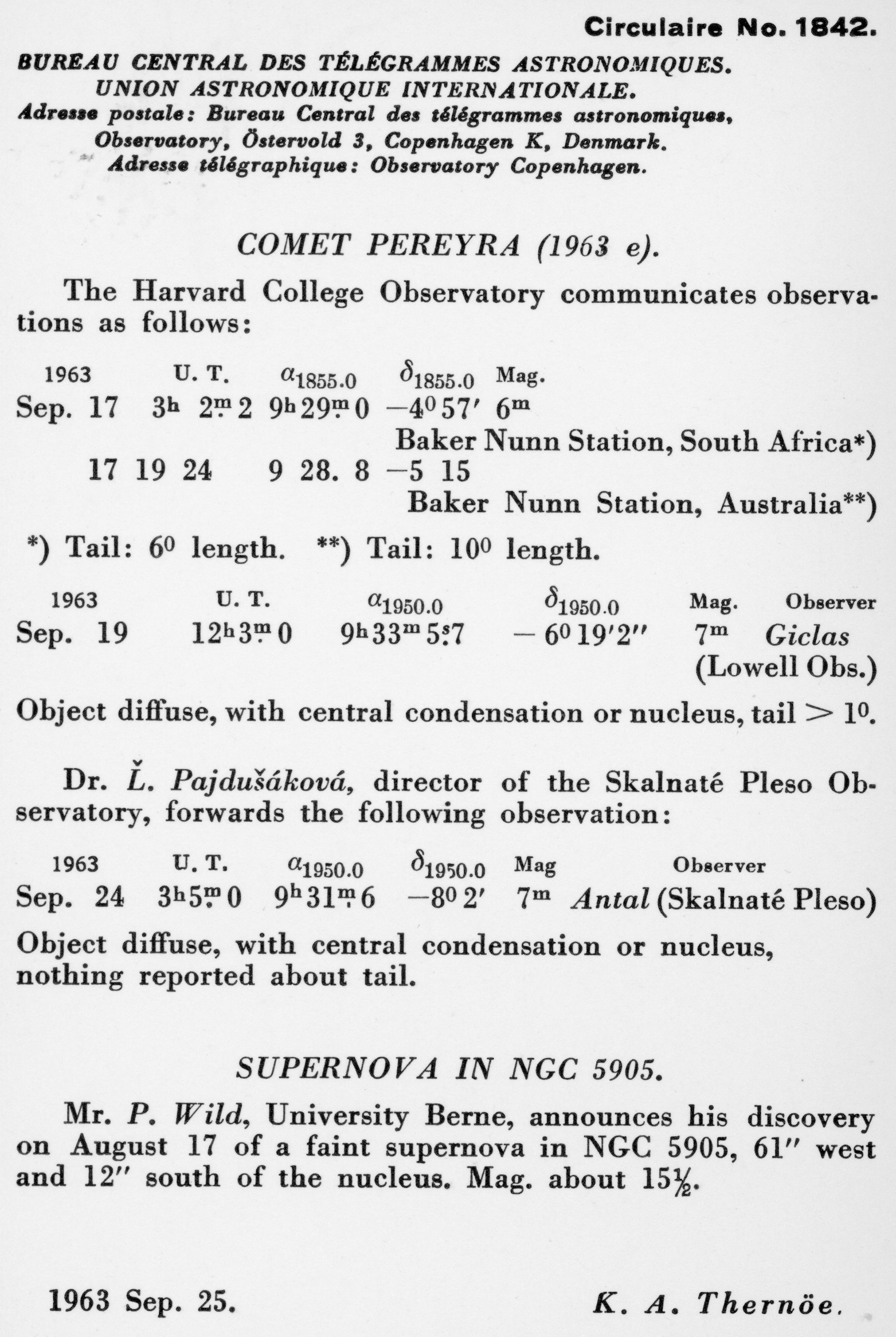
- ↑ Wild, Paul (25 September 1963). Thernöe, K. A. (ed.). "SUPERNOVA IN NGC 5905". Central Bureau for Astronomical Telegrams (1842). IAU: 1. Retrieved 11 December 2025.
- ↑ "SN 1963O". Transient Name Server. IAU. Retrieved 11 December 2025.
External links
edit Media related to NGC 5905 at Wikimedia Commons
- NGC 5905 on WikiSky: DSS2, SDSS, GALEX, IRAS, Hydrogen α, X-Ray, Astrophoto, Sky Map, Articles and images