NGC 3938 is an unbarred spiral galaxy in the Ursa Major constellation. It was discovered by German-British astronomer William Herschel on 6 February 1788.[3] It is one of the brightest spiral galaxies in the Ursa Major South galaxy group and is roughly 76,000 light years in diameter.[2][4] It is approximately 41.4 million light years away from Earth.[1] NGC 3938 is classified as type Sc under the Hubble sequence, a loosely wound spiral galaxy with a smaller and dimmer bulge.[5] The spiral arms of the galaxy contain many areas of ionized atomic hydrogen gas, more so towards the center.[6]
| NGC 3938 | |
|---|---|
 NGC 3938 imaged by Mount Lemmon SkyCenter of the University of Arizona | |
| Observation data (J2000 epoch) | |
| Constellation | Ursa Major[1] |
| Right ascension | 11h 52m 49.4319s[2][1] |
| Declination | +44° 07′ 14.840″[2] |
| Redshift | 0.002695[2] |
| Heliocentric radial velocity | 808±2 km/s[2] |
| Distance | 41.40 ± 9.00 Mly (12.694 ± 2.760 Mpc)[2] |
| Apparent magnitude (V) | 10.9[1] |
| Characteristics | |
| Type | SA(s)c[2] |
| Size | ~76,400 ly (23.42 kpc) (estimated)[2] |
| Apparent size (V) | 5.4′ × 4.9′[1] |
| Other designations | |
| IRAS 11502+4423, UGC 6856, MCG +07-25-001, PGC 37229, CGCG 214-034[2] | |
NGC 3938 is a member of the NGC 4111 Group,[7] which is part of the Ursa Major Cloud and is the second largest group in the cloud after the NGC 3992 Group.[8][9][10]
Supernovae and Luminous Red Nova
edit
Five supernovae have been identified within NGC 3938:
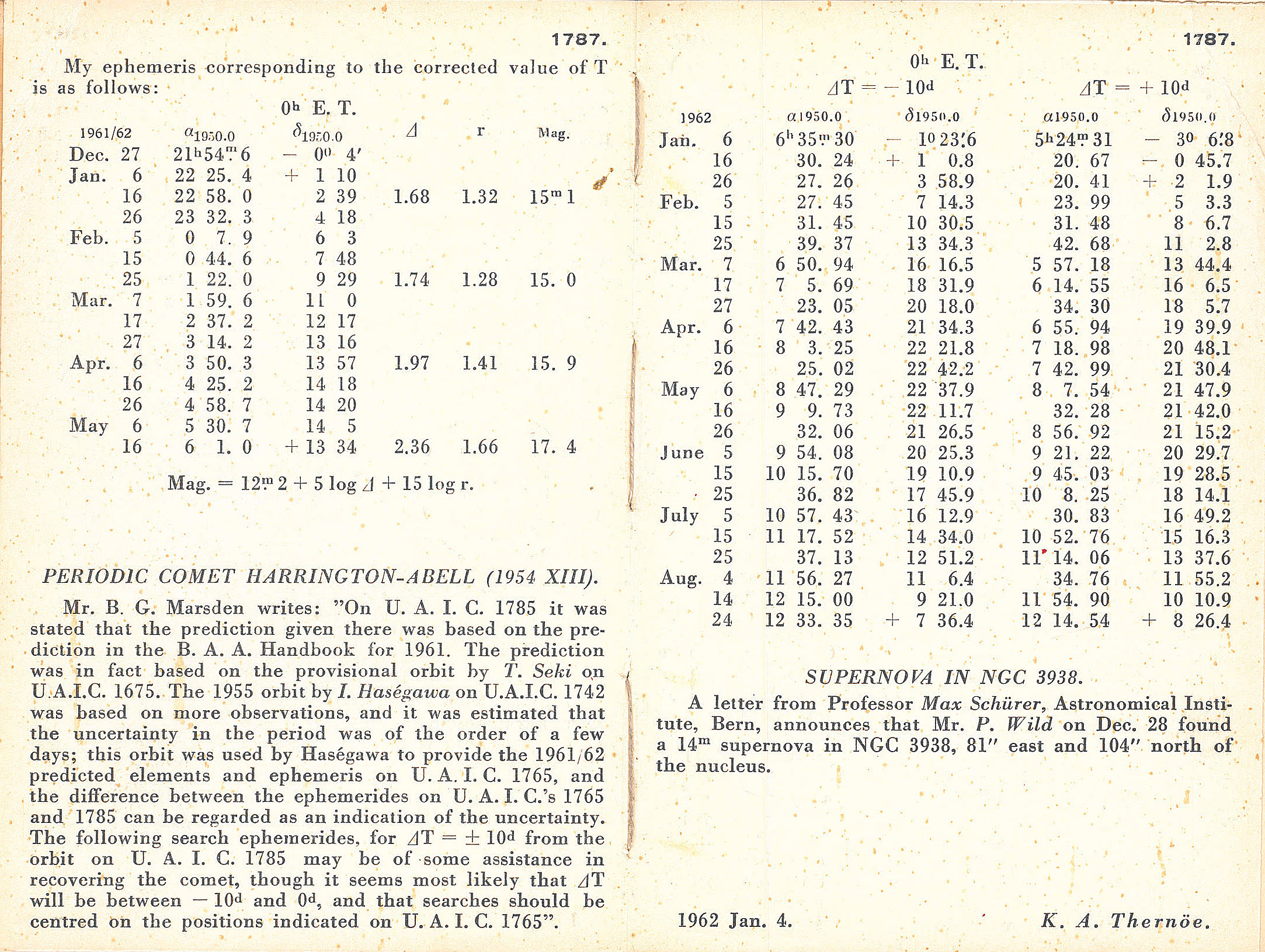
- SN 1961U (Type II, mag. 13.7) was discovered by Paul Wild on 28 December 1961.[11][12][a]
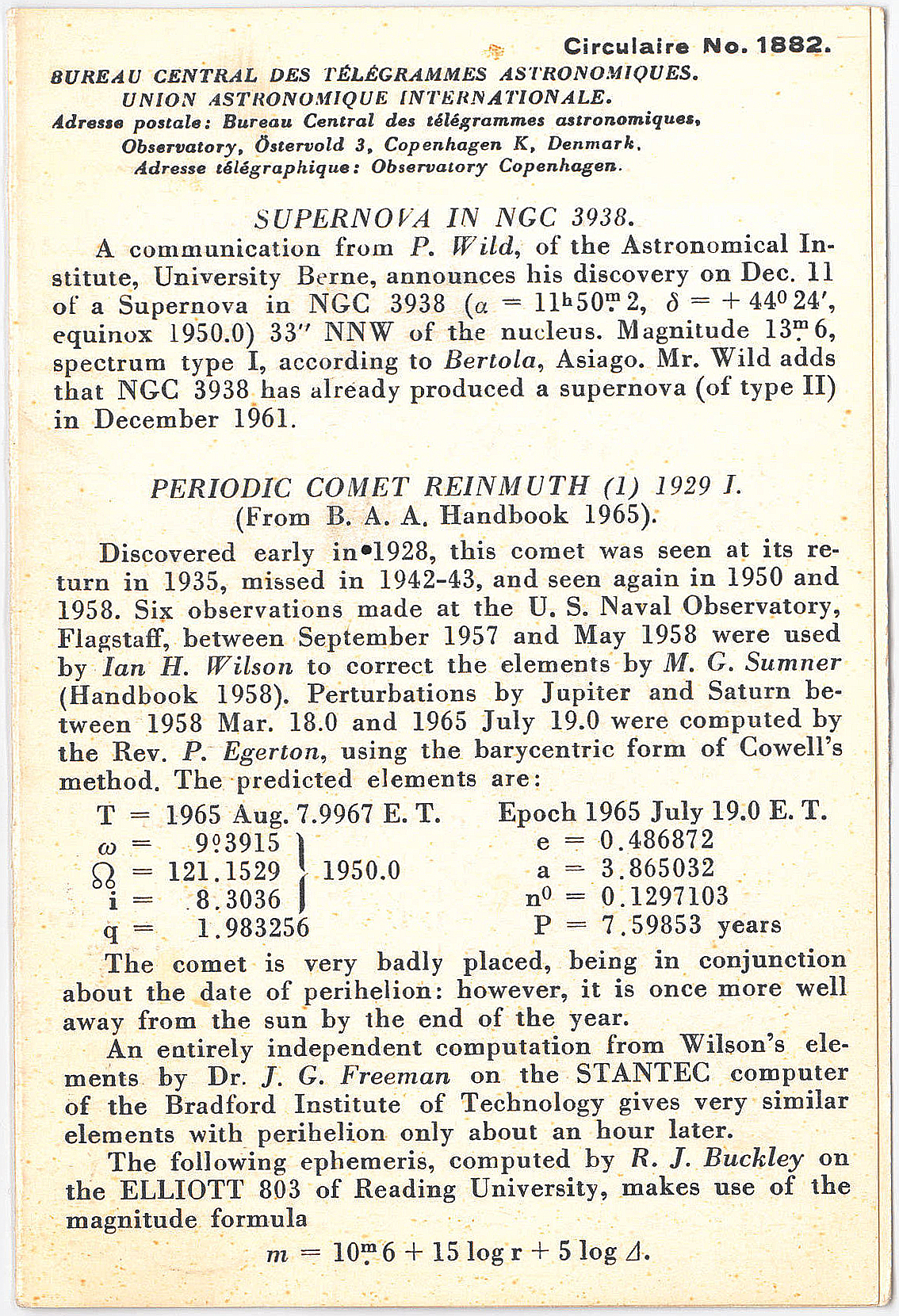
- SN 1964L (Type Ic, mag. 13.3) was discovered by Paul Wild on 11 December 1964.[13][14]
- SN 2005ay (Type II, mag. 15.6) was discovered by Doug Rich on 27 March 2005.[15][16][17]
- SN 2017ein (Type Ic, mag. 17.6) was discovered by Ron Arbour on 25 May 2017 and peaked at magnitude 14.9.[18][19] Images taken before the explosion point to a progenitor mass between ~47-48M☉, if it was in a single star system, and ~60-80M☉, if it was in a binary star system.[20]
- SN 2022xlp (Type Ia, mag. 17) was discovered by Kōichi Itagaki on 13 October 2022.[21]
One luminous red nova has been observed in NGC 3938:
- AT 2022ckk (type LRN, mag. 19.6766) was discovered by the Automatic Learning for the Rapid Classification of Events (ALeRCE) on 13 February 2022.[22]
Gallery
edit Artist's impression of progenitor star to a type Ic supernova SN 2017ein in NGC 3938.[23]
 Spiral galaxy NGC 3938, by HST. Location of SN 2005ay remnant is marked.
 The location of SN 2017ein, by HST.
 NGC 3938 by the Sloan Digital Sky Survey
 The luminous red nova AT 2022ckk with James Webb Space Telescope MIRI


.jpg)

See also
editNotes
edit- ↑ Some sources incorrectly list the discovery date as 2 January 1962.
References
edit- 1 2 3 4 5 George Normandin (5 May 2005). "Spiral Galaxy NGC 3839". kopernik.org. Retrieved 30 December 2011.
- 1 2 3 4 5 6 7 8 9 "Results for object NGC 3938". NASA/IPAC Extragalactic Database. NASA and Caltech. Retrieved 28 February 2021.
- ↑ Seligman, Courtney. "New General Catalogue Objects: NGC 3938". Celestial Atlas. Retrieved 7 June 2025.
- ↑ "The Ursa Major Groups". Atlas of the Universe. Retrieved 30 December 2011.
- ↑ van der Kruit, P.C.; Shostak, G.S. (1982). "Studies of Nearly Face-on Spiral Galaxies" (PDF). Astronomy and Astrophysics. 105: 351–358. Bibcode:1982A&A...105..351V. Retrieved 25 June 2014.
- ↑ Jiménez-Vicente, J.; E. Battaner; M. Rozas; H. Castañeda; et al. (1999). "Fabry-Perot observations of the ionized gas in NGC 3938" (PDF). Astronomy and Astrophysics. 342: 417–425. arXiv:astro-ph/9811391. Bibcode:1999A&A...342..417J.
- ↑ Makarov, Dmitry; Karachentsev, Igor (21 April 2011). "Galaxy groups and clouds in the local (z∼ 0.01) Universe: Galaxy groups in the local Universe". Monthly Notices of the Royal Astronomical Society. 412 (4): 2498–2520. arXiv:1011.6277. doi:10.1111/j.1365-2966.2010.18071.x.
- ↑ Karachentsev, I. D.; Nasonova, O. G.; Courtois, H. M. (1 March 2013). "Anatomy of Ursa Majoris". Monthly Notices of the Royal Astronomical Society. 429 (3): 2264–2273. arXiv:1211.5975. doi:10.1093/mnras/sts494. ISSN 1365-2966.
- ↑ Pak, Mina; Rey, Soo-Chang; Lisker, Thorsten; Lee, Youngdae; Kim, Suk; Sung, Eon-Chang; Jerjen, Helmut; Chung, Jiwon (29 September 2014). "The properties of early-type galaxies in the Ursa Major cluster". Monthly Notices of the Royal Astronomical Society. 445 (1): 630–647. arXiv:1409.3070. doi:10.1093/mnras/stu1722. ISSN 0035-8711.
- ↑ Ai, Mei; Zhu, Ming; Yu, Nai-ping; Xu, Jin-long; Liu, Xiao-lan; Jing, Yingjie; Jiao, Qian; Liu, Yao; Zhang, Chuan-peng; Wang, Jie; Jiang, Peng (1 April 2025). "Formation of the Dark Matter–Deficient S0 Galaxy NGC 4111 under the Tidal Interactions". The Astrophysical Journal Letters. 982 (2): L52. arXiv:2503.05171. Bibcode:2025ApJ...982L..52A. doi:10.3847/2041-8213/adbeee. ISSN 2041-8205.
- ↑ Schürer, Max; Wild, P. (4 January 1962). Thernöe, K. A. (ed.). "SUPERNOVA IN NGC 3938". Central Bureau for Astronomical Telegrams. 1787. Observatory Copenhagen, IAU: 3. Retrieved 27 November 2024.
- ↑ "SN 1961U". Transient Name Server. IAU. Retrieved 27 November 2024.
- ↑ Wild, P.; Bertola (29 December 1964). Thernöe, K. A. (ed.). "SUPERNOVA IN NGC 3938". Central Bureau for Astronomical Telegrams. 1882. Observatory Copenhagen, IAU: 1. Retrieved 27 November 2024.
- ↑ "SN 1964L". Transient Name Server. IAU. Retrieved 27 November 2024.
- ↑ Rich, D. (2005). "Supernova 2005ay in NGC 3938". Central Bureau Electronic Telegrams (128): 1. Bibcode:2005CBET..128....1R.
- ↑ Bishop, David. "Supernova 2005ay in NGC 3938". Rochester Astronomy. Retrieved 29 January 2013.
- ↑ "SN 2005ay". Transient Name Server. IAU. Retrieved 27 November 2024.
- ↑ "SN 2017ein". Transient Name Server. IAU. Retrieved 27 November 2024.
- ↑ Bishop, David. "Supernovae 2017ein in NGC 3938". www.rochesterastronomy.org. Retrieved 29 June 2017.
- ↑ Van Dyk, Schuyler; et al. (15 July 2018). "SN 2017ein and the Possible First Identification of a Type Ic Supernova Progenitor". The Astrophysical Journal. 860 (2): 90. arXiv:1803.01050. Bibcode:2018ApJ...860...90V. doi:10.3847/1538-4357/aac32c. hdl:10150/628570. S2CID 56265423.
- ↑ "SN 2022xlp". Transient Name Server. IAU. Retrieved 27 November 2024.
- ↑ "AT 2022ckk". Transient Name Server. IAU. Retrieved 7 June 2025.
- ↑ "Artist's impression of progenitor star to a type Ic supernova". www.spacetelescope.org. Retrieved 20 November 2018.
External links
edit Media related to NGC 3938 at Wikimedia Commons