
Mânzăleşti (Romanian pronunciation: [mɨnzəˈleʃtʲ]) is a commune in the north of Buzău County, Muntenia, Romania. It is composed of thirteen villages: Beșlii, Buștea, Cireșu, Ghizdita, Gura Bădicului, Jghiab, Mânzălești, Plavățu, Poiana Vâlcului, Satu Vechi, Trestioara, Valea Cotoarei, and Valea Ursului.
Mânzălești | |
|---|---|
 Dormition of the Theotokos wooden church from the Găvanu Monastery | |
 Coat of arms | |
 Location in Buzău County | |
  Mânzălești Location in Romania | |
| Coordinates: 45°30′N 26°39′E / 45.500°N 26.650°E | |
| Country | Romania |
| County | Buzău |
| Subdivisions | Beșlii, Buștea, Cireșu, Ghizdita, Gura Bădicului, Jghiab, Mânzălești, Plavățu, Poiana Vâlcului, Satu Vechi, Trestioara, Valea Cotoarei, Valea Ursului |
| Government | |
| • Mayor (2020–2024) | Viorel Moldoveanu[1] (PSD) |
Area | 94.7 km2 (36.6 sq mi) |
| Elevation | 440 m (1,440 ft) |
| Population (2021-12-01)[2] | 2,069 |
| • Density | 21.8/km2 (56.6/sq mi) |
| Time zone | UTC+02:00 (EET) |
| • Summer (DST) | UTC+03:00 (EEST) |
| Postal code | 127335 |
| Area code | +(40) 238 |
| Vehicle reg. | BZ |
| Website | primaria |
Location
editNeighbours
edit- The commune of Vintileasca, Vrancea County, to the north
- The commune of Bisoca, to the east
- The communes of Chiliile, Cănești, and Vintilă Vodă to the south
- The commune of Lopătari to the east
History
editThe first document mentioning a village from the Mânzălești commune is a property act of February 3, 1522, by which the prince of Wallachia, Radu of Afumați, gave ownership of the land of Peceneaga, from Menedic all the way to Cheia, to Negru Braga, his brothers and sons. The name Menedic refers to the present-day Meledic plateau, which lies close to the confluence of the Jghiab River and the Slănic River.
Throughout its medieval history, the commune was made up of several yeoman villages: Mânzălești-Mănești, Ciomagi, Răghinești, and Ichimești, as well as the serf settlements on the Meledic and Poiana Ascunsă lands.
Landmarks
edit- The cave on the Meledic plateau, considered the longest cave carved in salt in the world.
- The Găvanu Monastery, an Eastern Orthodox monastery, dating back to the 18th century.
- The White Rock, a 13 m (43 ft) high stone, showing wind and water erosion.
| Year | Pop. | ±% |
|---|---|---|
| 2002 | 3,026 | — |
| 2011 | 2,591 | −14.4% |
| 2021 | 2,069 | −20.1% |
| Source: Census data | ||
References
edit- ↑ "Results of the 2020 local elections". Central Electoral Bureau. Retrieved 15 June 2021.
- ↑ "2021 Romanian census". National Institute of Statistics. 1 December 2021.
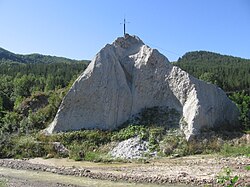 The White Rock in Mânzălești
