This is a list of the duchies and dukes of Pomerania.

Dukes of the Slavic Pomeranian tribes (All Pomerania)
editThe lands of Pomerania were firstly ruled by local tribes, who settled in Pomerania around the 10th and 11th centuries.
Non-dynastic
edit| Ruler | Born | Reign | Death | Ruling part | Consort | Notes | |
|---|---|---|---|---|---|---|---|
| Siemomysł | c.1000 or 1020 | After 1000–1046 | c.29 June 1046 | All Pomerania | Unknown | First known duke of all Pomerania. His origins are unknown. | |
| Świętobor | before 1046 | 1060–1106 | 1106 | All Pomerania | Anna | Son of Siemomysl. | |
| Świętopełk I | before 1106 | 1106–1113 | 1113 | Gdańsk Pomerania (future Pomerelia) | Unknown | ||
In 1106, Pomerania is divided by his two older sons: Wartislaw, who founded the House of Pomerania and the Duchy of Pomerania, and Świętopełk I. After Swietopelk's death, his lands were occupied by the Saxon prince Lothar of Supplinburg. In 1155, the lands regained independence under Sobieslaw I, who founded the dynasty of the Samborides, and the Duchy of Pomerelia.
Duchy of Pomerania
editThe Duchy resulted from the partition of Świętobor, Duke of Pomerania, in which his son Wartislaw inherited the lands that would become in fact known as Pomerania.

Partitions of Pomerania
editFirst partition 1155–1264
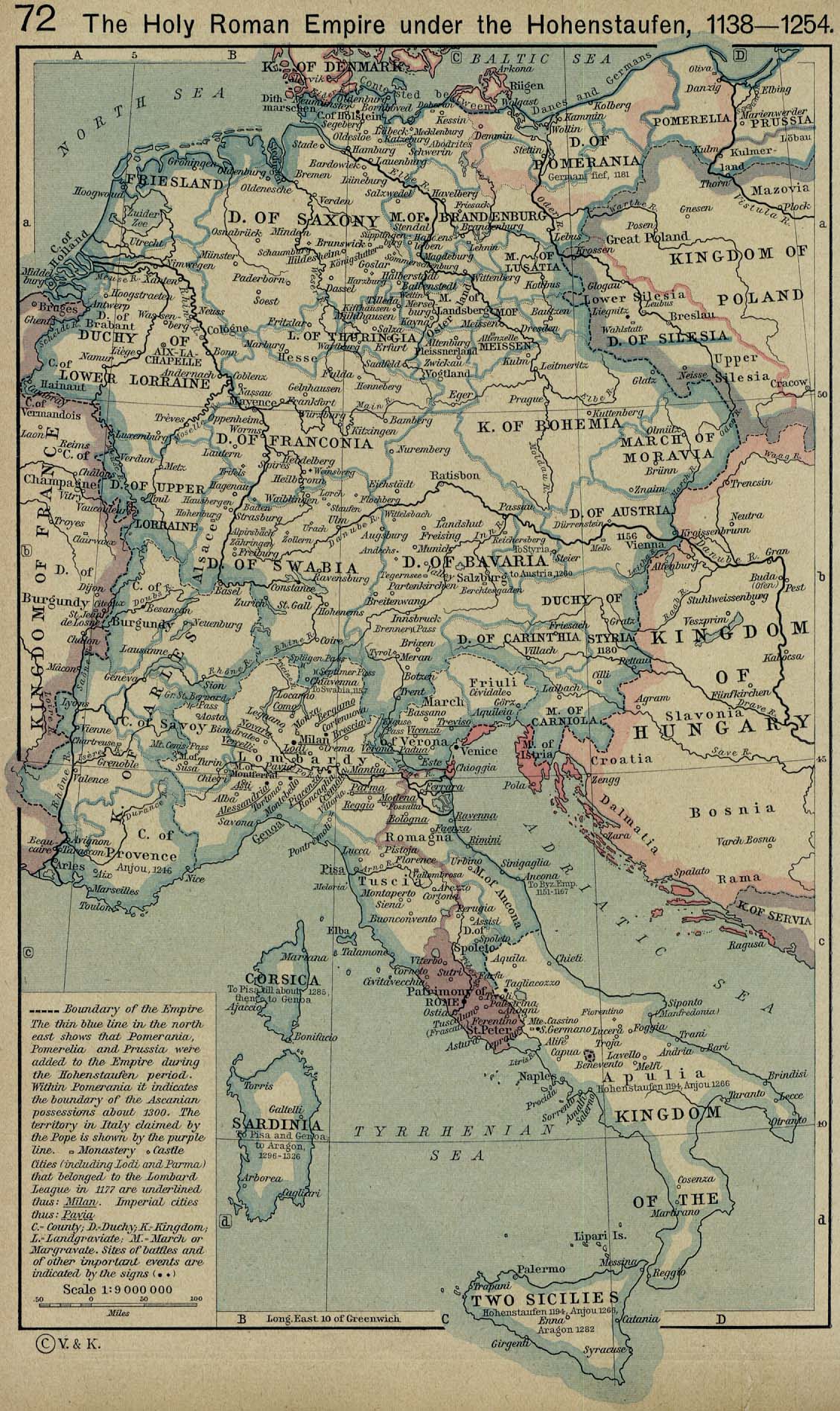
editIn 1155, Pomerania was divided in Pomerania-Szczecin and Pomerania-Demmin. In the struggle to shake off Polish and Danish claims to feudal overlordship, Pomerania approached the Holy Roman Empire. In 1181, while staying in the camp outside the walls of Lübeck, Emperor Frederick I Barbarossa recognised Bogislaw I as duke of S(c)lavia, as it was called in the document.[1] However, three years later in the Battle in the Bay of Greifswald (1184) the Danish Canute VI forced Pomerania to accept him as liege lord.[2] In 1190 the Land of Słupsk-Sławno separated itself from Szczecin. With the defeat of Denmark in the Battle of Bornhöved (1227) Pomerania shook off the Danish liege-lordship,[3] except for the city of Szczecin which remained under Danish suzerainty until 1235.
In 1231 Emperor Frederick II granted the immediate liege lordship over Pomerania to the Margrave of Brandenburg, who enforced this claim by the Treaties of Kremmen (1236) and of Landin (1250). Thus Pomerania had become a fief of Brandenburg, thus an only mediate (indirect) subfief of the Empire, with Brandenburg itself being an immediate imperial fief.
In 1227, Słupsk came to Eastern Pomerania (Pomerelia) within fragmented Poland, Sławno to Western Pomerania. In 1238 both became part of Pomerelia, ruled by the House of Sobiesław, and following the extinction of the line in 1294, both were directly reintegrated with Poland in accordance with the Treaty of Kępno. In 1317, the area became part of the Pomerania-Wolgast (Wołogoszcz), first as a pawn from Brandenburg, and definitively in 1347.
After Wartislaw III died heirless in 1264, Barnim I became sole duke of the whole duchy. After Barnim's death, the duchy was to be ruled by his sons Barnim II, Otto I and Bogislaw IV. The first years, Bogislaw, being the eldest, ruled in place of his too young brothers.
Second partition 1295–1368
editIn 1295, the Duchy of Pomerania was divided roughly by the Peene and Ina rivers, with the areas north of these rivers ruled by Bogislaw IV became Pomerania-Wolgast, whereas Otto I received Pomerania-Szczecin south of these rivers.
Third partition 1368–1376
editIn 1368, Pomerania-Wolgast was divided into a western part (German: Wolgast diesseits der Swine, including the name-giving residence in Wolgast) and an eastern part (German: Wolgast jenseits der Swine, in literature also called Pomerania-Stolp or Duchy of Słupsk after the residence in Słupsk (Stolp)), which came back under Polish suzerainty as a fief.
Fourth partition 1376/1377–1478 and Pomeranian immediacy
editIn 1376, the western part of Pomerania-Wolgast (German: Wolgast diesseits der Swine) was subdivided in a smaller western part sometimes named Pomerania-Barth (Bardo) after the residence in Barth, and an eastern part which included the residence in Wolgast. In the following year, the Duchy of Słupsk was divided into a western part which included Stargard and an eastern part which included the residence in Słupsk (Stolp).
In 1459, the eastern partitions of Pomerania-Wolgast around Stargard and Stolp ceased to exist. In 1478, after 200 years of partition, the duchy was reunited for a short period when all her parts were inherited by Bogislaw X. By the Treaty of Pyritz in 1493 Pomerania shook off the Marcher liege lordship and became again an immediate imperial estate, after new disputes finally confirmed by the Treaty of Grimnitz in 1529, both treaties provided Brandenburg succession in case the Pomeranian dukes would become extinct in the male line.
Fifth and sixth partitions 1531–1625
editIn 1531, Pomerania was partitioned into Pomerania-Stettin (Szczecin) and Pomerania-Wolgast. This time however, in contrast to the earlier partitions with the same names, Pomerania-Wolgast included the western, and Pomerania-Stettin the eastern parts of the duchy. In 1569, were created the duchies of -Barth (split off from -Wolgast) and -Rügenwalde (Darłowo) (split off from -Stettin).
Definitive reunification and annexation to Sweden
editIn 1625, Bogislaw XIV reunited all Pomerania under his rule. However, in 1637, Sweden hold western parts of Pomerania (Hither Pomerania), originally including Stettin, legalised by the Peace of Westphalia in 1648 (Swedish Pomerania, several times reduced in favour of Brandenburgian Pomerania). Between 1637 and 1657 Lauenburg-Bütow Land (Lębork and Bytów) were reintegrated directly to Poland as a reverted fief, thereafter passed to Brandenburg under Polish overlordship until the Partitions of Poland. In 1648, Brandenburg prevailed in the Peace of Westphalia with its claim only for eastern parts of Pomerania (Farther Pomerania), with the Brandenburg electors officially holding simultaneously the title of dukes of Pomerania until 1806 (end of the Empire and its enfeoffments), but de facto integrating their Pomerania into Brandenburg-Prussia, making it one of the provinces of Prussia in 1815, then including former Swedish Pomerania.
Dukes of Pomerania: the House of Griffins
editPartitions of Pomerania under Griffins rule
edit| Duchy of Pomerania (1st creation) (1121–1156) | |||
| Duchy of Demmin (1156–1264)[4] |
Duchy of Stettin[5] (1st creation) (1156–1264) |
Duchy of Schlawe-Stolp[6] (1156–1238) | |
| Duchy of Pomerania (2nd creation) (1264–1295) | |||
| Duchy of Stettin (2nd creation) (1295–1464) | |||
| Duchy of Rugen (1368–1478)[7] |
Duchy of Wolgast (1st creation) (1295–1478) |
Duchy of Stolp[8] (1368–1459) | |
| Duchy of Pomerania (3rd creation) (1478–1531) | |||
| Duchy of Wolgast (2nd creation) (1531–1625) |
Duchy of Stettin[9] (3rd creation) (1531–1625) | ||
| Duchy of Pomerania (4th creation) (1625–1637) | |||
Table of rulers
edit(Note: Here the numbering of the dukes is the same for all duchies, as all were titled Dukes of Pomerania, despite the different parts of land or particular numbering of the rulers. The dukes are numbered by the year of their succession.)
| Ruler | Born | Reign | Ruling part | Consort | Death | Notes | |
|---|---|---|---|---|---|---|---|
| Warcislaus I |  |
c.1091 First son of Świętobor, Duke of Pomerania (?) |
1121 – 9 August 1135 | Duchy of Pomerania | 24 pagan wives Heila of Saxony before 1128 one child Ida of Denmark 1129 three children |
1135 Stolpe an der Peene aged 43–44 |
Possible children of Świętobor, Duke of Pomerania, divided their inheritance. Warcislaus was the first duke of Pomerania and founder of the family as a vassal of Poland. A pagan, he converted to Christianity in the beginning of the 12th century. Then, along with his son Bolesław, backed Otto of Bamberg in his successful Conversion of Pomerania.
As for Racibor, he was the ancestor of the Ratiboriden branch of the House of Pomerania that ruled Słupsk-Sławno. |
| Racibor I |  |
c.1095 Second son of Świętobor, Duke of Pomerania (?) |
1121 – 1156 | Duchy of Schlawe-Stolp | Pribislava Yaroslavna of Volhynia 1136 four children |
1156 aged 60–61 | |
| Regency of Racibor I, Duke of Schlawe-Stolp (1135-1156) | Children of Warcislaus, divided their inheritance, but given their minority, ceded rule to their uncle. In 1184 after the death of his nephew Warcislaus II, Boguslaus I reunited Stettin and Demmin. | ||||||
| Boguslaus I |  |
1127 First son of Warcislaus I and Ida of Denmark |
9 August 1135 – 18 March 1187 | Duchy of Stettin | Walburga of Denmark three children Anastasia of Greater Poland 26 April 1177 two children |
18 March 1187 Sosnitza aged 59–60 | |
| Casimir I |  |
c.1130 Second son of Warcislaus I and Ida of Denmark |
9 August 1135 – 1180 | Duchy of Demmin | Pritolawa no children |
1180 aged 49–50 | |
| Swietopelk | c.1140 Son of Racibor I and Pribislava Yaroslavna of Volhynia |
1156–c.1190 | Duchy of Schlawe-Stolp | Unmarried | c.1190 aged 49–50 | Left no descendants. His land passed to a cousin. | |
| Warcislaus II | c.1160 Third son of Boguslaus I and Walburga of Denmark |
1180–1184 | Duchy of Demmin | Sophia of Poland no children |
c.1184 aged 23–24 | After his death Demmin returned briefly to Pomerania. | |
| Regency of Anastasia of Greater Poland (1187-1208) | Children of Bogislaw I, they split once more the duchy between them. | ||||||
| Boguslaus II |  |
1177 First son of Boguslaus I and Anastasia of Greater Poland |
18 March 1187 – 23 January 1220 | Duchy of Stettin | Miroslava of Pomerelia 1210 three children |
23 January 1220 aged 42–43 | |
| Dobroslawa | c.1175? Daughter of Boguslaus I and Anastasia of Greater Poland |
18 March 1187 – 1230 | Duchy of Stettin (at Schlawe and Gützkow) | Wartislaw, castellan of Stettin c.1200 one child |
c.1230 aged 44–45 | ||
| Casimir II |  |
c.1180 First son of Boguslaus I and Anastasia of Greater Poland |
18 March 1187 – 1219 | Duchy of Demmin | Ingard of Denmark 1210 two children |
1219 aged 38–39 | |
| Boguslaus III |  |
c.1170? Son of Boguslaus of Schlawe-Stolp |
c.1190–1223 | Duchy of Schlawe-Stolp | A daughter of Mieszko III of Poland before 1223 two children |
1223 aged 52–53 | Nephew of Swietopelk. |
| Regency of Ingard of Denmark (1219-1226) | After his death in 1264, Barnim became the sole duke. | ||||||
| Warcislaus III |  |
c.1210 Son of Casimir II and Ingard of Denmark |
1219 – 17 May 1264 | Duchy of Demmin | Sophia 1236 three children |
17 May 1264 aged 53–54 | |
| Racibor II | c.1190? Son of Boguslaus III[10] |
1223–1238 | Duchy of Schlawe-Stolp | Unmarried | 1238 aged 47–48? | After his death without descendants, the land returned to Pomerania. | |
| Stolp annexed to Pomerania | |||||||
| Regency of Miroslava of Pomerelia (1220-1226) | Since 1227 the dukes were again vassals of the Holy Roman Empire. In 1264 Barnim reunited all Pomerania. | ||||||
| Barnim I the Good |  |
c.1217 Son of Boguslaus II and Miroslava of Pomerelia |
23 January 1220 – 17 May 1264 | Duchy of Stettin | Anna Maria of Saxony c.1240 three children Margaret of Brunswick-Lüneburg 1252/3 one child Matilda of Brandenburg c.1265 six children |
13 December 1278 Dąbie aged 60–61 | |
| 17 May 1264 – 13 December 1278 | Duchy of Pomerania | ||||||
| Boguslaus IV |  |
c.1255 Son of Barnim I and Margaret of Brunswick-Lüneburg |
13 December 1278 – 24 February 1309 | Duchy of Wolgast (in Pomerania until 1295) | Matilda of Brandenburg-Stendal between 1275 and 1278 no children Margaret of Rügen 13 August 1284 six children |
24 February 1309 aged 53–54 |
Ruled jointly. Bogislaw was the eldest son of Barnim I, and ruled with his stepmother, who was regent of her own sons. From 1294 Bogislaw ruled directly with his half-brothers Barnim and Otto, who reached majority in that year. Following the death of Barnim without descendants in 1295, Bogislaw and Otto divided Pomerania between them: Bogislaw retained Wolgast and Otto received Stettin. |
| Regency of Matilda of Brandenburg, co-ruling with Bogislaw IV (1278-1294) | |||||||
| Barnim II |  |
c.1277 First son of Barnim I and Matilda of Brandenburg |
13 December 1278 – 28 May 1295 | Duchy of Pomerania | Unmarried | 28 May 1295 aged 17–18 | |
| Otto I |  |
1279 Second son of Barnim I and Matilda of Brandenburg |
13 December 1278 – 31 December 1344 | Duchy of Stettin (in Pomerania until 1295) | Elisabeth of Holstein April 1296 two children |
31 December 1344 aged 64–65 | |
| Warcislaus IV |  |
c.1270 Son of Boguslaus IV and Matilda of Brandenburg-Stendal |
24 February 1309 – 1 August 1326 | Duchy of Wolgast | Elisabeth of Lindow-Ruppin 11 April 1316 or 1317 three children |
1 August 1326 aged 55–56 | In 1325 annexed the Principality of Rügen. |
| Matilda | c.1300 Daughter of Otto I and Elisabeth of Holstein |
1317 – 12 July 1331 | Duchy of Stettin (at Stavenhagen) | John III, Lord of Werle 20 January 1317 three children |
12 July 1331 aged 30–31 | Daughter of Otto I, received from her father the town of Stavenhagen, which passed, through her marriage, to Werle. | |
| Stavenhagen annexed to Werle | |||||||
| Regency of Elisabeth of Lindow-Ruppin (1326-1330) | Sons of Bogislaw IV, ruled jointly. In 1368, Boguslaus, the last surviving brother, divided the land with his brother Barnim's heirs: They kept Wolgast, and Boguslaus created Stolp for himself. | ||||||
| Boguslaus V the Great |  |
c.1318 Slupsk First son of Warcislaus IV and Elisabeth of Lindow-Ruppin |
1 August 1326 – 23 April 1374 | Duchy of Stolp (at Wolgast until 1368) | Elisabeth of Poland 24 or 25 February 1343 three children Adelaide of Brunswick-Grubenhagen 1362 or 1363 four children |
23 April 1374 Belbuck aged 55–56 | |
| Barnim IV the Good[11] |  |
1325 Second son of Warcislaus IV and Elisabeth of Lindow-Ruppin |
1 August 1326 – 22 August 1365 | Duchy of Wolgast (at Rügen and Wolgast itself) | Sophia of Mecklenburg-Werle 1343 three children |
22 August 1365 aged 39–40 | |
| Warcislaus V the Father of the People |  |
c.1 November 1326 Third son of Warcislaus IV and Elisabeth of Lindow-Ruppin |
1 August 1326 – 1390 | Duchy of Wolgast (at Szczecinek) |
Anna of Mecklenburg-Stargard before 1390 no children |
1390 aged 63–64 | |
| Szczecinek rejoined Wolgast | |||||||
| Barnim III the Great[11] |  |
c.1300 Son of Otto I and Elisabeth of Holstein |
31 December 1344 – 14 August 1368 | Duchy of Stettin | Agnes of Brunswick-Grubenhagen 1330 five children |
14 August 1368 aged 67–68 | Co-ruling since 1320. |
| Casimir III |  |
1348 First son of Barnim III and Agnes of Brunswick-Grubenhagen |
14 August 1368 – 24 August 1372 | Duchy of Stettin | Unmarried | 24 August 1372 Chojna aged 23–24 | |
| Warcislaus VI the One-Eyed |  |
1345 First son of Barnim IV and Sophia of Mecklenburg-Werle |
22 August 1365 – 13 June 1394 | Duchy of Rügen | Anne of Mecklenburg-Stargard 1 October 1363 four children |
13 June 1394 Klępino Białogardzkie aged 48–49 |
Sons of Barnim IV, ruled jointly. In 1377, they divided the land: Bogislaw kept Wolgast and Warcislaus retained Rügen. However, as Bogislaw died without heirs, Warcislaus reunited Rügen with Wolgast. |
| 7 March 1393 – 13 June 1394 | Duchy of Wolgast | ||||||
| Boguslaus VI |  |
1354 Second son of Barnim IV and Sophia of Mecklenburg-Werle |
22 August 1365 – 7 March 1393 | Duchy of Wolgast | Judith of Saxe-Lauenburg between 1369 and 1377 no children Agnes of Brunswick-Lüneburg 14 or 19 September 1389 Celle two children |
7 March 1393 aged 38–39 | |
| Swantibor I |  |
1351 Second son of Barnim III and Agnes of Brunswick-Grubenhagen |
24 August 1372 – 21 June 1413 | Duchy of Stettin | Anne of Nuremberg 17 September 1363 four children |
21 June 1413 aged 61–62 |
Brothers of Casimir III, ruled jointly. |
| Boguslaus VII the Elder |  |
c.1355 Third son of Barnim III and Agnes of Brunswick-Grubenhagen |
24 August 1372 – 1404 | Unknown before 1404 no children |
1404 aged 48–49 | ||
| Casimir IV |  |
1351 First son of Boguslaus V and Elisabeth of Poland |
23 April 1374 – 2 January 1377 | Duchy of Stolp | Kenna of Lithuania 1360 no children Margaret of Masovia 1368 or 1369 no children |
2 January 1377 aged 25–26 | After his death his sons divided the land. |
| Margaret of Masovia | c.1355 Daughter of Siemowit III, Duke of Masovia and Euphemia of Opava |
2 January 1377 – 1379 | Duchy of Stolp (at Bydgoszcz, Dobryzn, Gniewkowo, Inowroclaw and Wyszogrod) | Casimir IV 1368 or 1369 no children Henry VII, Duke of Brzeg 1379 two children |
1409 aged 53–54 |
Widow and brothers of Casimir IV. Margaret received some towns from her husband as seats, which she may have been dispossessed after marrying again in 1379; as for the rest of the inheritance: Warcislaus received Stolp, and Boguslaus and Barnim received Stargard together. The death of Warcislaus made possible, for Boguslaus and Barnim, the reunion of the inheritance of their father. However, there was an heir to Stolp: Boguslaus, who would be brought up in Denmark and changed name to Eric. | |
| Warcislaus VII |  |
1363 Second son of Boguslaus V and Elisabeth of Poland |
2 January 1377 – 1395 | Duchy of Stolp | Maria of Mecklenburg-Schwerin 23 March 1380 one child |
1395 aged 31–32 | |
| Boguslaus VIII Magnus |  |
c.1364 First son of Boguslaus V and Adelaide of Brunswick-Grubenhagen |
2 January 1377 – 11 February 1418 | Duchy of Stolp (at Stargard until 1395) | Sophia of Holstein c.1398 two children |
11 February 1418 aged 53–54 | |
| Barnim V |  |
1369 Second son of Boguslaus V and Adelaide of Brunswick-Grubenhagen |
2 January 1377 – 1403 | Hedwig of Lithuania 27 September 1396 one child |
1403 aged 33–34 | ||
| Bydgoszcz, Dobryzn, Gniewkowo, Inowroclaw and Wyszogrod were annexed to the Duchy of Opole | |||||||
| Barnim VI |  |
c.1365 First son of Warcislaus VI and Anne of Mecklenburg-Stargard |
13 June 1394 – 22 September 1405 | Duchy of Wolgast | Veronica of Nuremberg circa or before 1395 three children |
22 September 1405 Pütnitz aged 39–40 |
Children of Warcislaus VI, divided their inheritance. |
| Warcislaus VIII |  |
1373 Second son of Warcislaus VI and Anne of Mecklenburg-Stargard |
13 June 1394 – 23 August 1415 | Duchy of Rügen | Agnes of Saxe-Lauenburg circa or before 1398 four children |
23 August 1415 aged 41–42 | |
| Regency of Warcislaus VIII, Duke of Pomerania-Rügen (1405-1415) | Sons of Barnim VI, divided their inheritance, but after Barnim VII's death without descendants, Warcislaus IX reunited it. | ||||||
| Barnim VII the Elder |  |
1390 First son of Barnim VI and Veronica of Nuremberg |
22 September 1405 – 22 September 1450 | Duchy of Wolgast (at Demmin) | Unmarried | 22 September 1450 Gützkow or Wolgast aged 59–60 | |
| Warcislaus IX |  |
c.1400 Second son of Barnim VI and Veronica of Nuremberg |
22 September 1405 – 17 April 1457 | Duchy of Wolgast | Sophia of Saxe-Lauenburg 1420 four children |
17 April 1457 Wolgast aged 56–57 | |
| Demmin rejoined Wolgast | |||||||
| Otto II |  |
c.1380 First son of Swantibor I and Anne of Nuremberg |
21 June 1413 – 27 March 1428 | Duchy of Stettin | Agnes of Mecklenburg-Stargard c.1411 no children |
27 March 1428 aged 47–48 |
Sons of Swantibor I, ruled jointly. Casimir participated in the famous Battle of Grunwald (1410). |
| Casimir V |  |
c.1380 Second son of Swantibor I and Anne of Nuremberg |
21 June 1413 – 13 April 1435 | Catherine of Brunswick-Lüneburg circa or before 1420 three children Elisabeth of Brunswick-Grubenhagen circa or before 1439 one child |
13 April 1435 aged 54–55? | ||
| Regency of Agnes of Saxe-Lauenburg (1415-1425) | Children of Warcislaus VIII. Swantibor and Barnim ruled jointly. As they had no descendants, their possessions returned to the sons of Barnim VI. Sophie was given separate lands, inherited later by Werle. | ||||||
| Barnim VIII the Younger |  |
c.1405 First son of Warcislaus VIII and Agnes of Saxe-Lauenburg |
23 August 1415 – 19 December 1451 | Duchy of Rügen | Anna of Wunstorf c.1435 one child |
19 December 1451 aged 45–46 | |
| Swantibor II the Calm | c.1408 Second son of Warcislaus VIII and Agnes of Saxe-Lauenburg |
23 August 1415 – 1435 | Unmarried | c.1435 aged 26–27 | |||
| Sophia | c.1405? Daughter of Warcislaus VIII and Agnes of Saxe-Lauenburg |
23 August 1415 – 1453 | Duchy of Rügen (at Barth, Zingst and Damgarten) | William, Lord of Werle after 1426 one child |
1453 aged 47–48? | ||
| Rügen briefly joined Wolgast; Barth, Zingst and Damgarten annexed to Werle | |||||||
| Regency of Sophia of Holstein (1418-1425) | |||||||
| Boguslaus IX |  |
1407 Son of Boguslaus VIII and Sophia of Holstein |
11 February 1418 – 7 December 1446 | Duchy of Stolp | Maria of Masovia 24 June 1432 Poznań two children |
7 December 1446 aged 38–39 | |
| Regency of Frederick II, Elector of Brandenburg (1435-1440) | Son of Casimir V. | ||||||
| Joachim the Younger |  |
1424 Son of Casimir V and Catherine of Brunswick-Lüneburg |
13 April 1435 – 4 October 1451 | Duchy of Stettin | Elisabeth of Brandenburg 29 September 1440 one child |
4 October 1451 | |
| Regency of Maria of Masovia (1446-1449) | Son of Warcislaus VII and original heir of Stolp in 1394, was under regency of his cousin's widow, Maria. His absence was probably the cause of his being bypassed in the Pomeranian succession. Also King of the Union of Kalmar between Denmark, Sweden and Norway. | ||||||
| Eric I |  |
1381 Darłowo Son of Warcislaus VII and Maria of Mecklenburg-Schwerin |
1449[12] – 3 May 1459 | Duchy of Stolp | Philippa of England 26 October 1406 Lund one child |
3 May 1459 Darłowo aged 77–78 | |
| Regency of Frederick II, Elector of Brandenburg (1451-1458) | After his death without descendants, Stettin was annexed to Wolgast. | ||||||
| Otto III |  |
29 May 1444 Son of Joachim and Elisabeth of Brandenburg |
4 October 1451 – 7 September 1464 | Duchy of Stettin | Unmarried | 7 September 1464 aged 20 | |
| Stettin annexed to Wolgast | |||||||
| Sophie |  |
1435 Daughter of Boguslaus IX and Maria of Masovia |
3 May 1459[12] – 1474 | Duchy of Stolp | 1451 twelve children |
24 August 1497 Slupsk aged 61–62 |
Heir of Eric I. Despite her husband had inherited the duchy itself, the fact that she only renounced her rights to Pomerania in 1474 is possibly a sign of a co-rulership between the spouses. |
| Eric II |  |
1427 First son of Warcislaus IX and Sophia of Saxe-Lauenburg |
17 April 1457 – 5 July 1474 | Duchy of Wolgast | 5 July 1474 Wolgast aged 46–47 |
Children of Warcislaus IX, divided their inheritance. In 1464 Eric absorbed Stettin, but it was only with Warcislaus' death that Pomerania was reunited, already under Eric's son, Boguslaus. | |
| Warcislaus X |  |
1435 Second son of Warcislaus IX and Sophia of Saxe-Lauenburg |
17 April 1457 – 17 December 1478 | Duchy of Rügen | Elisabeth of Brandenburg 5 March 1454 two children Magdalena of Mecklenburg-Stargard 1472 no children |
17 December 1478 Franzburg aged 42–43 | |
| Rügen annexed to Wolgast | |||||||
| Boguslaus X the Great |  |
3 June 1454 Darłowo Son of Eric II, Duke of Pomerania-Wolgast and Sophie, Duchess of Pomerania-Stolp |
5 July 1474 – 17 December 1478 | Duchy of Wolgast | Margaret of Brandenburg 20 September 1477 Prenzlau no children Anna Jagiellon of Poland 2 February 1491 Szczecin eight children |
5 October 1523 Szczecin aged 69 |
Reunited Pomerania in 1478. |
| 17 December 1478 – 5 October 1523 | Duchy of Pomerania | ||||||
| George I |  |
11 April 1493 First son of Boguslaus X and Anna of Poland |
5 October 1523 – 10 May 1531 | Duchy of Pomerania | Amalie of the Palatinate 22 May 1513 Szczecin three children Margaret of Brandenburg 23 January 1530 Berlin one child |
10 May 1531 Szczecin aged 38 |
Sons of Bogislaw X, ruled jointly. After George's death, Barnim divided Pomerania with his nephew Philip. After his abdication in 1569, his possessions went to Pomerania-Wolgast. |
| Barnim IX the Pious |  |
2 December 1501 Second son of Boguslaus X and Anna of Poland |
5 October 1523 – 1569 | Duchy of Stettin (in co-rulership in Pomerania until 1531) | Anna of Brunswick-Lüneburg 2 February 1525 Szczecin seven children |
2 November 1573 Szczecin aged 71 | |
| Margaret of Brandenburg |  |
1511 Daughter of Joachim I Nestor, Elector of Brandenburg and Elizabeth of Denmark |
10 May 1531 – 15 February 1534 | Duchy of Pomerania (at Barth, Damgarten, Tribsees, Grimsby and Klempenow)[13] | George I 23 January 1530 Berlin one child John V, Prince of Anhalt-Zerbst 15 February 1534 Dessau six children |
November 1577 aged 65–66 |
Heirs of George I. Margaret received her jointure in some towns in Pomerania, which were returned to the main duchy after her second marriage; Philip divided the main duchy with his uncle, Barnim IX. |
| Philip I the Pious |  |
14 July 1515 Szczecin Son of George I and Amalie of the Palatinate |
10 May 1531 – 14 February 1560 | Duchy of Wolgast | Maria of Saxony 27 February 1536 Torgau ten children |
14 February 1560 Wolgast aged 44 | |
| Barth, Damgarten, Tribsees, Grimsby and Klempenow joined Wolgast | |||||||
| Ernest Louis the Fair |  |
20 November 1545 Second son of Philip I and Maria of Saxony |
14 February 1560 – 17 June 1592 | Duchy of Wolgast | Sophie Hedwig of Brunswick-Wolfenbüttel 20 October 1577 Wolgast three children |
17 June 1592 |
Sons of Philip I, ruled jointly. Divided the land in 1569: Ernest Louis kept Wolgast, John Frederick received Stettin, Bogislaw received Barth and Neuenkamp (later Franzburg), and Barnim received Darłowo. In 1592 Bogislaw became tutor of his nephew Philip Julius. In 1600 after the death of John Frederick without children, the land was inherited by Barnim, who reunited it with Darłowo. At the latter's death in 1603 also with no descendants, Boguslaus received Stettin and united it with Barth. but he gave Rügenwalde to one of his sons, and gave Barth and Neuenkamp to Philip Julius. |
| John Frederick the Strong |  |
27 August 1542 Wolgast First son of Philip I and Maria of Saxony |
1569 – 9 February 1600 | Duchy of Stettin (in co-rulership in Wolgast 1560-69) | Erdmuthe of Brandenburg 17 February 1577 Szczecin no children |
9 February 1600 Wolgast aged 57 | |
| Barnim X the Younger |  |
15 February 1549 Wolgast Fourth son of Philip I and Maria of Saxony |
1569 – 1 September 1603 | Duchy of Stettin (in co-rulership in Wolgast 1560-69; in Darłowo until 1600) | Anna Maria of Brandenburg 8 January 1581 Berlin no children |
1 September 1603 Szczecin aged 54 | |
| Boguslaus XIII [XI][14] |  |
9 August 1544 Wolgast Third son of Philip I and Maria of Saxony |
1569 – 7 March 1606 | Duchy of Stettin (in co-rulership in Wolgast 1560-69; in Barth until 1603) | Clara of Brunswick-Lüneburg 8 September 1572 eleven children Anna of Schleswig-Holstein-Sonderburg 31 May 1601 no children |
7 March 1606 Szczecin aged 61 | |
| Regency of Boguslaus XIII [XI], Duke of Pomerania (1592-1598) | Reunited Barth with Wolgast in 1603. Left no descendants. His part joined Stettin. | ||||||
| Philip Julius |  |
27 December 1584 Son of Ernest Louis and Sophie Hedwig of Brunswick-Wolfenbüttel |
17 June 1592 – 6 February 1625 | Duchy of Wolgast | Agnes of Brandenburg 25 June 1604 Berlin no children |
6 February 1625 aged 40 | |
| Wolgast annexed to Stettin | |||||||
| George II |  |
30 January 1582 Fourth son of Boguslaus XIII [XI] and Clara of Brunswick-Lüneburg |
7 March 1606 – 27 March 1617 | Duchy of Stettin (at Darłowo only) | Unmarried | 27 March 1617 aged 35 |
Children of Bogislaw XIII (XI), divided their inheritance. As happened in the previous generation, each brother received a part of Stettin, and the parts were progressively reunited with each childless brother's death. In 1625 Boguslaus reunited all Pomerania, but as neither he nor his brothers had descendants, Pomerania was annexed by the Kingdom of Sweden by lack of heirs.[15] |
| Philip II the Pious |  |
29 July 1573 Franzburg First son of Boguslaus XIII [XI] and Clara of Brunswick-Lüneburg |
7 March 1606 – 3 February 1618 | Duchy of Stettin | Sophia of Schleswig-Holstein-Sonderburg 10 March 1607 Treptow an der Rega no children |
3 February 1618 Szczecin aged 44 | |
| Francis |  |
24 March 1577 Barth Second son of Boguslaus XIII [XI] and Clara of Brunswick-Lüneburg |
7 March 1606 – 27 November 1620 | Duchy of Stettin (at Barth until 1618) | Sophie of Saxony 26 August 1610 Dresden no children |
27 November 1620 Szczecin aged 43 | |
| Boguslaus XIV [XII] the Sociable[16] |  |
31 March 1580 Barth Third son of Boguslaus XIII [XI] and Clara of Brunswick-Lüneburg |
7 March 1606 – 6 February 1625 | Duchy of Stettin (at Darłowo until 1620) |
Elisabeth of Schleswig-Holstein-Sonderburg 1615 no children |
10 March 1637 Szczecin aged 56 | |
| 6 February 1625 – 10 March 1637 | Duchy of Pomerania | ||||||
Principality of Rugia
editThe Principality was initially a Danish feud, under local rulers, which formed a dynasty.
House of Wizlaw
edit| Ruler | Born | Reign | Ruling part | Consort | Death | Notes | |
|---|---|---|---|---|---|---|---|
| Ratislaus | c.1105 ? |
c.1130-1141 | Principality of Rügen | Unknown three children |
1141 aged 35–36 | First known ruler of Rügen. | |
| Tetzlav | c.1130 First son of Ratislaus |
1141-c.1175 | Principality of Rügen | Unknown at least one child |
c.1175 aged 44–45? |
Children of Raclaw, ruled jointly. | |
| Jaromar I |  |
c.1140 Second son of Ratislaus |
1141-1218 | Hildegard of Denmark (1157-?) c.1180 five children |
1218 aged 77–78? | ||
| Barnuta | c.1180 First son of Jaromar I and Hildegard of Denmark |
1218-1221 | Principality of Rügen | Slavonica at least one child |
c.1235 aged 54–55 | Abdicated to his brother in 1221. | |
| Vislav I |  |
c.1180 Second son of Jaromar I and Hildegard of Denmark |
1221 – 7 June 1250 | Principality of Rügen | Margaret Sverkersdotter of Sweden (before 1200-5 March 1232) c.1215 six children |
7 June 1250 aged 69–70 | |
| Jaromar II | c.1218 Son of Vislav I and Margaret Sverkersdotter of Sweden |
7 June 1250 – 20 August 1260 | Principality of Rügen | Euphemia of Pomerelia (c.1225–1270) c.1240 three children |
20 August 1260 aged 41–42 | ||
| Vislav II |  |
1240 First son of Jaromar II and Euphemia of Pomerelia |
20 August 1260 – 29 December 1302 | Principality of Rügen | Agnes of Brunswick-Lüneburg c.1265 eight children |
29 December 1302 aged 61–62 |
Children of Jaromar II, ruled jointly. |
| Jaromar III | 1249 Second son of Jaromar II and Euphemia of Pomerelia |
20 August 1260 – 1282 | Unmarried | 1282 aged 42–43 | |||
| Vislav III |  |
1265 First son of Vislav II and Agnes of Brunswick-Lüneburg |
29 December 1302 – 8 November 1325 | Principality of Rügen | Margaret c.1305 no children Agnes of Lindow-Ruppin 1310 three children |
8 November 1325 aged 36–37 |
Children of Vislav II, ruled jointly. After their childless deaths, the principality was annexed to Pomerania-Wolgast. |
| Sambor |  |
1267 Second son of Vislav II and Agnes of Brunswick-Lüneburg |
29 December 1302 – 4 June 1304 | Unmarried | 4 June 1304 aged 36–37 | ||
Duchy of Pomerelia
editIn 1155, the lands which belonged to Świętopełk I were organized by Sobieslaw I into the Duchy of Eastern Pomerania, also known as the Pomerelia, a provincial duchy of fragmented Poland. Sobiesław founded the House of Sobiesław.
The dukes of Pomerelia were using the Latin title dux Pomeraniae ("Duke of Pomerania") or dux Pomeranorum ("Duke of the Pomeranians").

Partitions of the Duchy of Pomerelia
editIn 1215, the duchy was divided in other smaller duchies: Gdańsk, Białogarda, Lubiszewo and Świecie.
Gdańsk Białogarda Lubiszewo Świecie
| Duchy of Pomerelia-Gdańsk Became independent in 1215. |
Duchy of Pomerelia-Białogarda Became independent in 1215. |
Duchy of Pomerelia-Lubiszewo Became independent in 1215. |
Duchy of Pomerelia-Świecie Became independent in 1215. |
In 1271 the duchy is reunited and in 1294 reincorporated directly into Poland per the Treaty of Kępno.
Dukes of Pomerelia
editNon-dynastic
edit| Ruler | Born | Reign | Death | Ruling part | Consort | Notes | |
|---|---|---|---|---|---|---|---|
| Świętopełk I | before 1106 | 1106–1113 | 1113 | Pomerania-Gdańsk (future Pomerelia) | Unknown | He wasn't duke of Pomerelia, but ruled in the lands that became Pomerelia 40 years later. | |
House of Sambor (1155–1296)
edit| Ruler | Born | Reign | Death | Ruling part | Consort | Notes | |
|---|---|---|---|---|---|---|---|
| Sobieslaw I | c.1130 | 1155-1178 | 1178 | Pomerelia | Unknown before 1150 two children | ||
| Sambor I |  | c.1150 | 1178-1205 | 7 February or 30 December 1205 | Pomerelia | Unknown before 1205 two children | |
| Mestwin I the Peaceful |  | c.1160 | 1205-1220 | 1/2 July 1220 | Pomerelia | Swinisława of Poland c.1190 eight children | Brother of Sambor. |
| Świętopełk II the Great |  | c.1190 | 1220-1266 | 11 January 1266 | Pomerelia-Gdańsk | Salomea of Halych before 1220 one child Euphrosyne of Greater Poland c.1220 two children Hermengard of Schwerin c.1230 two children | Son of Mestwin I. Ruler in Gdańsk, used the title Dux (Duke) from 1227. |
| Wartislaw I | c.1195 | 1220–1233 | 11 January 1233 | Pomerelia-Białogarda-Lubiszewo-Świecie | unmarried | Son of Mestwin I. Ruler in Świecie, used the title Dux (Duke) from 1227. After his death his domains were divided between the younger brothers. | |
| Racibor I | c.1212 | 1233–1262 | 6 June 1272 | Pomerelia-Białogarda | unmarried | Son of Mestwin I. Joined the Teutonic Order in 1262, and -Białogarda was annexed by -Gdańsk. | |
| Sambor II |  | c.1212 | 1233–1270 | 30 December 1277 | Pomerelia-Lubiszewo | Matilda of Mecklenburg six children | Son of Mestwin I. He initially resided at a burgh located in the later village of Lubiszewo. After the town of Tczew was founded nearby in the course of the German Ostsiedlung, the dukes shifted their residence to the town. |
| Mestwin II |  | 1220 | 1233–1270 | 29 December 1294 | Pomerelia-Świecie | Judith of Wettin before 1275 two children Euphrosyne of Opole 1275 (div.1288) no children Sulisława after 1288 no children | Son of Swiatopelk I. In 1270, he reunited the duchy. |
| Wartislaw II | 1237 | 1266–1270 | 9 May 1271 | Pomerelia-Gdańsk | unmarried | Son of Swietopelk II. After his death without descendants, Gdańsk was absorbed by the reunited Duchy of Pomerelia. | |
| Mestwin II | | 1220 | 1270–1294 | 29 December 1294 | Pomerelia | Judith of Wettin before 1275 two children Euphrosyne of Opole 1275 (div.1288) no children Sulisława after 1288 no children | Reunites the duchy in 1270. In 1282, he transfers suzerainty back to Poland, and in 1294 Pomerelia was reincorporated directly into Poland. |
Later history of Pomerelia
edit- 1296–1299 Part of Kuyavia within Poland
- 1299–1308 Part of Poland
- 1308–1454 Part of the State of the Teutonic Order
- 1454–1466 Thirteen Years' War between Poland and the Teutonic Order
- 1466–1772 Pomeranian Voivodeship (1466–1772) within the Kingdom of Poland, which was part of the Polish–Lithuanian Commonwealth from 1569
- 1772–1793 Mostly annexed by Prussia in the First Partition of Poland, except for Gdańsk, which remained with Poland until Second Partition of Poland
- 1793–1807 Province of West Prussia within the Kingdom of Prussia (Prussian Partition of Poland)
- 1807–1814 Part of Prussia, except for the Free City of Danzig (Gdańsk) a Napoleonic client state, with François Joseph Lefebvre ennobled as Duc de Dantzic (1808–1820)
- 1814–1918 Part of the Kingdom of Prussia, which was part of the German Empire from 1871
- 1814–1829 Province of West Prussia
- 1829–1878 Province of Prussia
- 1878–1919 Province of West Prussia
- 1920–1939 Part of Poland as the Pomeranian Voivodeship, except of Free City of Danzig, a League of Nations mandate
- 1939–1945 German occupation: Danzig-West Prussia, province of Nazi Germany
- 1945–present Part of Poland again
See also
editFurther reading
editThis article includes a list of general references, but it lacks sufficient corresponding inline citations. (December 2014) |
- Gerard Labuda (ed.), "Historia Pomorza", vol. 1–4, Poznan-Torun 1969–2003
- Edmund Kopicki, "Tabele dynastyczne", "Wykazy panujacych", in: "Katalog podstawowych monet i banknotow Polski oraz ziem z historycznie z Polska zwiazanych", vol. IX, part I
- Zugmunt Boras, "Ksiazeta Pomorza Zachdniego", Poznań 1969, 1978, 1996
- Casimir Kozlowski, George Podralski, "Poczet Ksiazat Pomorza Zachdniego", KAW, Szczecin 1985
- L. Badkowski, W.Samp. "Poczet ksiazat Pomorza Gdanskiego", Gdańsk 1974
- B. Sliwinski, "Poczet ksiazaat gdanskich", Gdańsk 1997
- Wojciech Myslenicki, "Pomorscy sprzymierzenscy Jagiellonczylow", Wyd. Poznanskie, Poznań 1979
- J. Spors, "Podzially administracyjne Pomorza Gdanskiego i Slawiensko-Slupksiego od XII do poczatkow XIV w", Słupsk 1983
- K. Slaski, "Podzially terytorialne Pomorza w XII–XII w.", Poznań 1960
- Edward Rymar, Krewni i powinowaci ksiazat pomorskich w zrodłach sredniowiecznych (XII–początek XVI w.), Materially Zachodniopomorskie, vol. XXXI
References
edit- ↑ Julius Ficker, Vom Reichsfuerstenstande: Forschungen zur Geschichte des Reichsverfassung zunächst im XII. und XIII. Jahrhunderte: 2 vols. in 4 pts., Innsbruck: Verlag der Wagner'schen Buchhandlung, 1861, vol. 1, p. 70.
- ↑ Hartmut Boockmann, „Barbarossa in Lübeck“, in: Zeitschrift des Vereins für Lübeckische Geschichte und Altertumskunde, vol. 61 (1981), pp. 7-18, here p. 18.
- ↑ Erich Hoffmann, „Die Bedeutung der Schlacht von Bornhöved für die deutsche und skandinavische Geschichte“, in: Zeitschrift des Vereins für Lübeckische Geschichte und Altertumskunde, vol. 57 (1977), pp. 9-37, here p. 15.
- ↑ Between 1184 and 1208 Demmin was reunited with Stettin.
- ↑ Also called Szczecin.
- ↑ Also called Sławno-Słupsk
- ↑ Rugen reannexed to Wolgast in 1393-94 and 1451-57.
- ↑ Also called Słupsk; Between 1377 and 1395 Stargard emerged as a short-lived state.
- ↑ Barth and Rugenwalde split off and reunited with Stettin several times between 1569 and 1620.
- ↑ Other historians suggest that he could be also son of Bogislaw II or Mestwin I of Pomerelia.
- 1 2 Barnim IV seemed to have ascended first (1326) then Barnim III, who assumed his rule in 1344. However, as stated, Barnim III was co-ruling with his father since 1320, which motivated his numbering being lower.
- 1 2 Eric arrived in Pomerania only in 1449. This opens the question of who was Maria of Masovia being regent for in the period 1446-49. A possibility is that Sophie, the then minor daughter of Boguslaus IX, was reigning under regency of her mother, and stepped down for Eric I, returning after the latter's death.
- ↑ Dirk Schleinert: Die 2. Hochzeit Herzog Georgs I. von Pommern mit Margarete von Brandenburg im Januar 1530 in Berlin. Kommentierte Edition einer zeitgenössischen Beschreibung, in: Baltische Studien, NF 94, 2008, pp. 55–70
- ↑ Numbered XIII, because of infants Boguslaus XI (son of George I, born and died in 1514) and Boguslaus XII (son of Barnim IX, born and died in 1542) who never ruled. This skipping also compromised the numbering of Boguslaus XIV. Boguslaus XIII was the eleventh ruler of this name.
- ↑ It's possible that the Ukrainian Hubytsky family could descend from the Pomeranian ducal family though Boguslaus II.
- ↑ Boguslaus XIV was the twelfth ruler of this name.
External links
edit- Bogislaw X
- Map of Pomerania and Pomerelia as part of the Hohenstaufen Holy Roman Empire 1138–1254.