
Lestoidea barbarae, commonly known as the large bluestreak, is a species of Australian damselfly in the family Lestoideidae.[3][4]
| Large bluestreak | |
|---|---|
 | |
| Female | |
Scientific classification  | |
| Kingdom: | Animalia |
| Phylum: | Arthropoda |
| Clade: | Pancrustacea |
| Class: | Insecta |
| Order: | Odonata |
| Suborder: | Zygoptera |
| Family: | Lestoideidae |
| Genus: | Lestoidea |
| Species: | L. barbarae |
| Binomial name | |
| Lestoidea barbarae | |
 | |

It is known only from rainforest streams in the vicinity of Wooroonooran National Park in north-east Queensland.[5]
Lestoidea barbarae is a medium-sized to large damselfly, dark brown to black in colour, with dull orange to greenish markings.[6]
Taxonomic history
editIn 1967, Watson described Lestoidea barbarae from specimens collected in north-east Queensland.[2]
Prior to its discovery, Lestoidea conjuncta was considered to be the only species in the genus.[2]
Watson distinguished Lestoidea barbarae from Lestoidea conjuncta by differences in wing venation and the shape of the male appendages.[2]
Description
editLestoidea barbarae is a medium-sized to large damselfly, dark brown to black in colour, with dull orange to greenish markings.[6]
Males have distinctive appendages at the tip of the abdomen, with the upper pair forming a broad angle when viewed from the side.[4][2]
Females differ from related species in the shape of the rear margin of the section behind the head, which forms a single continuous lobe.[4]
Distribution and habitat
editLestoidea barbarae is endemic to north-east Queensland and is known only from rainforest streams in the vicinity of Wooroonooran National Park.[5]
The species appears to have a highly restricted distribution.[1]
Etymology
editGallery
edit Female
 Female
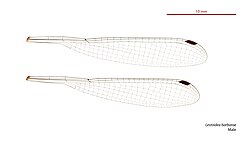 Male wings


.jpg)
See also
editReferences
edit- 1 2 Dow, R.A. (2017). "Lestoidea barbarae". IUCN Red List of Threatened Species. 2017 e.T87534464A87539959. doi:10.2305/IUCN.UK.2017-1.RLTS.T87534464A87539959.en. Retrieved 19 November 2021.
- 1 2 3 4 5 6 Watson, J.A.L. (1967). "A second species of Lestoidea Tillyard (Odonata: Zygoptera)". Journal of the Australian Entomological Society. 6: 77–78 [78]. doi:10.1111/j.1440-6055.1967.tb02147.x.
- ↑ "Species Lestoidea barbarae Watson, 1967". Australian Faunal Directory. 6. Australian Biological Resources Study: 77–78. 2012. Retrieved 11 April 2017.
- 1 2 3 Theischinger, Günther; Hawking, John (2006). The Complete Field Guide to Dragonflies of Australia. Collingwood, Victoria, Australia: CSIRO Publishing. p. 42. ISBN 978-0-64309-073-6.
- 1 2 Theischinger, Gunther; Endersby, Ian (2009). Identification Guide to the Australian Odonata (PDF). Department of Environment, Climate Change and Water NSW. p. 223. ISBN 978-1-74232-475-3.
- 1 2 Watson, J.A.L.; Theischinger, G.; Abbey, H.M. (1991). The Australian Dragonflies: A Guide to the Identification, Distributions and Habitats of Australian Odonata. Melbourne: CSIRO. ISBN 0-643-05136-8.
- ↑ Endersby, Ian (2012). "Etymology of the Dragonflies (Insecta: Odonata) named by R.J. Tillyard, F.R.S." Proceedings of the Linnean Society of New South Wales. 134: 1–16.
- ↑ Endersby, I. (2012). "Watson and Theischinger: the etymology of the dragonfly (Insecta: Odonata) names which they published". Journal and Proceedings of the Royal Society of New South Wales. 145 (443 & 444): 34–53 [38]. doi:10.5962/p.146542. ISSN 0035-9173 – via Biodiversity Heritage Library.
- ↑ Hämäläinen, Matti (9 February 2016). "Catalogue of individuals commemorated in the scientific names of extant dragonflies, including lists of all available eponymous species-group and genus-group names – Revised edition" (PDF). International Dragonfly Fund Report. 92: 1–132. ISSN 1435-3393.
{{cite journal}}: CS1 maint: date and year (link)

