
The left triangular ligament is a large peritoneal fold. It connects the posterior part of the upper surface of the left lobe of the liver to the thoracic diaphragm.
| Left triangular ligament | |
|---|---|
 The superior surface of the liver. | |
| Details | |
| Identifiers | |
| Latin | ligamentum triangulare sinistrum hepatis |
| TA98 | A10.1.02.305 |
| TA2 | 3776 |
| FMA | 76987 |
| Anatomical terminology | |
Structure
editThe left triangular ligament connects the posterior part of the upper surface of the left lobe of the liver to the thoracic diaphragm.[1] Its anterior layer is continuous with the left layer of the falciform ligament.
Additional images
edit Diagram to show the lines along which the peritoneum leaves the wall of the abdomen to invest the viscera.
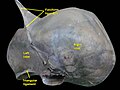 Triangular ligament of liver.Superior surface of liver.
 Triangular ligament.Diaphragmatic surface of liver.


References
edit This article incorporates text in the public domain from page 1193 of the 20th edition of Gray's Anatomy (1918)
External links
edit- liver at The Anatomy Lesson by Wesley Norman (Georgetown University) (liversuperior)
- Anatomy photo:38:10-0103 at the SUNY Downstate Medical Center - "Stomach, Spleen and Liver: Ligaments of the Liver"
- Anatomy image:7872 at the SUNY Downstate Medical Center


 | This ligament-related article is a stub. You can help Wikipedia by adding missing information. |