
The Kumutoto Stream (Māori: Kumutoto Awa) is a culverted stream in Wellington, New Zealand. In the 1860s, it was the first stream in Wellington to be culverted. A part of the stream is listed as Wāhi Tūpuna by Heritage New Zealand.[1]
| Kumutoto Stream | |
|---|---|
 The Kumutoto Stream as it enters the culvert above the Terrace Motorway Tunnel | |
 | |
| Etymology | Māori: 'bleeding from behind' |
| Native name | Kumutoto Awa (Māori) |
| Location | |
| Country | New Zealand |
| City | Wellington |
| Physical characteristics | |
| Source | Kumutoto Forest |
| • location | Kelburn |
| • coordinates | 41°17′17″S 174°46′13″E / 41.2880°S 174.7703°E |
| Mouth | Kumutoto Plaza |
• location | Wellington Harbour |
• coordinates | 41°16′58″S 174°46′45″E / 41.2828°S 174.7791°E |
| Length | 2km |
The stream begins in the Kumutoto Forest (below Salamanca Road near Victoria University of Wellington), enters a culvert above the Terrace Motorway Tunnel, and flows through underground pipes alongside The Terrace and beneath Woodward Street, before entering Wellington Harbour at Kumutoto Plaza.[2]
An art installation by Michel Tuffery, featuring large kina shell sculptures, marks the stream's entrance into the harbour.[3][4]
History
editIn the 1860s, Kumutoto was the first of Wellington's nine urban streams to be buried into culverts, concrete pipes and stormwater drains.[5][2] The construction of a brick culvert at the stream's mouth was put out to tender in 1857,[6] and was built by 1861.[7] In 1868, the culvert beneath Woodward Street burst and needed to be replaced,[8] and more of the stream was culverted over the decades.[2][9] By the 1920s, the stream ran above ground from Kumutoto Forest to The Terrace, where it entered a culvert opposite Boulcott Street.[10]
The final parts of the stream were culverted in the 1970s, with the construction of the Terrace Motorway Tunnel and a section of SH1 along the stream bed.[11]

A number of public artworks mark the stream's path in central Wellington.[3] In 2012, sculptor Michel Tuffery's Nga Kina was installed in Kumutoto Plaza, at the stream's entrance into Wellington Harbour. Nga Kina consists of nine concrete kina shells, ranging in size from two to three metres in diameter.[4] Kumutoto Stream, an audio soundscape by Wellington artist Kedron Parker, plays the sounds of running water and native birdsong in the Woodward Street pedestrian tunnel, to "[imagine] the area in its natural state before development, [and] evoke the experience of walking along the former Kumutoto Stream."[12][13] Installed in February 2014, the work was originally meant to run until the Wellington Fringe Festival in March, before being kept as a permanent installation.[14][12]
By the 21st century, only 90 metres (300 ft) of the approximately 2-kilometre-long (1.2 mi) stream remained above ground.[11][9][15] This above-ground section, at its source within the Kumutoto Forest, was listed as Wāhi Tūpuna (of historic cultural significance to Māori) by Heritage New Zealand in 2025.[1][2]
Proposed daylighting
editIn 2015, it was estimated that 95.5% of Wellington's streams were culverted underground.[16] Over the years, there have been proposals to daylight parts of the Kumutoto, but none have developed beyond a concept.
During the 2022 Wellington Regional Council election, Green Party-endorsed candidates proposed daylighting parts of Wellington's urban streams, including Kumutoto,[17] and in 2025 local architect Allistar Cox designed a concept to daylight the stream on upper Woodward Street and further down along Waring Taylor Street, as part of a wider urban development.[18]
A conservation group, the Kumutoto Restoration Project, have also advocated for daylighting the stream above the Terrace Motorway Tunnel, and constructing a fish ladder to connect to the existing pipe beneath the road.[19]
 Woodward Street, looking down to Lambton Quay and Midland Park. The stream runs through a culvert beneath the street.
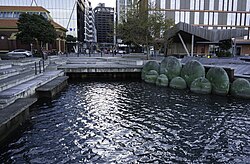 The Kumutoto Stream's outlet (centre) into Wellington Harbour. To its right is Michel Tuffery's sculpture of kina shells.


Etymology
editThe name of the river translates to "bleeding from the behind",[3] from the Māori language words kumu ('from behind' / 'backside') and toto ('to bleed').[9][20] For Māori, the stream "was tapu (or restricted) for birthing practices",[20] and a birthing pool was located in the stream beneath what is now the Wellington Club.[21]
Ecology
editOnly three species of native fish have been recorded in the unculverted section of the stream: banded kōkopu, kōaro (climbing galaxias), and eels. As diadromous species, they migrate up the underground pipes and climb the culvert to the daylight sections of the stream.[15][22]: 16 In the 19th century, before being culverted, the stream was also home to inanga and native bullies,[23][24] but due to being poor climbers they, along with giant kōkopu, are unable to migrate past the culvert and other barriers.[15]
Poet and former Victoria University lecturer Alice Te Punga Somerville once recalled a Ngāti Awa elder visiting her office and talking about the eels that still swim up the stream via the culvert, joking that "no one told the eels to stop acting like eels".[20][25]
Kumutoto's water quality and overall stream health was rated as "Fair", based on a Macroinvertebrate Community Index (MCI) survey conducted between 2016–2019. It found Kumutoto is home primarily to macroinvertebrates with a greater tolerance of poor habitat and water quality, with a higher abundance of species of Diptera (two-winged flies), Oligochaeta (worms) and Mollusca (mainly Potamopyrgus and Physa freshwater snail species) compared to other streams in the Wellington region.[22]
Kumutoto Pā
edit
A kāinga ('settlement'), known as Kumutoto Pā, was established by Wiremu Piti Pōmare of Ngāti Mutunga at the stream's mouth in 1824. It was ceded to Ngātata-i-te-rangi of Te Āti Awa in 1835. The pā was an important hub for flax trading and fishing in the region,[2] and was home to a tāpu ('sacred') birthing pool within the stream.[21][20]
All of the buildings at Kumutoto Pā were destroyed in a large fire on 9 November 1842,[26] and by 1850 the settlement was largely abandoned. The settlement's chief, Wi Tako Ngātata, son of Ngātata-i-te-rangi, exchanged Kumutoto for land in Lower Hutt, moving there in 1853,[27][28] and the remnants of the pā disappeared as Wellington developed.[2]
The former pā site was at the intersections of the Woodward St and The Terrace / Lambton Quay,[1] and sat on the former shoreline of Wellington Harbour prior to land reclamations that followed the 1855 Wairarapa earthquake.[28][29]
References
edit- 1 2 3 "Kumutoto". New Zealand Heritage List/Rārangi Kōrero. Heritage New Zealand. Retrieved 4 May 2026.
- 1 2 3 4 5 6 Paewai, Pokere (6 January 2026). "The hidden river that shapes central Wellington". Radio NZ. Retrieved 7 January 2026.
- 1 2 3 Amery, Mark (12 January 2021). "Walking on water through the streets as Wellington's hidden art revealed". Stuff. Retrieved 5 May 2026.
- 1 2 Hunt, Tom (7 November 2012), "Giant kina sculpture placed at wharf", Stuff, retrieved 27 May 2026
- ↑ "CREEKS THAT SANG". Evening Post. Vol. CXX, no. 1. Evening Post. 1 July 1935. p. 14. Retrieved 13 May 2026 – via PapersPast.
- ↑ "Tenders". New Zealand Spectator and Cook's Strait Guardian. Vol. XII, no. 1246. 11 July 1857. p. 2. Retrieved 13 May 2026 – via PapersPast.
- ↑ "Local Intelligence: Wellington Terrace Road". Wellington Independent. Vol. XVI, no. 1505. 15 March 1861. p. 2. Retrieved 13 May 2026 – via PapersPast.
- ↑ Marchant, Nicolas (18 August 1868). "The City Surveyor's Report". Wellington Independent. Vol. XXIII, no. 2720. p. 4. Retrieved 10 May 2026 – via PapersPast.
- 1 2 3 Thorp, Eleanor (27 April 2026). "Kumutoto, the Forgotten Awa". Salient. Vol. 89, no. 8. pp. 16–19. Retrieved 29 April 2026.
- ↑ I.A.E (22 September 1928). "Memories of The Terrace". The Evening Post. Vol. CVI, no. 61. p. 17. Retrieved 11 May 2026 – via PapersPast.
- 1 2 Wellington Urban Motorway: Stage Four. Wellington: National Roads Board. 1973. p. 3. Retrieved 11 May 2026 – via Wellington City Recollect.
- 1 2 "A sound installation imagines Woodward Street before cement took over the Terrace", creativenz.govt.nz, retrieved 27 May 2026
- ↑ Holder, Ryan (15 January 2014), "A street with a stream and a turntable", Stuff, retrieved 27 May 2026
- ↑ "A Hidden Beauty: Seeing (And Hearing) The Kumutoto Stream : Water New Zealand", www.waternz.org.nz, retrieved 27 May 2026
- 1 2 3 Davis, Stephanie (June 2021). Fish Passage Barrier Assessment in Wellington City (PDF) (Report). Trelissick Park Group. p. 20. Retrieved 11 May 2026.
- ↑ "Hidden streams field trip | NZ History". nzhistory.govt.nz. 16 December 2025. Retrieved 5 May 2026.
- ↑ Green, Kate (22 September 2022). "Can Wellington's underground urban streams once again see the light?". Stuff. Retrieved 10 May 2026.
- ↑ Norquay, Kevin (10 October 2025), "Bricks, vodka, a hidden stream: restoring Wellington's past to inspire its future", The Post, retrieved 10 May 2026
- ↑ "Kia ora Kumutoto whānau, public submissions regarding the State Highway 1 Improvements Project[...]". Kumutoto Restoration Project. 14 December 2025. Retrieved 10 May 2026 – via Facebook.
- 1 2 3 4 Case, Emalani (August 2021). "That which feeds: Sacred solidarities and roots of resistance". Asia Pacific Viewpoint. 62 (2): 132–142. doi:10.1111/apv.12312.
- 1 2 Telling Tales | Kumutoto Stream (Video). Wellington Museum. 22 July 2025. Retrieved 5 May 2026 – via YouTube.
- 1 2 Harrison, E (November 2019). Ecosystem health in Wellington City urban streams: Stage one summary report (PDF) (Report). Greater Wellington Regional Council.
- ↑ Irvine-Smith, F. L. (1967). The Streets of My City. A. H. & A. W Reed. pp. 38–39. Retrieved 10 May 2026 – via Wellington City Recollect.
- ↑ MacMorran, George (1900). Some schools and schoolmasters of early Wellington. Wellington: S & W Mackay. Retrieved 10 May 2026 – via Wellington City Recollect.
- ↑ Te Punga Somerville, Alice (2015). Horrocks, Ingrid; Davidson, Lynn; Fransham, Lena; Aitken, Thomas (eds.). "Culvert: the slipperiness of place". Pukeahu: An Exploratory Anthology. Wellington: Alexander Turnbull Library. Retrieved 5 May 2026.
- ↑ "Calamitous fire". New Zealand Gazette and Wellington Spectator. Vol. III, no. 193. 12 November 1842. p. 2 – via Papers Past.
- ↑ "[untitled]". Wellington Independent. Vol. VI, no. 510. 31 August 1850. p. 5 – via Papers Past.
- 1 2 Love, Matene; Pomare, Miria; Whelan, Roger (1996). Te Ara o nga Tupuna : The path of our ancestors (Pamphlet) (First ed.). Wellington: Wellington City Council. pp. 9–10 – via Wellington City Recollect.
- ↑ Thomson, Rebecca (23 May 2012), "Streetwise History: Lambton Quay", The Dominion Post, retrieved 10 May 2026 – via Stuff
External links
edit
- Kumutoto's listing at Heritage New Zealand
- The Kumutoto Restoration Project at Predator Free Wellington