
This article needs additional citations for verification. (June 2026) |
Kruševo (Macedonian: Крушево [ˈkruʃɛvɔ] ⓘ; Aromanian: Crushuva[2]) is a town in North Macedonia. In Macedonian, the name means the 'place of pear trees'. It is the highest town in the country and one of the highest in the Balkans, situated at an altitude of over 1,350 metres (4,430 ft) above sea level.[3] The town is the seat of Kruševo Municipality. It is located in the western part of the country, overlooking the region of Pelagonia, 33 kilometres (21 mi) and 53 kilometres (33 mi) from the nearby cities of Prilep and Bitola, respectively.
Kruševo
| |
|---|---|
      Northern vista; St. Nicholas Church; a common street; southeastern vista; paragliding championship; Makedonium Monument | |
 Flag  Coat of arms | |
  Kruševo Location within North Macedonia | |
| Coordinates: 41°22′12″N 21°14′54″E / 41.37000°N 21.24833°E | |
| Country |  North Macedonia North Macedonia |
| Region | Pelagonia |
| Municipality | Kruševo |
| Government | |
| • Mayor | Tome Hristoski (SDSM) |
| Elevation | 1,350 m (4,430 ft) |
| Population (2021)[1] | |
• Total | 4,104 |
| Time zone | UTC+1 (CET) |
| • Summer (DST) | UTC+2 (CEST) |
| Postal code | 7550 |
| Area code | +389/48/47X-XXX |
| Vehicle registration | KS |
| Climate | Cfb |
Etymology
editHistory
editMiddle Ages
editInitially part of the Byzantine Empire, the area of present-day Kruševo was conquered by the First Bulgarian Empire in the 9th century and subsequently reconquered by the Byzantines in the 11th century. It then feel under short-lived, 14th-century Lordship of Prilep, before coming under Ottoman Turkish rule in 1395.[5]
Ottoman rule
edit


A large part of the Macedonian population in Kruševo originate from Lazaropole and descend from Mijaks, a Macedonian subgroup who settled in the town alongside Aromanians by the middle of the eighteenth century.[10][11] Aromanians settled in Kruševo along with Orthodox Albanian refugees, often in groups of families and led by a priest, fleeing the 18th-century sociopolitical and economic crises in present-day southern Albania.[10][11] Orthodox Albanians arrived from Vithkuq and the Opar region, while local Kruševo traditions also relate that other families arrived from Korçë and the villages of Polenë, Dardhë, and Mborje.[10]
In the 19th century, Kruševo grew as a commercial center, with connections throughout the Balkans and beyond. Local merchants such as the Nitsiotas brothers and five other companies were active in Vienna.[12] Orthodox Albanians from Moscopole founded the so-called Ohtul di Arbinesh ("hill of the Albanians") neighborhood. This community would soon assimilate into the Aromanian population of the city.[13] In the 1860s, a Bulgarian municipality and school were established in the town.[14] Subsequently, a Bulgarian girls' school was also opened,[15] and it operated simultaneously with the Greek schools in the town. A Romanian school opened its doors in Kruševo in 1876.[16] In the early 20th century, Kruševo was a small town in Manastir Vilayet, with a mixed population of 4,950 Bulgarians, 4,000 Vlachs (Aromanians), and 400 Christian Albanians, according to the Bulgarian geographer Vasil Kanchov's statistics.[17] Due to intermarriage with locals, at the onset of the twentieth century, few in the small Orthodox Albanian community spoke Albanian.[10] A neighbourhood inhabited by Aromanians in Kruševo bears the name Arbineš, meaning "Albanians" in the Aromanian language.[18] Per the Bulgarian teacher Nikola Kirov, who was native to the town, most of the Aromanians as well as the Orthodox Albanians were in fact Grecomans.[19]
During the Ilinden Uprising of 1903, the rebels proclaimed a short-lived Kruševo Republic.[20] Its leader, Nikola Karev, created a council of Kruševo's notable citizens, with twenty members from each of the town's three major ethnic groups (Slavic speakers, Albanians, and Vlachs).[21][22] As the uprising was suppressed, the city was almost completely destroyed by the Ottoman army. One of the most important points in the Ilinden Uprising was the declaration of the "Kruševo Manifesto", which called for all the people of Macedonia, regardless of their nationality or religion, to fight together against the Ottoman Empire in order to establish an independent Macedonian republic.[23][24] There is a monument in Kruševo called Mečkin Kamen ("bear's stone"), marking the place where Pitu Guli's band tried to defend the town from Turkish troops. The band and their leader are remembered as heroic defenders of Kruševo and the surrounding villages.[original research?]
Kingdom of Yugoslavia
editThis section needs expansion. You can help by adding missing information. (September 2025) |
Demographics
editAs of the 2021 census, the town of Kruševo had 4,104 inhabitants, and its ethnic composition was as follows:[1]
- Macedonians 3,053 (74.4%)
- Aromanians 866 (21.1%)
- Persons for whom data are taken from administrative sources 146 (3.6%)
- Serbs 10 (0.2%)
- Albanians 9 (0.2%)
- Bosniaks 1 (0.0%)
- others 19 (0.5%)
| Year | Macedonian | Albanian | Turks | Romani | Aromanians | Serbs | Bosniaks | Others | Person for whom data are taken from administrative sources | Total |
|---|---|---|---|---|---|---|---|---|---|---|
| 2002 | 4.273 | ... | ... | ... | 1.023 | ... | ... | 37 | 5,330 | |
| 2021 | 3.053 | 9 | ... | ... | 866 | 10 | 1 | 165 | 146 | 4,104 |
The official languages of the town are Macedonian and Aromanian. Kruševo is the only locality where Aromanian has any kind of official status.[citation needed]
The religious composition of the town was the following:
- Orthodox Christians – 5,275 (99.0%)
- others – 55 (1.0%)
- Churches in Kruševo
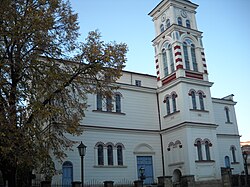 Church of St. Nicholas
 Church of St. Nicholas
 Church of the Holy Trinity
 Church of St. John the Baptist
 Church of St. Mother of God


Features
edit

Kruševo is a mountainous town. Situated at an altitude of 1,350 metres (4,430 ft), it is the highest town in North Macedonia. It is known for its 19th-century Ottoman architecture.
Kruševo is the home of Mečkin Kamen, a historical landmark that marks the location of the Ilinden Uprising of 1903. On 2 August each year, it is one of two sites where the Macedonian Day of the Republic is celebrated. The town also hosts the Makedonium monument, another landmark commemorating the Ilinden Uprising.
The local football club FK Pitu Guli is named after the revolutionary leader and plays in the Macedonian Third League (South division).
Toše Proeski Memorial House
editThe pop singer Toše Proeski grew up in Kruševo, and after his death in 2007, several monuments to him were inaugurated in the town, including the Toše Proeski Memorial House, which opened in April 2011.[25] The museum holds all his awards, many of his childhood belongings, recreations of his living room and home recording studio, as well as a wax model of Proeski. The museum is shaped like a cross as a reference to Proeski's devout Orthodox faith. Its interior walls are covered with song lyrics, including his signature concert phrase "Ve sakam site" (I love you all), translated into over 100 languages.[26] At the 2011 World Architecture Festival in Barcelona, the building won the People's Choice Award.[27]
Notable people
edit- Toše Proeski (1981–2007), pop singer famous throughout the Balkans
- Nikola Karev (1877–1905), politician, revolutionary leader
- Pitu Guli (1865–1903), revolutionary leader
- Vasil Iljoski (1902–1995), writer
- Nikola Martinoski (1903–1973), painter
- Ioryi Mucitano (1882–1911), revolutionary
- Ilija Najdoski (born 1964), footballer, European Cup champion
- Taki Fiti (born 1950), academic, former president of the Macedonian Academy of Sciences and Arts, politician, author
- Nicolae Constantin Batzaria (1874–1952), writer, Ottoman Minister of Public Works and Commerce
- Alexandros Svolos (1892–1956), prominent Greek legal expert, president of the Political Committee of National Liberation, a Resistance-based government during the Axis Occupation of Greece
- Mencha Karnicheva (1900–1964), revolutionary
- Nikola Gabrovski (1871–1962), military figure
- Yiannis Boutaris (1942–2024), Greek businessman, politician, former mayor of Thessaloniki
Architecture
edit 1920s postcard from Kruševo
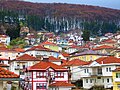 Town architecture
 Kruševo in winter
 A typical house
 Birth house of Nikola Martinoski
 A house where Nikola Karev lived
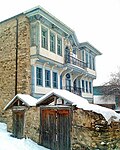 A typical house
 A typical house
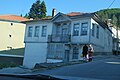 A typical house
 A typical house
 Toše Proeski Memorial House
 Kruševo during the 1930s
 Mother of God church and a town school
 Nikola Martinoski Gallery

.jpg)


.jpg)


References
edit- 1 2 Macedonian census, language and religion[permanent dead link]
- ↑ Kahl, Thede (1999). Ethnizität und räumliche Verbreitung der Aromunen in Südosteuropa [Ethnicity and geographical distribution of Aromanians in Southeast Europe] (in German). Universität Münster: Institut für Geographie der Westfälischen Wilhelms. p. 147. ISBN 3-9803935-7-7.
{{cite book}}: CS1 maint: publisher location (link) "Crușuva" - ↑ Information about Krusevo on travel2macedonia.com.mk
- ↑ Vladimir I. Georgiev, Bulgarian etymological dictionary, vol. 3, Bulgarian academy of sciences, 1986, p. 31. (in Bulgarian)
- ↑ J.VA Fine, The late mediaeval Balkans, p.380
- ↑ Contested Ethnic Identity: The Case of Macedonian Immigrants in Toronto, 1900–1996, Chris Kostov, Peter Lang, 2010, ISBN 3034301960, p. 71.
- ↑ Fieldwork Dilemmas: Anthropologists in Postsocialist States, Editors Hermine G. De Soto, Nora Dudwick, University of Wisconsin Press, 2000, ISBN 0299163741, pp. 36–37.
- ↑ Tanner, Arno (2004). The Forgotten Minorities of Eastern Europe: The history and today of selected ethnic groups in five countries. East-West Books. p. 215. ISBN 952-91-6808-X.
- ↑ The past in question: modern Macedonia and the uncertainties of nation, Keith Brown, Publisher Princeton University Press, 2003, ISBN 0-691-09995-2, pp. 81–82.
- 1 2 3 4 Koukoudis, Asterios (2003). The Vlachs: Metropolis and Diaspora. Thessaloniki: Zitros Publications. ISBN 9789607760869. p.355. "In many cases, the refugees arrived in organised groups of families with a leader, usually a priest. Right from the start, the Vlachs were accompanied by Arvanites from Vithkuq and the Opar area. Those from Vithkuq preceded those from Opar and occupied the western part of the settlement, forming their own district there. According to local lore, other Arvanite families came from Korçë and the surrounding villages of Polenë, Dardhë, and Mborje. By the early twentieth century, intermarriage meant that very few families spoke Albanian any more."; p. 436. "Mijaks... Quite a large group, from Lazaropole mainly, formed the nucleus of the Slavonic-speaking population of Kruševo, who had settled alongside the Vlachs by the mid-nineteenth century."
- 1 2 Zografski, Dančo (1986). Odbrani dela vo šest knigi: Makedonskoto nacionalno dviženje [Selected Works in Six Books: The Macedonian National Movement] (in Slovenian). Naša kniga. p. 21.
- ↑ Vacalopulos, Konstandinos A. Modern history of Macedonia, Thessaloniki 1988, pp. 138–139
- ↑ Murati, Qemal (2011). "Shqipa Dhe Maqedoarumanishtja Nga Aspekti I Kontakteve Midis Tyre" [Albanian and Macedonian-Romanian from the Aspect of Contacts Between Them]. Studime Albanologjike (in Albanian). ITSH: 10.
- ↑ Иванов, Йордан. Българите в Македония, София 1917, с. 333 (Ivanon, Yordan. Bulgarians in Macedonia, Sofia 1917, p. 333), Ванчев, Йордан. Новобългарската просвета в Македония през Възраждането, София 1982, с. 115 (Vanchev, Yordan. New Bulgarian education in Macedonia during the National Revival, Sofia 1982, p. 115)
- ↑ Божинов, Воин. Българската просвета в Македония и Одринска Тракия 1878–1913, София 1982, с. 73 (Bozhinov, Voin. Bulgarian Education in Macedonia and Adrianopole Thrace 1878–1913, Sofia 1982, p. 73)
- ↑ Романски, Стоян. Македонските ромъни, Македонски преглед, г. I, 1925, кн. 5–6, с. 83–84 (Romanski, Stoyan. Macedonian Romanians, Macedonian review, 1925, vol. 5–6, p. 83–84) According to other sources, the Romanian school was established in 1868 by A. Margarit – Ласку, Стојка. Од историјата на ароманскиот печат во Македонија. Списанијата "Братство" и "Светлина", Скопје 2007, с. 122
- ↑ Васил Кънчов. "Македония. Етнография и статистика". София, 1900, стр.240 (Kanchov, Vasil. Macedonia — ethnography and statistics Sofia, 1900, p. 39-53).
- ↑ Rexha, Iljaz (2011). "Vendbanimet dhe popullsia albane gjatë mesjetës në hapësirën e Maqedonisë së sotme: Sipas burimeve sllave dhe osmane" [Albanian settlements and population during the Middle Ages in the area of present-day Macedonia: According to Slavic and Ottoman sources]. Gjurmime Albanologjike: Seria e Shkencave Historike (in Albanian) (41–42): 178.
- ↑ Keith Brown (2018) The Past in Question: Modern Macedonia and the Uncertainties of Nation, Princeton University Press, ISBN 0691188432, p. 202.
- ↑ Marco Dogo; Stefano Bianchini, eds. (1998). The Balkans: National Identities in a Historical Perspective. Longo. p. 121. ISBN 8880631764.
The Uprising organised and led by TMORO was called on 2 August 1903, on St. Ilija's day, thus entering history with the name of "the Ilinden Uprising", while European diplomats called it "the Macedonian Revolution". The Ottoman Empire managed once again to suppress the Ilinden Uprising brutally, with much bloodshed, despite the mass support it had enjoyed and the liberation of a large portion of territory and three towns: Neveska, Klisura and Krushevo. In liberated Krushevo, the rebel government established itself as a republic, to be remembered in historiography and collective memory as the Krushevo Republic. The Republic, the first of its kind on the Balkans, represented a model of statehood for all of Macedonia and an expression of the revolutionary ideology of TMORO: the "Macedonian Independent Republic" would provide real freedom for the Macedonian people, including minorities, independence, economic, political, cultural and social development
- ↑ Micgiel, J.S. (1996). State and Nation Building in East Central Europe: Contemporary Perspectives. Institute on East Central Europe, Columbia University. p. 300. ISBN 9780965452007.
- ↑ Tanner, A. (2004). The Forgotten Minorities of Eastern Europe: The History and Today of Selected Ethnic Groups in Five Countries. East-West Books. p. 215.
- ↑ Loring M. Danforth (1997). The Macedonian Conflict: Ethnic Nationalism in a Transnational World. Princeton University Press. p. 51. ISBN 0691043566.
On August 2, 1903, VMRO led the Macedonian peasantry in the Ilinden Uprising, named after the festival of the Prophet Elijah on which it began. This was one of the greatest events in the history of the Macedonian people. The high point of the Ilinden Revolution was the establishment of the Krushevo Republic in the town of Krushevo in central Macedonia. The leaders of the Krushevo Republic called on all the people of Macedonia, Moslems and Christians alike, to join them in fighting for an independent Macedonia.
- ↑ Singleton, Fred (1985). A Short History of the Yugoslav Peoples. Cambridge University Press. p. 99. ISBN 9780521274852.
The initial aim of the rising was to create an independent state in the vilayet of Monastir (Bitola), and then to extend the free area to the whole of Macedonia. The appeal was not only to the Slavs, but also to 'Turks, Albanians and Moslems' who suffered under the Ottoman yoke. A 'republic' was established in the town of Kruševo, but the revolt was ruthlessly suppressed after only eleven days.
- ↑ "Спомен-куќата на Тоше во Крушево е најпосетуван музеј во регионот" [Tose's Memorial House in Krusevo is the most visited museum in the region]. Nezavisen (in Macedonian). 25 April 2021.
- ↑ Dave Wilson (2022). "The remembered future: Macedonian pop icon Toše Proeski and musical life after death". Popular Music. 41 (1): 57, 61–64, 66, 68–73, 76–77.
- ↑ "Memorial house Todor Proeski, Krushevo, Macedonia". World Buildings Directory. Archived from the original on 11 October 2012. Retrieved 11 July 2013.

