
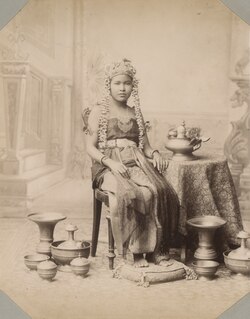
Kemben (Javanese: ꦏꦼꦩ꧀ꦧꦼꦤ꧀, romanized: kêmbên; Sundanese: ᮊᮨᮙ᮪ᮘᮨᮔ᮪, romanized: keumbeun; Balinese: ᬓᬫᭂᬦ᭄, romanized: kamen) is a form of Native Indonesian torso wrap originally found in traditional native Java (Javanese, Sundanese, Baduy, and Osing) and Bali (Bali Aga and Balinese) clothing cultures. It is made by wrapping a piece of kain (clothes), usually but not limited to batik, tenun, ikat, or any type of fabrics, covering the chest wrapped around one's torso.[3]
 | |
| Type | Traditional female torso wrap |
|---|---|
| Place of origin | Java[1][2] |
History
edit

Prior to the prevalence of kebaya, it is believed that kemben was the most popular and common female dress in the ancient and classical period of Java. It was commonly worn in the Majapahit era until the Mataram Sultanate. Today, this shoulder-baring garment still features in many Javanese (and Balinese) rituals, traditional Javanese (and Balinese) dances or palace ceremonies in Javanese (and Balinese) keratons.[1]
The bare shoulders of the kemben may be regarded as a representation of elegance and femininity. In recent decades, however, kemben has fallen out of favor among Javanese Muslim women as they abandoned their traditional fashion and wear Islamic clothing such as the hijab, which was previously uncommon in Indonesia. Today, the tradition of wearing kemben has been preserved and kept alive in the Javanese royal court of Yogyakarta and Surakarta keratons, especially among nobles and abdi dalem (palace servants). However, in recent years, this also had stirred debate about the efforts to preserve classic Javanese court culture being contended by the growing conservative Islamism among the Indonesian Muslims community.[4]
Uses
edit._Java_TMnr_60034291.jpg)

Traditional kemben is worn by wrapping a piece of cloth around the torso, folding and securing the edge, tying it with additional rope, and covering it with an angkin, a smaller sash around the abdomen. Traditional Javanese batik kemben worn by palace ladies in keratons are mostly this type of kemben.[5] Today, there is also tight-fitted and tailored kemben secured using buttons, straps or zippers similar to the western corset. The kemben of female Javanese traditional dancers (srimpi or wayang wong) are usually made of tailored velvet corsets.
Javanese diaspora
editin Europe
editIn Europe, it is oftenly dubbed as akin to European décolletage, however, it is more indigenous by using local fabrics such as batik, ikat, songket, or tenun, and simply secured by folding and slipping the cloth edges and tying the knot. Traditionally, women wear two pieces of clothes; the lower one is wrapped around the hips covering lower parts of the body (hips, thighs, and legs) and is called as kain or sarong, while the piece that is wrapped about the upper body (chest and torso) is called kemben.
in the Americas
editSuriname
edit
In the South American country of Suriname, kemben is traditionally worn due to the Javanese diaspora community existence in the country. It is worn in daily life (especially by the elderies) and during special cultural Javanese-related events, such as Java New Year celebration where traditional Javanese dances commonly performed.
in Asia
editMalaysia
edit_(14583643838).jpg)
_(14583809677).jpg)
_(14767920874).jpg)
_(14583809217).jpg)
In Malaysia, due to the existence of Javanese diaspora (or Indonesian diaspora in general) kemban is introduced and essentially worn in a type of sarong and was a very popular style of clothing prior to the prevalence of Baju Kurung (of Sumatran diaspora introduction) and Baju Kebaya (of Javanese diaspora introduction). The members of the nobility used better quality and designed cloths, as well as elaborate jewelry made of gold and precious stones.[7] They had their kain kelubung (shawl) to cover their heads from the sun and a kain kemban worn from the bust downwards to keep them cool in the tropical heat. According to the Malay Annals, Sultan Mansur Shah, the sixth Malaccan ruler, banned Malaysian Malay women from wearing only a kemban as it ran contrary to personal modesty based on Islamic teachings.[8] Today, the kemban torso wrap is rarely worn in the piously Islamic Malay community of Malaysia, regarded as a relic of the past, replaced by the more modest Baju Kurung which is generally worn with tudong to comply with Islamic modesty requirements. A third piece of cloth is used to cover the head (head, shoulders, and arms) from the sun and it is called kain kelubung as shown in the pictures above.
See also
edit


References
edit- 1 2 "Cara Berpakaian Orang Jawa Kuno". historia.id (in Indonesian). November 2018. Archived from the original on 2020-11-28. Retrieved 2020-11-20.
- ↑ Raffles, Thomas Stamford (1817). The History of Java. London: John Murray. OCLC 74175458.
- ↑ "Hasil Pencarian - KBBI Daring". kbbi.kemdikbud.go.id (in Indonesian). Retrieved 2017-10-12.
- ↑ "Dikritik Gara-gara Unggah Foto Abdi Dalem, Jawaban Putri Keraton Jogja ini Tak Terduga!". Tribun Wow (in Indonesian). Retrieved 2020-11-22.
- ↑ "Memakai Batik Untuk Kemben, Eksotisme Fashion Wanita Jawa - Indonesian Batik". Indonesian Batik (in Indonesian). 2018-02-26. Archived from the original on June 4, 2018. Retrieved 2018-06-01.
- ↑ Thomas Athol Joyce & Northcote Whitridge Thomas (1908). Women of All Nations: A Record of Their Characteristics, Habits, Manners, Customs, and Influence. Funk & Wagnalls Company. ASIN B011C9TDQE.
- ↑ "Carian Umum - Kemban". prpm.dbp.gov.my (in Malay). Retrieved 2020-11-19.
- ↑ "Enduring charm of the baju kurung". 18 August 2019. Retrieved 19 November 2020.