
This article may need to be rewritten to comply with Wikipedia's quality standards. (April 2024) |
Josei Tennō (女性天皇) is a Japanese term referring to an empress regnant.[b][2] Tennō is the title for the emperor; the addition of the term josei (女性, woman) distinguishes that the emperor is a woman.[note 1] It is distinct from the title Kōgō, which refers to an empress consort.
| Josei Tennō (女性天皇) | |
|---|---|
| Creation date | 686 |
| Created by | Empress Jitō |
| First holder | Empress Suiko (retroactively)[a] Empress Jitō (officially) |
| Last holder | Empress Go-Sakuramachi |
| Subsidiary titles | None |
| Status | Extinct (unless Japan allows female rulers again) |
| Extinction date | 1889 (under the Imperial House Law of 1889, which barred women from ruling)[1] |
| Supporters | See polling |

Origins
editBefore Emperor Tenmu (the first to use the title Tennō),[3][4] all monarchs were likely called Great King/Queen of Yamato, and not Tennō.
From the reign of Empress Jitō onwards, emperors (Tennō 天皇) who were women were distinguished from their male counterparts with the qualifier of josei (女性, woman).[2][3][4] However, as empresses regnant, they held the rank of Tennō without the qualifier, indicating they were emperors equal to their male counterparts. Due to this, it is generally acceptable and preferred to use Tennō when referring to a female monarch.
Before the influence of the Fujiwara clan and their Five regent houses, and in times when an heir was underaged, a female relative (typically a sister or mother) would take the throne. Out of all empresses regnant, Empress Kōken (known as Shōtoku during her second reign) is the only one to have been granted the title "crown princess" before accession.[5]
Usage
editWhen referring to female monarchs, they are referred to as "Tennō" and not "Josei Tennō". Tennō refers to individual monarchs, regardless of gender. Therefore, Empress Meishō would be properly referred to as Meishō Tennō, and not Meishō Josei Tennō.[3]
Josei Tennō does not refer to individual female monarchs as a specific title. Instead, it refers to all the female monarchs in general (usually when distinguishing them from their male counterparts), or the concept of having a female monarch. As an example, during parliament debates, references to Josei Tennō are specifically related to the concept of having a woman (josei) succeed to the throne as an emperor, not the general concept of having a Tennō (an emperor). The addition of the qualifier josei specifies that the Tennō is a woman ruling as an emperor (i.e. an empress regnant) in her own right.[6]
Josei Tennō should also not be confused with Jokei tennō (女系天皇) which is a female-line emperor (an emperor that gains their imperial blood solely through their mother, meaning their father is not the emperor or a prince). Of that there have been none.[7]
Jokei tennō
editJokei Tennō (女系天皇; literally meaning "matrilineal emperor") refers to an emperor whose imperial blood is solely on his mother's side.[7] A female line emperor is heavily contested by conservatives in Japan. As of 2026 there has not been an emperor who was of imperial blood solely from his mother's side.[7][8][9]
Historically verifiable debates on whether there should be a female emperor and female line emperor go back to at least the Meiji era. However the debate ended with the consensus that further discussions should not go through.[10]
In the past, it is believed that anyone could succeed to the throne, regardless of gender, so long as they were of imperial blood (close enough related to be born a princess or prince). It is also believed there was no emphasis as to whether the line was passed through the male line or female line, and old Nara period succession laws used until the early modern period recognised the children of female emperor's as valid successors, meaning up until the Meiji Constitution a female line/matrilineal emperor (Jokei Tennō 女系天皇) was possible.[11][12] The old imperial laws did not exclude female line descendents.[12]
List
editEight women have been recognized as empress regnant in Japan.
- Empress Suiko[13]
- When Suiko's husband Emperor Bidatsu, died, her brother Emperor Yōmei took the throne. However, Yōmei soon died of illness, and so Emperor Sushun took the throne. Sushun was assassinated and the throne was vacant. In a time of need, Suiko became the empress, and was given a regent, Prince Shōtoku. Despite having a regent, Suiko still exerted some of her own power, possibly even getting a say in who her regent would be.[14] She was likely styled as great queen of Yamato, not Tennō, which only came into use under the reigns of Emperor Tenmu, and Empress Jitō. Suiko ruled until her death.[15][16]
- Empress Kōgyoku
- After taking the throne, Kōgyoku was soon forced to abdicate due to the Isshi incident, when Soga-no-Iruka was killed by her son, Naka no Ōe, in front of the empress, so the impure act would not stain her reign.[16][17][18] She was succeeded by her brother, Emperor Kōtoku. Kōgyoku reigned a second time after Kōtoku's death, assuming the throne as Empress Saimei.[19][20] As Empress Saimei, she led an army to aid their ally, Baekje, against an invasion by Silla. After arriving in Chikuzen Province with her army prepared to leave for Baekje, she fell ill and died.[21]
- Empress Jitō[22]
- Jitō was the wife of Emperor Tenmu. After he died and her son Prince Kusakabe was deemed too young to rule, Jitō took the throne in his place until he was old enough. When Kusakabe died, Jitō remained as empress until her grandson came of age.[23] Jitō was the first to be referred as "josei tennō"[2][3][4]
- Empress Genmei[24]
- The wife of Jitō's son Kusakabe and Jitō's half-sister. After Genmei's son died, Genmei became empress. After copper was found near the capital, a new era in her honour (called the Wadō) was ushered in. The Kojiki was also completed under her reign.[25] She was succeeded by her daughter, Empress Genshō.[26]
- Empress Genshō[27]
- The daughter of Empress Genmei. Genshō helped complete the Nihon Shoki. She was also the only empress to be preceded by another (her predecessor being her own mother).[28][29] In 724, Genshō abdicated in favor of her nephew, who would be known as Emperor Shōmu. She lived for 25 years after her abdication, never married, and had no children.[30]
- Empress Kōken
- The daughter of Emperor Shōmu and his consort, Empress Kōmyō. Her father proclaimed her the first crown princess in Japanese history in 738 to protect the bloodline of Prince Kusakabe. She succeeded Shōmu in 749, after her father resigned to become a Buddhist monk. Kōken's first reign was heavily controlled by mother, Empress Dowager Kōmyō.[31] Kōken abdicated under pressure in 758, in favour of Emperor Junnin, and as a Daijō Tennō, she retired to become a nun. After Kōmyō's death, Junnin was deposed following the Fujiwara no Nakamaro Rebellion. Kōken, with her supporters, consolidated power to reassume the throne under a new name, Empress Shōtoku.[32] She never married and did not declare an heir during her lifetime. Following her death, courtiers forged a letter which claimed Shōtoku had named her cousin Prince Shirakabe as her successor. Prince Shirakabe was also Shōtoku's brother-in-law through marriage to her half-sister and would succeed the throne as Emperor Kōnin.[33]
- Empress Meishō[34]
- Meishō assumed the throne at five-years-old after her father, Emperor Go-Mizunoo, was forced to abdicate due to his involvement in the Purple Robe Incident.[35] Meishō was given precedence to ascend the throne as the eldest surviving child of Emperor Go-Mizunoo and his empress, Tokugawa Masako, over her younger half-brothers, who were the children of concubines. Meishō did not hold much power as she assumed the throne as a child. Like her male counterparts at the time, by the time of her reign, the Shōgunate system was in place, limiting the monarch's power.
- Empress Go-Sakuramachi[34]
- Similar to Empress Meishō, she did not have much power due to the shogunate. She was the last josei tennō. On January 9, 1771, she abdicated in favor of her young nephew, Emperor Go-Momozono. The retired Empress held the position of Daijō Tennō in the forty years after her abdication and acted as a sort of guardian to subsequent emperors.[20] Prior to Emperor Go-Momozono's death in 1779 at the age of 21, the retired empress Go-Sakuramachi arranged for her nephew to adopt Emperor Kōkaku as his son and heir to avoid a dynastic interregnum. Empress Go-Sakuramachi died in 1813.[36]
Empress Jingū is not counted among the official monarchs.[c] Princess Iitoyo's legitimacy and validity (concerning her reign) is mostly unknown or disputed, with it being believed she likely could have merely been a place holder.[37]
Women who almost became emperor
editPrincess Kasuga no Yamada, who was the empress of Emperor Ankan was recommended by Emperor Kinmei to succeed to the throne. However she declined and instead Kinmei himself succeeded to the throne and she became the Empress Dowager.[d][39]
Princess Sakahito was part of an attempt by Emperor Kōnin to have her succeed to the throne. While this failed, Emperor Kanmu made Princess Sakahito his wife.[40]
The debate for a possible future Josei Tennō
editThe current Japanese rules of succession do not allow a woman to inherit the throne. Emperor Naruhito has admitted the imperial family is running out of male heirs.[41] There have been calls to allow Aiko, Princess Toshi, the only child of Naruhito, to become the ninth empress regnant. To this day there is an ongoing succession debate. A public discussion was held in Tokyo in June 2023 called "Making Aiko the Imperial heir", which pushed for the rules to be changed and a new line of succession to be introduced, which would be as follows:
- Aiko, Princess Toshi
- Fumihito, Prince Akishino
- Princess Kako of Akishino
- Prince Hisahito of Akishino
- Masahito, Prince Hitachi
- Princess Akiko of Mikasa
- Princess Yōko of Mikasa
- Princess Tsuguko of Takamado[42]
A parliamentary meeting was held in December 2023 to debate the possibility of female succession to the throne.[43] In February 2024, former Prime Minister Yoshihiko Noda held another Parliament meeting, suggesting women should be allowed to marry without losing their titles, lead their own branch of the Imperial family, and possibly rule.[44]
Princess Sumiko remained the last woman born into the Imperial family to lead a branch of the imperial family, until September 2025, when Princess Akiko of Mikasa became head of the Mikasa-no-miya branch.[45][46] On March 15, 2024, there were more discussions within the ruling Liberal Democratic Party about allowing women to inherit the throne[47] with discussions of women being allowed to retain their titles upon marriage on March 18 of the same year.[48][49] As of June 2024, the LDP and opposition parties agreed women should marry without losing their title, with no conclusion on the status on their spouses.[50] Shigeru Ishiba, who served as Japanese prime minister from 2024 to 2025, is known to support female succession.[51]
The United Nations Committee on the Elimination of Discrimination against Women requested the succession laws be amended to allow female succession. Minister for Foreign Affairs Takeshi Iwaya expressed his displeasure in this request, stating “It is not appropriate for the committee to raise this issue in relation to the Imperial House Law”.[52]
The current prime minister of Japan, Sanae Takaichi, is not in favour of female succession.[51][53] In an interview with the magazine Bungei Shunju in 2021, she stated "I'm not opposed to a female emperor. I'm opposed to a matrilineal emperor", adding "[i]n reality, I imagine it would be difficult for a woman to succeed to the throne [...] it would be better to restore the former imperial families to the imperial family."[54] She later went back on these comments, and has reaffirmed her opposition to female succession.[55][56]
Stronger pushes on male adoption
editOn June 5, 2026, the speakers and deputy speakers of both houses of government have compiled a proposal on succession to the throne:[57]
1. Imperial women are allowed retain their titles upon marriage.
We believe that, as it is consistent with the history of the Imperial Family and in light of considerations such as the continuity of public activities, the Imperial House Law should be amended and work should proceed on the specific design of the system. Furthermore, given that Their Imperial Highness the Imperial Princesses (Naishinnō) and Their Imperial Highnesses the Princesses (Joō) have lived their lives under the current system whereby they would lose their imperial status upon marriage, certain considerations should be made as transitional measures, such as respecting their wishes regarding whether or not to retain their status as members of the Imperial Family.
2. That former male members in the paternal branches of the imperial family be readmitted into the imperial house, and that the succession from Fumihito to Hisahito not be disrupted.
The specific framework of the system shall be designed to apply to male-line descendants of the male members of the so-called former 11 Imperial Houses.
These former male members will not have succession rights and shall only be adopted upon their expressed consent. Later the summary stated "The Government shall solemnly accept this 'consensus of the legislature', immediately commence drafting the bill, carry out the drafting work in good faith, report to the Vice-Speakers of the House of Representatives and the House of Councillors in advance once the outline of the bill has been finalised, and, once the draft bill has been completed, explain it to all parties and parliamentary groups at a plenary meeting. We strongly urge the Government to submit the bill to the Diet without delay once confirmation has been obtained."[57] The proposal fails to bring up the titles of the spouses and children of imperial women, of which parties remain divided.[58] The proposal states that parties should go over the proposal and it should be re-evaluated as a non permanent solution, as division still remains on female inheritance.[57][58] Due to disagreements between parties, no legislature may be drawn during the remainder of the current diet session which ends on June 22.[58] Opposition parties have continuously criticised the ruling parties for ignoring the possibility of a female emperor.[59]
Polling
editSince 2019 and the enthronement of Emperor Naruhito, many polls have been published on support for a female emperor. Some major polls include the following:
| Recent polls | ||||||
|---|---|---|---|---|---|---|
| Poll conducted by | Date | Amount polled | Percentage in favour | Poll type | Poll location | Reference |
| Shūkan Bunshun | April 29 - May 7, 2026 | 25,000 | 93%[e] | By magazine | Nation wide | [60] |
| The Yomiuri Shimbun | September 24 – October 31, 2025 | 2,004[f] | 69% | By mail | Nation wide | [61] |
| Mainichi Shimbun | May 17 – 18, 2025 | 2,045 | 70% | Online | Nation wide | [62] |
| Kyodo News | March – April 2024 | 1,966[g] | 90% | By mail | Nation wide | [63] |
| Kyodo News | March – April 2020 | 1,899[h] | 85% | Domestic[i] | Nation wide | [64] |
| NHK | October 22, 2019 | 1,539[j] | 70% | By telephone | Nation wide | [65] |
| Kyodo News | October 2019 | 1,009 | 81% | By mail | Nation wide | [66] |
Gallery
edit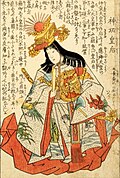 Empress Jingū, the first mythical empress regnant.
 The tomb of Empress Iitoyo, also known as Empress Tsunuzashi. The validity of her reign is disputed.
 Empress Suiko, the first woman whose reign is historically verifiable.
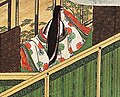 Empress Kōgyoku/Saimei, the second historically verifiable empress.
 Empress Jitō, the third historically verifiable empress, first to use the title Josei Tennō
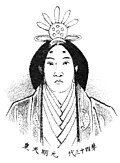 Empress Genmei, the fourth historically verifiable empress.
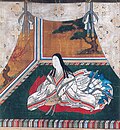 Empress Genshō, the fifth historically verifiable empress.
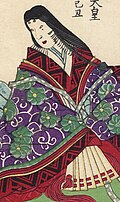 Empress Kōken/Shōtoku, the sixth historically verifiable empress.
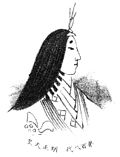 Empress Meishō, the seventh historically verifiable empress.
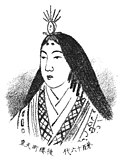 Empress Go-Sakuramachi, the eighth and final historically verifiable empress.


.jpg)


See also
editNotes
edit- ↑ Suiko ruled during her life as sovereign in her own right but under different titulary than next female emperors.
- ↑ Josei Tennō (女性天皇) literally means "female heavenly emperor".
- ↑ Jingū is only sometimes referred to as Tennō (天皇) and is typically referred to only as a regent, thus she does not count as a Josei Tennō either.
- ↑ The Empress Dowager that Emperor Kinmei appointed may also be referring to his mother, Princess Tashiraka, or Princess Tachibana no Nakatsu, widow of Emperor Senka. As such, she's not counted among most lists of Empress Dowagers.[38]
- ↑ The poll also included results for those in favour of a matrilineal emperor (emperor in the female line). Of which 88.9% were in favour.
- ↑ 3,000 were contacted and 2,004 responded.
- ↑ 3,000 were polled, of which 1,966 gave valid responses
- ↑ 3,000 polled, with 1,899 valid responses
- ↑ Source simply states "Domestic" for the polling type.
- ↑ 2,790 were contacted, of which 1,539 responded
References
edit- ↑ p. 1235, "The Imperial House Law - Chapter 1: Succession to the Imperial Throne," Japan Year Book 1933, Kenkyusha Press, Foreign Association of Japan, Tokyo
- 1 2 3 4 Cherry, Kittredge (November 14, 2016). Womansword: What Japanese Words Say About Women. Stone Bridge Press. ISBN 978-1-61172-919-1.
During Japan's long history eight women have ruled as female emperor or josei tenno. An older term is empress or jotei. In English "empress" can mean either a reigning monarch or the wife of an emperor, but in Japanese there are separate words for each. The title bestowed on the emperor's wife is kogo.
- 1 2 3 4 "Tennō | Emperor, Imperial, Japan | Britannica". www.britannica.com. Archived from the original on November 10, 2022. Retrieved January 30, 2024.
- 1 2 3 Henshall, Kenneth (November 7, 2013). Historical Dictionary of Japan to 1945. Scarecrow Press. ISBN 978-0-8108-7872-3.
- ↑ Harper, Cathy (December 8, 2022). "More than placeholders: The 'century of empresses' against modern succession laws". Melbourne Asia Review (12). Archived from the original on May 28, 2024. Retrieved May 28, 2024.
- ↑ 根本, 猛; Nemoto, T. (March 10, 1999). "女性天皇と法の下の平等に関する小論 (松富弘志先生退官記念号)". 静岡大学法政研究 (in Japanese). 3 (3–4): 121–133. Archived from the original on June 21, 2025. Retrieved June 21, 2025.
- 1 2 3 デジタル大辞泉. "女系天皇(ジョケイテンノウ)とは? 意味や使い方". コトバンク (in Japanese). Retrieved June 21, 2025.
- ↑ Shimbun, The Yomiuri (April 18, 2025). "Draft Plan on Japan Imperial Family to be Presented Before Summer Election; No Consensus on Giving Imperial Status to Spouses, Children of Female Members". japannews.yomiuri.co.jp. Archived from the original on April 21, 2025. Retrieved June 3, 2025.
- ↑ Shimbun, The Yomiuri (June 4, 2025). "Japan's Ruling, Opposition Parties to Delay Compiling Plan on Imperial Succession; General Agreement on Female Imperial Family Members Keeping Status". japannews.yomiuri.co.jp. Archived from the original on June 4, 2025. Retrieved June 3, 2025.
- ↑ ""Dual Lineage" as Japanese Tradition: The Female Emperor Debate Moves Forward". nippon.com. February 22, 2024. Archived from the original on June 21, 2025. Retrieved June 21, 2025.
- ↑ "日本本来の皇位継承は男系も女系も容認の「双系」:動き出した女性天皇論議". nippon.com (in Japanese). November 21, 2023. Archived from the original on July 3, 2025. Retrieved October 8, 2025.
- 1 2 "Japan historian questions claim of unbroken male-line Imperial succession". Mainichi Daily News. July 2, 2026. Retrieved July 3, 2026.
- ↑ "-天皇陵-推古天皇 磯長山田陵(すいこてんのう しながのやまだのみささぎ)". kunaicho.go.jp. Archived from the original on September 29, 2023. Retrieved January 24, 2024.
- ↑ "Suiko | EBSCO Research Starters". www.ebsco.com. Retrieved August 22, 2025.
- ↑ Varley, p. 126.
- 1 2 Ponsonby-Fane, Richard. (1959). The Imperial House of Japan, p. 46.
- ↑ Ponsonby-Fane, p. 50.
- ↑ Nihongi: Chronicles of Japan from the Earliest Times to A.D. 697. Society. 1896. ISBN 978-0-524-05347-8.
{{cite book}}: ISBN / Date incompatibility (help) - ↑ "-天皇陵-". kunaicho.go.jp. Archived from the original on January 17, 2024. Retrieved January 24, 2024.
- 1 2 Nipon o daï itsi ran; ou, Annales des empereurs du Japon (in French). Oriental Translation Fund. 1834.
- ↑ Tsurumi, E. Patricia. “Japan’s Early Female Emperors.” Historical Reflections / Réflexions Historiques 8, no. 1 (1981): 41–49. http://www.jstor.org/stable/41298739.
- ↑ "-天皇陵-持統天皇 檜隈大内陵(じとうてんのう ひのくまのおおうちのみささぎ)". kunaicho.go.jp. Archived from the original on September 25, 2023. Retrieved January 24, 2024.
- ↑ Varley, H. Paul. Jinnō Shōtōki, p. 137.
- ↑ "-天皇陵-元明天皇 奈保山東陵(げんめいてんのう なほやまのひがしのみささぎ)". kunaicho.go.jp. Archived from the original on May 11, 2023. Retrieved January 24, 2024.
- ↑ Titsingh, p. 63.
- ↑ "Emperors and Empresses Regnant of Japan | Japanese Monarchy, Imperial Lineage, Imperial Dynasty | Britannica". www.britannica.com. Archived from the original on August 15, 2025. Retrieved September 9, 2025.
- ↑ "-天皇陵-稱徳天皇 高野陵(しょうとくてんのう たかののみささぎ)". kunaicho.go.jp. Archived from the original on December 8, 2023. Retrieved January 24, 2024.
- ↑ Titsingh, pp. 64–65.
- ↑ Yoshida, Reiji (March 27, 2007). "Life in the cloudy Imperial fishbowl". The Japan Times. Archived from the original on September 3, 2019. Retrieved April 10, 2024.
- ↑ Varley, H. Paul. Jinnō Shōtōki, p. 141.
- ↑ Mulhern, Chieko Irie (July 1991). Heroic with Grace: Legendary Women of Japan. M.E. Sharpe. ISBN 978-0-7656-3265-4.
- ↑ "-天皇陵-明正天皇 月輪陵(めいしょうてんのう つきのわのみささぎ)". kunaicho.go.jp. Archived from the original on June 8, 2023. Retrieved January 24, 2024.
- ↑ Women and Confucian Cultures in Premodern China, Korea, and Japan (1 ed.). University of California Press. 2003. doi:10.1525/j.ctt1pp3b9. ISBN 978-0-520-23105-4. Archived from the original on June 8, 2025. Retrieved September 9, 2025.
- 1 2 "-天皇陵-仁孝天皇 後月輪陵(にんこうてんのう のちのつきのわのみささぎ)". kunaicho.go.jp. Archived from the original on September 3, 2023. Retrieved January 24, 2024.
- ↑ 三訂版, 精選版 日本国語大辞典,デジタル大辞泉,日本大百科全書(ニッポニカ),百科事典マイペディア,改訂新版 世界大百科事典,山川 日本史小辞典 改訂新版,ブリタニカ国際大百科事典 小項目事典,旺文社日本史事典. "紫衣事件(しえじけん)とは? 意味や使い方". コトバンク (in Japanese). Archived from the original on November 19, 2023. Retrieved January 30, 2024.
{{cite web}}: CS1 maint: multiple names: authors list (link) - ↑ Meyer, Eva-Maria (1999). Japans Kaiserhof in der Edo-Zeit: unter besonderer Berücksichtigung der Jahre 1846 bis 1867 (in German). Lit. ISBN 978-3-8258-3939-0. Archived from the original on February 11, 2025. Retrieved April 26, 2024.
- ↑ Brinkley, F. (Frank) (1915). A history of the Japanese people from the earliest times to the end of the Meiji era. New York, London: Encyclopædia Britannica Co., University of Michigan.
- ↑ "Nihon Shoki 2". Worldcat. Archived from the original on October 4, 2025. Retrieved August 22, 2025.
- ↑ Kojima, Noriyuki (1996). 日本書紀 2(新編日本古典文学全集 3) [Nihonshoki 2 (Complete Works of Classical Japanese Literature, New Edition 3)] (in Japanese). 小学館. ISBN 4-09-658003-1.
- ↑ Ko, Dorothy; Haboush, JaHyun Kim; Piggott, Joan R. (August 28, 2003). Women and Confucian Cultures in Premodern China, Korea, and Japan. University of California Press. ISBN 978-0-520-23138-2.
- ↑ Tokyo, Richard Lloyd Parry (June 25, 2024). "Japanese emperor admits his family is running out of heirs". The Times. Archived from the original on April 21, 2025. Retrieved June 25, 2024.
- ↑ "Aiko on the Throne? Event Seeks to Pave the Way for a Female Emperor". nippon.com. September 25, 2023. Archived from the original on February 23, 2025. Retrieved February 28, 2024.
- ↑ "皇位継承議論促進へ 額賀福志郎衆院議長が各党に意見集約要請". 産経ニュース (in Japanese). December 19, 2023. Archived from the original on December 24, 2023. Retrieved February 28, 2024.
- ↑ "女性宮家「緊急的な課題」 立民検討委の皇位継承案". nippon.com (in Japanese). February 20, 2024. Archived from the original on March 6, 2024. Retrieved February 28, 2024.
- ↑ Donald Keene, Emperor of Japan: Meiji and His World, 1852-1912, 2010
- ↑ 日本放送協会 (September 30, 2025). "不在の三笠宮家当主は彬子さまに 母・信子さまは新宮家創設へ". NHKニュース (in Japanese). Archived from the original on October 2, 2025. Retrieved October 5, 2025.
- ↑ 内藤 慎二, 永原 慎吾 (March 15, 2024). "動くか皇位継承、与野党の議論本格化 政府は制度精通の内閣官房参与復帰の異例人事". 産経ニュース (in Japanese). Archived from the original on March 18, 2024. Retrieved April 12, 2024.
- ↑ "女性皇族が「結婚後も皇族の身分保持」案におおむね賛同 自民・皇室に関する懇談会|FNNプライムオンライン". FNNプライムオンライン. March 18, 2024. Archived from the original on April 4, 2024. Retrieved April 12, 2024.
- ↑ "安定的な皇位継承 "女性皇族が婚姻後も残る案"異論出ず | TBS NEWS DIG (1ページ)". TBS NEWS DIG (in Japanese). March 18, 2024. Archived from the original on March 19, 2024. Retrieved April 12, 2024.
- ↑ Shimbun, The Yomiuri (June 1, 2024). "Parties Say Japan's Married Princesses Should Keep Status; No Agreement Reached on Status of Husbands, Children". japannews.yomiuri.co.jp. Archived from the original on June 23, 2024. Retrieved June 25, 2024.
- 1 2 "Japan's scandal-hit ruling party picks Shigeru Ishiba as next PM". www.bbc.com. September 27, 2024. Archived from the original on October 8, 2024. Retrieved October 11, 2024.
- ↑ Funakoshi, Sho; Correspondents, Yasushi Kaneko / Yomiuri Shimbun (November 23, 2024). "U.N. Panel's Stance on Imperial Succession Refuted; Experts Question Motives, Lack of Transparency". japannews.yomiuri.co.jp. Archived from the original on November 23, 2024. Retrieved November 23, 2024.
{{cite web}}:|last2=has generic name (help) - ↑ "基本理念 | 高市早苗(たかいちさなえ)". www.sanae.gr.jp. Archived from the original on April 9, 2022. Retrieved October 5, 2025.
- ↑ "自民・高市氏「女性天皇に反対しない」 月刊誌で". 日本経済新聞 (in Japanese). December 10, 2021. Archived from the original on December 10, 2021. Retrieved October 5, 2025.
- ↑ 産経新聞 (August 25, 2021). "高市早苗氏「総裁選に何が何でも立候補」 月刊正論で". 産経新聞:産経ニュース (in Japanese). Archived from the original on July 11, 2022. Retrieved October 5, 2025.
- ↑ "A Woman Is Poised to Lead Japan. Will That Help Japanese Women?". October 19, 2025. Archived from the original on November 29, 2025. Retrieved October 21, 2025.
- 1 2 3 日本テレビ. "皇族数確保「立法府の総意案」判明 衆参正副議長がとりまとめ(2026年6月5日掲載)|日テレNEWS NNN". 日テレNEWS NNN (in Japanese). Retrieved June 5, 2026.
- 1 2 3 "Parties fail to reach consensus in imperial succession talks".
- ↑ 日本放送協会 (May 29, 2026). "共産 社民など 安定的な皇位継承めぐり "議論やり直しを"". NHKニュース (in Japanese). Retrieved June 5, 2026.
- ↑ 「週刊文春」編集部 (May 20, 2026). "「女性・女系天皇」緊急アンケート結果発表!《回答者2.5万人の93%が…》《男系男子論に「皇紀2686年の正統性がある」「側室なければ無理」》". 週刊文春 (in Japanese). Retrieved May 20, 2026.
- ↑ "女性天皇「賛成」69%、将来の皇位継承「不安」68%…読売世論調査". 読売新聞オンライン (in Japanese). December 14, 2025. Archived from the original on April 25, 2026. Retrieved April 6, 2026.
- ↑ "66% in Japan interested in Imperial Family, 70% approve female succession: Mainichi poll". Mainichi Daily News. May 23, 2025. Archived from the original on April 21, 2026. Retrieved April 6, 2026.
- ↑ "90% in Japan support idea of reigning empress: survey". Japan Wire by Kyodo News. April 28, 2024. Archived from the original on July 22, 2025. Retrieved April 6, 2026.
- ↑ "*女性・女系天皇に関する世論調査 – 宗教情報リサーチセンター" (in Japanese). Retrieved April 6, 2026.
- ↑ "新時代の皇室観". NHK.or.jp. March 1, 2020. Archived from the original on May 17, 2025. Retrieved April 6, 2026.
- ↑ "世論調査で日本人の80%超が女性天皇支持と判明". Arab News (in Japanese). Retrieved April 6, 2026.