
The Jurong Region Line (JRL) is a Mass Rapid Transit (MRT) line under construction in Singapore, intended to serve the western region of the country, particularly the new town of Tengah and its surrounding districts. First proposed as a Light Rail Transit (LRT) system in 2001, the project was subsequently deferred before re-emerging in its current form as a fully fledged MRT line, which was officially confirmed in 2013. Construction is underway, with the line scheduled to open in stages between 2028 and 2029.[4][5] Upon completion, it will become Singapore’s first fully elevated MRT line and the fifth to operate entirely with automated, driverless trains.
| Jurong Region Line | ||||||||||||||||||||||||||||||||||||||||||||||||||||||||||||||||||||||||||||||||||||||||||||||||||||||||||||||||||||||||||||||||||||||||||||||||||||||||||||||||||||||||||||||||||||||||||||||||||||||||||||||||||||||||||||||||||
|---|---|---|---|---|---|---|---|---|---|---|---|---|---|---|---|---|---|---|---|---|---|---|---|---|---|---|---|---|---|---|---|---|---|---|---|---|---|---|---|---|---|---|---|---|---|---|---|---|---|---|---|---|---|---|---|---|---|---|---|---|---|---|---|---|---|---|---|---|---|---|---|---|---|---|---|---|---|---|---|---|---|---|---|---|---|---|---|---|---|---|---|---|---|---|---|---|---|---|---|---|---|---|---|---|---|---|---|---|---|---|---|---|---|---|---|---|---|---|---|---|---|---|---|---|---|---|---|---|---|---|---|---|---|---|---|---|---|---|---|---|---|---|---|---|---|---|---|---|---|---|---|---|---|---|---|---|---|---|---|---|---|---|---|---|---|---|---|---|---|---|---|---|---|---|---|---|---|---|---|---|---|---|---|---|---|---|---|---|---|---|---|---|---|---|---|---|---|---|---|---|---|---|---|---|---|---|---|---|---|---|---|---|---|---|---|---|---|---|---|---|---|---|---|---|---|---|
 | ||||||||||||||||||||||||||||||||||||||||||||||||||||||||||||||||||||||||||||||||||||||||||||||||||||||||||||||||||||||||||||||||||||||||||||||||||||||||||||||||||||||||||||||||||||||||||||||||||||||||||||||||||||||||||||||||||
 JRL site at Jurong East station. | ||||||||||||||||||||||||||||||||||||||||||||||||||||||||||||||||||||||||||||||||||||||||||||||||||||||||||||||||||||||||||||||||||||||||||||||||||||||||||||||||||||||||||||||||||||||||||||||||||||||||||||||||||||||||||||||||||
| Overview | ||||||||||||||||||||||||||||||||||||||||||||||||||||||||||||||||||||||||||||||||||||||||||||||||||||||||||||||||||||||||||||||||||||||||||||||||||||||||||||||||||||||||||||||||||||||||||||||||||||||||||||||||||||||||||||||||||
| Native name | Malay: Laluan Daerah Jurong Chinese: 裕廊区域线 Tamil: ஜூரோங் வட்டாரப் பாதை | |||||||||||||||||||||||||||||||||||||||||||||||||||||||||||||||||||||||||||||||||||||||||||||||||||||||||||||||||||||||||||||||||||||||||||||||||||||||||||||||||||||||||||||||||||||||||||||||||||||||||||||||||||||||||||||||||
| Status | Under construction | |||||||||||||||||||||||||||||||||||||||||||||||||||||||||||||||||||||||||||||||||||||||||||||||||||||||||||||||||||||||||||||||||||||||||||||||||||||||||||||||||||||||||||||||||||||||||||||||||||||||||||||||||||||||||||||||||
| Owner | Land Transport Authority | |||||||||||||||||||||||||||||||||||||||||||||||||||||||||||||||||||||||||||||||||||||||||||||||||||||||||||||||||||||||||||||||||||||||||||||||||||||||||||||||||||||||||||||||||||||||||||||||||||||||||||||||||||||||||||||||||
| Locale | Singapore | |||||||||||||||||||||||||||||||||||||||||||||||||||||||||||||||||||||||||||||||||||||||||||||||||||||||||||||||||||||||||||||||||||||||||||||||||||||||||||||||||||||||||||||||||||||||||||||||||||||||||||||||||||||||||||||||||
| Termini | ||||||||||||||||||||||||||||||||||||||||||||||||||||||||||||||||||||||||||||||||||||||||||||||||||||||||||||||||||||||||||||||||||||||||||||||||||||||||||||||||||||||||||||||||||||||||||||||||||||||||||||||||||||||||||||||||||
| Stations | 27[a] | |||||||||||||||||||||||||||||||||||||||||||||||||||||||||||||||||||||||||||||||||||||||||||||||||||||||||||||||||||||||||||||||||||||||||||||||||||||||||||||||||||||||||||||||||||||||||||||||||||||||||||||||||||||||||||||||||
| Color on map | Teal (#0099aa) | |||||||||||||||||||||||||||||||||||||||||||||||||||||||||||||||||||||||||||||||||||||||||||||||||||||||||||||||||||||||||||||||||||||||||||||||||||||||||||||||||||||||||||||||||||||||||||||||||||||||||||||||||||||||||||||||||
| Service | ||||||||||||||||||||||||||||||||||||||||||||||||||||||||||||||||||||||||||||||||||||||||||||||||||||||||||||||||||||||||||||||||||||||||||||||||||||||||||||||||||||||||||||||||||||||||||||||||||||||||||||||||||||||||||||||||||
| Type | Rapid transit Light metro | |||||||||||||||||||||||||||||||||||||||||||||||||||||||||||||||||||||||||||||||||||||||||||||||||||||||||||||||||||||||||||||||||||||||||||||||||||||||||||||||||||||||||||||||||||||||||||||||||||||||||||||||||||||||||||||||||
| System | Mass Rapid Transit (Singapore) | |||||||||||||||||||||||||||||||||||||||||||||||||||||||||||||||||||||||||||||||||||||||||||||||||||||||||||||||||||||||||||||||||||||||||||||||||||||||||||||||||||||||||||||||||||||||||||||||||||||||||||||||||||||||||||||||||
| Services | 3 | |||||||||||||||||||||||||||||||||||||||||||||||||||||||||||||||||||||||||||||||||||||||||||||||||||||||||||||||||||||||||||||||||||||||||||||||||||||||||||||||||||||||||||||||||||||||||||||||||||||||||||||||||||||||||||||||||
| Operator(s) | Singapore One Rail[b] (SBS Transit and RATP Dev)[1][2] | |||||||||||||||||||||||||||||||||||||||||||||||||||||||||||||||||||||||||||||||||||||||||||||||||||||||||||||||||||||||||||||||||||||||||||||||||||||||||||||||||||||||||||||||||||||||||||||||||||||||||||||||||||||||||||||||||
| Depot | Tengah | |||||||||||||||||||||||||||||||||||||||||||||||||||||||||||||||||||||||||||||||||||||||||||||||||||||||||||||||||||||||||||||||||||||||||||||||||||||||||||||||||||||||||||||||||||||||||||||||||||||||||||||||||||||||||||||||||
| Rolling stock | Hyundai Rotem J151 | |||||||||||||||||||||||||||||||||||||||||||||||||||||||||||||||||||||||||||||||||||||||||||||||||||||||||||||||||||||||||||||||||||||||||||||||||||||||||||||||||||||||||||||||||||||||||||||||||||||||||||||||||||||||||||||||||
| History | ||||||||||||||||||||||||||||||||||||||||||||||||||||||||||||||||||||||||||||||||||||||||||||||||||||||||||||||||||||||||||||||||||||||||||||||||||||||||||||||||||||||||||||||||||||||||||||||||||||||||||||||||||||||||||||||||||
| Planned opening |
| |||||||||||||||||||||||||||||||||||||||||||||||||||||||||||||||||||||||||||||||||||||||||||||||||||||||||||||||||||||||||||||||||||||||||||||||||||||||||||||||||||||||||||||||||||||||||||||||||||||||||||||||||||||||||||||||||
| Technical | ||||||||||||||||||||||||||||||||||||||||||||||||||||||||||||||||||||||||||||||||||||||||||||||||||||||||||||||||||||||||||||||||||||||||||||||||||||||||||||||||||||||||||||||||||||||||||||||||||||||||||||||||||||||||||||||||||
| Line length | ~30 km (19 mi) | |||||||||||||||||||||||||||||||||||||||||||||||||||||||||||||||||||||||||||||||||||||||||||||||||||||||||||||||||||||||||||||||||||||||||||||||||||||||||||||||||||||||||||||||||||||||||||||||||||||||||||||||||||||||||||||||||
| Character | Fully elevated | |||||||||||||||||||||||||||||||||||||||||||||||||||||||||||||||||||||||||||||||||||||||||||||||||||||||||||||||||||||||||||||||||||||||||||||||||||||||||||||||||||||||||||||||||||||||||||||||||||||||||||||||||||||||||||||||||
| Track gauge | 1,435 mm (4 ft 8+1⁄2 in) standard gauge | |||||||||||||||||||||||||||||||||||||||||||||||||||||||||||||||||||||||||||||||||||||||||||||||||||||||||||||||||||||||||||||||||||||||||||||||||||||||||||||||||||||||||||||||||||||||||||||||||||||||||||||||||||||||||||||||||
| Electrification | 750 V DC third rail | |||||||||||||||||||||||||||||||||||||||||||||||||||||||||||||||||||||||||||||||||||||||||||||||||||||||||||||||||||||||||||||||||||||||||||||||||||||||||||||||||||||||||||||||||||||||||||||||||||||||||||||||||||||||||||||||||
| Operating speed | 70 km/h (43 mph)[3] | |||||||||||||||||||||||||||||||||||||||||||||||||||||||||||||||||||||||||||||||||||||||||||||||||||||||||||||||||||||||||||||||||||||||||||||||||||||||||||||||||||||||||||||||||||||||||||||||||||||||||||||||||||||||||||||||||
| ||||||||||||||||||||||||||||||||||||||||||||||||||||||||||||||||||||||||||||||||||||||||||||||||||||||||||||||||||||||||||||||||||||||||||||||||||||||||||||||||||||||||||||||||||||||||||||||||||||||||||||||||||||||||||||||||||


The JRL will comprise at least 27 stations,[a] extending north to Choa Chu Kang, south to Jurong Pier, west to Peng Kang Hill and east to Pandan Reservoir. A future extension linking Pandan Reservoir station of the JRL to West Coast station of the Cross Island Line and Kent Ridge of the Circle Line is planned for completion in the late 2030s to early 2040s, further enhancing connectivity between Singapore’s western districts. The line will appear in teal on the MRT system map and will be the seventh MRT line in the national rail network.
Operations will be undertaken by Singapore One Rail (SOR), a joint venture between SBS Transit and RATP Dev Asia Pacific.[b] Services will be operated using Hyundai Rotem’s J151 trains, configured in three-car formations with provision for future expansion to four cars. Train movements will be controlled by a moving-block signalling system supplied by Siemens, enabling fully automated and driverless operation across the network.
History
editOrigins and development
editPlans for a rail transit link serving the Jurong area can be traced back to the 1990s. A 1996 white paper proposed a light rail line connecting Nanyang Technological University (NTU) with Boon Lay station on the East–West Line (EWL).[6] In November 1998, the Land Transport Authority (LTA) announced that feasibility studies were being conducted for a light rail transit (LRT) system in Jurong,[7] although then-Communications Minister Mah Bow Tan stated that the project’s viability would depend on future demand and ridership levels.[8]
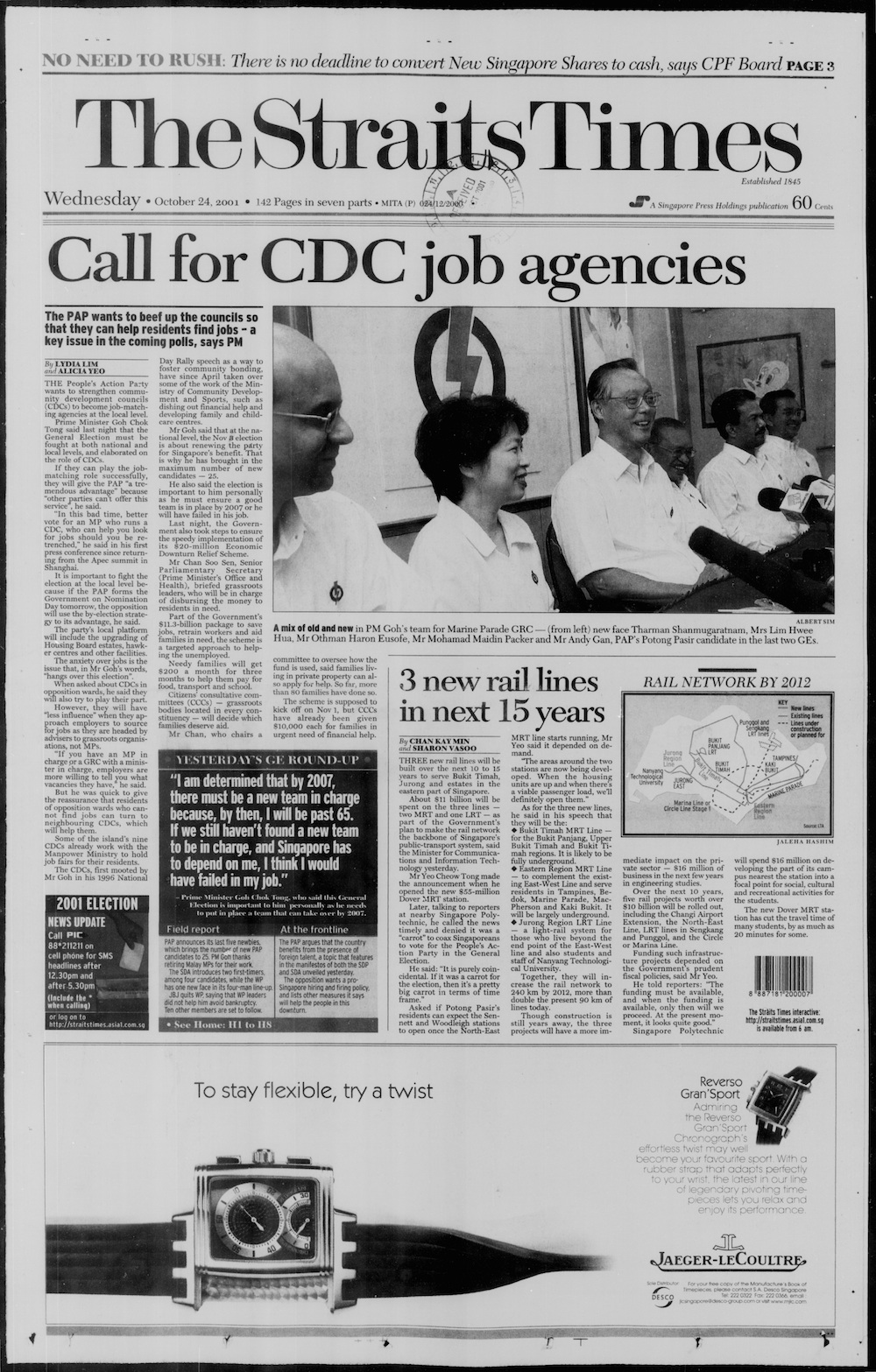
The Jurong Region Line (JRL) was formally announced on 23 October 2001 by then-Transport Minister Yeo Cheow Tong. Conceived as a light rail system, the line was intended to serve residential areas in Jurong beyond the reach of the EWL while also providing a direct connection to NTU.[9][10][11] However, passenger demand projections remained insufficient to justify construction, and in May 2008 the project was placed on hold owing to a lack of financial viability.[12]
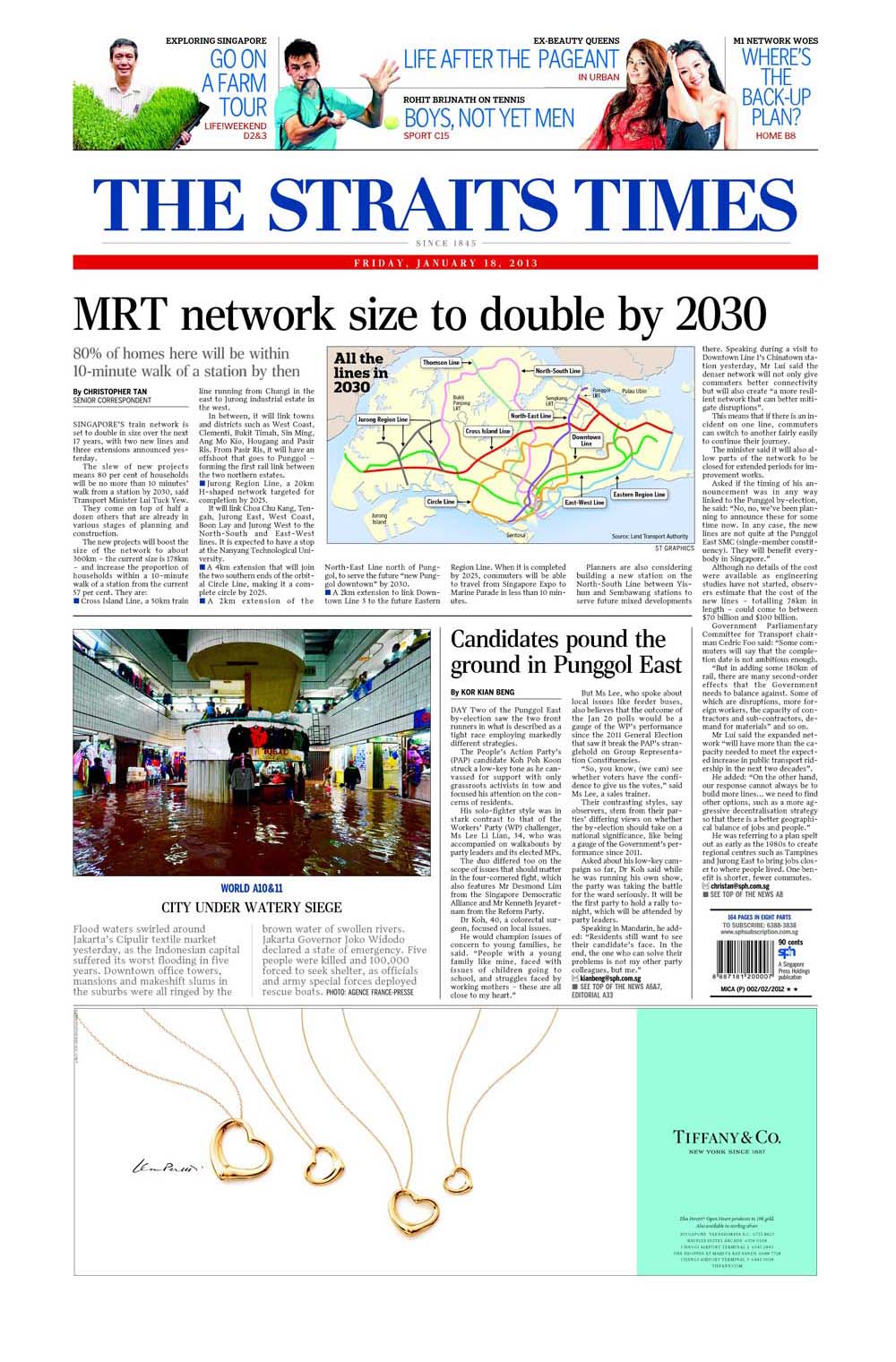
Renewed plans for the line emerged as part of the 2013 Land Transport Master Plan, announced by then-Transport Minister Lui Tuck Yew in January that year.[13] Reflecting changing development priorities in western Singapore, the proposed line was expanded beyond its earlier concept and was intended to serve Choa Chu Kang, Tengah, Bukit Batok, Jurong East, West Coast, Jurong West, NTU and Jurong Industrial Estate.[13][14]
Construction of initial phases
edit

| Date | Project | Description |
|---|---|---|
| mid-2028 | Stage 1 (JRL1) | Choa Chu Kang – Boon Lay & Bahar Junction – Tawas |
| 2028 | Stage 2 (JRL2) | Tengah – Pandan Reservoir |
| 2029 | Stage 3 (JRL3) | Enterprise – Jurong Pier & Nanyang Gateway – Peng Kang Hill |
| mid-2030s | JS2A station | Opening of JS2A infill station |
| late-2030s | West Coast Extension Phase 1 (WCE1) | Pandan Reservoir – West Coast |
| early-2040s | West Coast Extension Phase 2 (WCE2) | West Coast – Kent Ridge |
The final alignment of the JRL was announced on 9 May 2018.[15][16] The line was planned as a 30-kilometre (19 mi) medium-capacity MRT system comprising 24 stations and constructed in three phases. The first phase consisted of the western section from Choa Chu Kang to Bahar Junction, together with branches to Tawas and Boon Lay. The second phase comprised the eastern section extending from Tengah to Pandan Reservoir, while the final phase would continue westwards to NTU and Jurong Pier. The three phases were initially scheduled for completion between 2026 and 2028.[17][18]
The alignment attracted discussion owing to its multiple branches and indirect routing. While many NTU students welcomed the prospect of a rail connection to the university, some observed that journeys between NTU and Boon Lay would require a transfer at Bahar Junction, making existing direct bus services more convenient. Transport analysts noted that the alignment represented a compromise between operational efficiency and the constraints of navigating established residential and industrial developments.[19] Although designated as an MRT line, the JRL was designed to use smaller trainsets capable of negotiating the tighter curves required by its route.[20]
Preparatory works for the project involved a number of land acquisitions and infrastructure relocations. A multi-storey car park in Choa Chu Kang was acquired, while portions of 19 land plots were partially acquired, primarily affecting ancillary features such as fences and landscaped verges.[21][22] To accommodate construction works, the Choa Chu Kang and Jurong East bus interchanges were relocated on 16 December 2018 and 6 December 2020 respectively.[23][24] Pioneer Primary School was merged with Juying Primary School in 2022, enabling a revised alignment that would pass through the former school’s premises.[25][26]
Contracts for the first group of stations were awarded in September 2019.[27][28] This was followed by the award of the contract for Tengah Depot in November 2019[29] and the rolling stock contract in February 2020.[30] The final station contract was awarded in May 2022.[31] Construction of the line was formally marked by a groundbreaking ceremony on 13 January 2023.[32][33][34]
In May 2023, LTA invited tenders for the operation of the line.[35] The operating contract was awarded in November 2024 to Singapore One Rail (SOR), a joint venture between SBS Transit and RATP Dev Asia Pacific, for S$750 million.[36] The venture will operate the line under an initial nine-year licence, with the possibility of a two-year extension. The arrangement marked the first time a Singapore MRT line had been entrusted to a joint-venture operator,[37][38][39] with SBS Transit holding a 75.01 per cent stake and RATP Dev the remaining 24.99 per cent.[40]
Opening
editIn March 2026, the Ministry of Transport announced that the opening of the first phase had been postponed to mid-2028.[41] The delay was attributed to earlier disruptions arising from the COVID-19 pandemic, as well as the challenges associated with constructing an entirely elevated railway through densely developed urban areas. Works adjacent to Housing and Development Board (HDB) estates, crossings over major roads including the Pan Island Expressway (PIE), and additional ground preparation required for a viaduct crossing over a canal further extended the construction timeline.[42][43]
West Coast extension
editPlans to extend the JRL beyond Pandan Reservoir station emerged shortly after the line was revived. On 25 August 2015, then-Transport Minister Lui Tuck Yew announced that LTA was studying a possible extension through Pasir Panjang to connect with the Circle Line at Haw Par Villa station.[44] The proposal was intended to strengthen transport links between western Singapore and the Central Business District,[45] with completion envisaged by around 2030 if found to be feasible.[46]
Interest in the extension intensified following the disruption of the East–West Line in 2024. Then-Non-Constituency Member of Parliament (NCMP) Leong Mun Wai called for the extension to proceed, arguing that a connection to both the Circle Line and the future Cross Island Line would improve transport resilience in western Singapore.[47] Responding to the proposal, then-Senior Minister of State for Transport Amy Khor stated that LTA was continuing to evaluate the project alongside future developments in the area.[48][49]
On 5 March 2025, then-Transport Minister Chee Hong Tat confirmed that the extension would proceed in two stages. Following further studies of anticipated transport demand and long-term land-use plans, LTA concluded that a connection to Kent Ridge station would provide greater benefits than the previously proposed link to Haw Par Villa. The first stage, targeted for completion in the late 2030s, will extend the line to West Coast station on the Cross Island Line. A second stage, planned for the early 2040s, will continue the line to Kent Ridge station.[50] The final alignment has yet to be determined, although it may include intermediate stations and a route through the National University of Singapore (NUS).[51] Engineering studies for the extension are scheduled to begin in 2026.[42]
JS2A infill station
editOn 4 March 2026, LTA announced plans for an infill station, provisionally designated JS2A, between Choa Chu Kang West and Tengah stations. The station is intended to serve Tengah’s future Forest Hill district and is expected to open in the mid-2030s in conjunction with the area’s development.[42]
Network and operations
editNetwork
edit
The JRL has approximately 30 km (19-mile) (19 miles) of track, with 27 stations.[52][53] The line, which is shaped like an “H”, has four branches extending to Choa Chu Kang in the north, Jurong Pier in the south, Pandan Reservoir in the east and Peng Kang Hill in the west.[54]
The northern branch terminates at Choa Chu Kang, where interchange is provided with the North–South Line and Bukit Panjang LRT,[55] while the eastern branch serves Tengah and Jurong East before terminating at Pandan Reservoir.[56][57] The southern and western branches diverge at Bahar Junction,[56] serving Jurong Pier and Peng Kang Hill respectively, with the latter running through Nanyang Technological University before reaching its terminus.[55][58]
Other interchanges with the MRT network are provided at Boon Lay, for the East–West Line, and at Jurong East, for the North–South and East–West lines. The eastern branch will be extended beyond Pandan Reservoir as part of the West Coast Extension, providing connections with the Circle Line at Kent Ridge and the Cross Island Line at West Coast.[50]
Between Jurong East station and Toh Guan station, the JRL runs parallel to the North–South Line. Elsewhere, the line serves the residential estates of Choa Chu Kang, Jurong West, Tengah, Bukit Batok and Jurong East, as well as the Jurong Industrial Estate, crossing the Pan Island Expressway and Ayer Rajah Expressway at several locations.
Stations
editThe line has 27 stations between Choa Chu Kang and the branch termini at Jurong Pier, Pandan Reservoir and Peng Kang Hill. Three stations provide interchanges with other MRT and LRT lines,[59] while the planned West Coast Extension will further strengthen connections between western Singapore and the Central Business District through additional links with the Circle and Cross Island lines.[60]
| Station code | Station name | Images | Interchange; Adjacent transportation |
Opening |
|---|---|---|---|---|
| JRL1 (under construction, to be ready by mid-2028) | ||||
| JS1 NS4 BP1 | Choa Chu Kang |  | North–South Line Bukit Panjang LRT ―  Choa Chu Kang Choa Chu Kang | mid-2028; 1 year's time |
| JS2 | Choa Chu Kang West |  | — | |
| JS3 | Tengah |  | Jurong Region Line (East) (2028) ― Tengah | |
| JS4 | Hong Kah |  | — | |
| JS5 | Corporation |  | ||
| JS6 | Jurong West |  | ||
| JS7 | Bahar Junction |  | Jurong Region Line (West) | |
| JS8 EW27 | Boon Lay |  | East–West Line ― Boon Lay | |
| JW1 | Gek Poh |  | — | |
| JW2 | Tawas |  | ||
| JRL2 (under construction, to be ready by 2028) | ||||
| JE1 | Tengah Plantation |  | — | 2028; 2 years' time |
| JE2 | Tengah Park |  | ||
| JE3 | Bukit Batok West |  | ||
| JE4 | Toh Guan |  | ||
| JE5 NS1 EW24 | Jurong East |  | North–South Line East–West Line ― Jurong East | |
| JE6 | Jurong Town Hall |  | ||
| JE7 | Pandan Reservoir |  | ||
| JRL3 (under construction, to be ready by 2029) | ||||
| JS9 | Enterprise |  | — | 2029; 3 years' time |
| JS10 | Tukang |  | ||
| JS11 | Jurong Hill | _040622.jpg) | ||
| JS12 | Jurong Pier |  | ||
| JW3 | Nanyang Gateway |  | ||
| JW4 | Nanyang Crescent |  | ||
| JW5 | Peng Kang Hill | _040622.jpg) | ||
| JS2A infill station (under planning, to be ready by mid-2030s) | ||||
| JS2A | JS2A | — | mid-2030s; 9 years' time | |
| WCE1 (under planning, to be ready by late 2030s) | ||||
| JE CR18 | West Coast | Cross Island Line | late-2030s; 13 years' time | |
| WCE2 (under planning, to be ready by early 2040s) | ||||
| JE CC24 | Kent Ridge | Circle Line | early-2040s; 14 years' time | |
Infrastructure
editRolling stock
edit
The JRL will be operated by a fleet of 62 Hyundai Rotem J151 trains.[61][62][63] Designed specifically for the line’s alignment, the fully automated trains are configured in three-car formations,[30] with provisions for expansion to four cars as passenger demand grows.[64] Owing to the tight curves along the route, the trains are smaller than those used on Singapore’s other MRT lines, with each car measuring 18.6 m (61 ft) in length and 2.75 m (9.0 ft) in width.[20] To facilitate faster boarding and alighting, every car is fitted with three 1.5 m (4.9 ft)-wide doors on each side.[30]
Powered by a 750 V DC third-rail system,[31][64] the trains are capable of operating at speeds of up to 70 km/h (43 mph).[62] They also introduce two new technologies to Singapore’s rail network: Condition Based Maintenance (CBM), which enables real-time monitoring of train conditions, and Automatic Track Inspection (ATI), which continuously detects track defects.[62][30] In the event of a power failure, onboard emergency batteries allow trains to proceed to the nearest station.[61] The first JRL trains arrived in Singapore in September 2025.[65][66]
Depot
editThe line is supported by Tengah Depot, a 44.5 ha (110-acre) at-grade facility that serves as the primary maintenance and stabling depot for the JRL fleet.[17] Constructed by China Railway 11 Bureau Group Corporation at a cost of S$739.5 million (US$498 million),[67] the depot incorporates the line’s Operations Control Centre and has capacity for up to 100 trains.[17]
Located west of Tengah,[68] the depot is integrated with a bus depot and a workers’ dormitory, forming a multi-purpose transport and support complex.[29][67] Plans were also considered for an additional stabling facility near Peng Kang Hill station, which would have enhanced train launching and withdrawal operations along the line.[17][69]
Signalling technology
editThe JRL employs Siemens’ Trainguard Sirius communications-based train control (CBTC) system, a moving-block signalling technology that enables fully automated operation at Grade of Automation 4 (GoA4).[70][71][72] The radio-based system continuously monitors train locations and speeds, allowing precise control of train movements across the network.[70][73]
The signalling architecture incorporates several subsystems. Automatic Train Protection (ATP) regulates train speeds and maintains safe separation between services, while the Controlguide Rail 9000 Automatic Train Supervision (ATS) system manages train tracking and service scheduling. Train routing and interlocking functions are handled by the Trackguard Westrace MKII computer-based interlocking (CBI) system,[74] which prevents conflicting signal and point settings. Similar CBTC technology is also used on Singapore’s Downtown Line.[75]
Passenger safety at stations is enhanced through the use of Siemens platform screen doors installed along the network.[76][71]
Notes and references
editNotes
editReferences
edit- ↑ "SBS Transit in Partnership with RATP Dev Wins Tender to Operate the Jurong Region Line". SBSTransit. Archived from the original on 29 November 2024. Retrieved 29 November 2024.
- ↑ "SBS Transit in partnership with RATP Dev wins tender to operate the Jurong region line". RATPDev. 28 November 2024. Archived from the original on 29 November 2024. Retrieved 29 November 2024.
- ↑ "First JRL train arrives in Singapore; has wider doors, smaller carriages: LTA". The Straits Times. 25 September 2025. Archived from the original on 2 October 2025. Retrieved 30 September 2025.
- ↑ "Jurong Region Line, Singapore's 7th MRT line, to open in phases from 2026". Channel NewsAsia. 9 May 2018. Archived from the original on 9 May 2018. Retrieved 9 May 2018.
- ↑ "Jurong Region Line to open from 2026 in three phases". The New Paper. 10 May 2018. Archived from the original on 12 May 2018. Retrieved 12 May 2018.
- ↑ White Paper: A World Class Land Transport System (PDF). Singapore: Land Transport Authority. 1996. pp. 45–46. ISBN 978-9971-88-488-8. Archived (PDF) from the original on 22 August 2021. Retrieved 22 August 2021.
- ↑ "Jurong May Be Next to Get LRT Line" – via NewspaperSG.
- ↑ Yeo, Geraldine (5 December 1998). "More MRT Lines Under Study". The Straits Times. p. 1. Archived from the original on 17 January 2023. Retrieved 3 June 2024.
- ↑ "Speech By Mr Yeo Cheow Tong At the Official Opening of Dover Station on 23 Oct 2001". Ministry of Transport. 23 October 2001. Archived from the original on 5 October 2017. Retrieved 5 October 2017.
- ↑ Chan, Kay Min; Vasoo, Sharon (24 October 2001). "3 New Rail Lines in Next 15 Years". The Straits Times. p. 1. Archived from the original on 17 February 2023. Retrieved 17 February 2023.
- ↑ "Development Plans for Jurong West". Housing and Development Board. 5 October 2003. Retrieved 15 July 2024.
{{cite web}}: CS1 maint: deprecated archival service (link) - ↑ "No Plans to Develop Jurong LRT for Now". Land Transport Authority. 26 May 2008. Archived from the original on 6 October 2017. Retrieved 5 October 2017.
- 1 2 "Speech by Mr Lui Tuck Yew at visit to DTL1 Chinatown Station on 17 January 2013". Ministry of Transport. 17 January 2013. Archived from the original on 26 February 2020. Retrieved 19 September 2019.
- ↑ Tan, Christopher. "MRT network size to double by 2030". The Straits Times. p. 1. Archived from the original on 13 May 2024. Retrieved 22 June 2024.
- ↑ "Speech by Minister Khaw Boon Wan at the Work Site of Canberra MRT Station". Ministry of Transport. 9 May 2018. Archived from the original on 13 May 2018. Retrieved 13 May 2018.
- ↑ Lim, Adrian (9 May 2018). "New Jurong Region Line to Boost Access for NTU Students". The Straits Times. Archived from the original on 9 April 2021. Retrieved 9 April 2021.
- 1 2 3 4 "News Room – News Releases – Joint News Release By the Land Transport Authority (LTA) & SLA – Jurong Region Line: Enhancing Connectivity in the West". Land Transport Authority. 9 April 2021. Archived from the original on 9 April 2021. Retrieved 9 April 2021.
- ↑ "Jurong Region Line to Serve NTU, Tengah Estate, Jurong Industrial Estate". Channel NewsAsia. Mediacorp. 9 May 2018. Archived from the original on 21 September 2019. Retrieved 21 September 2019.
- ↑ "Residents and students welcome Jurong Region Line but find it confusing". Today. 21 September 2019. Archived from the original on 21 September 2019. Retrieved 21 September 2019.
- 1 2 Lim, Adrian (10 May 2018). "Smaller train cars for Jurong Region Line to navigate tight curves in built-up areas". The Straits Times. Archived from the original on 11 May 2018. Retrieved 3 March 2022.
- ↑ Wong, Pei Ting (9 May 2018). "HDB multi-storey car park with shops to make way for construction of Jurong Region Line". Today. Archived from the original on 13 May 2018. Retrieved 22 June 2024.
- ↑ "Jurong Region Line: Enhancing Connectivity in the West". Singapore Land Authority. 18 June 2024. Retrieved 22 June 2024.
- ↑ "New Choa Chu Kang Bus Interchange to Open on 16 December 2018". Land Transport Authority. 16 December 2018. Archived from the original on 13 December 2023. Retrieved 1 June 2024.
- ↑ Tan, Christopher (11 November 2020). "Jurong East bus interchange to be relocated from Dec 6 till 2027". The Straits Times. Archived from the original on 22 January 2021. Retrieved 22 June 2024.
- ↑ "School Mergers". Ministry of Education. 7 April 2021. Retrieved 22 June 2024.
- ↑ Ng, Wei Kai (7 April 2021). "4 pairs of primary schools, 5 pairs of secondary schools to merge in S'pore as student numbers shrink". The Straits Times. Archived from the original on 3 May 2024. Retrieved 22 June 2024.
- ↑ "Work to construct 5 MRT stations on Jurong Region Line to start in 2020". CNA. 10 September 2019. Archived from the original on 2 November 2019. Retrieved 6 February 2020.
- ↑ "LTA Awards Civil Contracts to Construct Five Stations for the Jurong Region Line". Land Transport Authority. 10 September 2019. Archived from the original on 21 June 2024. Retrieved 22 June 2024.
- 1 2 "LTA Awards Civil Contract to Construct Tengah Depot for the Jurong Region Line". Land Transport Authority. 20 November 2019. Archived from the original on 6 December 2019. Retrieved 22 June 2024.
- 1 2 3 4 "Hyundai Rotem Company Awarded Contract for 62 Jurong Region Line Trains". Land Transport Authority. 6 February 2020. Archived from the original on 1 December 2021. Retrieved 20 March 2022.
- 1 2 "LTA Awards Two Contracts for Jurong Region Line". Land Transport Authority. 18 May 2022. Archived from the original on 18 May 2022. Retrieved 22 June 2024.
- ↑ "Construction of Jurong Region Line begins, with 24 new MRT stations". CNA. 13 January 2023. Archived from the original on 13 January 2023. Retrieved 13 January 2023.
- ↑ "Construction of Jurong Region Line begins, MRT stations to open in three stages from 2027 to 2029". The Straits Times. 13 January 2023. Archived from the original on 20 January 2023. Retrieved 13 January 2023.
- ↑ "Work Commences for Jurong Region Line". Land Transport Authority. 13 January 2023. Archived from the original on 20 January 2023. Retrieved 13 January 2023.
- ↑ "Tenders Called to Appoint Operators for Jurong Region Line and Cross Island Line". Land Transport Authority. 9 May 2023. Archived from the original on 22 June 2024. Retrieved 22 June 2024.
- ↑ Lim, Paige (28 November 2024). "SBS Transit and French transport operator RATP Dev win tender to run Jurong Region Line". The Business Times. Retrieved 29 November 2024.
- ↑ "Jurong Region Line Operations Awarded to Joint Venture Between SBS Transit Rail and RATP Dev Asia Pacific". Land Transport Authority. 28 November 2024. Archived from the original on 2 January 2026. Retrieved 28 November 2024.
- ↑ Lee, Nian Tjoe (28 November 2024). "SBS Transit, French firm RATP Dev to operate Jurong Region Line". The Straits Times. Archived from the original on 28 November 2024. Retrieved 28 November 2024.
- ↑ Chan, Rachel (28 November 2024). "French firm joins SBS Transit to win Jurong Region Line contract; first foreign operator in Singapore rail". CNA. Retrieved 29 November 2024.
- ↑ Yufeng, Kok (27 January 2025). "SBS Transit tie-up with French firm RATP Dev aims to bring best of the world to Jurong, say CEOs". The Straits Times. Archived from the original on 27 January 2025. Retrieved 27 January 2025.
- ↑ "Written Reply By Minister for Transport Ong Ye Kung to Parliamentary Question on Prioritising Early Completion of Jurong Region Line". Ministry of Transport. 1 February 2021. Archived from the original on 19 February 2021. Retrieved 24 March 2021.
- 1 2 3 Chelvan, Vanessa Paige (4 March 2026). "New Jurong Region Line station added in Tengah; opening of line delayed to mid-2028: Jeffrey Siow". The Straits Times. Retrieved 4 March 2026.
- ↑ "Factsheet: The Next Phase of Rail Development". Land Transport Authority. 4 March 2026. Retrieved 5 March 2026.
- ↑ Tan, Christopher (25 August 2015). "LTA studying possible extension of planned Jurong Region Line to connect to Circle Line". The Straits Times. Archived from the original on 14 July 2019. Retrieved 29 July 2022.
- ↑ "More MRT Stations to be Upgraded and Possible Extension of Jurong Region Line". Land Transport Authority. 25 August 2015. Retrieved 29 July 2022.[dead link]
- ↑ Yeo, Marissa (25 August 2015). "Jurong line may be extended to link with Circle Line". Today. Retrieved 29 July 2022.
{{cite web}}: CS1 maint: deprecated archival service (link) - ↑ "Adjournment Motion: Realising the Vision of a 45-Minute City in the West of Singapore under the Land Transport Master Plan 2040". Leong Mun Wai. 15 October 2024. Archived from the original on 22 October 2024. Retrieved 18 October 2024.
- ↑ "Response by Senior Minister of State for Transport Dr Amy Khor to Adjournment Motion on Realising the Vision of a 45-Minute City Under the Land Transport Master Plan 2040 in the West of Singapore". Ministry of Transport. 15 October 2024. Archived from the original on 19 February 2025. Retrieved 18 October 2024.
- ↑ Loi, Esther (15 October 2024). "Govt says plans ongoing to boost connectivity in the west, after NCMP flags gaps in rail network". The Straits Times. Archived from the original on 11 November 2024. Retrieved 18 October 2024.
- 1 2 Ong, Justin (5 March 2025). "New Tengah and Seletar MRT lines being studied, could be operational from 2040s". CNA. Archived from the original on 5 March 2025. Retrieved 5 March 2025.
- ↑ Kok, Yufeng (5 March 2025). "Two new MRT lines under study; Jurong Region Line extension in West Coast to proceed". The Straits Times. Archived from the original on 5 March 2025. Retrieved 5 March 2025.
- ↑ "Singapore's Jurong Region Line alignment finalised". Metro Report International. Archived from the original on 12 May 2018. Retrieved 12 May 2018.
- ↑ "New Jurong Region Line will connect NTU to existing Choa Chu Kang and Boon Lay stations". todayonline.com. Archived from the original on 12 May 2018. Retrieved 12 May 2018.
- ↑ "Jurong Region Line". Land Transport Authority. Archived from the original on 6 September 2017. Retrieved 12 May 2018.
- 1 2 "Jurong Region Line: Enhancing Connectivity in the West (Updates on ongoing works until Q4 2025)" (PDF). Land Transport Authority. Retrieved 27 March 2025.
- 1 2 "LTA Awards Civil Contract to Construct Tengah Depot for the Jurong Region Line". Land Transport Authority. 20 November 2019. Archived from the original on 6 December 2019. Retrieved 27 March 2025.
- ↑ "Tengah (map)" (PDF). Housing and Development Board. Retrieved 27 March 2025.
- ↑ "Residents and students welcome Jurong Region Line but find it confusing". todayonline. Archived from the original on 12 May 2018. Retrieved 13 May 2018.
- ↑ "Future System Map" (PDF). Land Transport Authority. Archived from the original (PDF) on 9 September 2020. Retrieved 9 September 2020.
- ↑ "Expanding our Rail Network and Strengthening Rail Reliability and Resilience". Archived from the original on 15 January 2026. Retrieved 4 March 2026.
- 1 2 "Jurong Region Line to use Korean trains with emergency battery propulsion". The Straits Times. 6 February 2020. Archived from the original on 6 February 2020. Retrieved 6 February 2020.
- 1 2 3 소식-상세. 현대로템 (in Korean). 7 February 2020. Archived from the original on 19 March 2022. Retrieved 20 March 2022.
- ↑ "Contract J151" (PDF). Land Transport Authority. Archived (PDF) from the original on 29 December 2021. Retrieved 20 March 2022.
- 1 2 Sim, Fann (9 May 2018). "Jurong Region Line to serve NTU, Tengah estate, Jurong Industrial Estate". Channel NewsAsia. Archived from the original on 9 May 2018. Retrieved 12 May 2018.
- ↑ Hamzah, Aqil (25 September 2025). "First JRL train arrives in Singapore; has wider doors, smaller carriages: LTA". The Straits Times. Archived from the original on 25 September 2025. Retrieved 25 September 2025.
- ↑ "地铁裕廊区域线首列列车运抵我国 预计2027年始分阶段通车". 8world. 25 September 2025. Retrieved 25 September 2025.
- 1 2 Toh, Ting Wei (20 November 2019). "LTA awards $739.5 million project to build Tengah Depot for Jurong Region Line". The Straits Times. Archived from the original on 6 December 2019. Retrieved 22 June 2024.
- ↑ 早上尖峰时段公交乘客比率提高. 联合早报 (in Chinese). 17 June 2017. Archived from the original on 28 April 2018. Retrieved 13 May 2018.
- ↑ "Contract J115" (PDF). Land Transport Authority. 18 February 2020. Archived (PDF) from the original on 29 December 2021. Retrieved 22 June 2020.
- 1 2 "Siemens Mobility to install CBTC on Jurong Region Line in Singapore". Siemens Press. Archived from the original on 6 February 2021. Retrieved 6 February 2021.
- 1 2 "LTA Awards Four Jurong Region Line Contracts". Land Transport Authority. 17 July 2020. Archived from the original on 22 June 2024. Retrieved 22 June 2024.
- ↑ "Trainguard MT" (PDF). Siemens Assets. Archived (PDF) from the original on 23 August 2020. Retrieved 23 June 2024.
- ↑ "Communications-Based Train Control System". Siemens Mobility Global. 24 April 2024. Archived from the original on 23 June 2024. Retrieved 23 June 2024.
- ↑ "Trackguard Westrace Mk ll" (PDF). Siemens Assets. Archived (PDF) from the original on 15 June 2024. Retrieved 23 June 2024.
- ↑ "Siemens-equipped driverless underground metro line in Singapore starts operations for Downtown Line 2". Siemens Press. 13 December 2019. Archived from the original on 23 June 2024. Retrieved 23 June 2024.
- ↑ "LTA awards 4 Jurong Region Line contracts worth more than S$682 million". CNA. Archived from the original on 17 July 2020. Retrieved 17 July 2020.




External links
edit