
Ictinogomphus dobsoni is a species of dragonfly in the family Gomphidae.[3][4] and known as the Pilbara tiger.[5] It is a medium to large, black dragonfly with yellow markings and clear wings.[6] Ictinogomphus dobsoni is endemic to the Pilbara region in Western Australia,[5] where it inhabits rivers, lakes and ponds.[7]
| Pilbara tiger | |
|---|---|
Scientific classification  | |
| Kingdom: | Animalia |
| Phylum: | Arthropoda |
| Clade: | Pancrustacea |
| Class: | Insecta |
| Order: | Odonata |
| Infraorder: | Anisoptera |
| Family: | Gomphidae |
| Genus: | Ictinogomphus |
| Species: | I. dobsoni |
| Binomial name | |
| Ictinogomphus dobsoni | |
 | |
| Synonyms[3] | |
| |

Ictinogomphus dobsoni appears similar to Ictinogomphus australis.[5]
Etymology
editThe genus name Ictinogomphus is derived from the Greek ἴκτινος (iktinos, "kite"), combined with Gomphus, a genus name derived from the Greek γόμφος (gomphos, "peg" or "nail"). The name likely refers to the large size of the genus, emphasised by the distinctive large flaps near the end of the abdomen in both males and females.[8]
In 1969, Tony Watson named this species dobsoni, an eponym honouring Roderick Dobson, who collected specimens used in research on this species.[2][9][10][11]
Gallery
edit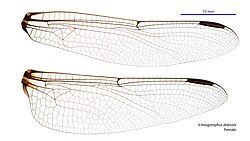 Female wings
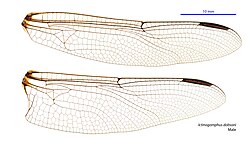 Male wings
.jpg)
.jpg)
See also
editReferences
edit- ↑ Dow, R.A. (2017). "Ictinogomphus dobsoni". IUCN Red List of Threatened Species. 2017 e.T14278410A59256758. doi:10.2305/IUCN.UK.2017-1.RLTS.T14278410A59256758.en. Retrieved 12 September 2024.
- 1 2 Watson, J.A.L. (1969). "Taxonomy, ecology, and zoogeography of dragonflies (Odonata) from the north-west of Western Australia". Australian Journal of Zoology. 17 (1): 65–112 [88]. doi:10.1071/ZO9690065.
- 1 2 "Species Ictinogomphus dobsoni (Watson, 1969)". Australian Faunal Directory. Australian Biological Resources Study. 2022. Retrieved 1 September 2024.
- ↑ Paulson, D.; Schorr, M.; Abbott, J.; Bota-Sierra, C.; Deliry, C.; Dijkstra, K.-D.; Lozano, F. "World Odonata List". OdonataCentral. University of Alabama.
- 1 2 3 Theischinger, Günther; Hawking, John (2021). The Complete Field Guide to Dragonflies of Australia (2nd ed.). Melbourne, Australia: CSIRO Publishing. ISBN 978-1-4863-1374-7.
- ↑ Watson, J.A.L.; Theischinger, G.; Abbey, H.M. (1991). The Australian Dragonflies: A Guide to the Identification, Distributions and Habitats of Australian Odonata. Melbourne: CSIRO. ISBN 0-643-05136-8.
- ↑ Theischinger, Gunther; Endersby, Ian (2009). Identification Guide to the Australian Odonata (PDF). Department of Environment, Climate Change and Water NSW. p. 238. ISBN 978-1-74232-475-3.
- ↑ Endersby, Ian; Fliedner, Heinrich (2015). The Naming of Australia's Dragonflies. Eltham, Victoria, Australia: Busybird Publishing. ISBN 9781925260625.
- ↑ Endersby, I. (2012). "Watson and Theischinger: the etymology of the dragonfly (Insecta: Odonata) names which they published". Journal and Proceedings of the Royal Society of New South Wales. 145 (443 & 444): 34–53 [39]. doi:10.5962/p.146542. ISSN 0035-9173 – via Biodiversity Heritage Library.
- ↑ "Dobson, Roderick". Encyclopedia of Australian Science and Innovation. Swinburne University of Technology. Retrieved 13 May 2026.
- ↑ Hämäläinen, Matti (9 February 2016). "Catalogue of individuals commemorated in the scientific names of extant dragonflies, including lists of all available eponymous species-group and genus-group names – Revised edition" (PDF). International Dragonfly Fund Report. 92: 1–132. ISSN 1435-3393.
{{cite journal}}: CS1 maint: date and year (link)

