
Hinava is a traditional native salad dish of the Kadazan-Dusun people in the state of Sabah within East Malaysia.[1] It is made from raw fish and mixed with lime juice, bird's eye chilli, sliced shallots and grated ginger.[2] Hinava is one of the main ethnic foods among the Kadazan and Dusun, often served during occasions such as the Kaamatan harvest festival, engagements, weddings, and other cultural feasts.[3] The dish has been recognised as a national heritage dish by Malaysia's Department of National Heritage in 2009, alongside umai of Sarawak.[4]
 A swordfish hinava served with sandwich bread | |
| Alternative names | hinata |
|---|---|
| Type | Salad dish |
| Course | Appetiser |
| Place of origin | Malaysia |
| Region or state | Sabah |
| Associated cuisine | Sabahan cuisine |
| Created by | Kadazan or Lotud Dusun |
| Main ingredients | Fish, lime juice, bird's eye chilli, red onion, salt |
| Variations | Hinava ginapan, hinava tongi |

Preparation
editPart of the Kadazan-Dusun heritage,[5][6] hinava often served as a salad or appetiser, made by mixing fresh raw tenggiri (Spanish mackerel), thinly sliced or diced, then mixed with chillies, grated ginger, sliced shallots, grated bambangan (Mangifera pajang) seed, and salt, together with a squeeze of lime or calamansi juice.[4][7] The dish is usually made using either sharks or mackerel, although other fish can also be used depending on the individual's taste.[3] While the Kadazan are famous for their hinava tongi,[1] the Lotud Dusun called their similar raw fish dish spread with lemon and vinegar as hinata.[8] Hinava is rich in source of protein as it contains all the healthy components of a raw fish.[9] Another version of hinava with prawn as the main source is called the hinava ginapan.[10]
Gallery
edit Freshly made hinava with chillies, lime and mango
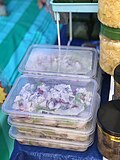 Hinava served inside a container during a food festive
 The mixture of hinava
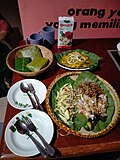 Hinava served with other traditional foods of Sabah


See also
edit

- Umai, a similar dish from neighbouring state of Sarawak
- Kinilaw, a similar dish from the Philippines
- Ceviche
- Sashimi
- Pinaasakan sada
- List of raw fish dishes
References
edit- 1 2 Su-Lyn & Tay 2003, p. 157.
- ↑ (Richmond et al. 2013, p. 706)
- 1 2 Murphy (2 December 2024). "Hinava: Heritage Salad of Sabah". MySabah.com. Archived from the original on 8 March 2026. Retrieved 8 June 2026.
- ↑ Md Ramli et al. 2023, pp. 31–41.
- ↑ Binisol, Lorena (8 June 2026). "Keeping Kadazan-Dusun-Murut traditions alive". Daily Express. Archived from the original on 29 May 2026. Retrieved 8 June 2026.
- ↑ "Hinava: Sabah's ocean-tasting signature delight". New Straits Times (Business Times ed.). 21 March 2024. Archived from the original on 8 June 2026. Retrieved 8 June 2026.
- ↑ Mu, Paul (16 December 2021). "Sabah recognises Lotud as ethnic group". New Straits Times (Busines Times ed.). Archived from the original on 18 October 2025. Retrieved 8 June 2026.
- ↑ (Harmayani et al. 2019, p. 1)
- ↑ "Hinava Ginapan". Sabah Education Department. Archived from the original on 31 January 2019. Retrieved 9 June 2026.
Bibliography
edit- Su-Lyn, Tan; Tay, Mark (2003). Malaysia & Singapore. Lonely Planet. ISBN 978-1-74059-370-0.
- Richmond, Simon; Bonetto, Cristian; Brash, Celeste; Brown, Joshua Samuel; Bush, Austin; Karlin, Adam; Low, Shawn; Robinson, Daniel (1 April 2013). Lonely Planet Malaysia Singapore & Brunei. Lonely Planet Publications. ISBN 978-1-74321-633-0.
- Harmayani, Eni; Anal, Anil Kumar; Wichienchot, Santad; et al. (2019). "Healthy food traditions of Asia: exploratory case studies from Indonesia, Thailand, Malaysia, and Nepal". Journal of Ethnic Foods. 6 (1). doi:10.1186/s42779-019-0002-x – via Springer Nature.
 Text is licensed by Journal of Ethnic Foods under CC BY 4.0
 - Md Ramli, Adilah; Ahmad Sapawi, Dg Khairunisa; Ibrahim, Shalawati; Chin Weon, Saw (2023). "Factors affecting the selection of Kadazandusun ethnic foods among students of Universiti Malaysia Sabah, Malaysia". Canrea Journal: Food Technology, Nutritions, and Culinary. 6 (1). Makassar, Indonesia: 31–41. doi:10.20956/canrea.v6i1.923. eISSN 2621-9468. Archived from the original on 10 June 2026 – via Faculty of Agricultural Technology, Hasanuddin University. Text is licensed by Canrea Journal: Food Technology, Nutritions, and Culinary under CC BY 4.0
