
The Grohmann Museum at the Milwaukee School of Engineering (MSOE) is an art museum located Milwaukee, Wisconsin, whose collection focuses on the historical evolution and visual representation of human labor.[2]
 | |
.jpg) Exterior of the Grohmann Museum in 2022 | |
 Interactive fullscreen map | |
| Established | 2007 |
|---|---|
| Location | 1000 N. Broadway Milwaukee, Wisconsin United States |
| Coordinates | 43°02′38″N 87°54′29″W / 43.043806°N 87.907944°W |
| Type | Art museum |
Collection size | 2,000 works[1] |
| Director | James Kieselburg |
Public transit access |  MCTS 15, 18, 30, 57, and Green Line MCTS 15, 18, 30, 57, and Green Line  The Hop M-Line The Hop M-Line |
| Website | www |
The museum originated in 2001 after businessman Eckhart Grohmann (b. 1936), the former president of the Milwaukee Aluminum Casting & Engineering Company, gifted his art collection to the school, along with funding to operate a structure to display it. The museum building opened in 2007 in a renovated 1924 auto dealership building located next to the city's former German-English Academy.[3][4]
Among the institution's 2,000 art pieces are a large group of works by German Romantic painter Carl Spitzweg, including versions of The Bookworm (on long-term loan from the Milwaukee Public Library) and The Poor Poet, two of his most famous compositions.[1][5][6][7] The collection also comprises paintings and sculpture by European and American artists including Pieter Brueghel the Younger, Jan van Goyen, Ludwig Knaus, Eyre Crowe, John George Brown, Max Schlichting, Max Liebermann, Julien Dupré, Norman Rockwell, and Frederic Remington.[1]
Both the ceiling painting and floor mural of the museum's entry hall were designed by contemporary German artist Hans Dieter Tylle.[8]
Labor Art Collection
edit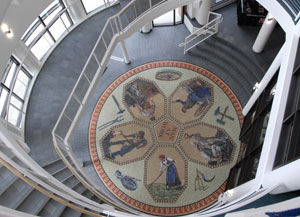 Atrium mosaic by Hans Dieter Tylle
 Rooftop sculpture garden


The Grohmann Museum collection contains over 2,000 European and American paintings, sculptures, and works on paper that depict various forms of labor. The objects reflect a variety of artistic styles and subjects that document the evolution of organized work, from manpower and horsepower to water, steam and electric power. The collection spans over 400 years of labor history (17th to 21st centuries).[3]

Earlier paintings depict handmade crafts and activities, while later images explore artists, craftspeople, and tradespeople during the Industrial and Post-Industrial Age. The collection also comprises 20th- and 21st-century paintings and sculpture addressing the paradoxes of industrialism and a machine-driven world. Some of these works were commissioned by factory owners to present favorable views of steel mills and foundries, yet some others adopt a grassroots approach to labor and social injustices. Most of the works in the collection were produced by German and Dutch artists, including German American painters from Wisconsin such as Carl von Marr and Richard Lorenz. A number of other European countries are also represented.
Since its opening, the museum has generated some controversy, particularly regarding links between some of the collection's artists like Erich Mercker (1891–1973) and the Nazi regime, the Eurocentric focus of the art on display, and Eckhart Grohmann's alleged history of anti-labor union positions.[9][10][11][12] In 2014, the museum addressed the specific concerns over Mercker's work for Nazi authorities in the exhibition "Erich Mercker: Painter of Industry". The accompanying catalogue acknowledged that, while the artist was "not fanatical", his decision to join the NSDAP was definitely motivated by antisemitism, a rejection of avant-garde artistic styles, and worries about unemployment in Germany.[13]
In 2015, the museum organized a retrospective exhibition of Carl Spitzweg's works in Milwaukee collections, which included nine paintings from the Milwaukee Art Museum.[14]
Gallery
edit Marten van Valckenborch, River Landscape with Iron Mining Scene, 1611
 Willem Drost, Geographer, 1655
 Carl Spitzweg, The Poor Poet, c. 1837-39
 Friedrich Paul Nerly, Transporting Marble to the Sculptor Thorvaldsen in Rome, 1860-70
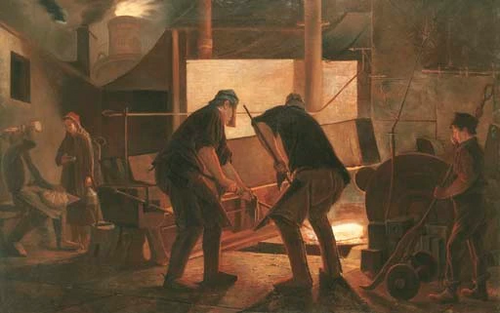 Eyre Crowe, The Forge, 1869
 Ludwig Knaus, Behind the Scenes, 1880
 Julien Dupré, The Hay Harvesters, c. 1880
 John George Brown, Extra, Extra (The Paper Boy), 1904
 Joseph Paul Vorst, Farm Workers, c. 1938
 Joe Jones, Railroad Workers, St. Louis, 1940
.jpg)

.jpg)


.jpg)


Exhibitions
editThe inaugural special exhibition Physicians, Quacks, and Alchemists, showed 17th century medical paintings and ran from October 27, 2007 to April 14, 2008.[15] Since then, the museum has hosted over 50 temporary exhibitions.[16]
List of Grohmann Museum Exhibitions |
|---|
|
References
edit- 1 2 3 "The Collection". Grohmann Museum. Retrieved March 12, 2025.
- ↑ "Grohmann Museum". Milwaukee School of Engineering - MSOE. Retrieved April 27, 2023.
- 1 2 Lawrence, Julie (October 11, 2007). "MSOE unveils new Grohmann Museum". OnMilwaukee. Milwaukee, WI: Andy Tarnoff. Retrieved July 19, 2025.
- ↑ "The history of MSOE's Grohmann Museum & the bronze statues that turn". WUWM 89.7 FM - Milwaukee's NPR. March 31, 2023. Retrieved March 12, 2025.
- ↑ Tanzilo, Bobby (May 29, 2014). "MPL gets the go ahead to discuss lending "The Bookworm" to Grohmann". OnMilwaukee. Milwaukee, WI: Andy Tarnoff. Retrieved July 19, 2025.
- ↑ Türk 2015, p. 14.
- ↑ Türk 2014, p. 312.
- ↑ "The Museum". Grohmann Museum. Retrieved March 12, 2025.
- ↑ Harty, Callen (April 8, 2019). "The Art of Labor". Belt Magazine. Pittsburgh, PA: Belt Media Collaborative. Retrieved July 19, 2025.
- ↑ Schumacher, Mary Louise (January 4, 2008). "WSJ blows it, ignores Nazi connection". Milwaukee Journal Sentinel. Milwaukee, WI: Gannett. Retrieved July 19, 2025.
- ↑ Schumacher, Mary Louise (December 5, 2014). "Grohmann Museum addresses life of controversial Nazi-era artist Erich Mercker". Milwaukee Journal Sentinel. Milwaukee, WI: Gannett. Retrieved July 19, 2025.
- ↑ Walzer, Joe (August 22, 2018). "Eckhart G. Grohmann". Immigrant Entrepreneurship. Milwaukee, WI: German Historical Institute. Retrieved July 19, 2025.
- ↑ Jung, Patrick J.; Stahnke, Carma M. (2014). Erich Mercker and Technical Subjects: a Landscape and Industrial Artist in Twentieth Century Germany. Milwaukee, WI: MSOE Press. pp. 52–56. ISBN 978-0972804417.
- ↑ Türk 2015, p. 5.
- ↑ Edinger, Kerensa (November 1, 2007). "The Art of Work". Urban Milwaukee. Milwaukee, WI: Dave Reid. Retrieved July 19, 2025.
- ↑ Lazaga, Debbie (January 23, 2024). "Museum Days 2024: The Grohmann Museum highlights the evolution of organized work". WTMJ. Milwaukee, WI: Good Karma Brands. Retrieved July 21, 2025.
- ↑ Brozek, Jim (2013). A Working Ranch. Milwaukee, WI: MSOE Press - Grohmann Museum. ISBN 978-0980093391.
Bibliography
edit- Türk, Klaus (2009). Sculptures of Workers: Figures from the Grohmann Museum. Milwaukee, WI: MSOE Press. ISBN 978-0980093346.
- Türk, Klaus (2014). Masterworks from the Grohmann Museum. Milwaukee, WI: MSOE Press. ISBN 978-0972804431.
- Türk, Klaus (2015). Carl Spitzweg in Milwaukee: Paintings from the Milwaukee Art Museum, the Eckhart G. Grohmann Collection, and the Grohmann Museum. Milwaukee, WI: MSOE Press. ISBN 978-0972804462.
External links
edit- Official website
- Virtual tour of the Grohmann Museum provided by Google Arts & Culture
 Media related to Grohmann Museum at Wikimedia Commons
