
Griseargiolestes eboracus is a species of Australian damselfly in the family Argiolestidae,[4] commonly known as a grey-chested flatwing.[5] It is endemic to eastern Australia, where it inhabits bogs.[6]
| Grey-chested flatwing | |
|---|---|
.jpg) | |
| Female Griseargiolestes eboracus | |
Scientific classification  | |
| Kingdom: | Animalia |
| Phylum: | Arthropoda |
| Clade: | Pancrustacea |
| Class: | Insecta |
| Order: | Odonata |
| Suborder: | Zygoptera |
| Family: | Argiolestidae |
| Genus: | Griseargiolestes |
| Species: | G. eboracus |
| Binomial name | |
| Griseargiolestes eboracus | |
 | |
| Synonyms[3] | |
| |

Griseargiolestes eboracus is a medium-sized damselfly, black-green metallic in colour with yellow markings; adults have pruinescence on the body,[5] but not the tail.[7] Like other members of the family Argiolestidae, it rests with its wings outspread.[7]
Griseargiolestes eboracus appears similar to Griseargiolestes griseus which is found south of the Hunter River in New South Wales.
Etymology
editThe genus name Griseargiolestes combines the Latin griseus ("grey" or "pearl-grey") with Argiolestes, the name of a related genus. It refers to the pale pruinescence seen in this group.[8]
The species name eboracus is derived from Ebor, New South Wales, where the species was first recorded, and the Greek suffix -ακός (-akos, "belonging to").[9]
Gallery
edit Female
 Female from above
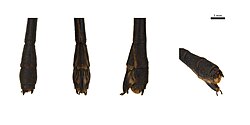 Tip of female tail
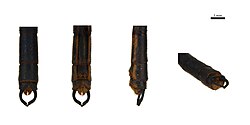 Tip of male tail
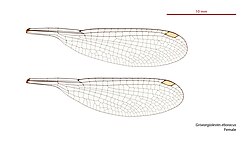 Female wings
 Male wings
.jpg)
.jpg)
.jpg)
.jpg)
.jpg)
.jpg)
See also
editReferences
edit- ↑ Dow, R.A. (2017). "Griseargiolestes eboracus". IUCN Red List of Threatened Species. 2017 e.T87532439A87534016. doi:10.2305/IUCN.UK.2017-1.RLTS.T87532439A87534016.en. Retrieved 20 November 2021.
- ↑ Tillyard, R.J. (1913). "On some new and rare Australian Agrionidae (Odonata)". Proceedings of the Linnean Society of New South Wales. 37 (1912): 404–479 [413]. Bibcode:1913PLSNS..37..404T. doi:10.5962/bhl.part.22352 – via Biodiversity Heritage Library.
- ↑ Paulson, D.; Schorr, M.; Abbott, J.; Bota-Sierra, C.; Deliry, C.; Dijkstra, K.-D.; Lozano, F. "World Odonata List". OdonataCentral. University of Alabama. Retrieved 3 April 2026.
- 1 2 "Species Griseargiolestes eboracus (Tillyard, 1913)". Australian Faunal Directory. Australian Biological Resources Study. 2022. Retrieved 1 November 2024.
- 1 2 Theischinger, Günther; Hawking, John (2006). The Complete Field Guide to Dragonflies of Australia. Collingwood, Victoria, Australia: CSIRO Publishing. p. 48. ISBN 978-0-64309-073-6.
- ↑ Theischinger, Gunther; Endersby, Ian (2009). Identification Guide to the Australian Odonata (PDF). Department of Environment, Climate Change and Water NSW. p. 216. ISBN 978-1-74232-475-3.
- 1 2 Watson, J.A.L.; Theischinger, G.; Abbey, H.M. (1991). The Australian Dragonflies: A Guide to the Identification, Distributions and Habitats of Australian Odonata. Melbourne: CSIRO. ISBN 0-643-05136-8.
- ↑ Endersby, I. (2012). "Watson and Theischinger: the etymology of the dragonfly (Insecta: Odonata) names which they published". Journal and Proceedings of the Royal Society of New South Wales. 145 (443 & 444): 34–53 [41]. doi:10.5962/p.146542. ISSN 0035-9173 – via Biodiversity Heritage Library.
- ↑ Endersby, Ian (2012). "Etymology of the Dragonflies (Insecta: Odonata) named by R.J. Tillyard, F.R.S." Proceedings of the Linnean Society of New South Wales. 134: 1–16.
