
Erythrina afra, the coast coral tree or African coral tree (historically also the kaffir tree), is a tree native to southeastern Africa, which is often cultivated and has introduced populations in California and India.[3][4] All the 17 species of coral tree in the genus Erythrina are collectively considered the official tree of Los Angeles, California in the United States.[5]
| Erythrina afra | |
|---|---|
 | |
| Growth habit of a mature tree | |
Scientific classification  | |
| Kingdom: | Plantae |
| Clade: | Embryophytes |
| Clade: | Tracheophytes |
| Clade: | Spermatophytes |
| Clade: | Angiosperms |
| Clade: | Eudicots |
| Clade: | Rosids |
| Order: | Fabales |
| Family: | Fabaceae |
| Subfamily: | Faboideae |
| Genus: | Erythrina |
| Species: | E. afra |
| Binomial name | |
| Erythrina afra | |
 | |
| Erythrina afra distribution
Extant (resident) | |
| Synonyms[2] | |

Description
edit
Erythrina afra is a medium to large deciduous tree. It grows in coastal bushes and riverine forests along the southeastern coast of South Africa and up into Zululand.
Leaves
edit
The compound leaves are made up of three leaflets. Each leaflet is broadly ovate to elliptical. The leaflets do not have prickles and are hairless.
Flowers
edit
The flowers are made up of a main petal and four small petals. The main petal curves back to expose the stamens. The flower colour is warm red to scarlet. This is one of the main differences between Erythrina affra and Erythrina lysistemon. The flowers form stalked axillary racemes up to 100mm long.
Trunk
edit
The bark on the plant or tree is relatively smooth with intermittent thorns, and the thorns tend to be sharper on younger branches.
Taxonomy
editThe original etymology of the species name caffra is related to kaffir, originally an Arabic term for unbeliever, but later an ethnic slur towards black people in parts of Africa. At the July 2024 International Botanical Congress, a vote was held with the result that "caffra" related names will be emended to afra related ones at the end of July 2024.[6]
Gallery
edit Close-up view, showing leaf arrangement, shape and size
 View of trunk showing prickles
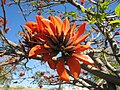 Inflorescence
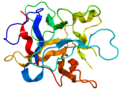 Trypsin inhibitor isolated from the seeds of Erythrina caffra


References
edit- ↑ Botanic Gardens Conservation International (BGCI) & IUCN SSC Global Tree Specialist Group (2020). "Erythrina caffra". IUCN Red List of Threatened Species. 2020 e.T146457362A146457364. doi:10.2305/IUCN.UK.2020-2.RLTS.T146457362A146457364.en. Retrieved 23 July 2024.
- ↑ "Erythrina caffra Thunb". Plants of the World Online. Royal Botanic Gardens, Kew. Retrieved 23 July 2024.
- ↑ "Erythrina caffra". ILDIS World Database of Legumes, version 10.01.
- ↑ Advisory Committee on Technology Innovation, Board on Science and Technology for International Development, Commission on International Relations, National Research Council (1979). Tropical Legumes: Resources for the Future. National Academy of Sciences. p. 258.
- ↑ Advisory Committee on Technology Innovation, Board on Science and Technology for International Development, Commission on International Relations, National Research Council (1979). Tropical Legumes: Resources for the Future. National Academy of Sciences. p. 258.
- ↑ McKie, Robin (2024-07-20). "Botanists vote to remove racist reference from plants' scientific names". The Observer. ISSN 0029-7712. Retrieved 2024-07-21.
External links
edit

- Werner Voigt Kirstenbosch (October 2006). "Erythrina caffra Thunb". South African National Biodiversity Institute. Archived from the original on 2012-10-06. Retrieved 2008-11-04.
 | This Phaseoleae-related article is a stub. You can help Wikipedia by adding missing information. |