
Epoca ("The Epoch") was a Romanian daily newspaper, published from Bucharest (and occasionally from Iași) in multiple series between 1885 and 1938. Until just before World War I, it was a mouthpiece of the Conservative Party, but more closely adhered to the fluctuating views of its owner, Nicolae Filipescu. As such, the paper was initially staffed by populists such as Barbu Ștefănescu Delavrancea and Alexandru Vlahuță, both of whom were sacked by Filipescu in 1886; though he maintained their neo-romantic approach to literature, he did not appreciate their extolling of the peasant class, nor their recurring conflict with the Junimea faction. Shortly after, Epoca merged into the Junimist paper, Constituționalul, only to reemerge as an independent publication in 1895. The patron changed several editorial teams, until finding Alexandru Antemireanu as his mainstay. Filipescu also combined Junimism with national conservatism, and his mix was adopted to varying degrees by his writing staff. As such, in the 1890s Epoca hosted articles by Ion Luca Caragiale, whose critique of the National Liberal Party came to border on xenophobia.
 Masthead in February 1926 | |
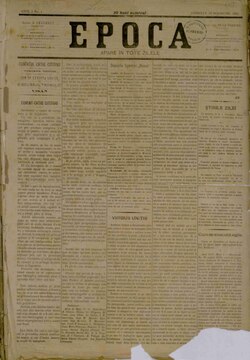 First-ever issue of Epoca, 16 November 1885 | |
| Type | Daily newspaper |
|---|---|
| Format | Broadsheet |
| Owner | Grigore Filipescu (last) |
| Founder | Nicolae Filipescu |
| Founded | 16 November 1885 |
Ceased publication | 15 July 1938 |
Political alignment |
|
| Language | Romanian |
| Headquarters | Clemenței Street 3, Bucharest (1885) Astoria Hotel, Calea Victoriei, Bucharest (1926) |
| City | Bucharest |
| Country | Kingdom of Romania |
| Circulation | 15,000 (as of 1936) |
In the period leading up to World War I, Epoca, directly managed by Timoleon Pisani, fused together the various currents of Romanian nationalism, and allowed Nicolae Iorga to publish his right-wing critique of Junimea. It was however staunchly opposed to left-nationalists and Poporanists such as Constantin Stere. Filipescu's uncompromising positions on such topics made the editorial offices vulnerable to penetration by spies from the Russian Empire (Gheorghe V. Madan, and later Ilie Cătărău), who embraced its counterrevolutionary narrative while diverting nationalism exclusively against Russia's opponents. Concerned about the fate of Romanians in Austria-Hungary, and increasingly supportive of Greater Romanian unification, Filipescu split with the Conservative and the Junimists by favoring the Entente powers. The newspaper followed suit, publishing content that excoriated the "Germanophiles" and calling for war with the Central Powers. It openly celebrated when Romania joined the Entente, but went under during the paralyzing counteroffensive of 1916–1917; Filipescu himself died in that interval.
Epoca was revived in 1918, shortly before the actual establishment of Greater Romania, by Nicolae's son Grigore Filipescu; when his personal resources were exhausted, funding mainly came from banker Aristide Blank. Reduced in content and attracting less familiar writers, it was largely used by Filipescu Jr in airing his political opinions, and from 1929 was an official paper of his Vlad Țepeș League. It embraced a monarchist vision that was centered on the exiled Prince Carol, exulting as he returned on the throne in June 1930. For the rest of its existence, Epoca began slipping away from the Carlist camp, criticizing governments for their debt relief policies, and ultimately chiding the king's own camarilla. It was briefly infiltrated by fascists such as Gheorghe Beza, and embarrassed by the latter's engagement in political violence; while still nationalistic, it emerged as highly critical of Fascist Italy, Nazi Germany, and the local Iron Guard. It finally went under due to restrictions imposed by Carol's authoritarian constitution, with all prospects of revival exhausted when Filipescu died later in 1938.
First editions
editEpoca emerged on 16 November 1885,[1] shortly after the coagulation of a conservative camp within the newly-formed kingdom's two-party system, whose other component was the National Liberal Party (PNL). Its initial editorial staff was made up of Grigore Păucescu (as political editor), Barbu Ștefănescu Delavrancea (as first editor), Nicolae Filipescu, Alexandru Vlahuță, and some others.[2] At the time a young conservative journalist, Constantin Bacalbașa claims to have observed the real power-relations. In his reading, the paper belonged to Filipescu in all but name, while Păucescu and Delavrancea were his "props".[3] This view was partly contradicted by Delavrancea's own account—he notes having been involved in discussions to create the paper (going back to October 1885), and explains that he was morally opposed to the PNL.[4] The young writer was also strongly committed to Epoca, and in one instance dueled Alexandru Djuvara of L'Indépendence Roumaine in a sword-fight; it ended with no casualties when Djuvara stated that was getting too tired.[5] Also debuting at Epoca in the 1880s, Alexandru Davila recalled that Filipescu was the paper's financial provider, with smaller sums sent in by his three associates—Leon Ghica, Constantin Hiott, and Alexandru A. Balș.[6]
In this first edition, the newspaper had ample literary columns. As observed by scholar Remus Zăstroiu, these illustrated Delavrancea and Vlahuță's shared taste for neo-romanticism, with only some traces of literary naturalism; with Epoca, Vlahuță mocked Alexandru Macedonski's aestheticism, while airing his own critique of the Romanian monarchy, and of the competing PNL, in a number of poems and articles.[7] As author of the satirical column Cronice, Dimitrie R. Rosetti was embracing the Conservative program, and ridiculing the PNL's views on society.[7] Literary historian Florin Faifer calls these pieces "brutal jibes", "of doubtul taste", and too focused on commentary about his adversaries' physical attributes.[8] The ideological mix was also found in the supplement Epoca Ilustrată, which was put out for a while after 1 January 1886; it had contributions by Mihai Eminescu, Bogdan Petriceicu Hasdeu, Titu Maiorescu, and Iacob Negruzzi.[7] The newspaper staff indirectly witnessed Eminescu's physical decline and loss of mental stability: as Epoca's parliamentary reporter, Davila attended the 1888 Assembly session which provided Eminescu with a disability pension.[9]
At that stage of his career, Filipescu generally approved of the anti-monarchist line; he too was a critic of King Carol I, seeing him as a PNL stooge.[10] However, the Delavrancea wing of the staff created embarrassment within the Conservative caucus, since it always supported the sharecroppers over the landowners. As Delavrancea puts it: Eu dam întruna cu țăranii și lor le ardea de altceva ("I would always side with the peasants, and they were not in the mood for that").[4] He was also airing his disputes with the Conservative internal faction, Junimea, which had rejected him. Several of his articles contained jibes at the Junimist leader, Titu Maiorescu.[11] Filipescu took full control in early 1886, when he was announced as both owner and manager—pushing out Delavrancea and Vlahuță, and, from September, hiring Grigore Ventura to be the head editor.[7] Ventura was additionally the theatrical columnist, but, in his absence, that role was fulfilled by Davila.[6]
The first editorial office was at No 3 Clemenței Street, in a building shared with Heliadi's print shop[12] and located just outside Păucescu's villa (on grounds later covered by the Central University Library).[13] Bacalbașa suggests that Epoca was "the most widely read political newspaper", with content that was secretly authored by Filipescu; the newspaper's very creation helped exacerbate political tensions—mounting the most competent opposition to the PNL and its Brătianu cabinet.[3] The Clemenței Street offices were said to have been raided by government supporters in June 1886, and its staff writer Emil A. Frunzescu was reportedly assaulted during that incident. The issue was brought up in the Assembly of Deputies by Nicolae Ionescu, of the Sincere Liberals opposition group, who spoke for more than three hours. Ionescu paid homage to Epoca as "the dignified organ of the young conservatives".[14]
During September 1886, after an assassination attempt targeting Prime Minister (and PNL chairman) Ion C. Brătianu, his incensed partisans raided Epoca and brutalized its on-call editor, Thoma Bazilescu, before moving on to attack other opposition gazettes. An inquest by the examining magistrates concluded that government had ordered street sergeants not to intervene, allowing the assailants to "do as they pleased".[15] Filipescu's hands-on approach was again manifested in 1887, when he and his Epoca staffer A. A. Balș invaded the home of a National Liberal rival, Nicolae Xenopol, and were only chased out at gunpoint. Both assailants were tried for this misdemeanor, and only freed by an amnesty, some three months into their sentence.[5] Shortly after, the offices of both Epoca and L'Indépendence Roumaine were vandalized by their respective opponents.[16]
Caragiale's tenure
edit
During the legislative elections of October 1888, two members of Epoca's staff, Bazilescu and Milone Lugomirescu, were reportedly considered as candidates for the Junimea caucus, within the larger Conservative alliance.[17] The vote secured gains for the alliance, and instituted Junimist power under the second Rosetti cabinet. In that context, however, Filipescu sparked intrigues against Dumitru Brătianu's Liberal Democratic faction, which had helped defeat the PNL as part of a government arc.[10] As summarized by the cultural historian Z. Ornea: "[By 1888] the Junimists had engineered the gradual takeover of N. Filipescu's Epoca group. This poaching was not without prudent reservations on Filipescu's side [...]."[18]
On 14 June 1889, Epoca merged with Junimea's România Liberă to become Constituționalul ("The Constitutionalist").[19] Absorbed by his activities as Mayor of Bucharest, Filipescu drifted apart from Junimists Maiorescu and Petre P. Carp after elections in March 1892, incensed that their role within the Catargiu administration included measures against economic nationalism.[20] The standalone Epoca was revived on 2 November 1895—an undertitle was added, clarifying its status as a "conservative newspaper" (ziar conservator).[3] Filipescu was again sole editor, remaking Epoca into a modernized newspaper that was closely based on its French counterparts.[21] At the time, he was recruiting among former left-wingers, personally negotiating for George Panu and his Radical Party to be welcomed into Conservative ranks.[10]
From November 1895 to March 1896, Filipescu had the former socialist Anton Bacalbașa as his chief editor, but, Zăstroiu notes, the latter's activity was minimal: as Demagog, he produced editorials that bordered on lampoons.[7] Afterwards, Filipescu resumed his sway over the editorial line, turning it toward national conservatism, which implied borrowing from the far-right of Romanian nationalism. As Zăstroiu notes, the inspiration for this transition was foreign, since Filipescu had read Ferdinand Brunetière.[22] Ion Luca Caragiale, the celebrated humorist and dramatist, also joined the staff. He had previously worked for George D. Pallade at Gazeta Poporului (where his assignments included habitually mocking Filipescu), but had then joined Panu's Radicals.[23] Initially made Epoca's political editor, he was thereafter manager of the literary sections.[24]
Caragiale's leading work for Epoca was a set of biographies of political figures that he either liked or despised. The former category included a young Conservative, Take Ionescu, who was becoming Caragiale's favorite.[23] He also contributed a series of satirical texts that mostly targeted the PNL. According to literary historian Marin Bucur, it showed Caragiale at his most xenophobic: despite being himself Greek, he spoke at length of the National Liberals as "the filth of the Phanar".[25] According to Bucur, Caragiale may have been stopped by Filipescu from mocking the PNL regarding their main proposal of the time, namely a law mandating the six-day workweek; he compensated by lampooning that proposal in Nicolae Fleva's newspaper, Dreptatea, which was also A. Bacalbașa's new workplace.[26] Also recruited in 1897, Timoleon Pisani was editor of international news. His first celebrated scoops came during that year's Greco–Turkish War, which he covered from Athens.[27] He too was of Greek origin; in his encounters with Caragiale, he provided him with literary subjects from the Sublime Porte. As part of these exchanges, Pisani observed that his older colleague could not speak Greek, despite it being his ancestors' language.[24]
Epoca was becoming more relevant as a literary publication, with this aspect handled by Alexandru Antemireanu (until 1903) and (only in 1897) by Ștefan Octavian Iosif. Antemireanu was highly supportive of Junimea, citing Maiorescu and Eminescu as his two main sources of inspiration,[7] and prolonging their polemics with Macedonski.[28] He combined these stances with echoes from Brunetière, which became explicit in his controversial series of articles about the "debacle of science".[29] For a while beginning in April 1896, the literary content was largely confined to a weekly supplement, Epoca Literară. Though it closed down in June, it is noted locally for having had Caragiale as its caretaker—with Antemireanu and Iosif as his deputies. During its ten-issue run, it featured commentary by Caragiale and Panu—the former advocated for professionalism in writing, exposed plagiarism, and added biographical sketches on authors he admired (such as Cilibi Moise).[30] For his part, Panu suggested that young writers needed to research their Romantic-era predecessors (whose work was regularly sampled over the other pages), and condemned Eminescu as a negative influence.[31] Caragiale insisted on obtaining a permament collaboration from Constantin Rădulescu-Motru, with both of them writing pieces that mocked the "pathological literature" of George Ionescu-Gion.[32] The Epoca Literară circle of contributors additionally included Delavrancea, Iosif, George Coșbuc, Anghel Demetriescu, Petre Dulfu, and Alceu Urechia.[31] Epoca Literară also hosted poetry by a young Jewish poet, Alexandru Toma (born Solomon Moscovici, he got his pen name from Caragiale).[33]
Late-1890s disputes and decline
edit
When Epoca ended its supplement and refused its literary pages into the core newspaper, its more or less regular contributors were Coșbuc (with notes on paremiology), Gheorghe V. Madan (with reviews covering Russian literature), François Robin (with an overview of France–Romania relations), Theodor Speranția (as literary historian and education columnist), and Oscar Spirescu (as a music critic).[7] From 1897, Epoca hosted Panait Cerna[34] and Dumitru Karnabatt,[35] with some of their first-ever literary productions. Zăstroiu also identified the young authors Tudor Arghezi and Gala Galaction as sharing the pen name Matei Corbora, which was used for a set of art chronicles in 1898.[36] In 1897, Epoca hosted Caragiale's in-depth reportage, O cercetare literară, which probed the main currents in Romanian literature during the fin de siècle, dividing them into "naturalistic", "romantic", and "idealistic".[7]
Fiction in prose form was contributed by Antemireanu and Caragiale, by Caragiale's former enemy Ionescu-Gion, and likewise by Ioan A. Bassarabescu and Emanuil Grigorovitza.[37] Coșbuc, Iosif, and Speranția also used Epoca for publishing new poetry, as did others—including Alexandru Obedenaru, D. Nanu, Radu D. Rosetti, Nicolae Mihăescu-Nigrim, and Vasile Podeanu.[7] At that stage, Epoca had a humorous page, with contributions by Nae Dumitrescu Țăranu.[38] Especially through Antemireanu, Epoca had near-daily translations of sketch stories by François Coppée, Leconte de Lisle, Catulle Mendès, François de Nion, Paul Rouget, and various other French authors; through Madan and others, it extended its international coverage—publishing pieces by Nikolai Gogol, Heinrich Heine, Sándor Petőfi, Henryk Sienkiewicz, and Leo Tolstoy.[36]
In early 1897, as the PNL formed its second Sturdza cabinet, Epoca rallied with its critics. In April, after clashes between police agents and opposition groups, the authorities arrested the paper's proofreader, Atanase Ranetti-Picolo. The latter was defended by the Junimist daily, Timpul, as an innocent bystander.[39] As members of the Epoca staff, Antemireanu and Vasile Demetrescu-Brăila joined in the nationalist agitation, which brought them into collision with Interior Minister, Mihail Pherekyde. According to Pherekyde's own report, in December 1897 the two men led a protest by the Cultural League for the Unity of All Romanians, which degenerated into violence after unidentified civilians tore apart the League's tricolor flag.[40] In summer 1898, Romania prepared for a golden jubilee of the Wallachian Revolution of 1848, transformed by government into a state-sponsored celebration of liberal ideology. Epoca opposed that trend, and, especially through Antemireanu, began publishing evidence about the forgotten, more conservative, contributors to the revolution, in particular Ion Heliade Rădulescu.[41] Now firmly on the right of the political spectrum, Epoca was the first paper to call for an intervention against the Social Democratic Workers' Party, which was organizing "peasant clubs" to increase its share of the vote.[42]
By 1898, Epoca was losing its previous team of writers, beginning with Caragiale. As recounted by Toma, Caragiale could not stomach Filipescu's antisemitism, which had come to target Caragiale's other Jewish friend, Ronetti Roman; when he left, it was to set up his own review, Calendarul Dacia, which republished his Epoca articles.[43] This period also witnessed Filipescu's 1899 duel with Emanoil Lahovary, who had criticized him in an editorial piece for L'Indépendence Roumaine.[44] The Epoca owner killed his rival, and was subsequently six-months imprisonment[45] at Văcărești.[46] Maiorescu privately jubilated, since Filipescu's neutralization served Junimea's interests. Commenting on this issue, Ornea observes that Filipescu was indeed in "an inevitable eclipse" after that moment.[47]
Between Pisani and Maiorescu
editOn 7 July 1900, Filipescu became Minister of Agriculture in the First Carp cabinet, and was obliged by law to sell of his interest in the paper; Pisani became the nominal owner.[48] At the same time, Alexandru Marghiloman, who was emerging as leader of the Conservative faction, personally sent notes about the party's congresses of 1901–1911, which Pisani then published as unsigned reportage pieces or opinions.[49] In 1900–1904, the Junimist art historian, Alexandru Tzigara-Samurcaș, held a permanent chronicle in Epoca. Here, he discussed art exhibits by artists ranging from Nicolae Grigorescu to Arthur Verona, supported reconstruction on Stavropoleos Church as a "national museum", and engaged in a bitter polemic with rival scholar Grigore Tocilescu—against whom he also filed a criminal complaint.[50]
For a while during the early 1900s, the Junimists parted ways with the Conservatives, seeking to establish themselves as powerbrokers. Filipescu drew suspicion from opposition groups, on the Conservative right as well as on the populist left, that he was being protected by the third Sturdza cabinet, and as such friendly toward the PNL. A May 1902 attack on the opposition journal Adevărul was blamed by such critics on Antemireanu and Filipescu, seen in that context as government stooges.[51] In November 1903, Pisani leased Epoca to a triumvirate of Junimists: Filipescu, Maiorescu, and Marghiloman.[52] Maiorescu made special efforts to control the editorial line, assigning editorial work to Alexandru G. Florescu. Already in December 1903, Maiorescu declared himself satisfied that Epoca was a fully Junimist institution, with ideologically convenient contributions by Delavrancea,Stavri Predescu, Tzigara-Samurcaș, Emanuel Antonescu, Constantin C. Arion, Mihail Dragomirescu, George Ranetti, Constantin Litzica, and Simion Mehedinți.[53] More in detail, however, Epoca illustrated tensions between the club's inner groups, particularly after Dragomirescu used it for a series of articles that praised Ronetti Roman in terms that ended up annoying other Junimists.[54]
The Junimist deal lasted for exactly a year, after which Pisani resumed full control of the paper.[55] At that stage, Nicolae Iorga was the paper's leading writer on literary topics, while Octavian Goga had a long series of articles which supported the emancipation of Romanians in Transylvania and other parts of Austria-Hungary.[56] During his tenure (March–October 1902), Iorga made it clear that he intended to make Epoca into an organ of "Romanianism" and "new nationalism", explicitly directed against Junimea's penchant for cosmopolitanism.[57] A similar line was followed by the young Epoca journalist G. Ranetti, with a series of articles that praised nationalist students for boycotting French-language plays at the National Theater Bucharest.[58]
In 1904, the writing staff was joined by other young literary critics: Eugen Lovinescu, with articles that were later collected as Pași pe nisip ("Footsteps on Sand"),[59] Petre V. Haneș,[60] and D. Ionescu-Morel.[61] Also then, as a feuilleton, Epoca was putting out Radu Rosetti's debut historical novel, Cu paloșul.[62] In 1905–1907, there was another visible rapprochement between the Filipescu–Pisani group and the mainline Junimea, leading historian Vasile Liveanu to describe Epoca as a "Junimist newspaper".[63] In that context, it hosted a political essay by the Junimist historian Teohari Antonescu, as Lupta și credința noastră ("Our Combat and Credo"). This text was ridiculed on behalf of the Conservatives by Lascăr Antoniu, who argued that its "pompous" verbiage clashed badly with the Junimist tradition of concise lucidity.[64]
1907 revolt and aftermath
edit
During 1907, as a show of opposition to the Second Cantacuzino cabinet, Epoca also serialized an essay by Vasile Kogălniceanu. The latter was proposing a gradual land reform that would have reduced the estates of Conservative landowners while empowering the sharecroppers, he was soon after arrested as an alleged instigator of the large-scale peasant uprising.[63] In leftist circles, Filipescu and Epoca were also suspected of having set up the republican magazine Protestarea, in turn seen as duping "the popular masses" into voting the Junimea way. Managed by G. Ranetti, Protestarea reportedly failed to convince its target audience, and was closed down by Filipescu in mid-1908.[65]
From September 1909, Epoca was at the center of a national scandal that tested the attitudes of Romanian nationalists in regard to the Russian Empire. At the time, Romania had taken in many Romanian-speaking refugees from the Russian Empire—generally identified as Bessarabians, due to mostly originating in the Bessarabia Governorate, a Romanian-speaking irredenta. Epoca's own staff included the Bessarabian Madan, though, unbeknownst to his colleagues, he was an agent provocateur of the Russian secret police.[66] Acting in conjunction with Pavel Krushevan, Madan publicized claims that Constantin Stere, who represented the PNL's Bessarabian faction, had defrauded the Zemstvo of Kishinev.[67] The PNL's own Viitorul hosted Stere's responses, as well as other articles, which questioned Madan's own reputation. These also observed that, at Epoca, Madan was circulating opinions that agreed with the tenets of Tsarist autocracy, in that he was describing Stere as a radical enemy of social order.[68] Madan himself proudly admitted that he was being employed by the imperial censorship apparatus in vetting Romanian books for circulation in Bessarabia.[69]
At around the same time, Epoca was giving ample exposure to the novelist and polemicist Duiliu Zamfirescu, with articles supporting the classical Junimist take on culture (which favored art for art's sake) and openly mocking Stere's "Poporanism" (which insisted on social realism and didacticism).[70] The Bessarabian scandal was followed by agents of Romania's own secret police, the Siguranța, who expressed amazement that Filipescu's publication, "which likes to parade its nationalism", had even hosted Madan's pieces. Such sources speculated that Filipescu had been blinded by his rage toward the PNL.[71] Epoca also contradicted its own nationalist agenda in October 1910, when it aired G. Ranetti's response to his Transylvanian critic, Liviu Rebreanu. Though Rebreanu had only commented on Ranetti's mistakes as a translator, the latter responded with a personal attack, and in the process suggested that the Austro-Hungarian authorities had been right to detain Rebreanu. The article greatly affected Rebreanu's reputation, and he was always disappointed with Ranetti.[72]
Additionally, Filipescu and Epoca were turning against other left-wing factions: in October 1909, they denounced unionizers at the Romanian Railways Company, depicting them as "anarchists", and tracing their links to the socialist Christian Rakovsky. Such claims were answered on behalf of the workers by Dimitrie Marinescu, who called Epoca a "reactionary rag", suggesting that it aimed to get the PNL to do its job in quashing unionization.[42] The paper was itself hit by the mounting wave of unionist activity. In June 1910, the workers at Gheorghe Ionescu's print shop, who were putting out Epoca, suddenly went on strike, demanding increased pay. This resulted in Epoca issuing a single-page issue for 22 June; upon reappearing in a full-content form, it denounced the six-day week as a dangerous innovation.[73]
In 1910–1912, Filipescu was serving as Minister of War in the Junimists' second Carp cabinet. In that context, he vexed the Conservative base, as well as King Carol, by openly discussing (including with interventions in Epoca) the 1907 revolt and its death toll. Opinia daily, which spoke for Take Ionescu's new Conservative-Democratic Party (PCD), quipped that Filipescu was not, as expected, a "civilian minister of war", but rather a "minister of civil war".[74] Pisani also gained more exposure as a politician after the elections of March 1911, when he took a seat in the Assembly of Deputies.[75] His newspaper grew more prosperous after accepting a stipend from the extremely rich Conservative landowner, Gheorghe Grigore Cantacuzino.[12] In 1912, the editorial staff working under Pisani was made up of: Constantin Gongopol (as editorial secretary), Barbu Voinescu, P. Macri, Ranetti-Picolo, Rudolf Uhrinowsky, M. Conitz, and C. Deleanu; N. Ținc was the proofreader.[12] New contributors included a dramatist and theater columnist, A. de Herz.[76] That July, after coordinating with Tzigara-Samurcaș, Epoca's writers managed to interrupt the project to rebuild Bucharest City Hall, accusing architect Petre Antonescu of having obtained it illegally.[77] Filipescu was still a target of Russian interference: also in 1912, Epoca hired another Bessarabian, Ilie Cătărău, who was a double agent for Russian intelligence and the Siguranța; he was the paper's correspondent in Serbia, sending back notes about the First Balkan War.[78]
World war
editFilipescu's nationalists and classical conservatives (who were now led by Maiorescu, Marghiloman, and other members of Junimea) disputed each other over control of Epoca; affiliates of the former camp were increasingly critical of the Junimist support for an alliance with the Central Powers. Pisani always allowed ample coverage to Filipescu's divergent opinions, which mentioned the distress of Romanians in Austria-Hungary—primarily those of Transylvania.[79] Cătărău took his commitment further, and is widely seen as responsible for two bomb attacks on Hungarian soil, one of which killed several people in Debrecen. Journalists beginning with Em. C. Grigoraș see him as acting on behalf of warmongers, who finally got their wish with the assassination at Sarajevo.[78]
The clash of geopolitical visions was exacerbated after the outbreak of hostilities in mid-1914. As Romania maintained neutrality, public opinion was sharply divided between those who endorsed the Entente and those who campaigned for neutrality or, as "Germanophiles", for engagement alongside the Central Powers. Initially, Epoca gave coverage to both sides of the debate; in August 1914, when he had been appointed head of the Romanian Red Cross, Marghiloman asked Pisani to host an homage to Disconto-Gesellschaft of Imperial Germany, which had agreed to sponsor his humanitarian effort.[80] Over the following months, Marghiloman was emerging as the leading Germanophile, while the other Epoca men were openly pro-Entente. Marghiloman had a publicized and increasingly vitriolic dispute with Pisani, which almost resulted in the two of them dueling each other in May 1915.[81]
Epoca found itself on the same side of the dispute as Adevărul—both institutions popularized Goga's views on the Transylvanian question, and both were being chided for this by the neutralists at Ziua. In April 1915, Ziua suggested that both Ententist newspapers were essentially "Russophile"; it also observed that Goga's excoriations were exclusively aimed at Marghiloman—even though the neutralist line was also tacitly favored by the PNL and its government team.[82] On 15 June, Epoca hosted an appeal, signed by Goga and Octavian Codru Tăslăuanu. The two Transylvanians asked their fellow Romanians to seize the moment, attack Austria-Hungary, and complete "the political unity of the Romanian nation" (or "Greater Romania").[83] Also around that time, Filipescu established the "National Action", an Ententist pressure-group, also joined by Epoca journalist Barbu Voinescu[84] and by Constantin Argetoianu, who now began his own involvement with that paper.[85] The coalition also counted on Avram Imbroane, who had fled the Banat in 1914. With his articles in Epoca and his speeches at Filipescu's rallies, he similarly argued for participation and annexation.[86] This association then fused into the PCD, which became the "Conservative-Nationalist" group.[87]
Epoca sponsored Gabriel Dichter, a Frenchman who supported the Ententist cause, to serve as its special envoy in Paris.[88] Some early contributors returned to Epoca in 1915, as with the aged Delavrancea. He was mocked in the left-wing magazine Chemarea as having revealed diplomatic secrets in his political contributions to Filipescu's paper.[89] Delavrancea's last-ever story, Vacanție, appeared in Epoca's April 1916 feuilleton.[90] In July 1916, Epoca published a letter to Marghiloman, supposedly from an Austrian politician identified as "N. Hruschka". Denounced by Marghiloman himself as an "idiotic" forgery, it aimed to expose intrigues that existed at the heart of the Conservative Party, and to recruit Constantin C. Arion for the Entente.[91] A month later, with articles in Epoca, Filipescu was focusing his ire on his former Junimist patron, Petre P. Carp, who was putting out Moldova, a Germanophile periodical.[92] Just shortly after, following ratification of a treaty with the Entente, Romania declared war on the Central Powers. Epoca openly celebrated with a special edition, which claimed that Marghiloman had been heckled by enthusiastic Bucharesters.[93] In the initial phases of the war, Romania made gains in Transylvania. Among the younger Epoca staff, Paul Costin volunteered for the front, and fought with distinction at Porumbacu, after which he withdrew with the Land Forces.[94]
Later in 1916, the neutralists and Germanophiles appeared vindicated, as southern Romania was invaded and occupied by the Central Powers. Filipescu died just shortly after, in October—personally affected by the loss of Turtucaia.[12] In that context, Junimists such as Carp, who remained in German-held territory, blamed him and his associates for the national crisis.[95] Epoca suffered as a consequence of its political agenda: it closed down on 22 November 1916, just as Bucharest was being besieged.[96] The Epoca staff traveled with the Land Forces into Western Moldavia, but the paper was not immediately revived there. By March 1918, Romania had sued for peace, and its administration was handled by Marghiloman's own Conservative-and-Germanophile cabinet. Pisani continued to own the Epoca trademark during the interval, but agreed to sell it to Grigore Filipescu in September 1918. Though the two men disagreed with each other on points of policy, Pisani thought it natural that the newspaper be returned its founders.[97]
1918–1926 revival
edit
A new series finally came out at Iași on 18 September 1918.[98] The country reentered the war in November 1918, shortly before the general armistice; this again reshuffled power in Romania, allowing the Ententists to return. Epoca, now partly handled by Eugen Titeanu (who also did its literary column, under the pen name of Stilet), moved back to Bucharest on 2 December 1918.[99] Its new editors included Raul Crăciun, who had been a prisoner of the Odessa Soviet Republic before reaching Iași in February 1919.[100] The staff made repeated efforts to recruit Pisani as a chief editor, but he declined—though he allowed his articles to be carried by his former daily.[97] He is known to have briefly returned as administrative director in 1922, directly intervening in educating other staff writers and ensuring that their articles were up to standards.[101]
By its own definition, Epoca was now a general-interest paper,[3] though its content was primarily political and partisan. Financed from Filipescu's personal fortune, its content was reduced to only four pages, of which three were its patron's various political polemics—a format that no longer changed for the rest of the paper's existence.[36] Additional support came from General Gheorghe Cantacuzino-Grănicerul, who is said to have spent whole days at the Epoca headquarters (shared with the Conservative Club), and from the aging politician Mihail "Mișu" Deșliu, who spent some of his own money on keeping the venture afloat.[101] Filipescu was eventually faced with a likely bankruptcy. He and his political associate Argetoianu made special efforts to obtain more funds, and ended up accepting stipends from financiers Aristide Blank and Jean Chrissoveloni. Since they also provided the latter two with political support, Argetoianu and Filipescu were confirmed on the administrative board of Marmorosch Blank Bank; that institution effectively owned Epoca.[102]
By 1922, the newspaper had been joined by a cartoonist, Ion Valentin Anestin, as well as by several young reporters, including Raul Anastasiu, Alexandru V. Cazimir, I. Șt. Ioachimescu, Titel Miciora, Mihail Munteanu, Mirel Ramiro Neculau, and Mircea Ștefănescu.[101] Epoca was briefly supportive of the right-wing People's Party (and criticized by Iorga as the "evening edition" of the Populists' own Îndreptarea).[103] However, it also clashed with that group in some instances, including in June 1920—when Zamfirescu, now a leading Populist, dueled Crăciun with pistols, over claims that he viewed as insulting.[104] The paper continued to be published in Bucharest to 19 August 1923. It had a hiatus that lasted until 2 February 1926.[105] According to Zăstroiu, this edition of Epoca, which had Filipescu Jr as its publisher, was almost entirely nationalistic in the mainstream form, with only vague mentions of conservatism; this followed Filipescu's own passage through the revived PCD, and then to the Romanian National Party.[36]
In his memoirs, journalist and publisher Pamfil Șeicaru observed that the newspaper owed all the popularity it still had to Filipescu's polemical articles, which were genuinely informed and well-written.[106] Political and literary content was blended in Alexandru Kirițescu's column, Balta cu broaște ("Puddle of Frogs"). In 1926, he responded there to claims made by the French communist Henri Barbusse, who had criticized Romanian efforts during the previous war.[107] Epoca was in print until 22 April 1926,[98] when the Averescu cabinet ordered it shut down. The reason cited for this measure was that Filipescu had used the paper to ridicule Miron Cristea, the Orthodox Metropolitan of All Romania.[108] The same issue riled up nationalist students organized as the "Christian League". On 18 April 1926, they devastated the paper's offices, which were then located on Calea Victoriei[109] (on grounds owned by Astoria Hotel).[16] Filipescu's tight association with Blank, who was Jewish, was drawing attention in antisemitic circles, where Epoca became known as a "kike" mouthpiece.[110]
1929 edition
editA final series came out on 5 February 1929, and resisted for almost nine years.[98] Upon relaunching the paper, its editors announced their readiness to defend it from any future censorship, even at gunpoint.[108] In this final avatar, Epoca was mostly a mouthpiece of Filipescu's new conservative party, originally known as the Vlad Țepeș League (LVȚ).[111][112] Epoca's main focus was on undermining the regency regime and the Știrbey cabinet, to whom Filipescu opposed the exiled Carol Caraiman. The threats of violent responses to government censorship failed to materialize, as Epoca was frequently suspended, or had its circulation confiscated, after specific and crude attacks on Barbu Știrbey, Ion I. C. Brătianu, and the Dowager Queen Marie.[108] The LVȚ was part of a caucus that eventually managed to obtain Caraiman's arrival on the throne, on 8 June 1930. The former exile deposed his own son Michael, and reigned as Carol II. The coup was immediately praised in Epoca by Radu Budișteanu, who declared that Carol would "put the house in order", "bring[ing] us peace and plenty."[113]
Immediately after Carol's seizure of power, both the LVȚ and Epoca were joined by Gheorghe Beza, who came in from the antisemitic Iron Guard. His arrival there alienated Budișteanu, who claimed to have left the newspaper after being slapped by Beza, whom Filipescu still would not fire.[111] Budișteanu also observed that Beza had turned Epoca into a "guttersnipes' club", and that, under his influence, the paper came very close to eulogizing the Iron Guard—a move that was only curbed through Filipescu's personal intervention.[111] Beza took charge of the LVȚ's youth wing, Tineretul Țepist, and, as he himself acknowledged in 1936, maintained a close relationship with the Guardists.[114] Just weeks later, Epoca was at the center of a national scandal, following Beza's attempt to shoot down a government official, Constantin Angelescu. Beza openly admitted his action, since he regarded Angelescu as a leading enemy of his own Aromanian community, though he indignantly rejected allegations (originating with Budișteanu) that he had also wanted to kill Constantin Stere.[115] During the resulting inquiry, examining magistrates took testimonies from Filipescu and from Epoca's editor, I. Manu.[115] In his more public response, Filipescu suggested reintroducing the death penalty and applying it to his disgraced employee. The proposal was dismissed as "extreme" by the left-wingers at Adevărul.[116]
During the last days of 1930, Filipescu intercepted and published in Epoca a letter from the German Ambassador Gerhard von Mutius, in which the latter defended Știrbey while criticizing Carol. Filipescu demanded a duel, describing von Mutius as the tool of German revisionism.[117] He himself had joined the new Carlist establishment, and, in this capacity, ensured that the monarch would marginalize Iuliu Maniu and his National Peasants' Party (PNȚ). As such, Epoca was for a while outstandingly critical of Maniu, though he and Filipescu later formed an alliance against Carol's camarilla.[118] From 1931, Epoca was also involved in its owner's conflict with the right-wing politician Mihail Manoilescu, after exposing the latter's political corruption. Manoilescu sued the paper, but a grand jury ruled against in a final trial of 1937.[119] In matters of international policy, Epoca was primarily focused on criticizing Fascist Italy, identified by Filipescu as a threat to global peace. As a result of his radicalism on this issue, he was unable to accept appointment as Foreign Minister in the PNȚ-and-Carlist cabinet.[87]
Epoca was lenient toward the repentant Germanophile Dumitru Karnabatt, who was allowed to return as a literary contributor in 1930.[35] Zăstroiu notes that Titeanu's one literary page was a throwback to Păucescu's neo-romanticism (being utterly indifferent towards modernism), while also making no effort to recruit contributors of a standing similar to Caragiale, Delavrancea, Iorga, and Lovinescu's.[120] Only a few original poems appeared in the interwar Epoca, by authors such as Nicolae Davidescu and Alexandru Carussy; the relatively few sketch stories were usually penned by Gheorghe Brăescu, Paul Daniel, and Virgil Treboniu.[107] The interwar Epoca hosted some of the first-ever articles penned by Nicolae Crevedia[121] and Eugène Ionesco,[122] as well as the earliest installments from Constantin Gane's celebrated work of women's history, Trecute vieți de doamne și domnițe.[123] Some other regulars of the art and literary page included Kirițescu, Dimitrie Cuclin, Theodor Rășcanu, Aida Vrioni, N. Constantinescu-Nicon, George Iancu Ghidu, I. M. Negreanu, Alexandru Nichita, Dinu Rocco, Dan Smântânescu, Vladimir Tudor, and Erast Vicol.[36] Epoca was at the time much focused on theater, with sometimes scathing reviews that challenged plays (including those by contributors past and present, from Iorga to Kirițescu), and performances (such as Marioara Ventura's).[107] A special series of cultural-themed articles stood in defense of linguistic purism, with Iuliu Scriban as a contributor (and Pisani as an ideological inspiration).[97]
Final years
edit
After the full shock of the Great Depression, Filipescu and his staffers engaged began virulently opposing debt relief, as enacted by the Iorga cabinet; former ally Argetoianu, who was at the Finance Ministry, once noted that Epoca's attacks on him amounted to "Gypsy swearwords".[124] Iorga went from being Filipescu's personal friend to a regular target of his jibes, hosted by Epoca throughout the mid-1930s.[125] In 1935, Filipescu was driving the effort to suspend all forms of government censorship in the Romanian press.[126] Epoca was still opposed to far-left groups. It celebrated that the already outlawed Romanian Communist Party was being targeted by police in early 1936, and supported the communists' mass prosecution at Craiova. Suggesting that most defendants were non-Romanians, it depicted anti-fascism as a front for Soviet interference.[127] Filipescu himself nuanced such claims by proposing a rapprochement between France, Italy, the Little Entente, the Balkan Entente, and the Soviet Union, with a mutual assistance pact to be signed between the Soviets and Romania.[128]
The LVȚ leader was also emerging as a critic of Nazi Germany and of its appeasement by Romania's Western allies. The newspaper hosted his article on these issues, which enjoyed some international exposure after being translated for L'Ouest-Éclair (March 1935).[129] Filipescu was also outspoken in his opposition to the Iron Guard, viewing himself as compatible with its breakaway faction, called Crusade of Romanianism—which recruited Beza, now a public critic of the Guard, in January 1936.[130] In July 1936, when an Iron Guard death squad had murdered Crusade leader Mihai Stelescu, Epoca featured its owner's mournful thoughts. In that piece, Filipescu depicted Stelescu as a "romantic misfit", and suggested that Crusader ideology was based on Constantin Rădulescu-Motru's moderate nationalism.[131]
Also 1936, approaching the end of its run, Epoca had a relatively small readership, with 15,000 copies per issue. This was half of what Viitorul was putting out; the general-interest daily, Universul, had 150 thousand copies per issue.[87] In addition to the LVȚ's own priorities, it was branching out into coverage of social and political tensions, from a conservative viewpoint. As observed by leftist Ion Pas, in early 1936 Epoca was airing Scriban's ideas "on all issues, whatever they may pertain to". In that context, Pas was responding to his adversary's negative review of a conference on abortion, suggesting that Scriban had failed to understand the topic, and had been morally outraged by its simple coverage.[132] A parallel dispute, opposing Epoca's Emanoil Hagi-Moscu to the PNL's Gherman Pântea, focused on allegations that the latter had been disloyal to Romania in 1917, during the Russian Revolution. Pântea decided to sue Hagi-Moscu for libel, but the matter was fully dropped in November 1939, when he repeatedly failed to make his case in front of several courts.[133]
The post-1918 owners continued to regard Epoca as directly linked to the 1885 paper, and celebrated 1935 as its golden jubilee—while honoring the elderly Pisani as a founding figure.[97] Also in 1935, the feuilleton was revived, for Rășcanu's roman à clef, Promoția '907 (which came with jibes at writers and journalists of other political persuasions).[134] Filipescu's party was banned under Carol's new authoritarian constitution, in February 1938. Filipescu reluctantly accepted this outcome, and, citing financial hurdles imposed through new censorship laws, suspended Epoca on 8 May 1938.[135] At the time, he announced that bimonthly editions were being prepared. Though researcher Andrei Popescu could not locate any additional issues in his 2012 overview,[87] Zăstroiu notes the paper's formal closure as being 15 July.[98] At the time, Filipescu's had become terminally ill. Upon his death in August, since he had no heirs, any ownership transfers could not be clarified in time—meaning that Epoca was no longer revived in later years.[97]
Notes
edit- ↑ Barbu, p. 210; Trohani (2002), pp. 222, 226; Zăstroiu, p. 530
- ↑ Zăstroiu, pp. 530–531, 532
- 1 2 3 4 Barbu, p. 210
- 1 2 Constantin Călin, "Frontispicii. Delavrancea: Drumul spre oratorie", in Orizont, Vol. XXVII, Issue 48, December 1976, p. 3
- 1 2 Petcu, p. 58
- 1 2 Dumitru Karnabatt, "Deschiderea stagiunii Teatrului Național. Vlaicu Vodă de Al. Davila. După douăzeci și trei de ani...", in Rampa, 28 August 1925, p. 1
- 1 2 3 4 5 6 7 8 9 Zăstroiu, p. 531
- ↑ Florin Faifer, "Rosetti, Dimitrie R.", in Dicționarul general al literaturii române. P/R, p. 1091. Bucharest: Museum of Romanian Literature, 2020. ISBN 978-606-555-295-1
- ↑ Augustin Z. N. Pop, "Eminescu — Întregiri biografice. Al. Davila pentru Eminescu", in Convorbiri Literare, June 1976, p. 3
- 1 2 3 D. A., "Frămîntările d-luĭ N. Filipescu", in Adevărul, 2 October 1905, p. 1
- ↑ Gafița, pp. 248–249, 363
- 1 2 3 4 Trohani (2002), p. 225
- ↑ M. N. Rusu, "Orașul. Teritoriul 'Luceafărului'", in Viața Studențească, Vol. XXVIII, Issue 23, June 1984, p. 12
- ↑ "Corpurile legiuitoare. Adunarea Deputaților. Ședința de la 4 Iunie 1886", in Voința Națională, 5 (17) June 1886, p. 3
- ↑ "Afacerea de la 5 Septembrie 1886. Rechizitoriul procuroruluĭ", in Universul, 24 February 1889, pp. 1–2
- 1 2 Petcu, p. 61
- ↑ "Svonurǐ", in Voința Națională, 14 (26) September 1888, p. 2
- ↑ Ornea, Junimea și junimismul, p. 322
- ↑ Zăstroiu, p. 530. See also Barbu, p. 210; Gafița, pp. 249, 297; Trohani (2002), p. 222
- ↑ Ornea, Junimea și junimismul, pp. 334–335
- ↑ Zăstroiu, pp. 530, 531
- ↑ Zăstroiu, p. 532. See also Medianu, p. 9
- 1 2 Paul Zarifopol, "Ediția critică I. L Caragiale", in Adevărul Literar și Artistic, Vol. XI, Issue 626, December 1932, p. 1
- 1 2 Șerban Cioculescu, "Memoriile lui Șerban Cioculescu (XL). Timoleon Pisani", in Flacăra, Vol. XXII, Issue 50, December 1973, p. 13
- ↑ Bucur, pp. 1–2
- ↑ Bucur, p. 2
- ↑ Trohani (2002), pp. 222–223
- ↑ Medianu, p. 12
- ↑ Medianu, pp. 8–9
- ↑ Zăstroiu, pp. 532, 534
- 1 2 Zăstroiu, p. 534
- ↑ Stancu Ilin, "Rădulescu-Motru, Constantin", in Dicționarul general al literaturii române. P/R, pp. 790–791. Bucharest: Museum of Romanian Literature, 2020. ISBN 978-606-555-295-1
- ↑ Stancu Ilin, "Toma, A. [Alexandru]", in Dicționarul general al literaturii române. T/Z, p. 186. Bucharest: National Foundation for Science and Art, 2021. ISBN 978-606-555-308-8
- ↑ Stănuța Crețu, "Cerna, Panait", in Dicționarul general al literaturii române. C, p. 276. Bucharest: Museum of Romanian Literature, 2016. ISBN 978-973-167-382-0
- 1 2 Florin Faifer, "Pluta de naufragiu. Sangvinicul (I)", in Convorbiri Literare, February 1999, p. 32
- 1 2 3 4 5 Zăstroiu, p. 532
- ↑ Zăstroiu, pp. 531–532
- ↑ N. Scarlat, "Pagini antologice. Nae Dumitrescu Țăranu (1872–1933)", in Urzica, Vol. XVI, Issue 1, January 1964, p. 7
- ↑ "Informațiunĭ. Scandalurile polițieĭ", in Timpul, 8 April 1897, pp. 2–3
- ↑ "Desbaterile Parlamentare. Camera. Ședința de la 15 Decembre 1897", in Constituționalul, 16 December 1897, pp. 2–3
- ↑ Medianu, pp. 15–16
- 1 2 Dimitrie Marinescu, "Furia Epocei împotriva muncitorilor din c. f. r.", in România Muncitoare, Vol. V, Issue 61, October 1909, p. 1
- ↑ Rodica Pandele, "Calendarul Dacia", in Dicționarul general al literaturii române. C, p. 31. Bucharest: Museum of Romanian Literature, 2016. ISBN 978-973-167-382-0
- ↑ Ornea, Junimea și junimismul, p. 342; Petcu, p. 58
- ↑ Ornea, Junimea și junimismul, pp. 342
- ↑ Mircea Vrânceanu, Însemnările unui răsvrătit, pp. 120–121. Bucharest: Editura Socialistă, 1947
- ↑ Ornea, Junimea și junimismul, p. 342
- ↑ Trohani (2002), p. 223 & (2008), p. 310
- ↑ Trohani (2008), pp. 310–315
- ↑ "'Lupta vieții' unui mare intelectual 1901–1903", in Anca Podgoreanu et al., Alexandru Tzigara-Samurcaș 1872–1952. Biobibliografie adnotată, pp. xxxvi, xxxviii. Constanța: Central University Library & Ex-Ponto, 2004. ISBN 973-95464-7-1
- ↑ "Ediția de searǎ. Ultime informațiunĭ", in Adevărul, 12 May 1902, p. 2
- ↑ Trohani (2002), pp. 223–224 & (2008), p. 310
- ↑ Ornea, Junimea și junimismul, p. 122
- ↑ Ornea, Junimea și junimismul, p. 124
- ↑ Ornea, Junimea și junimismul, p. 122; Trohani (2002), pp. 223–224 & (2008), p. 310
- ↑ Zăstroiu, p. 532. See also Barbu, p. 210; Cliveti, passim
- ↑ Cliveti, pp. 38, 41–42, 44–45. See also Ornea, Junimea și junimismul, pp. 124–126
- ↑ Corina Popescu, "Ranetti, George", in Dicționarul general al literaturii române. P/R, p. 762. Bucharest: Museum of Romanian Literature, 2020. ISBN 978-606-555-295-1
- ↑ Teodora Dumitru, "Lovinescu, Eugen", in Dicționarul general al literaturii române. H/L, pp. 816, 818. Bucharest: Museum of Romanian Literature, 2017. ISBN 978-973-167-430-8; Zăstroiu, p. 532. See also Barbu, p. 210
- ↑ Victor Durnea, "Haneș, Petre V.", in Dicționarul general al literaturii române. H/L, p. 15. Bucharest: Museum of Romanian Literature, 2017. ISBN 978-973-167-430-8
- ↑ Constantin Paiu, "Ionescu-Morel, D. [Dumitru]", in Dicționarul general al literaturii române. H/L, p. 324. Bucharest: Museum of Romanian Literature, 2017. ISBN 978-973-167-430-8
- ↑ Victor Durnea, "Rosetti, Radu", in Dicționarul general al literaturii române. P/R, p. 1093. Bucharest: Museum of Romanian Literature, 2020. ISBN 978-606-555-295-1
- 1 2 Vasile Liveanu, "Critică și bibliografie. Philip Gabriel Eidelberg, The Great Rumanian Peasant Revolt of 1907. Origins of a Modern Jacquerie", in Anale de Istorie, Vol. XXI, Issue 4, 1975, pp. 175–176
- ↑ Lascăr Antoniu, "'Beția de cuvinte' a unui archeolog", in Opinia, 27 February 1907, p. 1
- ↑ B., "Politica internă", in Democrația, Vol. I, Issue 6, August 1908, p. 12
- ↑ Negru, passim
- ↑ Negru, pp. 34–36
- ↑ Negru, pp. 34–35
- ↑ Negru, pp. 35–36
- ↑ Gafița, pp. 633–634, 647
- ↑ Negru, p. 36
- ↑ Stancu Ilin, foreword to Liviu Rebreanu, "Spovedanii 1932-I", in Transilvania, Issue 6/1972, p. 19
- ↑ "Mișcarea lucrătorilor tipografi. Greva dela atelierele 'Independența' și Gh. Ionescu", in România Muncitoare, Vol. VI, Issue 31, June 1910, p. 3
- ↑ "Ministru de război civil", in Opinia, 1 February 1912, p. 1
- ↑ Trohani (2008), p. 310
- ↑ Mircea Popa, "Herz, A[dolf] de", in Aurel Sasu (ed.), Dicționarul biografic al literaturii române, Vol. I, p. 721. Pitești: Editura Paralela 45, 2004. ISBN 973-697-758-7
- ↑ Alexandru Tzigara-Samurcaș, "Cronici. Cronica artistică. Estetica Capitalei. Arcul de triumf. Palatul Comunal", in Convorbiri Literare, May–August 1928, pp. 322–323
- 1 2 (in Romanian) Radu Petrescu, "Enigma Ilie Cătărău (I)", in Contrafort, Issues 5–6/2012
- ↑ Trohani (2002), pp. 224–225
- ↑ Trohani (2008), p. 315
- ↑ Trohani (2002), p. 225 & (2008), pp. 310, 316
- ↑ Agenor, "Legendă sau infamie? Pentru d. Goga", in Ziua, 27 April 1915, p. 1
- ↑ D. Ivănescu, "Scriitorii și Marea Unire", in Convorbiri Literare, November 1983, p. 7; Vasile Netea, "Lupta emigrației transilvane pentru desăvîrșirea unității de stat a României", in Studii. Revistă de Istorie, Vol. 21, Issue 6, 1968, pp. 1152–1153
- ↑ "Barbu Voinescu", in România, 9 July 1926, p. 1
- ↑ Z. Ornea, "Cazul Argetoianu. Versatilul Constantin Argetoianu", in Dilema, Vol. VI, Issue 267, March 1998, p. 10
- ↑ I. D. Suciu, "Banatul și Unirea din 1918", in Studii. Revistă de Istorie, p. 1091
- 1 2 3 4 A. Popescu, p. 21
- ↑ Barbu, pp. 210–213
- ↑ Paul Cernat, "Chemarea", in Dicționarul general al literaturii române. C, p. 293. Bucharest: Museum of Romanian Literature, 2016. ISBN 978-973-167-382-0
- ↑ Șerban Cioculescu, "La centenarul nașterii lui Barbu Ștefănescu Delavrancea", in Călăuza Bibliotecarului, Issue 4/1958, p. 16
- ↑ Trohani (2008), pp. 316–317
- ↑ Senex, "Petre Carp și Nicu Filipescu", in Ziua, 2 July 1916, pp. 1–2
- ↑ Trohani (2002), p. 225 & (2008), p. 310
- ↑ "Viața politică. Moartea camaradului nostru Paul Costin", in Curentul, 13 October 1941, p. 3
- ↑ Ornea, Junimea și junimismul, p. 396</ref Filipescu's son [[Grigore Filipescu|Grigore]] received telegrams of condolences from [[Eleftherios Venizelos]] and [[Nikolaos Politis]] of the [[Provisional Government of National Defence|Greek government in Thessaloniki]].<ref>"Războiul României. Condoleanțele lui Venizelos și Politis pentru moartea lui N. Filipescu", in Dimineața, 17 October 1916, p. 3
- ↑ Trohani (2002), pp. 222, 224. See also Barbu, p. 210; Zăstroiu, p. 530
- 1 2 3 4 5 Trohani (2002), p. 226
- 1 2 3 4 Zăstroiu, p. 530
- ↑ Zăstroiu, pp. 530, 532, 533. See also Barbu, p. 210
- ↑ "Ultime informații", in Mișcarea, 6 February 1919, p. 2
- 1 2 3 Mircea Ștefănescu, "Carnet. din Vreme în Vreme. Luni, marți & Co", in Vremea, 18 July 1943, p. 12
- ↑ A. Popescu, pp. 19, 36
- ↑ A. Popescu, pp. 20, 24
- ↑ "Lumea de ieri. Scandaluri, reclame, anunciuri", in Flacăra, Vol. XXII, Issue 35, August 1973, p. 23
- ↑ Zăstroiu, p. 530. See also A. Popescu, p. 20
- ↑ A. Popescu, p. 39
- 1 2 3 Zăstroiu, p. 533
- 1 2 3 A. Popescu, p. 20
- ↑ "Ultima orǎ. Injuriile ziarului Epoca contra Patriarhului. Demonstrația studenților—Devastarea redacției ziarului Epoca", in Opinia, 18 April 1926, p. 3
- ↑ A. Popescu, pp. 19–20
- 1 2 3 Radu Budișteanu, "Polemică în jurul atentatului", in Adevărul, 26 July 1930, p. 3
- ↑ A. Popescu, p. 20; Trohani (2002), p. 226; Zăstroiu, p. 532
- ↑ Ioan Spătan, "Presa românească despre sosirea Pincipelui Carol în țară — iunie 1930", in Muzeul Național, Vol. XVI, 2004, pp. 349–350
- ↑ Gheorghe Beza, "Demascarea mișcării de dreapta prin ea însăși. Gardistul Beza despre Garda de Fier", in Țara de Mâine, Vol. II, Issues 2–3, February–March 1936, p. 44
- 1 2 "Atentatul dela ministerul de interne — Ce spune atentatorul Gh. Beza. — Ce a stabilit ancheta judiciară. — Percheziții. — Starea d-lui subsecretar de stat Anghelescu. — Comunicatul guvernului", in Universul, 24 July 1930, p. 1
- ↑ "Note" and Kix, "Năzbâtii. Soluția", in Adevărul, 24 July 1930, p. 1
- ↑ "Un incident à Bucarest entre le ministre d'Allemagne et un journaliste roumain", in Le Figaro, 18 December 1930, p. 3. See also Popescu (2012), p. 36
- ↑ A. Popescu, pp. 20, 35
- ↑ "Câteva din afacerile d-lui Manoilescu in faţa justiției. 'Traficantul tricolor' înfierat de Curtea cu Juri din Ilfov. Cum s'a ajuns la respingerea acţiunei intentată contra d-lui Grigore Filipescu", in Lupta, 28 April 1937, p. 6
- ↑ Zăstroiu, pp. 532–533
- ↑ Alexandru Piru, "Crevedia N.", in Aurel Sasu (ed.), Dicționarul biografic al literaturii române, Vol. II, p. 419. Pitești: Editura Paralela 45, 2004. ISBN 973-697-758-7
- ↑ Eugen Simion, "Ionescu, Eugen", in Dicționarul general al literaturii române. H/L, pp. 293, 298. Bucharest: Museum of Romanian Literature, 2017. ISBN 978-973-167-430-8
- ↑ Theodor Rășcanu, "O nouă lucrare istorică a scriitorului C. Gane", in Acțiunea, 19 November 1943, pp. 2–3
- ↑ A. Popescu, p. 19
- ↑ A. Popescu, p. 35
- ↑ "Ultima Orǎ. Pentru destiințarea cenzurii. O acțiune comună a opoziției?. O scrisoare a d-lui Grigore N. Filipescu", in Facla, 9 March 1935, p. 4
- ↑ "Intețirea propagandei comuniste", in Universul, 9 March 1936, p. 5
- ↑ A. Popescu, pp. 31–32
- ↑ A. Popescu, p. 30
- ↑ "Viața politică. Incă un trădător. George Beza", in Cruciada Românismului, 8 February 1936, p. 8
- ↑ Sándor Cseresnyés, "Aki könyvvel védekezett a revolversortűz ellen. Stelescu: Tisztán érzem ma, hogy halálom órája már nincs messze", in Brassói Lapok, 20 July 1936, p. 5
- ↑ Ion Pas, "Cărți – Teatre – Idei. Pe o foaie de bloc", in Gazeta. Cotidian Independent de Seară, 22 February 1936, p. 4
- ↑ "Curier judiciar. Calomnie prin presă", in Universul, 10 November 1939, p. 6
- ↑ Victor Durnea, "Râșcanu, Theodor", in Dicționarul general al literaturii române. P/R, pp. 812, 813. Bucharest: Museum of Romanian Literature, 2020. ISBN 978-606-555-295-1
- ↑ A. Popescu, pp. 20, 21
References
edit- Cristina Barbu, "Scrisoarea trimisă de Henriette de Beaufort la redacția ziarului Epoca: un demers de istorie culturală și poștală", in Muzeul Național, Vol. XXXIII, 2021, pp. 207–214.
- Marin Bucur, "Inedit. Repaosul duminical într-o nouǎ versiune", in Viața Românească, Vol. LXXXVI, Issue 9, September 1991, pp. 1–3.
- Gheorghe Cliveti, "Critica modernității românești de secol XIX și enunțul 'noului naționalism', în iorghiene cuvinte adevărate", in Convorbiri Literare, March 2023, pp. 38–45.
- Mihai Gafița, Duiliu Zamfirescu, Bucharest: Editura pentru literatură, 1969.
- Apriliana Medianu, foreword to Alexandru Antemireanu, Din vremea lui Căpitan Costache, pp. 3–18. Bucharest: Universul, 1937.
- Gheorghe Negru, "Gheorghe Madan — agent al Imperiului Rus. 'Agent personal' al guvernatorului Basarabiei. Cazul Sergiu Cujbă", in Transilvania, Issue 1/2009, pp. 30–40.
- Z. Ornea, Junimea și junimismul, Vol. I. Bucharest: Editura Minerva, 1998. ISBN 973-21-0561-5
- (in Romanian) Marian Petcu, "Întâmplări cu ziariști morți și răniți. O istorie a agresiunilor din presă", in Revista Română de Jurnalism și Comunicare, Issue 1/2007, pp. 58–62.
- (in Romanian) Andrei Popescu, "Grigore N. Filipescu (1886–1938): Repere biografice", in Analele Universității din București. Seria Științe Politice, Vol. 14 (2012), Issue 2, pp. 17–46.
- George Trohani,
- "Ziaristul Timoleon Pisani (1868–1943). Schiță biografică", in Muzeul Național, Vol. XIV, 2002, pp. 214–238.
- "Raporturile dintre Alexandru Marghiloman și ziaristul Timoleon Pisani pe baza unor scrisori inedite", in Muzeul Național, Vol. XX, 2008, pp. 309–318.
- Remus Zăstroiu, "Epoca"; "Epoca Literară", in Dicționarul general al literaturii române. D/G, pp. 530–534. Bucharest: Museum of Romanian Literature, 2017. ISBN 978-973-167-429-2