
Submission declined on 2 January 2026 by Meadowlark (talk). This draft is not adequately supported by reliable sources. Wikipedia's verifiability policy requires that all content be supported by reliable sources.
Where to get help
How to improve a draft
You can also browse Wikipedia:Featured articles and Wikipedia:Good articles to find examples of Wikipedia's best writing on topics similar to your proposed article. Improving your odds of a speedy review To improve your odds of a faster review, tag your draft with relevant WikiProject tags using the button below. This will let reviewers know a new draft has been submitted in their area of interest. For instance, if you wrote about a female astronomer, you would want to add the Biography, Astronomy, and Women scientists tags. Editor resources
|  |
 Comment: This school does not appear to meet the criteria set out in WP:NCORP. Large sections are uncited; there should not be any uncited sections in a draft. The draft says only what the school wants us to know, not what independent reliable sources have said about it - more information at WP:42. Meadowlark (talk) 05:11, 2 January 2026 (UTC)
| Tbilisi Public School No. 70 | |
|---|---|
Tbilisi Georgia | |
| Information | |
| Type | Public school |
| Established | 1989 |
Tbilisi Public School No. 70 (Georgian: Georgian: სსიპ ქალაქ თბილისის №70 საჯარო სკოლა) is a public general-education school in the Ponichala area of Tbilisi, Georgia.
History
editThe school was established in 1989 and operates as an educational centre in the Upper Ponichala area of Tbilisi.[1] Since 2014, the school has been led by principal Valerian Giorgadze, and the deputy principal for academic affairs is Marina Varamashvili. In 2025, a second deputy principal (Ketevan Meurmishvili) was appointed with responsibility for teaching quality.[2] The school’s activities include both educational achievements and a range of club-based and community initiatives.[3]
Mission
editThe school’s mission is:
To ensure equal learning conditions for every student; to develop independent, critical and logical thinking skills; and to educate highly responsible and competitive individuals who uphold humanistic and democratic values.
Principles
editThe school states that its principles include the following:[citation needed]
- Equality — equal access and opportunities for all students.
- Inclusion — a safe learning environment for students with disabilities and special educational needs.
- Quality — continuous improvement of the learning process and professional-development standards.
- Accountability — transparent and accountable approaches to teaching, learning, and school governance.
- Solidarity — fostering supportive relationships based on community and family values.
Strategic directions and methods
editThe school states that its strategic directions and methods include:[citation needed]
- Modernisation and technological integration of the curriculum — innovative and interactive lessons, project-based learning, and practical activities.
- Professional development — continuous learning, seminars, and training for teachers and the wider pedagogical team.
- Active student participation — individual and group projects, student self-governance, discussions, and pedagogical clubs.
- Open collaboration — cooperation with families, the local community, and educational partners; cultural and sports events; educational excursions.
- Additional support — individual consultations, support programmes, and specialised resources for students experiencing learning difficulties.
Assessment, monitoring, and expected outcomes
edit- Evaluation
- 1.1 Periodic internal and external evaluation is carried out.
- 1.2 Evaluation includes analysis of achieved results.
- 1.3 Targeted plans are adjusted on the basis of evaluation findings.
- Expected outcomes
- 2.1 Improvement in academic achievement.
- 2.2 Strengthening of critical and logical thinking skills.
- 2.3 Development of active civic engagement.
- 2.4 Notable participation and success in competitions and academic olympiads.
- Skills and qualification development
- 3.1 Increased opportunities in both higher education and professional environments.
- 3.2 Formation of independent individuals with strong social responsibility.
- Monitoring
- 4.1 Data collection and regular analysis.
- 4.2 Systematic measurement of performance indicators (academic and social).
- 4.3 Use of integrated evaluation and monitoring mechanisms.
Facilities
editThe school building is four storeys high and consists of two blocks. A school directory describes the infrastructure as “as modern as possible”, providing the minimum conditions necessary for the educational process.[4]
The school facilities include:
- two computer laboratories
- a biology classroom
- a chemistry classroom
- a gym
- an assembly hall[5]
Administration and statistics
editAcademic activities
editThe school’s teaching is delivered in line with Georgia’s national curriculum.[citation needed] Students take part in subject olympiads, debates, and a range of project-based and research activities.[8]
Several student clubs operate at the school, focusing on educational and civic initiatives:
- “Iberians” Historians’ Club (Georgian: „ისტორიკოსთა კლუბი იბერიელები“) — promotes interest in history and develops research skills.[citation needed]
- Media Club — focuses on civic education and media literacy.[9]
- Civic Education Club — aims to strengthen students’ civic competencies and community engagement.[citation needed]
- Wiki Club — encourages student participation in Wikipedia and other Wikimedia projects.[10]
Community life
editThe school participates in local and national educational initiatives and is noted for cultural and educational events, including activities related to library promotion and civic-themed weeks.[11] Students also take part in youth activities and civic-education projects described in local media coverage.[12]
Staff outreach and publications
editSelected articles on edu.aris.ge
edit- What question should assessment answer, and why it should not be used as a tool of punishment or reward in schools (end-of-year discussion)
- Intimidating students with school-leaving examinations does not align with pedagogical principles
- How to keep students engaged before the winter holidays
- “Life is worth it for moments like this” – a competition that changes teachers’ lives
- School subject departments and the Georgian context
- Why regular attendance in class matters
- Why the principal assigns teaching hours – the “hours crisis” and possible solutions
- Assessment criteria: approaches and examples from a subject specialist
- Unfair grades, low-quality lessons, and their impact on children
- A history teacher’s view: several serious risks in the new law
- How the system can remove unqualified teachers from schools: a young teacher’s perspective
- Finalists of Georgia’s National Teacher Award (2025)
- Career mentor for teachers: only a financial benefit? Why do teachers take the exam?
- The Italian school model and a comparison with Georgia
- When a student leaves textbooks at home: causes and recommendations
- Interview before a commission: what teachers should pay attention to
- The main problem in schools, or why a teacher should not work at full load
- When your child is a student: practical steps for parents
- The practical value of a bachelor’s degree in Georgia for state institutions
- Holistic assessment of students and its benefits
- What happens when children are left without education
- What a student’s parent should understand – interview with Shalva Mindadze
- Authority or bureaucracy: professional challenges for teachers in Georgia
Gallery
edit- Tbilisi Public School No. 70 — building and interiors
 Main façade
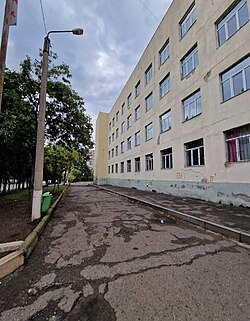 General view
 Side façade
 Part of the building
 School courtyard
 Interior foyer
 Interior detail
 Interior view
 Classroom
 Classroom (another angle)

.jpg)
.jpg)
.jpg)
.jpg)
.jpg)
.jpg)
.jpg)
.jpg)
.jpg)
Further reading
edit- Asatiani, Nodar (2006). თბილისის ისტორია [History of Tbilisi] (in Georgian). Tbilisi.
{{cite book}}: CS1 maint: location missing publisher (link) - Ministry of Education and Science of Georgia (2015). თბილისის სკოლების კატალოგი [Catalogue of Tbilisi Schools] (in Georgian). Tbilisi.
{{cite book}}: CS1 maint: location missing publisher (link)
External links
edit- "School listing (08.ge)". 08.ge (in Georgian). Retrieved 30 December 2025.
References
edit- ↑ სსიპ ქალაქ თბილისის N70 საჯარო სკოლის მუშაობა. skola70.blogspot.com (in Georgian). Retrieved 30 December 2025.
- ↑ თბილისის №70 საჯარო სკოლა (საჯარო ინფორმაცია). 08.ge (in Georgian). Retrieved 30 December 2025.
- ↑ თბილისის N70 საჯარო სკოლაში „გააცოცხლე ბიბლიოთეკა“. Etaloni.ge (in Georgian). Retrieved 30 December 2025.
- ↑ "Liberali Schools — თბილისის №70 საჯარო სკოლა". schools.liberali.ge (in Georgian). Retrieved 30 December 2025.
- ↑ "Edu.aris.ge — თბილისის №70 საჯარო სკოლა". edu.aris.ge (in Georgian). Retrieved 30 December 2025.
- ↑ "Edu.aris.ge – თბილისის №70 საჯარო სკოლა". edu.aris.ge (in Georgian). Retrieved 30 December 2025.
- ↑ "08.ge – თბილისის №70 საჯარო სკოლა". 08.ge (in Georgian). Retrieved 30 December 2025.
- ↑ "თბილისის N70 საჯარო სკოლაში „გააცოცხლე ბიბლიოთეკა" — Etaloni.ge". Etaloni.ge (in Georgian). Retrieved 30 December 2025.
- ↑ "თბილისის N70 საჯარო სკოლის კლუბი „პრეამბულა" და ახალგაზრდული აქტივობები — etm.ge". etm.ge (in Georgian). Retrieved 30 December 2025.
- ↑ "Wikimedia Community User Group Georgia – WikiClubs". Meta-Wiki. Wikimedia Foundation. Retrieved 30 December 2025.
- ↑ "თბილისის N70 საჯარო სკოლაში „გააცოცხლე ბიბლიოთეკა" — Etaloni.ge". Etaloni.ge (in Georgian). Retrieved 30 December 2025.
- ↑ "თბილისის N70 საჯარო სკოლის კლუბი „პრეამბულა" და ახალგაზრდული აქტივობები — etm.ge". etm.ge (in Georgian). Retrieved 30 December 2025.
- provide significant coverage: discuss the subject in detail, excluding routine coverage like product launches, staff appointments, or financial reports and listings in databases or listicles;
- are reliable: from reputable outlets with editorial oversight;
- are independent: not connected to the subject, such as press releases, the subject's own website, or sponsored content.
Please add references that meet all three of these criteria. If none exist, the subject is not yet suitable for Wikipedia.