
Submission declined on 24 January 2026 by Quinntropy (talk).
Where to get help
How to improve a draft
You can also browse Wikipedia:Featured articles and Wikipedia:Good articles to find examples of Wikipedia's best writing on topics similar to your proposed article. Improving your odds of a speedy review To improve your odds of a faster review, tag your draft with relevant WikiProject tags using the button below. This will let reviewers know a new draft has been submitted in their area of interest. For instance, if you wrote about a female astronomer, you would want to add the Biography, Astronomy, and Women scientists tags. Editor resources
|  |
A Hall Switch is an electrical engineering concept which solves the problem of controlling lights in a room from two separate switches. In any room with more than one door, for example a hall or corridor, a person travelling through will want to turn the lights on at one place and turn them off at another, with the possibility of either retracing their steps or being followed by a second person going in the same direction. Thus the need exists to be able to toggle the lights at any time from their current state (eg on) to the opposite (eg off) from either switch at any time.
This is achievable through several strategies, three of which are often found in domestic settings, each of which relies on a pair of SPDT switches to control the path from Live to Neutral, via the light fittings. SPDT stands for "Single Pull, Double Throw" meaning the switch has two states, connecting a Common pole to either one of two other poles. An SPDT switch is never open-circuit, except momentarily while changing state, and while it may be used as an open/close SPST switch by not connecting the third pole the Hall Switch setup makes use use of the ability to carry current through either pole.
Three wires between switches
editA simple setup runs Live, Neutral and a third wire between the switches, with the bulbs on the Live rail. Whenever either switch is toggled, the route to Neutral is either completed or broken and the lights change state.
Two wires between switches
editIn this configuration two wires are connected only to the switches and when both are connected to the same wire the path to Neutral is completed.
One wire between switches
editA variation on the three-wire solution supplies power from either end rather than down the middle.
No wire between switches
editIn this arrangement power is supplied to both switches independently and a single common rail carries power only if the switches are connected to opposite poles, and carries nothing when the switches are connected to the same pole.
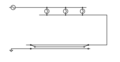 Three wires between
 Two wires between
 One wire between
 No wires between


The exact physical path the wires take is of course not important. The wires "between" the switches might easily follow run along the same route as the wires that connect to the light fittings. It is often impossible to understand which strategy has been employed in an existing installation without careful investigation with a multimeter.
- Reliable sources include: reputable newspapers, magazines, academic journals, and books from respected publishers.
- Unacceptable sources include: personal blogs, social media, predatory publishers, most tabloids, and websites where anyone can contribute.
Replace any unreliable sources with high-quality sources. If you cannot find a reliable source for the material, it should be removed.