| Review waiting, please be patient.
This may take 3 months or more, since drafts are reviewed in no specific order. There are 4,641 pending submissions waiting for review.
Where to get help
How to improve a draft
You can also browse Wikipedia:Featured articles and Wikipedia:Good articles to find examples of Wikipedia's best writing on topics similar to your proposed article. Improving your odds of a speedy review To improve your odds of a faster review, tag your draft with relevant WikiProject tags using the button below. This will let reviewers know a new draft has been submitted in their area of interest. For instance, if you wrote about a female astronomer, you would want to add the Biography, Astronomy, and Women scientists tags. Editor resources
Reviewer tools
|
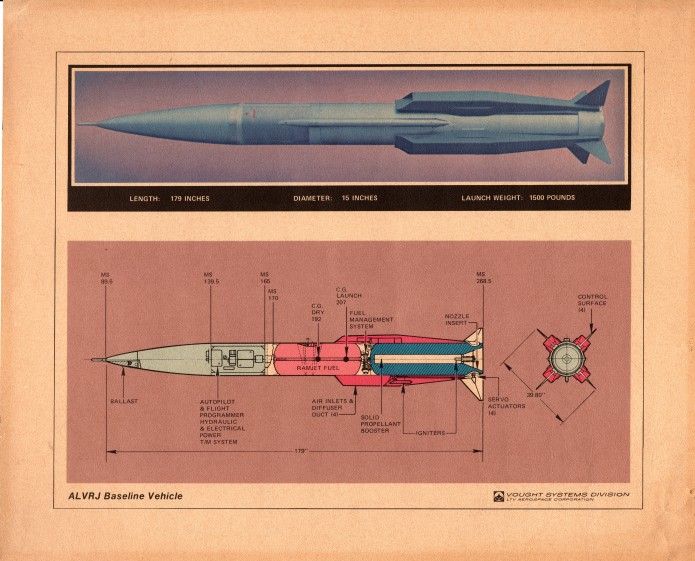
The ALVRJ (Advanced Low Volume Ramjet) was an experimental integrated rocket-ramjet cruise missile technology demonstrator developed by Ling-Temco-Vought and Texaco inc. for the US Navy for use on air and sea based assets. Development ensued in the late-60s to early-70s with its first flight in 1974. [1]
Development
editThe ALVRJ program was initiated by the Navy in 1968 under contract (N0019-68-0605) with the purpose of demonstrating the flight characteristics and mission capability of an integrated rocket-ramjet missile. The missile was built around it’s integral booster low-volume ramjet propulsion system which after the solid rocket engine had exhausted it’s fuel after its 5 second burn time [2], would repurpose the now empty rocket chamber as a ramjet combustion chamber using JP-5 fuel.[3] Thus reducing the volume used for propulsion in the missile, hence: Advanced “Low Volume” Ramjet. [1] The guidance system used on the ALVRJ was inertial with a proposed inertial/active radar homing package. In the 6 ALVRJ missiles built there was not a warhead present but rather a ballast that stabilized the missile and acted as a placeholder for the proposed high-explosive unitary warhead[3] not completely dissimilar to the one in the AGM-78 Standard ARM.
Operational history
editThroughout the 8 year lifespan of the program 6 Dynamic Test Vehicles (DTVs), which 5 were flown, plus ground testing equipment were built to provide data for the improvement of the integrated rocket-ramjet system in the future. The first flight of the ALVRJ DTVs occurred in 1974. At the Program’s conclusion in 1976 all 5 flight tests resulted in a resounding success as the ALVRJ demonstrated a smooth transition from solid rocket-fueled engine thrust to ramjet thrust and stable cruise performance at sea level and 35,000 ft (11,000 m) at speeds exceeding Mach 2.5 (1,918 mph, 3,087 km/h). In addition to this the missile demonstrated excellent controllability and satisfactory ramjet performance through lateral turns, pull-up, and nose-down maneuvers all with angles of attack expected in operations.[1]
General info
editSpecifications
edit- Maximum speed:[1][9]
- At sea level: Mach 2.5 (1,918 mph, 3,087 km/h)
- At 35,000 ft (11,000 m): Mach 3 (2,301 mph, 3,704 km/h)
- Maximum range (demonstrated): [9]
- At sea level: 28 nmi (32 mi, 52 km)
- At 35,000 ft (11,000 m): 108 nmi (124 mi, 200 km)
- Service ceiling: >35,000 ft (11,000 m)[1]
- Booster: Solid-fuel rocket[1][3]
- Burn time: 5 sec[2]
- Guidance: Inertial guidance[3]
- (Proposed): Inertial + Active Radar Homing (ARH)
- Warhead: Ballast for stability [3]
- (Proposed): High-explosive unitary warhead
References
edit- 1 2 3 4 5 6 7 8 9 10 11 12 “ALVRJ.” Vought.org, 2013, https://www.vought.org/products/html/alvrj.html. Accessed 29 May 2026. Archived
- 1 2 Parsch, Andreas. “LTV ALVRJ.” Designation-Systems.net, 2003, https://www.designation-systems.net/dusrm/app4/alvrj.html. Accessed 29 May 2026. Archived
- 1 2 3 4 5 6 7 8 9 “ALVRJ Specifications.” Vought.org, 2013, https://www.vought.org/products/html/alvrjspec.html. Accessed 30 May 2026. Archived
- ↑ picryl.com. “A-7A Corsair II.” Picryl.com, getarchive.net, 2015, https://picryl.com/amp/topics/a+7+a+corsair+ii. Accessed 31 May 2026.
- ↑ Connery, Carroll. “F-4 Phantom.” Facebook.com, Facebook Groups, 13 Sept. 2024, https://www.facebook.com/groups/1317420939138586/posts/1527414231472588/. Accessed 31 May 2026.
- ↑ “ALVRJ Photo Gallery.” Vought.org, 2013, https://www.vought.org/photo/html/palvrj.html. Accessed 29 May 2026. Archived
- 1 2 3 4 https://apps.dtic.mil/sti/tr/pdf/ADA115370.pdf Advisory Group For Aerospace Research And Development , and North Atlantic Treaty Organization . AD/A115 370 RAMJETS and RAMROCKETS for MILITARY APPLICATIONS Advisory Group for Aerospace Research and Development France. US Department of Commerce—National Technical Information Service, Mar. 1982.
- 1 2 3 4 LTV Aerospace Corporation—Vought Systems Division. “ALVRJ Baseline Vehicle.” Up-Ship.com, 2022, https://up-ship.com/blog/wp-content/uploads/2022/04/ALVRJ-1.jpg. Archived Accessed 29 May 2026.
- 1 2 Waltrup, Paul J., et al. “A History of Ramjet and Scramjet Propulsion Development for U.S. Navy Missiles.” JOHNS HOPKINS APL TECHNICAL DIGEST, vol. 234, no. 2, 1997, https://secwww.jhuapl.edu/techdigest/Content/techdigest/pdf/V18-N02/18-02-Waltrup.pdf. Accessed 29 May 2026.