
Diphlebia lestoides is a species of Australian damselfly in the family Lestoideidae,[4] commonly known as a whitewater rockmaster.[5] It is endemic to south-eastern Australia, where it inhabits streams and rivers.[6]
| Whitewater rockmaster | |
|---|---|
 | |
| Male Diphlebia lestoides | |
Scientific classification  | |
| Kingdom: | Animalia |
| Phylum: | Arthropoda |
| Clade: | Pancrustacea |
| Class: | Insecta |
| Order: | Odonata |
| Suborder: | Zygoptera |
| Family: | Lestoideidae |
| Genus: | Diphlebia |
| Species: | D. lestoides |
| Binomial name | |
| Diphlebia lestoides | |
 | |
| Synonyms[3] | |
| |

Diphlebia lestoides is a large, solid-looking damselfly; the male is a blue to grey colour with black markings, while the female has a more muted colouring. It sits with its white marked wings spread out.[7]
Etymology
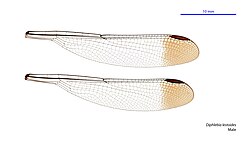
editThe genus name Diphlebia is derived from the Greek δίς (dis, "twice" or "double") and φλέψ (phleps, "vein"), likely referring to distinctive wing venation.[8][9]
The species name lestoides combines Lestes, a genus name derived from the Greek λῃστής (lēstēs, "robber"), with the suffix -ώδης (-ōdēs, "resembling"), referring to its resemblance to Lestes.[2][9]
Gallery
edit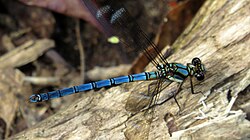 Male
Male Male, face on
 Note the white band in his wings
 Female wings
 Male wings
.jpg)
.jpg)
.jpg)
.jpg)
.jpg)
See also
editReferences
edit- ↑ Hawking, J. (2009). "Diphlebia lestoides". IUCN Red List of Threatened Species. 2009. IUCN: e.T163576A5618141. doi:10.2305/IUCN.UK.2009-2.RLTS.T163576A5618141.en.
- 1 2 Selys-Longchamps, E. (1853). "Synopsis des Caloptérygines". Bulletins de l'Académie Royale des Sciences, des Lettres et des Beaux-arts de Belgique (in French). 20 (Annexe): 1–73 [67] – via Biodiversity Heritage Library.
- ↑ Paulson, D.; Schorr, M.; Abbott, J.; Bota-Sierra, C.; Deliry, C.; Dijkstra, K.-D.; Lozano, F. "World Odonata List". OdonataCentral. University of Alabama. Retrieved 3 April 2026.
- ↑ "Species Diphlebia lestoides (Selys, 1853)". Australian Faunal Directory. Australian Biological Resources Study. 2012. Retrieved 11 April 2017.
- ↑ Theischinger, Günther; Hawking, John (2006). The Complete Field Guide to Dragonflies of Australia. Collingwood, Victoria, Australia: CSIRO Publishing. p. 16. ISBN 978-0-64309-073-6.
- ↑ Theischinger, Gunther; Endersby, Ian (2009). Identification Guide to the Australian Odonata (PDF). Department of Environment, Climate Change and Water NSW. p. 210. ISBN 978-1-74232-475-3.
- ↑ Watson, J.A.L.; Theischinger, G.; Abbey, H.M. (1991). The Australian Dragonflies: A Guide to the Identification, Distributions and Habitats of Australian Odonata. Melbourne: CSIRO. ISBN 0643051368.
- ↑ Selys-Longchamps, E. (1859). "Additions au synopsis des Caloptérygines". Bulletin de la Classe des Science, Academie Royale de Belgique. 2 (in French). 7: 437-451 [450] – via Biodiversity Heritage Library.
- 1 2 Endersby, Ian; Fliedner, Heinrich (2015). The Naming of Australia's Dragonflies. Eltham, Victoria, Australia: Busybird Publishing. ISBN 9781925260625.
